Business analyst techniques

Key takeaways
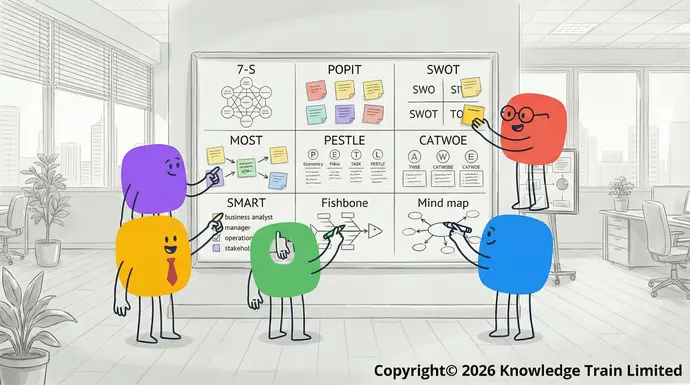
Business analysis techniques help turn unclear needs into actionable change.
- Use structured models to uncover root problems in systems, software, and processes.
- Apply holistic frameworks such as 7-S and POPIT to check both tangible and cultural factors.
- Use SWOT, PESTLE, and MOST to connect internal capabilities with external drivers and strategy.
- Use CATWOE to surface different stakeholder viewpoints before deciding solutions.
- Use SMART, fishbone diagrams, and mind maps to define clear requirements and explore causes and options.
Introduction

These business analyst tools and techniques are taught in detail on many of the BCS Business Analysis courses including the popular BCS Business Analysis Foundation certificate in Business Analysis.
A business analyst needs a variety of techniques, methods, and analytical tools to:
- Analyse business needs;
- Evaluate options;
- Define requirements and;
- Help to deliver change.
Techniques are important for business analysts because they:
- Help identify root problems within systems, software and processes;
- Help understand the interconnections within parts of the business;
- Provide analytical information for decision makers;
- Help to clarify and define roles and responsibilities;
- Provide effective results.
1. McKinsey 7-S model
This model helps when executing strategy. It helps understand the tangible and intangible factors which can affect the implementation of strategy.
Read more about the McKinsey 7-S model and see the colour infographic here.
2. POPIT model
The POPIT model ensures that all internal business aspects are considered when investigating a business area. It helps a business analyst identify where problems exist. This holistic approach helps ensure the analyst considers all relevant areas.
Read more about the POPIT model and see the colour infographic here.
3. SWOT analysis
SWOT analysis is a technique used to analyse:
- External factors affecting an organisation (opportunities and threats);
- Internal factors (strengths and weaknesses) that can help an organisation address the external factors.
Read more about SWOT analysis and see the colour infographic here.
4. MOST analysis
Any successful change requires starting from a clear understanding of the organisation’s current business situation. MOST analysis can help to achieve this.
Read more about MOST analysis and see the colour infographic here.
5. PESTLE analysis
PESTLE analysis is a tool used to analyse the key drivers of change in the strategic or business environment.
Read more about PESTLE analysis and see the colour infographic here.
6. CATWOE analysis
CATWOE is a technique that helps the business analyst understand different stakeholder perspectives.
Read more about CATWOE analysis and see the colour infographic here.
7. SMART technique
The SMART technique is used when conducting requirements analysis, which is the process of describing the users’ expectations of a business solution.
Read more about the SMART technique and see the colour infographic here.
8. Fishbone diagrams
A Fishbone diagram (also known as Ishikawa diagram) is a problem analysis technique. It helps understand the basic causes of a business problem. Sometimes the root cause of the problem may be obvious. At other times, only the symptoms may appear.
Read more about Fishbone diagrams and see the colour infographic here.
9. Mind maps
Mind maps are useful tools for brainstorming. Their simple visual form highlights connections between ideas and topics. They can help identify problems and solutions.
Read more about Mind maps and see the colour infographic here.
All these techniques and methods are covered in more detail in our Business Analysis Learning Library (BALL)™ which is available for a monthly subscription.
Containing 28 different business analysis techniques and continuously updated, the library is a great resource for working business analysts, or people wanting to become a business analyst.