Is business analysis a career trap or a launchpad? A developer’s honest guide to making the move

Key takeaways
See how business analysts stays technical, what you do day to day, and how to protect your coding skills while planning next steps.
- BA is analysis and change within tech delivery
- Requirements and data thinking replace coding commits
- Technical skills can atrophy without practice
- BA pay varies by seniority, sector, and track
- CV and portfolio can keep developer optionality.
BA is still a technical profession, even if it does not look like one from the outside
If you have spent several years writing code, it is understandable to see business analysis as a sideways move out of tech. The job title sounds managerial, the role descriptions mention stakeholders and workshops, and nobody is asking you to push a single commit. That reading misses what the work actually involves.
The BCS business analysis certification sits within the BCS IT and digital profession framework. BCS business analysis certifications focus on analysis and change rather than general management or operations responsibilities, which reflects how the profession is understood: as a discipline for people working on technology-enabled change, not for those who have stepped away from it. Many practising BAs have moved from development, testing, architecture or DevOps roles, and they bring that technical credibility into the work.
The day-to-day work reflects this. Where a developer solves a defined technical problem, a BA works one layer upstream: clarifying what problem needs solving, modelling the processes and data involved, and translating between what a business wants and what an engineering team can realistically build. You are still in tech, still reading technical documentation, still sitting in architecture discussions, and still asking whether a proposed solution is feasible. In many BA roles, production coding is uncommon or stops altogether, and there is no point glossing over that, but the analytical thinking that made you good at debugging or system design does not become redundant. It is redirected.
For a developer who has grown frustrated with implementation details and wants to influence the shape of a system rather than its syntax, that redirection can feel like relief rather than loss.
What a BA actually does day to day: an honest picture for developers
If you have spent years debugging builds, reviewing pull requests, and shipping features, the BA working day will feel genuinely different rather than slightly rebranded. You swap a coding editor for a shared whiteboard, Jira tickets for conversation, and individual problem-solving for coordinated group effort.
A typical BA day is anchored around requirements. That means interviewing product owners, running structured elicitation workshops, and working through stakeholder interviews to surface what a system needs to do versus what people initially say they want. The gap between those two things is often significant, and closing it is where much of the analytical effort goes.
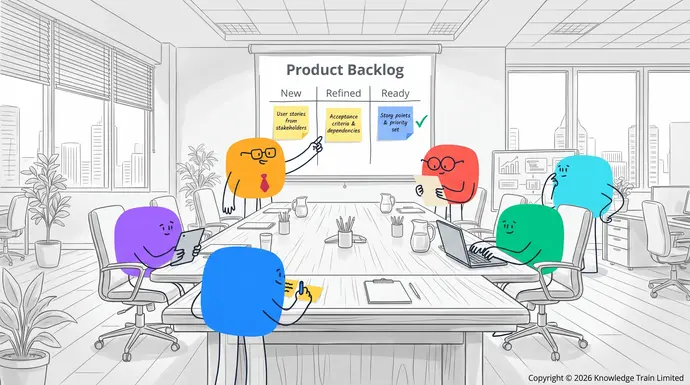
From there, the output takes several forms. You will write user stories and acceptance criteria, map current and proposed processes, and maintain a living backlog that reflects evolving business priorities. In agile delivery, none of this is a one-off activity. Requirements are revisited and refined regularly, often at least once per iteration, through backlog refinement and sprint reviews, and challenged when new information changes the scope. It is iterative work, grounded in delivery cycles, and it demands a tolerance for ambiguity that most developers will recognise from complex architectural decisions.
Data analysis also features more than people expect. BAs regularly query spreadsheets, interpret reports, and model business scenarios to quantify the impact of proposed changes. This is not SQL at scale or machine learning, but it is structured, evidence-based thinking.
The structured craft behind this work is recognised formally. The AgileBA Agile Business Analyst guidance provides tools and techniques to support business analysis in agile environments, including stakeholder-focused practices, and is designed to align business analysis with agile, iterative delivery and help bridge analysis and delivery work. Developers who want to understand how AgileBA qualifications support your career in tech will find the syllabus maps closely to real agile team structures.
As for coding, many BA roles focus on requirements and analysis rather than committing production code, though some require scripting, SQL or configuration work that may use repositories. You may read code, review technical designs, or question implementation choices, but in most BA positions you will not be committing to a repository. Technical skills can start to noticeably atrophy within months of leaving hands-on work, and developers making this transition should factor that into any long-term career planning.
The honest risk: how quickly technical skills atrophy, and what to do about it
To be direct: if you stop writing code daily, your practical fluency will decline. This is not a scare story. The muscle memory for syntax, the instinct for spotting a bad query or a fragile API contract, and the comfort with debugging under pressure all fade without regular practice. The rate depends heavily on how deep your existing knowledge is and how similar your BA work remains to an engineering context. Many developers who step away from a codebase report a meaningful drop in confidence after an extended period, though the timing varies considerably from person to person.
The more pressing question is what you actually lose. Highly specific, rarely used tools and frameworks tend to atrophy faster than broader conceptual skills. Many practitioners find that foundational understanding, such as systems thinking, data modelling, and how distributed architectures behave under load, tends to be more durable over time. A developer who becomes a BA does not forget how software is built; they may simply struggle to implement it quickly after a long gap.
The mitigation is real, but it requires deliberate effort. Side projects are one effective route: even a few hours a week building something small can help you stay hands-on with tooling and keep your mind engaged with implementation decisions. Open-source contributions serve a similar purpose and have the added benefit of being visible. Reading public architecture decision records can help you stay focused on architectural trade-offs and structure without requiring you to ship features. Staying involved in code review conversations at work, even informally, signals credibility with engineering teams and keeps your code-reading skills active.
Maintaining a public portfolio matters more than most people expect. Recent commits on a GitHub profile, or a personal site documenting technical decisions you have made, can signal ongoing engagement with coding and craftsmanship to future employers on either side of the fence. Keeping these habits consistent is achievable with realistic expectations and a modest weekly commitment.
Salary reality: what the market actually pays BAs versus developers in the UK
Money is rarely the only reason to switch roles, but it is a reasonable thing to care about. The question most developers ask is whether moving into business analysis means accepting a permanent salary ceiling below what a senior engineer could eventually reach.
The honest answer is that it depends on which path you take.
BA market rates vary considerably by sector, seniority, and specialism, as UK salary data broadly confirms. According to Business Analyst Jobs UK | Top BA Roles, Salaries & Skills in 2025 published by IT Job Board, BA pay at entry and mid-career levels can overlap with some technical roles at similar experience levels. Senior or lead BA roles, particularly those with domain expertise in finance, regulatory change, or enterprise architecture, can reach £70,000 to £105,000 or more, overlapping with many senior developer salaries.
Where the gap does tend to open up is at the specialist end of software engineering. A staff engineer, principal architect, or developer with rare expertise in a high-demand technical area can command earning potential that most BA tracks do not reach. If that ceiling matters to you, it is worth being direct with yourself about it.
The more useful comparison is between the role you are likely to occupy as a developer and the BA role you are being offered. Some market data suggests the gap between mid-level developer and mid-level BA salaries may be smaller than common narratives imply, though comparable benchmarks are scarce and vary considerably by sector and region. A BA who moves into product ownership, enterprise analysis, or consulting may also see their market rate rise over time.
Sector matters enormously too. A BA working in financial services or large-scale digital change will typically see a different salary trajectory than one working in a smaller agency or a public sector team with rigid pay bands.
Treat any figures you encounter as directional rather than guaranteed, and use them as a starting point for researching the specific roles and industries you are considering.
Three career trajectories from BA: which one fits you
One of the less obvious advantages of moving into business analysis is that the role sits at a genuine crossroads. After a year or two as a BA, three distinct paths forward tend to emerge. They suit quite different personalities, so being honest about where you actually want to be in five years is worth your time.
The leadership track: from BA to transformation director or CIO
Some BAs discover that organisational change itself energises them more than any particular technology. If you are drawn to stakeholder politics, budget conversations, and the question of why a business operates the way it does, the leadership track may be the natural direction. For example, some BAs move into business change management, then programme management, and eventually into transformation director or CIO-level roles, though the precise path varies by organisation and sector.
What determines whether someone ends up here is a willingness to move progressively further from technical detail and closer to strategic governance. Developers who were always more interested in the product roadmap than the codebase tend to thrive on this path.
The hybrid technical track: from BA to solution architect or product owner
This is arguably the most natural long-term fit for a developer moving into business analysis. The hybrid technical track keeps one foot in systems thinking while the other moves into product strategy or architecture. Roles along this path can include, for example, technical BA, solution architect, and product owner, though the specific progression depends on the organisation and the frameworks it uses.
Developers who continue reading architecture decision records, attend technical design reviews, and stay close to engineering teams position themselves credibly for these hybrid roles. How BCS business analysis qualifications can help your career shows that the BCS pathway spans requirements engineering, solution development, and business change, reflecting how much these disciplines overlap in practice.
The return-to-dev track: using BA as a strategic pause
This path is underestimated. Some developers use a BA role not as a permanent career change but as a structured way to broaden their system-level thinking before returning to engineering. Spending time in BA, whether that is one year or several, understanding how requirements form, how non-technical stakeholders conceptualise software, and how delivery failures happen at the organisational level can make a returning developer considerably more effective. The right duration is an individual decision rather than a fixed recommendation.
The condition for making this work is intentional maintenance of technical skills throughout the BA period. Engineers who contribute to technical documentation or shadow architecture reviews are far better placed to re-enter development, often at a senior or principal level, than those who let those habits lapse.
The three tracks are not rigid pipelines. Many people who start down the hybrid route end up influencing the leadership track, and some who intended to return to engineering find they prefer the product owner role. What matters is making conscious decisions at each juncture rather than drifting.
Why BA skills may prove more resilient than a single language stack as AI changes software development
There is a strategic argument for moving toward business analysis that has nothing to do with escaping difficult work or chasing a quieter life. It centres on where obsolescence risk sits in software teams right now.
Developers who have watched AI-assisted coding tools mature over the past few years will have noticed that the tools are increasingly capable of generating boilerplate, suggesting implementations, and catching common errors. Nobody can say with certainty how far that capability will extend or on what timeline, but the direction of travel is clear enough to take seriously. A developer whose value is concentrated in fluency with one language stack or one framework is more exposed to that shift than someone whose value lies in reasoning about problems before any code is written.
Business analysis sits closer to that second category. Many BA skills are harder to fully automate because they focus on understanding business needs and context rather than repeatable implementation tasks. The ability to identify what a business needs, separate that from what stakeholders think they want, construct requirements that hold up under scrutiny, and communicate across technical and non-technical audiences operates at the layer above implementation, which is precisely the layer that becomes more visible as implementation itself becomes easier to produce.
This is not an argument that developers are at risk of being replaced wholesale, or that everyone should move away from engineering. Many developers will find their roles shift rather than disappear, and strong technical judgement will remain valuable. The point is narrower: if you are already weighing a move into BA, the concern that you are trading a durable technical skill set for something less durable deserves examination rather than assumption. Across technology cycles, the analytical and communication skills that define good business analysis have shown a consistent ability to remain relevant even as the underlying tools change.
How to frame your developer CV for a BA role without burning your engineering bridges
When developers move into BA roles, the instinct is often to bury technical skills to look more business-facing. Resist that. Your engineering background is precisely what makes you a distinctive candidate, and with careful language you can present it in a way that keeps future optionality intact.
Map your developer achievements to BA competencies directly.
A feature you scoped and built becomes evidence of requirements gathering and stakeholder communication. A production incident you diagnosed and resolved shows analytical thinking under pressure. Refactoring legacy code to meet new business rules demonstrates process analysis. Lead with outcomes and the business problem solved, not the language or framework used.
Keep a live technical portfolio, and say so explicitly on your CV.
A GitHub profile that shows recent commits, even personal projects, open-source contributions, or documented experiments, signals to future employers that your coding ability is current. One line in your CV profile, such as ‘active GitHub portfolio maintained throughout BA practice’, protects your technical credibility far more than any qualification can.
Choose language that preserves optionality rather than closing doors.
Phrases like ‘engineering-background BA’ or ‘technically fluent business analyst’ position your developer history as additive. Avoid describing your coding career as ‘previous experience’ or relegating it to a footnote. Keep it in a clearly labelled technical skills section, and update it honestly as skills evolve.
LinkedIn.
Use the headline to signal both identities, such as ‘Business Analyst | Software Development Background’. This reads well to BA hiring managers and keeps you visible to technical recruiters. Your summary should acknowledge the transition directly and frame it as broadening rather than retreating. Recommendations from engineering colleagues carry real weight here, particularly if they speak to your ability to communicate complex technical ideas clearly.
The goal is a CV that reads coherently to a BA recruiter today without making you look like a stranger to engineering if you want to return tomorrow.
The re-entry plan: returning to development after one, two, or five years as a BA
How hard is it to return to a developer role after working as a BA? The honest answer depends on how long you have been away, what you have kept alive in the meantime, and how flexible you are about re-levelling.
After one year
Many developers find that after a year away, they can return more smoothly by refreshing their portfolio and following a structured practice plan. Most core programming concepts will still feel familiar, but specific frameworks, tooling, and deployment practices move quickly. A couple of rebuilt side projects, some open-source contributions, and a structured look at what has changed in your stack is usually enough to reassure a hiring team. Expect to answer more questions about currency than a developer who never left, but the door is open.
After two years
Two years requires more deliberate effort. Interviewers will probe technical depth more carefully, and roles pitched at the level you left may be harder to land without demonstrable recent work. Re-levelling, accepting a position one rung below where you departed, is a realistic and often sensible step. Returning at a slightly lower grade and rebuilding momentum is far less damaging to a long-term career than stalling for a title that no longer reflects your current technical fluency.
After five years
For many engineers, returning to a senior dev role after around five years away is possible but demanding, provided they maintain and refresh their technical skills. Closing that gap takes sustained commitment: structured learning, rebuilt projects, and probably a willingness to interview for roles that feel junior relative to your overall experience. Many people who have spent five years in BA work find that hybrid positions, such as solution architecture or technical product management, are a more natural re-entry point than returning directly to a hands-on engineering team.
How BA work helps rather than hinders
BCS business analysis qualifications and the work itself keep practitioners close to systems thinking, solution design, and the logic of how software is structured. A returning developer who has spent years translating complex requirements into structured specifications, working alongside architects, and challenging technical assumptions brings a perspective that purely technical candidates often lack. The skills gap is real; the career capital is also real.
Which certifications give developers the fastest credibility as a BA
Stepping into a BA role without a recognised qualification can leave hiring managers uncertain about your intentions, even when your technical background is strong. The right certification signals commitment and gives you a shared vocabulary with the BA community from day one.
The BCS Business Analysis Foundation course is the natural starting point. It covers the core competencies that underpin the profession: investigation techniques, requirements elicitation, stakeholder analysis, and business change. Developers tend to move through the material quickly because they already understand systems thinking and the consequences of poorly defined requirements. What the course adds is a structured framework around knowledge that was previously instinctive.
If your organisation works in sprints and uses agile ceremonies, the AgileBA Foundation certification is a more immediate fit. It positions the BA role within agile delivery, equipping analysts with the skills and techniques to perform business analysis effectively within agile environments and teams. Developers who have already worked inside agile teams will recognise the context and can focus their energy on the BA-specific thinking the qualification introduces.
For those who want to go further on a competency that is central to almost every BA engagement, the BCS Requirements Engineering course builds rigour around eliciting, documenting, and validating requirements. A developer’s ability to think precisely about inputs, outputs, and edge cases is a genuine advantage here.
If you are still weighing which path suits your situation, reviewing the full range of business analyst certification options available can help you match a qualification to your experience level and the type of BA work you are moving into. None of these certifications alone completes a BA career, but each one accelerates credibility at a moment when you need it most.
Frequently asked questions
Will I stop coding if I move into a business analyst role?
- Most BA roles do not involve writing production code, but technical BAs regularly read code, review data models, and work inside engineering toolchains such as Jira and Confluence.
- How quickly coding skills atrophy depends on how actively you maintain them outside work; without deliberate practice, proficiency in a specific language can fade, though the rate varies considerably depending on the individual and the language involved.
- Agile and technical BA roles can help you stay close to sprint cycles and architecture discussions, which may reduce the risk of your technical skills becoming outdated compared with more traditional business-facing BA positions.
Is it hard to return to a developer role after working as a BA?
- After one year the transition back is manageable with a portfolio refresh and some structured practice.
- After two or more years you will likely need to retrain on current frameworks and accept that your hands-on seniority may need to be rebuilt, particularly in fast-moving stacks.
- After five years a direct return to a senior engineering role is possible but requires serious commitment; many people find a hybrid technical role or solution architecture a more realistic re-entry point.
What career paths open up from a BA role?
- Common progressions include product owner, product manager, solution architect, business change manager, programme manager, and for some, CIO or technology director.
- The hybrid technical track suits developers who want to stay close to engineering; the leadership track suits those drawn to strategy and stakeholder influence.
- BA experience combined with a technical background is particularly valued in roles that bridge IT and the business, such as enterprise architecture and digital transformation.
Is the salary ceiling for BAs lower than for senior developers in the UK?
- At junior and mid levels, BA and developer salaries are broadly comparable in the UK.
- At senior and principal level, specialist developers in high-demand areas such as cloud, machine learning, and security can command higher salaries than most BA roles offer.
- However, BAs who move into leadership, product management, or solution architecture can match or exceed developer salary bands; the ceiling depends on which track you take.
How do I frame my developer background on my CV when transitioning to BA?
- Position your coding experience as evidence of technical credibility rather than a role you are abandoning; emphasise systems thinking, debugging mindset, and delivery experience.
- Use the language of both worlds: map your developer achievements to BA competencies such as requirements elicitation, process analysis, and solution evaluation.
- Keep a live portfolio of side projects or open-source contributions so you can demonstrate current technical capability if you ever want to pivot back.
Next steps
If the BA path looks like the right move, the next step is straightforward. Browse the Knowledge Train Business Analysis courses, speak to an adviser about which qualification fits your background, and book a place when you are ready. Your technical experience is not a liability here; it is a genuine advantage from day one.