
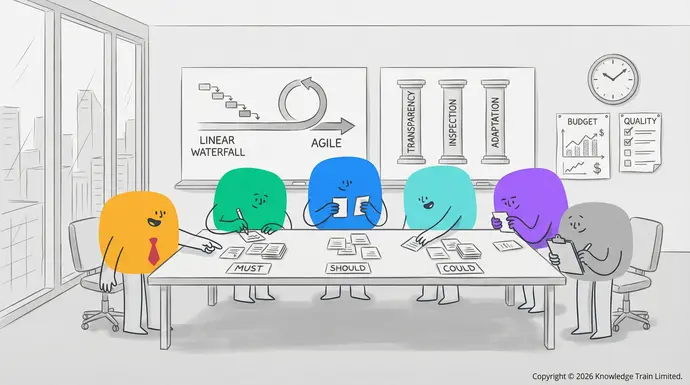
There’s still a lot of debate on whether Scrum can be used in more traditional Agile frameworks. There are two camps of thought on the subject. The first believe that Scrum cannot work with Agile in the traditional sense because there’s too much overlap beAgilePM is focused on delivering high-quality products and services to customers through iterative and progressive development.
It is designed to be scalable and flexible and can be used in projects of any size or complexity. Furthermore, it is compatible with other Agile frameworks such as Scrumtween roles prescribed by Scrum and other and Lean and can be tailored to the requirements and limitations of a particular project.Agile methodologies
Recognized as the most sought-after agile project management framework globally, AgilePM is a go-to approach for many organizations.For example, there’s no point in maintaining a project manager role because in some contexts, it fulfills the same duties as the
Instructor-led Agile trainingScrum Master
- Agile courses. Or that there’s no point in maintaining an agile product manager when you have a Scrum Product Owner on the job.
- AgilePM coursesAnother school of thought argues that anything is possible in Agile because there is no singular definition of what Agile is. You cannot say “this is Agile, but this not” because there only exist varying degrees of agility. So having both a Scrum Master and
- PRINCE2 Agileagile project management® is certainly possible. They might not function as you would expect, but this doesn’t detract from the value they can add to a project. coursesLet’s look at the problem from a few different perspectives.
- Scrum coursesAgile Scrum roles and responsibilities
- Agile Business Analysis coursesScrum purist might argue that there are only three roles in Scrum: the
Self-paced Agile trainingScrum Master
TranscriptScrum Master
Here’s the full transcript of the video. owns the process and protects the team from external micromanagement so it can learn to self-organise and figure out for itself what works best. Scrum Masters remove obstacles to development, facilitate communication, promote discussions within the team and negotiate with those external to the team.
00:00:02 Sevcan YasaBecoming a Scrum Master: Hello everyone. is a popular and rewarding career choice.
00:00:06 Sevcan YasaProduct Owner: Just while we wait for a few more people, we do have two very quick questions for you, so if you could answer them that would be great.The
00:00:27 Sevcan YasaProduct Owner: Seems like a variety of experiences here. represents the customer and makes decisions about the final product. They own the product backlog and are responsible for communicating the scope, and vision to the team, and prioritising backlog items.
00:00:47 Sevcan YasaDevelopment Team: So, we can start in one minute.The
00:01:06 Sevcan YasaDevelopment Team: Hi Andrew, nice seeing you. owns the estimates, makes task commitments, and reports daily progress to each other in a daily meeting. They are self-organising, meaning that over time, they should learn to structure their work without the need for intervention from higher-ups.
00:01:30 Sevcan YasaWhere is the agile project manager in Scrum?: And so let me start giving a small introduction. So to start off I’m Sevcan and I’m the marketing executive for In Scrum, the Knowledge Trainproject manager. Knowledge Train actually owns agileKRC. Just before I head over to Barbara. often fulfills the role of the Scrum Master. This is
00:01:46 Sevcan Yasanot: I would actually like to say that right at the end there will be a Q&A roughly around 10 to 15 minutes. always applicable and there are many situations in which a dedicated, trained, and experienced Scrum Master is required.
00:01:52 Sevcan YasaFor example, a project manager who has been serving as a subject matter expert might be better positioned as the Product Owner.: So, if you do have any questions or you have recommendations or any comments on Barbara’s presentation, feel free to leave in the comments and then we can go through them at the end.A
00:02:03 Sevcan Yasaproject manager: I’m going to close the poll now. responsible for coordinating larger teams (50+ people) may remain in that role but swap their focus to more general project tasks such as procurement and negotiation, while their Scrum teams (in this example, 6-10 Scrum teams) would each have their own
00:02:17 Sevcan YasaScrum Master: Over to you, Barbara.. In this example the project manager would coordinate the activities of the Scrum Masters rather than the developers.
00:02:19 Barbara RobertsWhere does the Scrum Master fit in agile project management?: OK, well good evening everybody or afternoon. Good evening. So, thanks for joining this webinar and thanks to KRC for giving me a chance to talk about Agile again. Shall thoroughly enjoy doing.Some might incorrectly label the Scrum Master as a de-facto project manager in
00:02:31 Barbara Robertsagile project management: I know at least one of you on that list that I can see a name I recognise. But for those of you that don’t know me, I’ve been working with . Unlike a project manager, however, the Scrum Master is not directly responsible for the success or failure of a project.AgileThe Scrum Master’s authority extends only to the process and uses it to get a team to perform to its highest level. The Scrum Master does not have many of the responsibilities traditionally given to project managers – scope, cost, personnel, basically forever.risk management
00:02:41 Barbara Roberts – for this reason, many organisations continue to employ a project manager to oversee more mundane details of a project.: Even when I started out in IT, I always worked in an agile way. I just didn’t know what it was called and basically, I specialised in agile in the complex corporate world.Who then, handles conventional project manager duties in a project primarily governed by Scrum?
00:02:52 Barbara RobertsAgile project management: So, I end up doing the difficult agile transformations. The complex ones where you’ve got formal regulatory or particular difficult problems, and I’m lucky enough to get invited to talk agile all around the world, which is great fun. often puts the project manager in a difficult position. Agile acknowledges this and allows the project manager to delegate responsibility.
00:03:06 Barbara RobertsMany of these duties, such as task assignment and day-to-day project decisions, revert to the team and Scrum Master, while decisions regarding scope and schedule go to the Product Owner.: Erm, anyone that knows me knows I’m passionate about doing this, but also I’m very very keen on the agnostic agile oath. I have a lot of enthusiasm for Agile Business Consortium, creating Quality managementAgilePM becomes a responsibility shared among the team, a Product Owner and Scrum Master. was actually my idea for APMG originally, but my style is that it’s about choosing the right approach, the most appropriate approach, not my agile, is better than your agile. So that’s the background to me.While the typical agile or Scrum project has between 5 and 20 people, Scrum can be used on projects with 200 to 500, or even 1,000 people.
00:03:39 Barbara RobertsProjects: What I’m going to talk about tonight. It was interesting to see we’ve got a good mix of knowledge from don’t know anything about agile to an expert, so that always makes it interesting. So some of you might find some of this fairly basic, others will hopefully find it useful. of that size must introduce more points of coordination than small-scale implementation. Even on a very large agile project however, teams still decide how to allocate tasks themselves. In the example above, the project manager role becomes more of a project coordinator in this example.
00:03:55 Barbara RobertsEnhance your skills with our expert-led courses: I wanted to talk a little bit about agile, how do we get here in 2022? Where’s this come from? Just cover some of the very basic concepts of agile because they’re often misinterpreted.
00:04:07 Barbara Roberts : And some of the agile misconceptions because we often talk about agile about something. That is, it’s easy to understand but difficult to master.
00:04:17 Barbara RobertsInstructor-led: And what I find frightening is how many people I come across who’ve got it completely wrong, either because they’re passionately enthusiastic or because they’re they’re frightened of it.Certified Scrum Master course
00:04:28 Barbara Roberts : So it’s quite interesting to cover off some of the misconceptions as well.£699 +vat
00:04:33 Barbara Roberts : So when I started out, I started out originally in IT a very long time ago, hence the grey hairs. And when I started in See all datesIT , basically that was a time when the world business world was ruled by machines.
00:04:49 Barbara Roberts : So we had these software engineers and usually elderly gentleman. Interestingly, often smoking pipes in the computer rooms and IT software was seen very much as magic and it drove businesses so you didn’t ask for what you wanted, you begged for something and IT basically would give you what they felt like giving you.Instructor-led
00:05:11 Barbara RobertsCertified Scrum Product Owner course: And in the very very early days of this, it was actually quite fun because there was little or no formal process and you could just be as innovative as you wanted to be and the attraction, you know the instruction was to get. Just get it done, which if you worked in IT was great fun.
00:05:29 Barbara Roberts£699 +vat: If you worked in business, it was less good because you often got solutions that you didn’t like, couldn’t use or didn’t work, but you were told that you should just be grateful.
00:05:38 Barbara RobertsSee all dates: When we started this this style of working when IT became so dominant, there was one fundamental mistake and that was the concept that software engineering worked very much the same as all other styles of engineering. So, if you were doing engineering, mechanical engineering, electrical engineering you’re dealing with things.
00:06:00 Barbara Roberts : The problem with software engineering is yes, the computer’s a thing, but you’re trying to interface to a human who is not as predictable as a brick or a building or calculating the stress on a wall. So, in the early years while IT was the master it worked OK, it worked while we kept users at arm’s length. That was really good.
00:06:27 Barbara RobertsSelf-paced: When we got into the 70s, what came along then was this concept of quality. It was the first of the we need formal quality, so a bit like you have approval for building. They wanted a similar similar sort of quality process for IT.Scrum Essentials self-paced online
00:06:42 Barbara Roberts : So, in 1970, the Royce approach was was published and this is the original waterfall approach called £499 +vatWaterfall20% OFF THIS BLACK FRIDAY because it looks like a a series of steps constantly going downhill from the beginning to the end and it’s a one-way track, like a waterfall. Use code
00:06:59 Barbara RobertsBF2026: And it was brought in in place to manage development of large software systems but it was designed very much for a static world where exception was the problem. Where change was the exception and it was seen as a problem. So, if you looked at page one of Royce’s paper, you’ve got this very, very simple, very clean diagram with some small print at the bottom. on selected courses. Book by 01 Dec 2026. Exam only purchases excluded.
00:07:22 Barbara Roberts : What’s interesting is if you look at this mindset, a lot of organisations are still working to this this mindset and it’s actually constraining them because if you roll forward from 1970s to the current world. In the 1970s you designed solutions around {"@context":"https://schema.org","@type":"ImageObject","contentUrl":"https://www.knowledgetrain.co.uk/training-courses/scrum-with-agile.webp","description":"Using Scrum with Agile","license":"https://www.knowledgetrain.co.uk/license","acquireLicensePage":"https://www.knowledgetrain.co.uk/license","creditText":"Knowledge Train","uploadDate":"2023-05-11T07:40:46.000Z","copyrightNotice":"© 2023 Knowledge Train Limited. All rights reserved.","creator":{"@type":"Organization","name":"Knowledge Train","url":"https://www.knowledgetrain.co.uk"}}ITRelated articles, and you quite often had projects that ran for 10-20 years.
00:07:45 Barbara Roberts : That simply doesn’t work in the modern world. That change is a fact of life, and if you’re still working to this defined sort of linear what way of working, it’s starting to cause a lot of problems, and it’s interesting that Royce spotted this even in the 70s, because although page one said do this waterfall defining how waterfall works, it’s often misinterpreted because at the bottom Royce stated that the implementation of simple waterfall described above is risky and invites failure. So, on page two he presented a much, much more complex diagram.
00:08:24 Barbara Roberts : So rather than the simple waterfall on the left, he expanded it to this very very complex diagram er on the left and unfortunately, most people never read page 2, so a lot of organisations still are trying to work this linear, predictable approach and it causes a lot of problems.
00:08:45 Barbara Roberts : So that was in place for about 10 years and then things started to change. With the advent of PC’s and this is one of the very very early IBM PCs and these arrived on the scene in in in the 80s and it was an absolutely fantastic time to be working in IT then, because suddenly as a developer we had the ability to do things quickly and easily. So instead of having to write sort of complex JCL stuff, getting it punched on cards, get it sent away then get it sort of sent off for compilation and find you type mistyped something you could sit on a PC and you could actually sit with a customer and create a solution. Ask them what they wanted and then build it and they love you for it.
00:09:31 Barbara Roberts : And they tell you that that’s brilliant and you think, well, that’s brilliant, would you like this.
00:09:36 Barbara Roberts : So, this style of working was called rapid application development because it was a way of quickly creating solutions to problems.
00:09:45 Barbara Roberts : Great fun on both sides, both from the customer and the and the IT side, but quite often I will be honest we we did sometimes focus on the more interesting parts, skipped the boring bits so it was all about creation, not necessarily about scalability, not necessarily about deep testing. It was just walking. Do some magic. Give somebody a solution, then walk away and walk on to the next customer.
00:10:10 Barbara RobertsWhat is Agile?: And it left a lot of legacy behind. Because this was the late 80s that we started doing this Rapid Application Development by the early 90s, RAD was getting a really bad name and it was often referred to as RAD Cowboys. You know, coming in doing the yeezy stuff and then swanning off and doing something else.
,
00:35:05 Barbara RobertsPRINCE2: Because in the modern world, you have to expect change and uncertainty. You’ll hear people talk a lot about this concept of. VUCA, the modern world is Volatile. It’s Uncertain, it’s Complex, it’s Ambiguous, it just is. Nobody even buys a phone without hesitating to check. If there’s a new model coming about coming out tomorrow.,
00:35:26 Barbara Robertsagile: Technology is constantly changing. The world is changing, so we need to stop being frightened of it and accept that. It’s just the norm these days. So, organisations and projects have got to be able to deal with uncertainty the unknown because the real modern world, the 21st century world is very unpredictable and it’s the one thing that that COVID taught people.,
00:35:51 Barbara Robertsbusiness analysis: Any , project managersprogramme management that laminated a plan in January 2020? How did that go then?, and
00:35:58 Barbara Robertschange management: I was supposed to be travelling the world in 2020 for the first six months. I’m talking agile. I got as far as my first trip, got to Chicago, got out of Chicago about the day before the world fell apart, managed to get home, and then was stuck at home for the next nine months. I ended up travelling the world via via teams. I did the same work but I did it through the Internet.. Choose from a full range of instructor-led and self-paced training and certifications to boost your career.
00:36:22 Barbara RobertsPRINCE2: We have to expect change and uncertainty and we have to learn to deal with it because the world is never going to go back to the way it used to be in the 60s, 70s, 80s. It just won’t.®
00:36:34 Barbara Roberts, MSP: And if you don’t keep up with the postal change, you’re gonna have real problems because it this is now about survival. And about thriving. Organisations need to be more flexible these days. They need to be nimble. They need to adapt.®
00:36:50 Barbara Roberts, ITIL: What we’ve seen over a number of years is the businesses can fail incredibly quick quickly if they don’t see the signs. Blockbusters went bust. Kodak’s leading brand for years missed the digital photography. BlackBerry thought this miniscule keypad and the folding model was the way to go. And the world moved on.®
00:37:12 Barbara Roberts, P3O: I was actually working at Nokia and I remember a discussion with the technical gurus in Cambridge and they wrote the operating system. And the discussion over lunch went. ‘What do you think to the iPhones?’®
00:37:24 Barbara Roberts, PRINCE2: And the answer was they’ll never catch on because I mean they’re not even any good at making phone calls and there was a complete twist, a complete volte face – in fast in the market and Nokia missed it and by the time they caught up, the world had gone.®
00:37:41 Barbara Roberts Agile, RESILIA: And apart from being the leading brand, they’re a sort of third rate. They have a small number of phones now, but the the effect on certainly on Finland. The Finnish economy was built around Nokia. The Finnish education system was built around Nokia and they missed the turning point. They missed the pivot in the market so no organisation is too big to fail sadly.®
00:38:06 Barbara Roberts, and the Swirl logo are registered trademarks of the PeopleCert group. Used under licence from PeopleCert. All rights reserved. AgilePM: So, some a few misconceptions. The first one, the concept that agile is the answer. You’re doing everything wrong. What you want to do is you should bin doing traditional. You need to become fully agile and I see this an awful lot. And the way this message is framed is basically if you look at an agilometer. Congratulations. Well done you you’re you’re fully agile if you’re not doing agile, you’re a failure. You must try harder. Agile is the answer to whatever you’re trying to solve.®
00:38:36 Barbara Roberts and AgileBA: The problem with that is it’s not true. This is a message being put out by people that don’t understand the complex corporate world.®
00:38:44 Barbara Roberts
00:42:29 Barbara Roberts: And because it just won’t work if you come in and ask me for my signed off functional spec, I’ll just tell you I haven’t got one, but I’ve got some really good photographs of post-it notes. digital photos of post-it notes, and that’s a working specification at the moment.Functional
00:42:45 Barbara Roberts : And there’s lots of complex corporations that are formally regulated. And yes, they’re doing agile. You can’t refuse to do agile if you’re a farmer.
00:42:55 Barbara Roberts : Colleague of mine worked closely in the pharmaceutical. I worked in financial, Ministry of Defence, manufacturing, and insurance. We have to comply with governance.
00:43:05 Barbara RobertsFunctional: But we have to talk to governance about what they’re asking for and where there’s room to negotiate. But what you find is if you’re working in a formally governed organisation, then Agile is going to be constrained. Live with it, it just is. So, I will challenge some things, but I also accept that some things are non-negotiable.
00:43:23 Barbara Roberts Always active : Straight fact of life. So, what we need to understand is doing agile in the corporate world is not the same as a couple of mates doing agile by selling DVD’s out of their garage. It’s still agile, but it’s heavyweight agile it’s much corporate strength.
00:43:40 Barbara Roberts : So, this perception that agile only works for small, simple projects is also not true. Complex projects need corporate strength agile and in that environment in my experience, Scrum on its own is rarely enough.
00:43:53 Barbara Roberts : This message that if you’re doing agile, you can’t do projects is wrong. It’s misguided, and I’ve published a paper on this with three colleagues from the Project Management Association and the Australian Institute of Project Management. There’s nothing Contra to agile and projects if you need to deliver projects, you can deliver agile projects.
00:44:14 Barbara Roberts : If you’re just doing team continuous delivery, Scrum is brilliant. When it tries to do corporate strength sometimes it falls into gaps.The technical storage or access is strictly necessary for the legitimate purpose of enabling the use of a specific service explicitly requested by the subscriber or user, or for the sole purpose of carrying out the transmission of a communication over an electronic communications network.
00:44:24 Barbara Roberts : Give an example of a corporate strength PreferencesAgile project . I was the adviser. There were three Ministry of Defence supplier organisations that were bidding for the work for the fly by wire and the Eurofighter and I was working on the supplier side because it was an agile bid and I was advising on the estimating for the agile bid.
00:44:46 Barbara Roberts : And my colleague was working on the other side of the Chinese wall, and he was working on the Ministry of Defence bid side of it to assess the bids. We weren’t allowed to talk to one another.Preferences
00:44:57 Barbara Roberts : My team won the bid. They delivered their fly by wire and as far as I’m aware it’s never gone wrong and you can’t get more highly regulated and safety critical fly by fly by wire missile guidance and missile guidance systems.
00:45:13 Barbara Roberts : We can also do small simple projects. We can do the whole range of projects , but we need to apply the appropriate style.
00:45:21 Barbara Roberts : One of the things I’m also very keen on, as you’ll appreciate when you look at me in the video. There’s a perception that really agile is only for the young. Well, I’m challenging that and I continue to challenge thatThe technical storage or access is necessary for the legitimate purpose of storing preferences that are not requested by the subscriber or user.
00:45:33 Barbara Roberts : When I was when I was at British Rail because I took on a lot of the graduates my my official title was RAD manager.Statistics
00:45:41 Barbara Roberts : My unofficial title was RAD Mum because I was looking after a lot of the youngsters. I’m I’m older now and somebody recently nicknamed me the Agile Granny. I’ll live with that. So Agile’s, for everyone it’s not just for Kevin., but it requires applying common sense.
00:45:59 Barbara Roberts : Unfortunately, this isn’t always common, but what I’ve seen is that agile agility is a natural human behaviour. We adapt to survive. Most of us, and I’ve met 100-year-olds that are still very agile. Although actually you know it’s mostly mental agility. Or I saw a 95-year-old doing yoga today and that was just amazing.Statistics
00:46:21 Barbara Roberts : I’ve also met some young agile fanatics or older agile fanatics that believe that they’re very, very dogmatic about what they do, and they come come up with it says in the book. They’re not flexible about what they do.
00:46:36 Barbara Roberts : My favourite personal experience, bit embarrassing. I did a presentation at a conference on Agile, an agile project, a difficult one we delivered. And this this guy came up to me. Afterwards he said ‘I enjoyed your presentation, but it was wrong’.
00:46:49 Barbara Roberts : ‘So, oh why was it wrong?’ He said, ‘well, I’ve got the books’ and he showed me his AgilePM handbook.
00:46:55 Barbara Roberts : He said ‘I carry it with me all the time’. He said, ‘you know, and that’s the way I work and I need to point out that on page so and so’ he said, ‘that’s not what it says in the book’.The technical storage or access th
00:47:03 Barbara Roberts: ‘So, it’s interesting, so you’ve read the book?’, he said ‘yeah’, I said ‘have you have you read the introduction?’ he said ‘no’. So I said, ‘well, if you have a look at page, whatever it is at the beginning. So, if you see the introduction, do you see the name at the bottom?’ He said ‘it’s Barbara somebody’. I said, ‘yeah, I wrote the book or I co-wrote the book’.at is used exclusively for statistical purposes.
00:47:21 Barbara Roberts : I said ‘it’s a guide, not a rule book. It’s something you you you use it to guide you, but you adapt as you need to. So please don’t use it, as the book says therefore I must do it. If it feels stupid, ask why it is stupid because one of the two of you is wrong. Either you or the book. But it definitely won’t work if you just follow the book. It was never designed to do that’.The technical storage or access that is used exclusively for anonymous statistical purposes. Without a subpoena, voluntary compliance on the part of your Internet Service Provider, or additional records from a third party, information stored or retrieved for this purpose alone cannot usually be used to identify you.
00:47:43 Barbara Roberts : You’ll see it’s also see a lot about agile bragging. I go to conferences and people announce that they’re doing agile brilliantly and I sit in the audience, and I think you’re not. I know you’re not in that project you’re presenting. Talk about smoke and mirrors. It was nothing like as shiny as you’re presenting.Marketing
00:48:01 Barbara Roberts : So, take this with a pinch of salt, because the reality is often very different. Organisations say ‘now we’re agile’ and if you look at it they might have one very small agile piece of work somewhere deep in the organisation and everything else in the organisation is still very traditional. A full agile transformation doesn’t happen overnight.
00:48:22 Barbara Roberts : It’s a major change programme. It’s not a binary switch. It’s not as simple as installing JIRA or MarketingDevOps . It involves significant behavioural change, so it’s not that simple.
00:48:33 Barbara Roberts : So agile after all these years. All that I’ve been fighting the norm for many years. It’s finally getting out that it’s finally being accepted. So whenever you go onto Amazon, you’re inundated with books with agile in the in the title. Apparently, you can do everything with agile.
00:48:55 Barbara Roberts : You know, not just IT testing, agile, HR, emotional agility, just getting results. Generally, the agile way, marketing agile. There’s so many.
00:49:03 Barbara Roberts : But you also see some misguided opinions. One of them is that agile is the solution to all problems. These are the agile fanatics. The other, the other one is agile is a necessary evil.The technical storage or access is required to create user profiles to send advertising, or to track the user on a website or across several websites for similar marketing purposes.
00:49:19 Barbara RobertsManage options: And these are people that are trying desperately to hope Agile is going to go away to me. Both views are equally dangerous.Manage services
00:49:25 Barbara RobertsManage {vendor_count} vendors: The answer is it depends. It’s agile is terrible in the wrong place. Traditional, it’s also terrible in the wrong place. It’s about making the right choice. So, if you look at the big picture for agile, lots and lots to think about here.Read more about these purposes
00:49:43 Barbara Roberts : This is a drawing that I picked up somebody trying to describe agile. I think they did it at a conference. The main thing to remember is agile is a mindset, but it’s based around common sense, common sense, things like the best way to communicate, if possible, is face to face, or if not face to face then video.Accept
00:50:03 Barbara Roberts : Another common sense thing is if you don’t satisfy your customer, you won’t have a business.Deny
00:50:08 Barbara Roberts : We also talk about getting results through teamwork and collaboration, so we’re driven by individuals and interactions rather than processes and tools.View preferences
00:50:17 Barbara Roberts : So things like having self-organising teams working together, talking to one another, daily touch touching base, daily, catching up on where we are, who’s got problems, who needs help.Save preferences
00:50:30 Barbara Roberts : But Agile is not just about being agile, it’s about doing agile and being agile means everything you do starts from thinking about agile.View preferences
00:50:39 Barbara Roberts{title}: Thinking about, can we cope with change? I’m not trying to pin anything down until I absolutely need to, so there’s a lot to think about in agile that it’s basically all around the people. All of these things I’ve highlighted are people based.{title}
00:50:54 Barbara Roberts{title}: So it’s a lot more than a buzzword, and there’s a lot more to it. It can be very simple, it can be incredibly complex depending on what you’re trying to deliver.Manage Consent
00:51:03 Barbara Roberts : Obviously delivering fly by wire controls for the Eurofighter was incredibly complex. You and a mate selling DVD’s, incredibly simple, but then you can always fold and start again. And nobody loses.To provide the best experiences, we use technologies like cookies to store and/or access device information. Consenting to these technologies will allow us to process data such as browsing behavior or unique IDs on this site. Not consenting or withdrawing consent, may adversely affect certain features and functions.
00:51:18 Barbara Roberts : OK, questions. I’ll sttop sharing and hand back to Sev.Functional
00:51:29 Sevcan Yasa : Hi, thank you so much for the presentation Barbara. Just before I head over to the questions, the webinar is recorded and Barbara kindly sent me the presentation slides. So, I will send everyone the recording and the slides.
00:51:46 Barbara Roberts : And there’s a couple I missed over which they’re in the original ones. You can still see them.
00:51:52 Sevcan YasaFunctional: Now we have a question here. So, the first one is my colleagues are struggling to join with the error ‘here is already a participant with this e-mail participant token’. Are you able to help?
00:52:07 Barbara Roberts Always active : Sorry I don’t understand the question.
00:52:09 Sevcan Yasa : And so this question is by George. Yeah, if you, if George if you’d like to expand on your question, that would be great.
00:52:22 Sevcan Yasa : We have a question by Amanda.
00:52:27 Sevcan Yasa : Have you seen The technical storage or access is strictly necessary for the legitimate purpose of enabling the use of a specific service explicitly requested by the subscriber or user, or for the sole purpose of carrying out the transmission of a communication over an electronic communications network.agile methods used in the NHS?Preferences
00:52:32 Barbara Roberts : Yes, and interestingly, I was doing some coaching with the NHS recently and it was a lady who wanted to do more agile and the problem she was finding was everything she tried to do was running up against traditional thinking at the next level up. Yes, we want to do agile, but we want everything formalised.
00:52:51 Barbara Roberts : And and that was one of the difficulties we had. But yes, and I think to be honest, agile at the you know it needs more agile thinking and it needs management to start taking a more agile approach. You’ve got to be flexible. You know what are the things we could do that are still safe that are still legal? What are the, you know we need to adapt sometimes, and sometimes you can’t do things by rule of law. You have to do to adapt to whatever you’re presented with.Preferences
00:53:18 Barbara Roberts : I’d love to do more work with the, you know, some of the large governance organisations, government organisations, but I find it very hard work because at the senior level often there’s this this blocker that they want to do things the old way, but they want all the benefits of agile and somehow we’ve got to talk to the senior people. To help them understand how they can gain from this without losing control without losing quality. And to be honest, uh, you know, NHS of all of them actually needs a lot of help at the moment.
00:53:49 Barbara Roberts : I was so frustrated I had to say to this lady I can’t continue to coach you because it’s not fair for me to take money from you. For me, coaching you when you’re saying, but I can’t do any of this. I said try and get me to talk to your seniors. Maybe I can explain to them how this could potentially help.
00:54:08 Sevcan Yasa : Yeah, thank you for that. We have another question. What is the difference between the different types under the oops sorry.The technical storage or access is necessary for the legitimate purpose of storing preferences that are not requested by the subscriber or user.
00:54:17 Barbara Roberts : So under the Agile umbrella I saw that OK, I sort of saw it so I could read it for once. If you look at StatisticsScrum , Scrum is probably the best. The simplest, the most popular agile approach and the reason it’s so popular is you can explain it on a page and if you’re if you’re selling to senior management. If you can explain it on a page, then you keep their attention span long enough for them to think it’s great, but it’s not the only agile approach.
00:54:44 Barbara Roberts : It’s not the answer to everything, so it’s not Scrum equals the agile, agile equals Scrum. Scrum is a very, very simple, team-based way of working brilliant to what it does, but it doesn’t scale. It doesn’t consider the strategic view. The pro-project view. For example, if you’re doing scrum, there’s no concept of the beginning, a middle and an end like you have in a project, and if you’re Statisticsdelivering projects , you need an agile project.
00:55:12 Barbara Roberts : Kanban is a way of managing things like work in progress, you know, Lean and Kanban. We often use Kanban boards to show things we’ve got to do. How’s it progressing across the board to see visual demonstrable progress of this? All this is all the work we’ve got to do. This is what’s in progress. This is what’s done.
00:55:32 Barbara Roberts : And we use that often in what’s often a two-to-four-week time box or Sprint to show how’s the work going with the team in the Sprint, and if we do it electronically, what we used to do at Nokia was the electronic versions of these boards. The system would pull round, pick up each team. And it would pick their board up and it would display on high big boards about the coffee machines in the vice President’s office and it would sit there for 10 minutes, and five minutes and it would go into another team.
00:56:04 Barbara Roberts : And when you know how to read them, you can look at it as a manager and say oh that looks OK. Oh dear, that looks really worrying. I’ll go and talk to them. So this is part of the transparency.The technical storage or access that is used exclusively for statistical purposes.
00:56:16 Barbara Roberts : The technical storage or access that is used exclusively for anonymous statistical purposes. Without a subpoena, voluntary compliance on the part of your Internet Service Provider, or additional records from a third party, information stored or retrieved for this purpose alone cannot usually be used to identify you.Agile Project Management is designed to deliver projects in a more complex environment, but my most common two is agile project management with Scrum. Because Scrum is brilliant at the team level and it’s most commonly known for people that have been trained in agile. But if you want to scale up, you need the wrapper to put the project bit on top, and that’s what I sometimes describe as the grown up bit. So what you’re trying to do at the project level is to protect the team from the project complications so that they can get on at work at full full speed.Marketing
00:56:50 Barbara Roberts : SAFe is Scaled Agile Framework and it’s designed for very complex distributed IT developments, but it has minimal focus on business, so it wouldn’t work on a business change. AgilePM will do a business change because it doesn’t focus necessarily on IT, so they all have their strengths and weaknesses.
00:57:11 Barbara Roberts : And if it’s anybody’s interested, I’ve got the Agile Wars white paper which I can make available and people can have a copy of that and they could. Read a bit more on that if that help.Marketing
00:57:23 Sevcan Yasa : And we have another question. We are actually going through a lot of the questions, but I don’t think we’ll have time for each one.
00:57:33 Sevcan Yasa : But there’s an interesting question for someone first learning about agile. Are there any key readings you can recommend?
00:57:40 Barbara Roberts : Oh gosh. There are. There are some good webinars, obviously excluding this one, there’s a few out there that I recommend. Have a look at uh, you know webinar describing what scrum does, what. I could try, what we could try and do, perhaps KRC we could recommend some presentations or webinars. Ones that are sort of useful rather than dogmatic or evangelical. About my Agile’s better than your Agile.
00:58:15 Barbara Roberts : Perhaps that’s that’s an an action we could take for afterwards, Sev, if you could make a note could ever think about that, yeah?The technical storage or access is required to create user profiles to send advertising, or to track the user on a website or across several websites for similar marketing purposes.
00:58:22 Sevcan YasaManage options: Uhm we have an interesting one. Actually, the Manage servicesdifference between PRINCE2 and AgileManage {vendor_count} vendors.Read more about these purposes
00:58:29 Barbara Roberts : OK, PRINCE2 was the old-fashioned way of defining a project. And in itself, in essence, there’s nothing wrong with PRINCE2. The thing the problem I have with PRINCE2 is some of the people that use it because it was never designed or written to be used as a weapon.Accept
00:58:46 Barbara Roberts : But some of the people, some of the project managers apply DenyPRINCE2 apply it like a weapon. So you can use PRINCE2 with any of the agile approaches, provided you treat each release if you like as a stage. You don’t treat each time box each sprint as a stage. If you look at something like Agile with PRINCE that was PRINCE with Agile sort of put over the top of it. The difference between that and say, AgilePM is AgilePM was written with agile at the heart from the start. It was written from we are doing agile. What does an View preferencesagile project look like? And there’s nothing in there that is anti PRINCE. If you want to make each release a PRINCE stage, that’s absolutely fine, but you need to be thinking agile all the way through because I spend quite a lot of my time coaching Save preferencesproject managers , programme managers helping them come away from the traditional style of thinking to understand that managing an agile project is not about relinquishing control it’s about letting the team organise themselves, but making sure that they and you understand where the boundaries are.View preferences
00:59:59 Barbara Roberts{title}: Empowerment doesn’t mean do whatever you like. It’s quite the opposite, and the reality is in a well-run agile team or a well-run agile project the discipline and the professionalism is often quite a lot higher than in a traditional project where you can get away with murder till about 5 minutes to midnight when it all comes home. In Agile you can’t get away with that, not if it’s done properly.{title}
01:00:25 Sevcan Yasa{title}: Next question, what if a project using Agile cannot finish with the original budget? We’re going to spend more and more unlimitedly.Manage consent
01:00:34 Barbara RobertsManage consent: We’re not talking about ages while we’re here, no, I probably won’t get into that one. Mike, well, is it an agile project, you said?
01:00:44 Sevcan Yasa: If a project using agile. So, yeah.
01:00:45 Barbara Roberts: Yeah. So, if it’s an agile project, so my first question is I would need to talk about what was your original plan like and what was your contingency because if you haven’t prioritised, if you’ve basically gone into this with more requirements, not enough room to negotiate. If you’ve gone for 95%, must-have requirements and you fixed time, cost and quality, then you’re at high risk unless you’re in a very, very, incredibly stable well performing team in a stable environment.
01:01:14 Barbara Roberts: So, we normally reckon on 6 no more than 60% effort on your must-have requirements and about 20 sort of about 40% on your shoulds and could something like that. Then we can fix time, cost and quality and negotiate features. If you don’t build in enough contingency, and when we talk about cost we are talking about the over the headcount count cost, not your your expenditure. Not buying new software and stuff. It’s something we need to know a bit more about, but it’s some if you want to send me a little bit more detail I can try and have a think about why that might have happened. And certainly it’s something that when you you know if you’re stopping it.
01:01:55 Barbara Roberts: If you can’t finish it, then you would need to do a retrospective and look at what went wrong with your planning. Because if you didn’t build in enough contingency, and it’s a big project then you were highly at risk from the start, and agile isn’t going to take it. Doesn’t make risk go away, it just gives you different risks to deal with.
01:02:14 Barbara Roberts: If people refuse to drop requirements when you come down to it, and I’ve had that with a contractual project, the customer asked for agile and when I said OK, we need to drop something he said I didn’t want that bit. I wanted the the quicker delivery. I want to deliver on on time on cost on budget but I didn’t know I had to drop stuff and you think, well, we did explain that.
01:02:35 Barbara Roberts: So, it’s making sure you’ve got a good working relationship. And something like the Project Approach Questionnaire and AgilePM gives you a very good starter to work out the relationship of what you’re building at the beginning of an agile project. Very useful for that to get a gut feel for is this going to be a good one or is this going to be really hard work? Or is this actually far too risky to do even trying to use that agile.
01:03:00 Sevcan Yasa: I think we’ll answer one more question just in the meantime, I am going to put up a little feedback just to understand whether you like the webinar, et cetera.
01:03:10 Sevcan Yasa: So, the last question is, what would you recommend to keep tabs site of all the different agile projects in the public sector organisation so as to avoid duplication?
01:03:22 Barbara Roberts: You need basically you above the projects you need agile programme management, you need agile portfolio management. You literally need the the layers of corporate strength agile. If you’re interested at the strategic level the Agile portfolio management is not an approach. It gives you a lot of good guidance and it would help for example a portfolio PMO at the portfolio level to help help keep track, but you know what you’ve got in a complex organisation.
01:03:51 Barbara Roberts: You’ve got projects run running under programmes, so we need to set the programmes up as an agile way of working so that you can drill down to whatever level you want to look at. If you’re at a strategic level, you might want to look at the programme level.
01:04:07 Barbara Roberts: If you’re at the programme level, you want to dip into the projects, but you need a way of sort of subsuming all these up into some sort of dashboard that people can quickly easily get the transparency that they need so they can go see for themselves.
01:04:23 Sevcan Yasa: Yep, perfect, thank you so much for that. If you do have any more questions, you can always e-mail Barbara. I’m sure she’ll be more than happy to help you.
01:04:32 Barbara Roberts: Well, I’ll do my best within reason.
01:04:34 Sevcan Yasa: Yeah, of course.
01:04:37 Sevcan Yasa: I can see some of you giving some feedback which is always great. So thank you everyone for joining. And once you finish the feedback, you’re welcome to leave.
01:04:50 Barbara Roberts: Will I get a copy of the chat? Can I get a copy of the chat service? Well come and see.
01:04:56 Sevcan Yasa: Of course, of course yes, definitely.
01:04:58 Barbara Roberts: Because I saw Andrew recommended you know lots of KRC yeah, webinars and things as well. Which would be useful. I don’t look at those obviously I don’t look at the website to see what what webinar I can watch.
01:05:33 Sevcan Yasa: Certainly receiving positive feedback, which is always great.
01:05:40 Barbara Roberts: And I’ll, I’ll send across a copy of the Agile Wars white paper if you want to share that on the website as well.
01:05:49 Sevcan Yasa: Yeah, that would be great.
01:06:11 Barbara Roberts: OK. Yes, it’s somebody’s asked my e-mail address. It’s on the it’s on the slides, so as soon as you send the handouts out my e-mail address, I think it’s on my introduction slide. Yeah, if not, you can find me on LinkedIn.
01:06:37 Sevcan Yasa: The agile resources which agile resources are you exactly talking about? Is it the one that Barbara mentioned?
01:06:53 Barbara Roberts: I think there’s two lots on there. There’s there’s ones that I can send over and then Andrew mentioned some resources on the KRC website as well, which is probably the best place for the the agile stuff.
01:07:04 Sevcan Yasa: Yep, I will send everyone both, so both on the AgileKRC and the and the the things Barbara will send to me. I will most probably send either today or tomorrow. So, you should have everything accessed by tomorrow.
01:07:31 Barbara Roberts: It’s obviously not easy when you’ve got everything from. I don’t know anything about agile, so I’m an expert, so I was trying to cover.
01:07:39 Sevcan Yasa: Yes, I will e-mail e-mail about this e-mail.
01:07:43 Barbara Roberts: Can I if I send the message, will it? Come on the chat.
01:07:45 Sevcan Yasa: It should do, yeah.
01:07:48 Barbara Roberts: Put my name right.
01:07:51 Sevcan Yasa: But I will also include it in the e-mail.
01:07:57 Barbara Roberts: See, I spelled my name wrong again. Too many A’s.
01:08:30 Sevcan Yasa: I think that should be fine for now. I see, few people are typing.
01:08:38 Barbara Roberts: There’s still a few online then.
01:08:39 Sevcan Yasa: Yeah.
01:08:53 Barbara Roberts: Should we use my KRC e-mail but I can never remember it
01:09:00 Sevcan Yasa: I can always send them by, should be fine.
01:09:03 Barbara Roberts: Well, I was checked the other one anyway. More regularly goes to see it on my phone so.
01:09:27 Sevcan Yasa: OK, I think that should be it. Thank you everyone for. See if there’s any other questions you can ignore my.. thanks Andrew.
01:09:36 Barbara Roberts: You’re not, you’re not saving difficult questions till last are you Andrew?
01:09:57 Sevcan Yasa: OK, I think that should be it for now. So thank you everyone for joining. Thank you so much Barbara for joining.
01:10:06 Sevcan Yasa: Really enjoyed the presentation and I’m sure a lot of people did as well as you. I can see from the feedback. So, thank you so much. So, it’s going to end it now.
01:10:22 Barbara Roberts: So, we stay on.
01:10:23 Sevcan Yasa: Or you can just exit. It’s gonna end it now, so everyone will actually be kicked out. Bye everyone.
01:10:30 Barbara Roberts: Bye.