Daily stand-ups that don’t waste time: how to fix attendance-check ceremonies with practical agile alternatives

Key takeaways
Stand-ups should be a short planning event, not a status check. Fix attendance‑check ceremonies by prioritising the sprint goal, surfacing real blockers, and choosing a format - board‑walk, async, or hybrid - that fits your team’s size, trust and timezones.
- Walk the board: focus conversation on work items, not individual reports.
- Time-box: keep the meeting under 15 minutes and use a visible timer.
- Use async: prefer async check-ins for distributed teams to protect focus and inclusivity.
- Handle blockers: name them, assign an owner for follow-up and move on.
- Experiment: run a short, measurable trial and decide by outcomes, not opinion.
Why stand-ups turn into status theatre
Most developers recognise the feeling: it’s 9am, the team is on the call, and one by one everyone reads from Jira in the same flat voice. ‘Yesterday I worked on the login bug. Today I’ll continue on the login bug. No blockers.’ Repeat seven times. Meeting adjourned. Fifteen minutes of focused work time gone, and nothing has changed for anyone.
This is not what a stand-up is for. According to the Agile Alliance, the Daily Scrum ‘waste of time’ discussion makes clear that the ceremony is intended as a short planning event, a chance for the team to inspect progress towards the sprint goal and adapt the plan for the next 24 hours. It is not a status report to a manager.
Why does it drift? A few patterns show up across teams. The questions themselves are the wrong prompt: ‘what did you do yesterday?’ invites a status report by design. The wrong audience makes it worse, because when a manager or stakeholder is in the room, the team often shifts into reporting mode rather than coordination mode. The meeting stops being a conversation between peers solving a shared problem and becomes an attendance check disguised as ceremony, with micromanagement built into the format.
The three questions that broke your stand-up
Most stand-ups are built around three questions: what did you do yesterday, what will you do today, any blockers? The format feels structured, but look at who answers and who listens. Each person reports in turn while everyone else waits. The implicit audience is whoever holds authority in the room, not the rest of the team. That dynamic turns a coordination meeting into a series of individual check-ins.
The Scrum Guide frames the Daily Scrum differently. It is a developer-owned event, not a reporting ritual. The stated purpose is for the Developers to inspect progress towards the Sprint Goal and adapt the Sprint Backlog as needed. Managers are not the intended audience, the team’s own plan is. The three questions are mentioned only as one possible approach, not a requirement.
The gap between those two framings is where most stand-ups go wrong. When the format shifts attention away from the Sprint Goal and onto individual task lists, the meeting stops functioning as a planning moment and starts functioning as an attendance register. The three questions did not cause this, but they make it easy.
When a Jira board makes the stand-up redundant (and when it doesn’t)
A well-maintained task board can answer the three classic questions before anyone speaks. If every ticket is updated, blockers are flagged in comments, and the team communicates freely in Slack or similar throughout the day, a live ceremony can start to feel like reading the board aloud to people who already have it open in another tab.
The stand-up becomes redundant when the team is small, self-coordinating, and has visible work with no ambiguity about who is doing what. In that situation, the board carries most of the coordination value, and the meeting adds friction rather than clarity.
But a board has limits. It cannot surface the tacit blocker someone is embarrassed to log as a ticket. It does not catch the quiet misalignment where two people are solving the same problem in different directions. It rarely builds the familiarity that makes a team willing to ask for help quickly. These are the moments when a short, well-run live stand-up still earns its place on the calendar.
How to run a stand-up that stays under 15 minutes
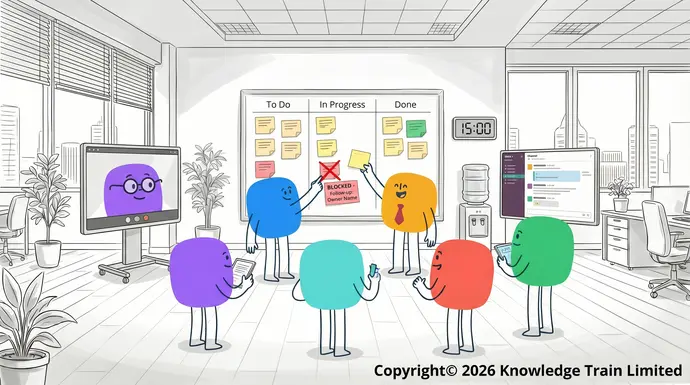
The most reliable fix for status-theatre stand-ups is to walk the board rather than go round the room. Instead of asking each person what they did yesterday, move through the work items on your board from right to left, starting with the work closest to done. Each item gets a sentence or two: is it moving, is it stuck, does it need anything? The conversation follows the work, not the person, which keeps the focus on flow.
Swarmia’s research into stand-up formats supports this approach, noting that teams who organise the meeting around work items rather than individuals report shorter meetings and fewer tangents. A useful rule of thumb: if an item has no update, skip it. If an item is blocked, name the blocker, assign one person to resolve it after the meeting, and move on. The stand-up is not the place to solve the problem, it is the place to surface it.
Handling blockers without derailing the meeting is mostly a discipline question. When a blocker comes up, the facilitator says ‘noted, who will own the follow-up conversation?’ and records it. That exchange takes seconds. Anything requiring more than that gets a separate slot, ideally straight after the stand-up for the people who need to be there and no one else.
To stay under fifteen minutes, time-box the whole meeting and keep a visible timer. Reviewing stand-up anti-patterns before your next retro can help the team agree on habits that protect focused work time.
Async alternatives for distributed and remote teams
When team members are spread across three or more time zones, a synchronous daily stand-up stops being a coordination tool and starts being a tax on whoever sits at the edges of the schedule. Forcing a 9am sync for one person can mean an 11pm call for another, and resentment tends to follow.
Async check-ins offer a genuine alternative. A stand-up bot can prompt each person at a sensible local time to answer a short set of prompts: what did you complete, what are you working on next, what is blocking you. Responses are posted to a shared channel where anyone can read and react without waiting for a meeting slot. The GitLab daily standup handbook treats this kind of async update as a first-class option rather than a fallback.
The risk is that async updates become the same status theatre, just in text form. A one-line ‘worked on tickets, nothing blocking’ posted without thought is no more useful than a robotic verbal update. Teams that get this right treat blockers as genuine requests for help, not a checkbox, and encourage brief threaded replies rather than silent reading.
What is lost is the spontaneous conversation that sometimes sparks in a synchronous call. What is gained is focus time, inclusivity across time zones, and a written record that reduces reliance on memory.
Choosing the right format: a quick decision checklist
Not every team needs the same fix. Use the questions below to match your situation to one of the three formats covered earlier: board-walk stand-up, async check-in, or hybrid.
Start here: where is your team?
- Mostly co-located, same time zone, consider the board-walk stand-up
- Distributed across two or more time zones, lean towards async check-in
- Mix of office and remote, hybrid is likely the best fit
Now check your tooling maturity:
- Team already uses a task board actively, board-walk works with minimal setup
- Team has a messaging platform and updates it consistently, async is viable today
- Tooling is patchy or inconsistently used, fix the board first, then revisit format
Finally, consider team size and trust level:
- Five or fewer people, high trust, async alone often covers coordination needs
- Six to nine people, mixed trust, hybrid keeps visibility without daily synchronous overhead
- Ten or more people, split into sub-team stand-ups rather than scaling any single format
Reviewing which format serves the team best is not a rejection of Agile principles. Regularly revisiting how ceremonies work is part of Agile practice.
How to make the case for change without seeming anti-Agile
Raising concerns about stand-ups should not be framed as wanting fewer meetings for the sake of it. The Agile Manifesto does not mandate daily stand-ups in any single format. Agile asks teams to inspect and adapt their processes based on what is actually working, which means experimenting with format is not a rejection of Agile values.
Adapting cadence and format based on team feedback is recognised Agile practice, so framing a proposal around evidence and outcomes will usually land better than a complaint.
Try these talking points with a sceptical manager or Scrum Master:
- Lead with data, not frustration. ‘Over the last two sprints, our stand-ups have averaged 20 minutes and rarely surfaced blockers that weren’t already on the board. Can we run a two-week experiment with a different format?’
- Tie the change to sprint goals. Explain that protected focus time can improve delivery.
- Propose, don’t abolish. A time-boxed experiment with agreed success criteria is usually easier to accept than scrapping the meeting outright.
- Invite team feedback. A retrospective discussion makes the case collectively, so the proposal does not rest on one person’s shoulders.
Changing how a stand-up works is not anti-Agile. Refusing to question a ceremony that no longer serves the team is.
Where to go from here
Fixing a stand-up is rarely a one-off change. Teams drift, new members join with old habits, and the format that works well at ten people can fall apart at twenty. Treat whatever you put in place as a working experiment rather than a settled policy, and revisit it every few sprints.
If you want to read more about agile ceremonies, sprint planning, and how high-performing teams use Scrum, the Agile Learning Library has practical guides and training options worth exploring.
Frequently asked questions
What is the purpose of a stand-up (Daily Scrum)?
A short, developer-owned planning event to inspect progress toward the sprint goal and adapt the plan for the next 24 hours – not a status report to a manager.
Why do stand-ups turn into status theatre?
Because the classic “yesterday/today/blockers” prompt encourages individual status reports, and the presence of managers or stakeholders shifts the meeting into an attendance-check.
What are the three classic stand-up questions and why are they a problem?
They are “What did you do yesterday?”, “What will you do today?”, and “Any blockers?” – they tend to focus reporting by individuals instead of team coordination around the sprint goal.
When can a task board make a stand-up redundant?
When the board is well maintained, tickets are updated, blockers are logged, and a small, self-coordinating team already has clarity about who is doing what.
When is a live stand-up still valuable?
When tacit blockers, quiet misalignment, or the need for team familiarity and spontaneous help cannot be surfaced or resolved via the board or async updates.
How do you run a stand-up that stays under 15 minutes?
Walk the board (work items first), skip items with no update, name blockers briefly, assign a follow-up owner, time-box the meeting, and use a visible timer.
How should blockers be handled without derailing the meeting?
Note the blocker, assign one owner to resolve or convene a follow-up, record the action, and move on – reserve deeper discussion for a separate session.
What are async stand-up alternatives and their trade-offs?
Use a bot or channel prompts to collect timed updates – gains include focus, inclusivity, and a written record; risks include shallow, checkbox-style updates and loss of spontaneous conversation.
How do you choose the right format for your team?
Match format to location, tooling, size and trust: board-walk for co-located teams, async for distributed teams, hybrid for mixed setups; ensure tooling and habits support the choice.
How do you make the case to change the stand-up format?
Lead with data and outcomes, propose a time-boxed experiment with success criteria, tie changes to sprint goals, and invite team feedback rather than unilaterally removing the meeting.