Project management: fundamentals, methodologies and best practices

Key takeawaysGovernance, clear roles, and transparent reporting improve accountability and decision-making.
Strong project delivery comes from clear lifecycle control, the right framework, and disciplined communication.Active stakeholder engagement and consistent communication build trust and maintain momentum.
- Project management guides a temporary endeavour through initiating, planning, executing, monitoring and controlling, and closing.Benefits realisation and KPIs ensure investment delivers value beyond time and budget.
- Match methodology to context: Agile suits changing needs, while Waterfall and PRINCE2 fit defined scope and governance.Standard methods, training, and continual improvement help programmes stay adaptable and repeatable.
- Clear roles, especially sponsor, stakeholders, and project manager, reduce conflict and speed decisions.
- Use practical tools like Gantt charts, critical path, and software dashboards to manage time, cost, and risk.
- Courses and certifications build leadership, communication, and analytical skills that improve career prospects and delivery outcomes.
What is project management?Programmes and portfolios
Project managementEach programme within a is the application of knowledge, skills, tools, and techniques to project activities to meet project requirements (source: portfolioProject Management Institute must align with the organization’s overarching strategic objectives. The cumulative success of the portfolio hinges on the collective performance of its constituent programmes and projects. By fulfilling their distinct deliverables and outcomes, they collectively further the strategic aims embodied in the ). It is structured around five core phases: portfolioInitiating, Planning, Executing, Monitoring and Controlling,. and Enhance your skills with our expert-led coursesClosing .
Project management is a structured approach that guides a team or organisation in planning and controlling activities to achieve defined objectives and deliverables within agreed constraints of scope, schedule, cost and quality. A Instructor-ledprojectMSP Practitioner (with Foundation) course is a temporary endeavour with a specific goal, differing from routine operations. Project management ensures successful delivery through systematic processes and best practices.
Project life cycle phases£1,899 +vat
The project life cycleSee all dates generally comprises five standard process groups:
- Initiating : Defining the project at a broad level, setting business caseSelf-paced, and identifying stakeholders.MSP Practitioner (with Foundation) self-paced online
- Planning : Establishing the scope, objectives, detailed schedule, risk management plan, budget, deliverables, and resource allocation.£1,399 +vat
- Executing : Coordinating people and resources, as well as meeting established milestones and deliverables.
- Monitoring and controlling : Tracking, reviewing, and regulating progress and performance, managing changes, and ensuring project stays on schedule and within scope.Instructor-led
- ClosingMSP Foundation course: Finalising all activities, handing over deliverables to the user/customer, releasing resources, and capturing lessons learned£1,299 +vat.
Project management methodologies & frameworksSee all dates
Multiple methodologies and models structure how Differences between programmes and projectsprojectsTable showing the differences between programmes and projects. are managed:Projects
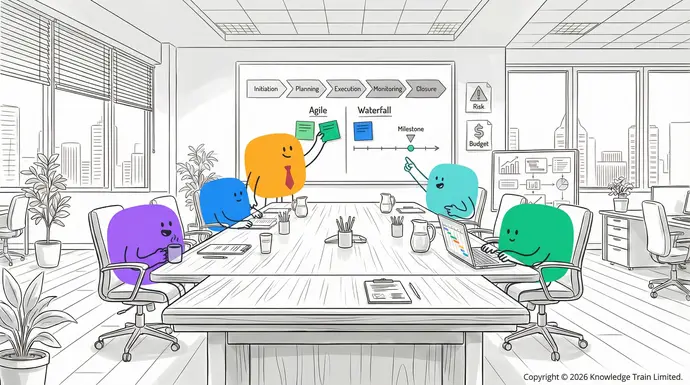
- Agile methodologyProgrammes: Purpose and objectivesAgileDeliver specific, outputs within a set time and cost. is an iterative, flexible approach emphasising collaboration, adaptability and rapid delivery; commonly used in software development and rapidly changing environments. Popular Agile frameworks such as Achieve a broader set of strategic outcomes by managing a group of interrelated projects.ScrumScope and timeframe are used by teams to deliver the products specified by the customer.Have a defined scope and timescale.
- Waterfall modelHave a broader scope, comprising multiple related projects. Their timescale continues until all the desired outcomes are achieved.: A sequential, linear process suited for projects with clear, fixed requirements, such as construction and manufacturing.Management approach
- Lean project managementFocuses on the delivery of specific outputs, : Minimises waste and maximises value; ideal for manufacturing, service improvement, and efficiency-focused projects.managing risks
- Project Management Body of Knowledge (PMBOK), issues, quality, and stakeholders.: A set of standard terminology and guidelines from the Focuses on coordinating multiple related projects to achieve a common outcome. Also focuses on managing project interdependencies and realizing benefits.Project Management InstituteBenefits of programmes that covers all There are multiple benefits to an organization if it manages its change initiatives as programmes.project management processesStrategic alignment.Programme management
- PRINCE2 ensures that all projects within a programme align with the broader organizational goals, ensuring resources are channelled towards initiatives that match the strategic vision.: A highly structured methodology focussed on business justification, clear organisation and divided into manageable stages; widely adopted by UK public sector and internationally.Optimized resource allocation
Project roles and responsibilitiesResources, including time, manpower, and finances, are allocated and utilized more efficiently across various projects, preventing redundancy and waste.
Projects rely on well-defined roles and accountability:Risk management
- Project managerBy looking at a collection of projects, programme management can identify, mitigate, and manage risks that might not be visible at the individual project level.: Oversees planning, execution, monitoring, control and closing; manages risks, stakeholders, schedule, and budget.Enhanced stakeholder engagement
- StakeholdersProvides a structured framework for consistent and effective communication with all stakeholders, fostering trust and collaboration.: Individuals or groups affected by the project or who can impact its outcome, such as clients, suppliers, and team members.Management of interdependencies
- Project teamEnables efficient handling of dependencies between projects, ensuring that the progress or outcome of one project doesn’t adversely impact another.: Specialists responsible for delivering project tasks and deliverables.Improved decision-making
- Project sponsorOffers a holistic view of all projects, leading to better-informed decisions based on comprehensive data and insights.: Provides financial resources and strategic guidance.Benefits realization
- Project board/steering committeeGoes beyond just completing : High-level governance and decision making.projects
Effective stakeholder management and clear team communication are essential for project success. The project manager must align interests, resolve conflicts, and support collaborative team dynamics. on time and budget, focusing on achieving the desired outcomes and ensuring that the anticipated benefits are realized and sustained.
Essential project management skillsIncreased flexibility
The Provides a framework that can adapt to changes in the business environment or organizational strategy, ensuring projects remain relevant and aligned.skills required by project managersConsistency and standardization are varied.By adopting a standardized approach, organizations can ensure consistency in the delivery and quality of projects across the board.
| SkillContinuous improvement | DescriptionFacilitates a culture of learning and improvement by regularly reviewing performance, capturing |
|---|---|
| Leadershiplessons learned | Inspiring and guiding teams towards common goals., and implementing best practices across all projects. |
| CommunicationValue for money | Conveying information clearly among stakeholders and team members.Ensures that investments in individual projects culminate in the desired benefits, yielding a positive return on investment for the organization. |
| Risk managementBoosted morale and team cohesion | Identifying, analysing, and mitigating risks.With clear objectives and coordinated efforts, teams have a clearer sense of purpose, leading to increased motivation and collaboration. |
| SchedulingIn essence, | Planning timelines and managing deadlines using tools like Gantt charts and CPM.programme management |
| Budgeting offers organizations a structured and strategic approach to managing multiple projects, ensuring not just their successful delivery but also the realization of broader business objectives and benefits. | Estimating, allocating, and controlling project finances.Enhance your skills with our expert-led courses |
| Scope management | Defining and controlling what is included and excluded in the project. |
| Resource allocation | Assigning people, equipment and budget where needed.Instructor-led |
| Problem solvingMSP Practitioner (with Foundation) course | Overcoming obstacles and finding effective solutions. |
| Negotiation£1,899 +vat | Reaching agreement among parties to resolve issues. |
| Critical thinkingSee all dates | Evaluating situations and implications for decision making. |
Project management tools & techniques
- Project management software : (e.g., Microsoft Project, Asana, Trello) aids collaboration, scheduling, task assignment, budgeting, and document management.Self-paced
- Gantt chartMSP Practitioner (with Foundation) self-paced online: Visual timeline for planning and tracking progress.
- Work Breakdown Structure (WBS)£1,399 +vat: Divides project into manageable sections.
- Critical Path Method (CPM) : Identifies sequence of crucial tasks that determine project duration.
- Project portfolio managementInstructor-led: Prioritising, balancing, and overseeing multiple MSP Foundation courseprojects aligning with organisational strategy.£1,299 +vat
- : Process-based methodology emphasising control and organisation.
- Best practices: Align with global standards, stakeholder engagement, clear documentation, regular reviews, and continuous improvement.
Refer to the Project Management Institute for further study.
- PMI
- Foundation and Practitioner level PRINCE2 certifications and PRINCE2 Agile certifications .P3O: An Overview of Portfolio, Programme and Project Offices
- Foundation and Knowledge TrainPractitioner29 Apr 2026 level AgilePM certificationsP3O, or Portfolio, Programme and Project Offices, is a best practice framework that helps organisations optimise decision-making, governance and delivery across their initiatives. Learn how the P3O model supports effective management of portfolios, programmes and projects. from APMG
Certifications are valued globally and support career advancement.