Stakeholder Engagement: A Key to Project Success with David Longstaff

Key takeaways
Strong stakeholder engagement reduces delivery risk and improves the chances of meeting time, cost, and scope.
- Identify stakeholders widely, including groups indirectly impacted, and revisit the list throughout the project life cycle.
- Map stakeholders by interest and influence, and tailor actions such as monitor, inform, satisfy, or engage intensively.
- Consult early and often, using the right team members and sponsor to reach influential stakeholders.
- Build trust through empathy, transparency, and consistent communication, and watch for shifts in attitude.
- Treat stakeholders as both threats and opportunities, and plan compromises by clarifying what success means to them.
Introduction
This session explains why stakeholder engagement sits at the heart of project success. It shows how to identify stakeholders, understand interests, and maintain support. Watch this webinar to learn practical steps you can apply now.
This webinar, ‘stakeholder engagement: a key to project success’, shares a straightforward approach. You will map stakeholders and plan actions that build trust and reduce risk. Expect clear guidance, useful examples, and tools you can reuse.
Video
Access the presentation here, listen to the audio, or read the full transcript below.
About the speaker
David Longstaff is an APM-accredited project manager, trainer, and consultant with over 20 years’ experience. He has trained more than 10,000 staff across the pharmaceutical, higher education, and financial services sectors. His background includes contract management, negotiation, and leading global teams.
David provides tailored training to improve resource management and support change. He focuses on engaging stakeholders and improving operational efficiency. He has grown a client base of over 150 organisations across the UK, Europe, and America.
Transcript
Here’s the full transcript of the webinar.
00:00:00 Sevcan Yasa : I’m Sevcan, I’m the Marketing Executive for Knowledge Train. We have David with us today. So, David, thank you so much for joining. The webinar will be on stakeholder engagement, the webinar will be recorded, so you will all have access alongside the transcription, the audio, and the PDF version of the slides. It will be all on our website, you will receive an email from me when all of these have been published. David will give a presentation, and then right at the end, we’ll have a Q&A session. So, feel free to write your suggestions, your comments, anything you want David to mention in the chat, and we’ll go through them right at the end. So, David, over to you.
00:00:42 David Longstaff : Thank you very much, Sevcan. I should have quickly checked with you. Interaction, can they make audio comments, or is it type chat?
00:00:51 Sevcan Yasa : It’ll be type chats.
00:00:52 David Longstaff : That’s absolutely fine. Good, no problem at all because there will be plenty of opportunity for engagement. This is an interactive session today on the topic of stakeholder engagement. Now, why is it important? Well, this slide here just shows one or two of the background research that was carried out. Most of this is by PMI, which is the sort of American equivalent to APM here in the UK. I think it stacks up very well and is incredibly accurate, just in terms of if you are in the project management industry, you are needed because you’ll see, bottom left, there a requirement for 25 million new project managers is the estimate by 2030. So, clock is ticking, more are required. Some of the facts that just highlight the importance of stakeholder engagement, 65% of projects are deemed to have an element of failure in them, either over 50% was due to being over budget, 74% time, schedule being late, 52% of them by scope creep. 1.6 trillion pounds per year wasted through poor project management practices, top right there. PMI did a survey on thousands of their members and asked them, What do you think are the key skills required that really make a difference in a project? And they came up with what was referred to as power skills. Now here, in the UK, if you’re based in the UK, we might know that as being soft skills, power skills. 72% of projects met their goals when they really focused on these power skills. Now, what do we mean by power skills? Well, a lot of them are stakeholder-based. So interpersonal skills, what we may refer to as soft skills, communication, empathy, relationship building, these are all topics very relevant to project success. And you’ll see as well, bottom middle there, out of all of the key elements that were critical to project success, stakeholder engagement made up for 1/3 of that.
00:03:16 David Longstaff : So, a key factor in the project management principles. Just one other screen around why project stakeholder management is important. This is the syllabus from the PMQ, that APM and run, the Association of Project Managers, PMQ, the Project Management Qualification, a five-day course. You’ll see stakeholders, and communication is one of the key topics. However, it almost has an impact on pretty much every other chapter. There’s 24 chapters covered in the PMQ, and there’s hardly a chapter in there that I’m displaying on the screen that actually doesn’t have a relevance to stakeholder management. So, if there’s any skill to really focus on and to develop its stakeholder management, stakeholder engagement, and communication management. Now here’s what we’re going to cover during the rest of this session. So, this session’s around about sort of 45 minutes or so, and then we’ve got an opportunity for questions at the end. So first of all, we’ll do an exercise where I’ll get you to consider one of your projects, and we’ll do some identification analysis and coming up with a strategy to work with our stakeholders. And we’ll use some material that APM provide, very similar to other countries, PMI have a very similar structure as well. And then for the rest of the session, you’ll see I’ve listed 10 areas. Now these 10 areas are covered on APM’s website. If you do search in your web browser for 10 principles of stakeholder engagement, and if you limit the site to APM, it will take you to a section where they take you through these 10 areas or 10 skills, 10 principles in a little bit more depth.
00:05:15 David Longstaff : But we’ll cover them briefly in this sort of 45-minute session. We’ll have an opportunity to ask questions at the end, and then I’ll hand back over to Sevcan with some next steps for you. So, let’s start by just having initially a look at identification analysis and strategy. So first of all, just a quick definition. What do we mean by stakeholders? Well, stakeholders are incredibly broad as a group. You might think of some key stakeholders, but actually a stakeholder is anyone, individual or not just an individual but a group, an organisation, an institution, who have an interest or a role in the project. And in the definition that APM give you, they also take it broader. They say it might not be just the project, it could be the programme, or it might be even higher than that at portfolio level. So, it’s these individuals or groups who either have an interest in or a role in, or look at that last part of the sentence, or are impacted by your project. Wow, that is a much wider group than we might typically imagine. So, when we do stakeholder identification, it’s probably going to be a lot broader than we initially think. Now, just a little note, I should make this early on. The term stakeholder, I realise, the history of that word and even the etymology of it can have negative connotations. There are some links, it is true to colonialism. However, I think just at least it’s probably a well-recognised international term that we use. So, for the purpose of today’s course, we will still refer to stakeholders. So how do you identify them? Well, what I would probably recommend is don’t try and do it on your own.
00:07:14 David Longstaff : Now, in today’s exercise, you are going to be doing this on your own, because this is an individual exercise. However, I would recommend in real terms, very early on in the project. So, if you are used to project management, this would be in the concept phase, right at the start, get together some key people. Now, the project sponsor is mentioned there. Your project sponsor is, of course, one of your key stakeholders. Also, other team members who are already in place early on, and you could carry out a few formats for identifying all your stakeholders. You could brainstorm; you could carry out workshops where you would brainstorm. So that’s kind of linked, if stakeholders don’t have time to attend a big all-encompassing meeting, you might want to carry out some interviews with them one-to-one and have discussions and see if you can gather other stakeholders and who might be involved, who might be impacted by your upcoming project. You can also look back at previous projects that you’ve delivered and then look at what we call lessons learned. So, these are all techniques for identifying stakeholders. Now here’s the exercise I’m going to get you to do. If you want to just grab a plain piece of paper, or you can do this in a Word document or some other note-taking solution, doesn’t really matter what. I want you to think about a current project that you’re involved with. If it’s one that you’re just starting, might be even better still, or if you can’t think of one that you’re just starting, maybe think back a little bit, you could think to a recent project.
00:08:58 David Longstaff : Do you know, in some ways, this even works just as well for home life? So, you could also think of a personal project that you’ve been involved with. If you can’t think of any, then could I ask you just, how about I give you a scenario to consider? Imagine you’re the project manager for a housing construction project in a major town. So, I’m going to go quiet now for a moment. Can I just get you to identify as many stakeholder individuals, groups, or organisations that you can come up with. You don’t have to share this, but if you want to, just identify as many as you can come up with, write them down on paper or whatever note-taking app you’re using. And this would typically normally be done as a collaborative workshop or brainstorming session.
00:10:39 David Longstaff : I’ll give you a couple of minutes for this exercise. I may witter on in the background. It’s purely just so that you know you’re still connected, and I’m still connected. If you are happy to share and there’s nothing confidential, then feel free to share in the chat box which project that you chose. Feel free to anonymise it if it’s a little bit more sensitive. And if you’re happy to share, you could maybe even pop into the chat box some of the types of stakeholders. You don’t need to put in individual names and organisations, but you could kind of broaden it out a little if you want; that is all optional. By the way, I don’t want you to share any confidential information, of course.
00:11:51 David Longstaff : So, it was a little bit tricky for me to know just how long to give you, because the reality is this would probably take, but it could be an hour’s workshop. I mean, this is an exercise you would come back to multiple times throughout your project, because you may identify new stakeholders in the definition stage, if you’re used to project management terminology. You’ll come across more stakeholders throughout deployment, still more in the transition phase, and then on into the extended life cycle, such as in the adoptions phase, the benefits management phase. And frankly, even if you’re using an agile project management methodology, you’ll come up with more stakeholders still, even in the evolutionary development phases, the transition phases, the even early on in the pre-project feasibility foundations, there’s all sorts of different terminology, but almost every stage of project life cycles, you’ll identify new stakeholders. Okay, if you want to share and you’re happy to share, feel free to type into the chat box. But no need, I don’t. Okay, excellent, so we just had a quick look. Is that right? So, Paula, NPD project refreshing an established and very successful product. Stakeholders are so, the team, you’re absolutely right, Paula. I don’t know anything about your project, but do not underestimate that your team members are clearly going to be involved. They’ll have a role, but they will also be impacted, and that links to some of your other comments, Paula, their colleagues and managers, the customers, our group who own the CO. And then everyone else in the business has a stake or an interest in the success of this product’s evolution. Nice points. Thank you, Paula.
00:13:59 David Longstaff : If anybody else wants to share, feel free to do so, but it sounds like you’ve already identified that in your project, almost everybody in the organisation is, and you’ll probably come up with, depending on the nature of your project, plenty of external groups as well. Some may be more impacted; some may be less impacted, but this is the very first part of stakeholder engagement. It’s identifying who they are and actually not limiting this list. There is sometimes a bit of a tendency to identify some key stakeholders early on, and then we sort of miss out others. So, it’s good to almost, it doesn’t matter how crazy the ideas are that come, let people in a brainstorming session feel comfortable at throwing in groups and individuals as well, that you may not automatically think of. So, I’ll just give you a moment longer; you’ve got some obvious ones. Do you also have some perhaps less obvious stakeholders? You’ve got to go back and think about these ones. Quick look at the second comment, an event, organisation, some big conference. The delegates are obviously stakeholders, excellent, thank you for that help. Speakers definitely are, yes. Suppliers, facilities, staff, catering. My goodness, these are wide groups, aren’t they? Thank you for that help. It’s much broader than we might initially think, and first part of this is just get them down. Now, at this stage, we haven’t done any analysis of them. All we’ve done is listed them, identified who they are. Let’s move on, so we also need to understand what’s their interest and relationship to the project, it won’t be the same for everyone. So, for some people or some groups, they may be particularly interested in the finance side of the project.
00:16:06 David Longstaff : What’s it going to cost? It might be that they’re more interested in health and safety aspects of your project in the top middle box there. It could be some sustainability factors that they’re really interested in, environmental issues. It could be even kind of very much on an individual level, a local level, it could be things like traffic and congestion. How is this project going to affect that? Amenities? What about schools? Are there going to be schools that will support this project? Medical facilities? What about shops? So now this is probably particularly in the example I gave regarding the housing construction, but this is just as relevant to other types of projects as well. So, can I just again, I’ll stop for a moment. Can you just next to all the various groups that you’ve listed and individuals that you’ve listed, just kind of identify what’s their sort of particular interest in the project? It won’t all be the same.
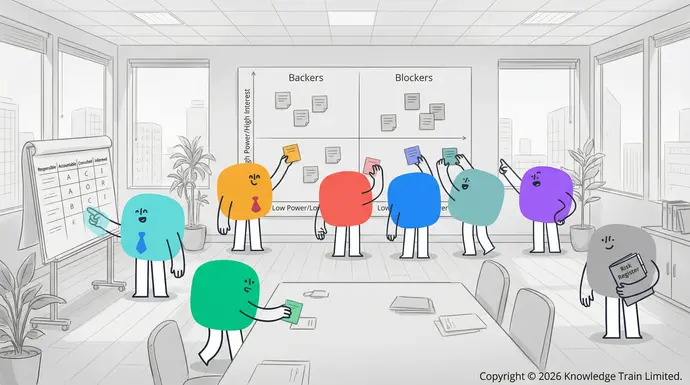
00:17:51 David Longstaff : Okay, and now I’m going to bring up a matrix that’s designed to help you further carry out an analysis. So, the early analysis was just to analyse what’s their area of interest but another element that is covered by APM’s material, and indeed PMIs, if this is pretty global, is understanding a stakeholder’s both level of interest and level of influence or power. So, you’ll see on this kind of typical two by two matrix, we’ve got those who have low interest in the project, low power. And down in the bottom left box, top right orange box, you’ve got high power and high interest, and then variations within there. Actually, we can just mirror that, because we might say, well, how about their attitude towards the project? We’ve got those who are very much for the project, but actually, if you were just to kind of replicate it, you might have just the same boxes for those who are against the project. And again, they will have a degree of power and influence and a degree of interest in your project. So, if I was to put just some terminology around these levels, you’ll see we’ve got backers and blockers. So right-hand side are all backers, the left-hand side are all blockers. We’ve got their power level, so highly influential in the top boxes. And then in the lower boxes, we’ve got those who are what are referred to as insignificant. I don’t want to kind of diminish their role, but that’s how they are mapped in APMs and PMIs and most matrices for stakeholder engagement and analysis. We’ve also got then their interest level mentioned in the middle option, which is whether they’re active, highly active, or whether they are actually quite passive towards this. Now, if you just think about some of your stakeholders, you might think about your project sponsor.
00:20:08 David Longstaff : So where would you want your project sponsor to be? Well, clearly up in that top right box. You want your project sponsor to be for your project, obviously, but you also want them to have a high degree of interest and a high degree of power or influence. You could ask, How influential does your project sponsor need to be? The answer tends to be high enough, but there is a balance because if they are too senior in the organisation, what you may find is that they lose activity. In other words, they’re not that interested because they’re being pulled in so many other directions. One factor around an effective sponsor is making sure that they have enough time to commit to your project. So, project sponsor, you want them to be very active, highly influential, and we’ll talk about why that’s a benefit a little bit later on. But yes, you want your project sponsor to be up there in the top right. You can also plot your other stakeholders. So, for example, if this were the housing construction project, or actually, frankly, Alpa, I know from my background in, I did have a role not too long ago in managing a major annual conference that the health and safety executive may well have quite an important part to play. Now, where would they appear on this stakeholder matrix? Are they that interested in whether your project actually succeeds or fails? Not particularly. So, you might find them slightly towards the middle of that vertical red line, but how influential are they? Incredibly. They can close your project down in minutes if you have a major failing in health and safety, and this can be all sorts of projects. So that’s just a couple of examples. I’m wondering if I can now just get you to go back to your exercise, and I’ll go quiet again for a few minutes while you do this. Can I get you to map out the stakeholders for your project? Just pop them into those boxes.
00:23:26 David Longstaff : And just while you’re doing that, yes, thank you, Sevcan. Please feel free to write your questions in the chat box at any time. Sevcan will kind of keep an eye on the questions, but also, I’d be interested in any of your comments, questions or observations. If you haven’t got any observation doing this type of exercise, is this something that you regularly do as part of your project initiation? Is it something that works well initially in the project? But perhaps drops off a little bit later on, often-what people find is that they do a really good initial exercise when they’re starting the project, but sometimes this can fall away. Still, others haven’t considered using this model. So, I’ll be interested in your observations about doing stakeholder, not only identification, but also analysis.
00:24:44 David Longstaff : Diane, yeah, great comment. Thank you. It’s true, we tend to see this as a two by two, whereas actually it is mirrored. Thank you, Diane. And Paula, first time doing this, realising I’m concerned that some might fall into influential active blockers. Wondering if you can move people into new sections with management. Paula, it’s a wonderful point that you’re making there, and the answer is, yes, to an extent or rather, I would probably suggest we can help them to an extent move into a different box. I don’t know what you feel, but I think managing stakeholders sounds like it’s been like being able to move pawns on a chessboard, and it’s not that easy. If I will comment on that in just a little moment, but yes, there are things that you can do to help, and actually, that’s the purpose of this session today. Thank you, Paula, a great point, and I as well.
00:25:46 David Longstaff : So that’s the first part of this, and now we move into APM’s 10 principles of stakeholder engagement. Now, in most cases, all I’m going to do is bring up just a single sort of slide, which is a kind of just a summary of what you’ll find if you go to their website, and we’ll just expand a little bit on it. But the first one, communicate, I just want to just take that a little bit further by going back to our chart, and this links in nicely to Paula’s point. So, you could overlay these eight boxes with some additional terminology. In other words, how do you deal with a particular group that may be in one of these boxes? Now, up at the top left and top right, where we’ve got people who are highly interested and have a high degree of influence, you’ll want regular engagement with these, intensive engagement. In the top middle boxes, so where they have less interest, you might simply need to keep these satisfied. In the bottom boxes there, you’ll want to keep them informed if they are highly interested but of low influence. And if they’re not terribly interested, so quite passive and don’t have a huge, and they are insignificant as opposed to influential, you might simply need to monitor these. So those are the terms that are used, you’ll see very slightly different terms between high power, high interest for, as opposed to those against, regular engagement versus intensive engagement. So, can I just ask you here, how would you translate some of these boxes into actual, practical actions? What would you do on a day-to-day basis? What would you do for each of these boxes or any of them, if you wish to comment?
00:28:15 David Longstaff : Oh, Paula, great point. Thank you. So, identify what project success means to them. It’s like we’re a double act here, Paula, because actually that’s covered in one of APM’s 10 principles of stakeholder engagement. So yeah, excellent point, thank you for that, Paula. Any other comments what you might do or how might this actually translate on the ground? So, you may find that a quick look at Thor’s comment, intensive engagement might be workshops. Yeah, thank you, regular might be stand-ups, keep informed might be regular briefings or central updates. Yeah, these are great comments. So, keep informed may not take as much effort, but there is probably more stakeholders at that level. So, what you find is that there’s almost a pyramid here that there are less people involved at the, sorry, there are more people involved who have lower power, and therefore you may be able to simply use things like a newsletter, something that you could use just to send out occasionally, keep them up to date, so that they still feel that they are part of this. But the regular intensive engagement, those highly powerful, highly for or against, then you may well need to take a very different approach. I think Thor gives some good examples, workshops, you might hold briefings, it might be town hall meetings. So, a chance for the community to engage so much more intensive. And there’s a comment coming up a bit about who might be involved from your side to help with that.
00:30:13 David Longstaff : So yeah, great points, thank you, Thor, Helen, tailored communications, absolutely. So, it takes a lot more effort, doesn’t it, Helen, at that top level. But the time that you’re saving from the lower levels can be used then for time that you can invest in those upper levels. Papy, nice point, thank you as well around. So, by the way, I do hope I’m pronouncing everyone’s names correctly. Please let me know if I get it wrong. So, building a project communication plan. Yeah, definitely, thank you. Monitoring, you may not need to do much more than just keep an eye on these. Now, a good point that was kind of raised earlier by, who was it? Was it Diane, I think, or no, it was Paula. People can move from one box to another. Sadly, they can go in the wrong direction from your perspective as a project professional because you could find that someone who was really for your project, and they are highly influential, and they’re very active, might start to lose trust in the project, lose interest, and they drop further left. Wouldn’t it be sad if they even ended up in the against box, but there are things that you can do with good management that helps to move them from potentially the left-hand side into that right-hand side. So, this is not an exercise that you just do at the beginning; it’s something you need to do regularly and often. So, let’s look at the other 9 elements of the stakeholder engagement principles. The second one is consult both early and often. So, this is so key because often at the early stages, stakeholders are not exactly clear on what your project is about. They’re not sure on the purpose, the scope, what’s involved, what risks there might be. So, if you can enter into regular consultation, so don’t just do it at the start, do it right the way through, then this can be particularly helpful. And this is the comment that we make about particularly those who are highly influential, highly active and against your project. The very bottom option there is you might want to get your sponsor involved in helping reaching these senior stakeholders. Now, that could be both those who are towards the ‘for’, but maybe not fully ‘for’ yet. Then again, use your project sponsor. So, get the right people involved, don’t take it all on yourself, use the whole team, pick the right person within the team to carry out that consultation. And just a little, I mean, this is probably what you might refer to as common sense. I may put it as being advanced common sense, but don’t start the process using email unless you already have a good working relationship with them. So, I’ll just pause for a moment. Can you just quickly look through your list of stakeholders and just identify people in your team and sphere who might be able to help you communicate with those specific individuals and groups that you’ve identified as stakeholders.
00:34:04 David Longstaff : By the way, just as an aside, I know there’s quite a lot of content on the screens. Don’t worry, because this is going to be available for you afterwards, you can go back and review and use in the future. So, there’s a real key, the second one there. Consult early and often, don’t do it all yourself. No problem, Paula, yeah good. Don’t just do it, take it all on yourself, use other people within your team. And as well, leverage that usefulness of the project sponsor, and that’s why, again, that comment we made earlier on about the project sponsor, if they are too senior in the organisation, they might not realise that actually there’s quite a bit of commitment to the role of being a project sponsor. So, leverage their ability to support you with those highly influential, highly active and interested parties, and particularly those who are against. So that needs intensive engagement, a nice comment as well. So, donors, government officials involved in my project, beneficiaries, there can be lots of people. So, I don’t know what your project is, and I don’t need to, but it’s just a great point. Thank you there that we can, there are lots of different stakeholder groups and individuals, and we’ve also got lots of people in our team that can support you. Here’s the next principle, which is, do remember your stakeholders, they’re people, they are human. And as a result, they don’t always think in a logical way, I don’t know if you’ve ever found this. Sometimes, to you, this seems so reasonable; it stacks up surely, why would anybody have a disagreement with this view? And you find that human feelings get somehow feel like they get in the way. I had an example of this just this week I was working with, I’m delivering a PMQ this week, actually. Somebody said, do you know we have a project which is involved with electrical power lines and putting them under landowners’ farms and so on. And so, they get quite a bit of money offered to allow us to do this, and you would think that the logic surely is that they would have no problem with that. And then you find that they comment, but, there’s a dog’s graveyard in this field. So, you have to try and think beyond your perspective and have empathy and understand their issues.
00:36:54 David Longstaff : You’ve got to try, and that takes a little bit more deep, deeper relationship building with them. You’re absolutely right, Di. It’s like political views on the same subject. Yeah, thank you. So, remember, people are only human, do watch for changes in their attitude. So, this is why a good project manager, project professional of any level, will keep their ear to the ground and particularly identify the ones that might be at risk of moving from positive and towards one that might be against your project or suddenly become indifferent towards it. So, keep that stakeholder approach that we looked at earlier on in this workshop relevant to you. Show them that you’ve listened and that you’ve heard, and how you’re going to try to input their ideas into your action plan. It may not always be possible, but if you can, try to make that accommodation, and then you’ll have a wider stakeholder group that are in favour of your project. Number 4, plan it, don’t leave this to chance; careful planning is required. How might you do that? Well, it’s pretty much through the steps that we’ve been taking you through. But you remember we said that quite often this early analysis is done once, right at the start of the project and then often gets forgotten. So, remember, that heat map that we showed, you know, the kind of for and against influence activity, keep that updated, review it frequently, build a plan to ensure that people feel that they’re being heard and that their concerns are being addressed. Oh, little aside, and I’ve just brought up on the screen now a QR code. Now, this QR code takes you straight to the 10 principles of stakeholder engagement from APM site. You can just search for it in the web browser as well, that’s a direct link if you want to use your mobile phones. On there, you’ll find they’ve also got some really good case studies, and it will be worthwhile just going back and having a look at some of their case studies. They’re from quite a variety of industries. So, I’m sure you can find something that’s really helpful there.
00:39:16 David Longstaff : They talked a bit about the background, the issues, and the solution that they came up with, particularly around the topic of stakeholder engagement and stakeholder communication. So don’t give it a chance, plan this. Number 5, relationships are key, absolutely. Just think about the network and building trust within your within your stakeholder groups. Understand how they all link to each other, map relationships about who you would want various stakeholders to engage with. You might actually just want to reverse that as well. If it’s possible, other stakeholders who maybe shouldn’t engage with other particular stakeholders? Sometimes it’s worthwhile keeping your eye on that as well, but do always act professionally, authentically to build that trust. Building that trust is so key, I heard a great illustration recently was that to build trust is like growing a coconut tree. To lose that trust is like the coconut falling off the tree in terms of time. So, it’s very quick that with some mistakes, you can really quickly lose relationships. Any comments from you? Can I just widen it out? And do you have any advice? What’s your advice? What have you found works in building relationships with your stakeholders?
00:40:53 David Longstaff : Thank you, Helen. You cannot get away from that, transparency. People will see beneath it, won’t they, if we’re being dishonest. Find common ground, that’s a nice example. Thank you, Thor. Demonstrate your, that you value and recognise their viewpoints, there’s so many comments, great comments coming in here. Regular communications, so keep it regular, thank you. Spend time, there’s no shortcutting that, is there, Lucy. Thank you. Cecilia, establish trust through common goals, that’s great. Yeah, we may have differences, we may have some conflicts. What are our common goals? Building time on that, Cecilia, great point. Thank you. Belinda, give them your time to help facilitate their issues and accountability. What great comments. Thank you so much, everyone, for those inputs. If I did miss your comment, it was just because quite a few came through there. Excellent, thank you for that input. So, relationships are key. Number 6, it sounds simple, but it’s not easy. The comment that they make in APM make regarding this topic is that although it does feel like it’s advanced common sense, in practice, it’s often done very poorly. So, it might seem simple, but it’s not always easy. So just quick reminders, listen to your stakeholders, do plan ahead, try and think from their perspective what’s coming next. Enable the team as well around you to move quickly, keep your ear to the ground, try and anticipate these shifts. There was a reference there to risks, we’ll come back to risks in just a moment. Lead authentically, but it also mentions there, understand your own leadership style. So, if you try to use a leadership style that is just not yours, again, it loses that authenticity, perhaps links to some of your comments in the last few moments and people will see through that. So great points, thank you everyone.
00:42:58 David Longstaff : Number 7, it is just part of managing risk, say APM, and it is absolutely. Now we could almost run another topic, a very similar exercise on managing risks. And risks, APMC, are not just threats I don’t know about you, but I always, whenever I think about the term risk, and we do risk management practices, and we do risk assessments and analysis of the risks, we always focus on the negatives. What are the things that can go wrong with our project? What are the challenges, the problems? But actually, risk in APM’s definition also refers to opportunities, things that could go right. So, think about your stakeholders as being risks. They are absolutely very sure they are part of the threats to your project, but they also bring opportunities to your project. What are they? And log those. Now, how do you log them? Just a bit of a comment that’s made there in this second statement about putting the, creating a risk management plan. Now in your risk management plan, you don’t typically list every single risk. That’s more a risk register which accompanies the plan and supports the plan, but it also makes reference there to the PBS and the WBS. If you are in the project management world, then the product breakdown structure, these stakeholders will have an influence on both what products that you’re delivering, the scope of your project, and also the work that’s going to be involved too. So, the work breakdown structure and then, funnily enough, another breakdown structure that’s covered in APM’s material is the OBS, the organisational breakdown structure.
00:44:50 David Longstaff : Now, if any of that sounds a bit vague and you haven’t come across that before, I’d probably recommend get in touch with Knowledge Train and join the next APM courses that we’re running, either the PFQ or the PMQ. By the way, I do promise this is not a marketing exercise. So, let’s keep to the material around these 10 topics. Topic number 8 is you may need to compromise; it’s unlikely that all stakeholders will get everything that they want. So, what you need to understand is what’s most important to them. What are their MoSCoW elements? MoSCoW, by the way, is an acronym used in project management for must-haves, should-haves, could-haves and won’t haves. So, what are the must things? What are the things that they will not compromise on? But what are the things that they would like to have, see happen about this project? And what are the could-haves? And what you want to do is try and find other areas that you could compromise on. But you do need to dig deeper because what you’ll find is that a stakeholder will almost put everything in the must-haves of MoSCoW. And then they’ll have nothing in the should-haves, and the could-haves, where if you dig deeper and work with them closely, again, that requires time. I think Lucy’s point there is that you may be able to then find compromises that make a workable solution. So, although we won’t do it in today’s exercise, what you may want to come back to in your stakeholder exercise is looking at what compromises could we make to provide a workable solution for some of our stakeholders who are maybe not as for our project.
00:46:40 David Longstaff : Di, that is a great technique. Do you fancy explaining a little bit further on the 5 Whys? It’s a great technique; I had one of the participants this week give me a good example of the 5 Whys. Has anybody come across the 5 Whys before? If you want to explain it further, Di. So, the 5 Whys, if you ask why, okay, don’t worry, Di. If you ask why 5 times, the idea behind it is that you really get to the nub of these things. So, if you know, you ask why once, they’ll give you an answer, and you go, but yeah, but why is that the case? And they dig a little bit deeper, and you go, yeah, now I understand. Thank you. But why is that the case? And they dig deeper still, and if the idea behind this, I’m not sure of the origins of this technique, but it sounds like a great technique. You just, if you ask it five times, you should really get to the nub of it, and you should understand then where they might be happy to compromise, and also, it leads to number 9, what success means to them. And assess that and try and put measures against it. Clarify these expectations and show the stakeholders the bigger picture and how their specific perspective and input fits into that bigger picture. You can see how doing that would really just help to ensure that we’ve got good stakeholder engagement, excellent. And the final one, take responsibility, that’s such a key factor. Not only yourself but have everybody else understands their responsibility in this.
00:48:27 David Longstaff : Now, we mentioned various breakdown structures earlier. The organisation breakdown structure, the OBS, and the WBS, the work breakdown structure, can be used to create what’s referred to as a RACI matrix. And this can be incredibly helpful for stakeholder engagement. Now, again, I don’t want to put you on the spot; I’ve already put Di on the spot, which is totally unfair of me, but have you come across a RACI matrix? Is it something that you use? And what does RACI refer to? If you feel happy to type into the chat box, you can do but the idea is that if we can involve all of our team members and make sure that everyone understands what’s expected of them, then that will really help for everyone to take ownership of their part of the stakeholder engagement and also what their role is in communicating with these stakeholders. Yes, it looks like it’s a tool that many recognise. So, RACI stands for Responsible, Accountable, Consulted, and Informed, absolutely. So, just to explain the difference between these, responsible means that person is going to make a response. In other words, they have an action to take. So, with communication, you’ll want them to understand, okay, I have an action here. I need to communicate with that person, with that stakeholder group, with that stakeholder individual. What’s the difference between responsible and accountable, then? Accountable means that if something goes wrong or indeed goes right, they might be held to account.
00:50:06 David Longstaff : So it might be, for example, that the design, one of the design team members, is responsible to take a communication with one of the stakeholders, and the team manager for the design team might be accountable for it. Consulted and informed, different elements, consulted means they need to be approached to get their input. Informed simply means they need to be aware of an action taking place; it could be that they have a follow-on action as a result of that. So APM’s PMQ and the PFQ, the Project Fundamentals Qualification, all look at this type of matrix as well. So yeah, it is a great tool, very useful in organisations. The reason why it’s useful is it keeps everybody aligned. Yes, thank you, Helen. It makes sure that everyone is on the same page, we all know what’s required of us, and it means that when we go away, we’re all clear on who’s got the action. And you probably want to also include their dates. When should this take place? What medium should we use for this communication? What kind of feedback do we want? How frequent should this communication take place as well? So, RACI matrix, very useful for that type of information.
00:51:27 David Longstaff : By the way, just in terms of this chart, every action, every task should have both an R and an A, the C and the I are optional. So, if you do create a RACI matrix, it’s nice because it helps you just to see where we’ve got gaps for this. You can see from my example on the screen that sometimes the R and the A can be the same person; that’s not a problem. So, this last one was take responsibility, it’s not just one member, it’s not just a project manager that has this responsibility, as we’ve said earlier, get everyone involved. Make sure that the team are fully equipped, that they’ve got the right communication tools and access to them, and also that they’ve all got access to this RACI matrix as well, there we go. In just a little short while, we’ve covered the 10 key principles of stakeholder engagement, and we also did a little bit of an exercise just prior to that around identifying our stakeholders. I’m going to hand it back over to Sevcan in a moment, but just finally, thank you so much for all your input. That was very helpful, and I do appreciate that. It’s your involvement that makes this a success. So, oh, let me just, while Sevcan’s just kind of returning on to this, can I just quickly look at that last comment? One of my biggest challenges is getting high-impact, senior stakeholders to engage or respond on time. They directly influence project and delivery time scales, but sometimes emails go unanswered, and they’re not reachable by phone because they’re so busy. I’m wondering if you have any suggestions or tips on how to get them to engage more. And it sounds like it’s not an isolated problem because look at people now adding here, thumbs up.
00:53:19 David Longstaff : Yeah, thank you. Well, I say what, I will give some comments, but do you have any observations of what you have found helpful? Now, I would say just a nice point that is made about it does link back to if stakeholders are too senior and too busy, they may not engage as well. How can you engage them? I suppose if I was to give you my tip, but if you’ve got tips, feel free to feed them in. Is making sure that there is clear accountability. That’s why, actually, I know we looked at it at the end there, but if you in a meeting can make sure that everyone’s clear on their actions and have a due date when this needs to be done by and take a, do track it as well. Having in your task management system, having a category for waiting fors, is really important. So at least you’re aware of what needs to be done by who and by when. The when is clear, but to get that accountability, sometimes a meeting can be helpful, where there’s a wider group. But do document it and do document, if for example, you’ve had a brief Teams call or a phone call with them and you think that you’ve agreed what the action is and when it was to be done by, you might want to follow that up with an email to say, hey, thanks for that discussion. Here’s what I think we’ve agreed, you’re going to contact soon, and so by, you know, December the 10th. You know, I look forward to your response. So, it is clear and it’s there’s an audit trail in there. So that can be helpful, and I see Helen said, physically just go and stand by their desk if necessary.
00:55:11 David Longstaff : Raising accountability is a real trick. Thor says this is where sponsorship is critical; it absolutely is to drive accountability engagement. If everybody can hold each other accountable, then that is definitely useful. So, make this a culture not to be unpleasant, but that we’ve got clear actions at the end of a meeting or end of a discussion, and they’re documented with who it is and by when. Helen’s making some comments as well, and Di, you might use MS Teams as a way to communicate, to follow up on an email, great, thank you. Belinda’s advice, I found if they are engaged, then book a regular session with them at a time that suits them. You can then get them to answer outstanding questions and follow up in writing. Another great tip, thank you for that, Belinda. Now, feel free to add more questions into the chat box, but I’m going to hand over to Sevcan as well. Thank you, Sevcan.
00:56:15 Sevcan Yasa : Thank you, David, that was an amazing presentation. I hope everyone actually learned something new there. Can you go on to the next slide, please? So, on this slide, we have a list of all of our courses. I’m going to pop my email, so if you do have any questions, if you would like further information, you can always email me. I do respond to my emails, so this is a list. The most relevant course here would be the APM course, which is the second one just under the project management courses. So, we both, as David also mentioned, we have the PFQ and the PMQ course. David, could you also run to the next slide, please? So here is our contact information. We are Knowledge Train, but we are also in partnership with agileKRC. So, we have both of our contact details there. While people write some questions in the chat, I am going to open up a very quick survey just so people can answer. It would be very important if you do answer it, because obviously it’s going to help us improve both myself and David to improve for future webinars. I do realise that some are regulars, so everyone, we do have regular webinars on a monthly, two-month basis, you obviously will get emails about it. So that’s it from my end, I can see a lot of thank you. But if you do have any questions, please jot them down; we are here for about 5 more minutes. So, David can answer them.
00:58:26 David Longstaff : Excellent, thank you. Thank you very much, everyone, for your input tonight, because it’s actually, it’s kind of your input that makes these sessions a success as much as anything. So, thank you for that, particularly given it’s the end of the day, probably a long day for many of you. So, thank you for joining us. Enjoy your evenings as well.
00:58:47 Sevcan Yasa : And those who are just about to exit, Merry Christmas, definitely a festive season.
00:58:53 David Longstaff : That’s early.
00:58:54 Sevcan Yasa : I’m going to pop down our website as well, just because the slide is not up. If you have any questions, please jot them down.
00:59:39 David Longstaff : Thank you, Thor. Thanks for all your comments, I appreciate that.
01:00:02 Sevcan Yasa : Thank you, everyone. Merry Christmas, if anyone doesn’t have any questions, I think it’s safe to say that we can end this webinar. Finish the poll.
01:00:52 Sevcan Yasa : Okay, once again, this webinar is recorded, and you will receive the recording most probably next week. So, thank you all for joining. David, thank you so much for joining and Merry Christmas and a Happy New Year, everyone.
01:01:17 David Longstaff : Thank you, Sevcan.
01:01:18 Sevcan Yasa : Thank you, bye.
01:01:19 David Longstaff : Bye.