
Key takeawaysFuture trends in project management frameworks
Strong project delivery comes from clear lifecycle control, the right framework, and disciplined communication.
- Project management guides a temporary endeavour through initiating, planning, executing, monitoring and controlling, and closing.Conclusion
- Match methodology to context: Agile suits changing needs, while Waterfall and PRINCE2 fit defined scope and governance.
- Clear roles, especially sponsor, stakeholders, and project manager, reduce conflict and speed decisions.FAQs
- Use practical tools like Gantt charts, critical path, and software dashboards to manage time, cost, and risk.Introduction
- Courses and certifications build leadership, communication, and analytical skills that improve career prospects and delivery outcomes.A
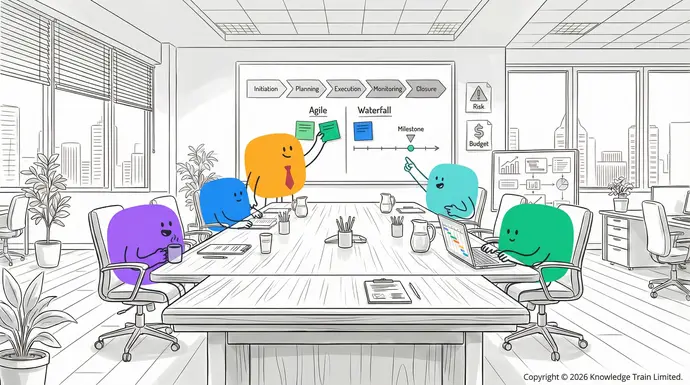
What is project management?: It creates uniformity in processes across the organisation. By following a structured plan, the estimates of time for planning and setting deadlines become more accurate.
Project managementClarity is the application of knowledge, skills, tools, and techniques to project activities to meet project requirements (source: : It helps to clearly define the activities required to accomplish a task and the tools needed for it. Therefore, there is less confusion when the work is being done.Project Management InstituteSimplification). It is structured around five core phases: : Larger and more complex projects are simplified when broken into a set of smaller, well-defined tasks.Initiating, Planning, Executing, Monitoring and Controlling,Resource optimisation and : It allows managers to evaluate if the allocated time and budget were spent properly, which can be used to drive resource optimisation in future projects.ClosingBetter communication.: The regular meetings mandated by the chosen frameworks make for better communication of information to the team members.
Project managementBy using these three components, organisations can ensure that their is a structured approach that guides a team or organisation in planning and controlling activities to achieve defined objectives and deliverables within agreed constraints of scope, schedule, cost and quality. A project management processesproject are effective, efficient and appropriate for their needs. is a temporary endeavour with a specific goal, differing from routine operations. Project management ensures successful delivery through systematic processes and best practices.Popular project management frameworks
Project life cycle phasesTraditional frameworks
The Waterfallproject life cycleDefinition and key characteristics generally comprises five standard process groups:Waterfall
- Initiating is a sequential project management framework that progresses through a series of phases, such as requirements, design, implementation, verification, and maintenance. In the waterfall framework, each phase must be completed before the next one can begin, and testing is performed at the end of the project.: Defining the project at a broad level, setting Pros and consbusiness casePros: Easy to understand, well documented, and identifying stakeholders.Cons: Inflexible, difficult to change requirements, testing is performed too late.
- PlanningBest use cases: Establishing the scope, objectives, detailed schedule, risk management plan, budget, deliverables, and resource allocation.Waterfall can be used for software development
- Executingprojects: Coordinating people and resources, as well as meeting established milestones and deliverables., where the requirements are well-understood and unlikely to change during the project, or for hardware development projects, such as those in the automotive industry.
- Monitoring and controllingAgile frameworks: Tracking, reviewing, and regulating progress and performance, managing changes, and ensuring project stays on schedule and within scope.Scrum
- ClosingDefinition and key characteristics: Finalising all activities, handing over deliverables to the user/customer, releasing resources, and capturing Scrumlessons learned is an iterative Agile framework for developing and delivering products. In Scrum, projects are divided into sprints, typically lasting two to four weeks, during which a minimum viable product (MVP) is developed and delivered..Pros and cons
Project management methodologies & frameworksPros: Flexible, focuses on collaboration, fast delivery of working products
Multiple methodologies and models structure how Cons: Requires skilled and experienced team members, difficult to scale.projectsBest use cases are managed:Scrum can be used in software development projects, product development projects, and other projects where the requirements are not well-defined or where there is a need for frequent updates and client feedback.
- Agile methodologyKanban: Definition and key characteristicsAgileKanban is an Agile framework that visualises the workflow and helps teams optimise work in progress (WIP) by using a board with cards representing tasks or work items. is an iterative, flexible approach emphasising collaboration, adaptability and rapid delivery; commonly used in software development and rapidly changing environments. Popular Agile frameworks such as Pros and consScrumPros: Visualise workflow, reduce WIP, increase efficiency are used by teams to deliver the products specified by the customer.Cons: May lack structure for complex
- Waterfall modelprojects: A sequential, linear process suited for projects with clear, fixed requirements, such as construction and manufacturing., requires discipline to maintain.
- Lean project managementBest use cases: Minimises waste and maximises value; ideal for manufacturing, service improvement, and efficiency-focused projects.Kanban can be used in projects where work is continuous and there is a steady stream of tasks to be completed, such as support or maintenance work, or in projects where teams are trying to improve their current processes and workflows.
- Project Management Body of Knowledge (PMBOK)Lean: A set of standard terminology and guidelines from the Definition and key characteristicsProject Management InstituteLean is a framework that aims to optimise value while minimising waste in project processes, with a focus on streamlining and simplifying the project workflow. that covers all Pros and consproject management processesPros: Increases efficiency, reduces costs, improves quality.Cons: Requires cultural shift, can be difficult to implement in some industries.
- PRINCE2Best use cases: A highly structured methodology focussed on business justification, clear organisation and divided into manageable stages; widely adopted by UK public sector and internationally.Lean can be used in manufacturing or production projects, as well as in healthcare or service industries where there is a need to improve efficiency and reduce waste.
Project roles and responsibilitiesPopular frameworks
Projects rely on well-defined roles and accountability:PRINCE2
- Project managerDefinition and key characteristics: Oversees planning, execution, monitoring, control and closing; manages risks, stakeholders, schedule, and budget.PRINCE2
- Stakeholders is a structured project management method that provides processes and principles for managing a project in a controlled environment.: Individuals or groups affected by the project or who can impact its outcome, such as clients, suppliers, and team members.Pros and cons
- Project teamPros: Highly structured, scalable, business justification is emphasised: Specialists responsible for delivering project tasks and deliverables.Cons: Can be bureaucratic, requires a lot of documentation.
- Project sponsorBest use cases: Provides financial resources and strategic guidance.PRINCE2 can be used for large, complex projects, especially in government or highly regulated industries, or for projects where there is a need for a high degree of control and governance.
- Project board/steering committeeIt’s important to note that these are just some of the most popular : High-level governance and decision making.project
Effective stakeholder management and clear team communication are essential for project success. The project manager must align interests, resolve conflicts, and support collaborative team dynamics. management frameworks, and that there are many other frameworks available that may be more suitable for your specific project or organisation.
Essential project management skillsEnhance your skills with our expert-led courses
The skills required by project managers are varied.
| SkillSelf-paced | DescriptionAPM PFQ blended online |
|---|---|
| Leadership | Inspiring and guiding teams towards common goals.£749 +vat |
| Communication | Conveying information clearly among stakeholders and team members. |
| Risk management | Identifying, analysing, and mitigating risks.Self-paced |
| SchedulingPRINCE2 Agile Practitioner (with Foundation) self-paced online | Planning timelines and managing deadlines using tools like Gantt charts and CPM. |
| Budgeting£1,399 +vat | Estimating, allocating, and controlling project finances. |
| Scope management | Defining and controlling what is included and excluded in the project. |
| Resource allocationSelf-paced | Assigning people, equipment and budget where needed.AgilePM Practitioner (with Foundation) self-paced online |
| Problem solving | Overcoming obstacles and finding effective solutions.£1,299 +vat |
| NegotiationChoosing the right project management framework | Reaching agreement among parties to resolve issues.Selecting the appropriate project management framework for your organisation is essential for successful project delivery. It provides a structured approach, guiding you through the various stages of a project. This article explores factors to consider when choosing a framework and provides a six-step process to help you make an informed decision. |
| Critical thinkingFactors to consider | Evaluating situations and implications for decision making.Project complexity and size |
Project management tools & techniques: Larger projects may benefit from more structured frameworks like
- Project management softwarePRINCE2: (e.g., Microsoft Project, Asana, Trello) aids collaboration, scheduling, task assignment, budgeting, and document management., while smaller or less complex projects can thrive under
- Gantt chartAgile methodologies: Visual timeline for planning and tracking progress..
- Work Breakdown Structure (WBS)Industry and technological environment: Divides project into manageable sections.: Consider the specific requirements of your industry and the technological landscape. Some sectors may demand more rigorous documentation and regulatory compliance, influencing your framework choice.
- Critical Path Method (CPM)Team experience and preferences: Identifies sequence of crucial tasks that determine project duration.: Assess your team’s expertise and their preference for certain frameworks. Their input can be valuable in ensuring the selected approach align
- Project portfolio management: Prioritising, balancing, and overseeing multiple