
Key takeaways®
Strong project delivery comes from clear lifecycle control, the right framework, and disciplined communication.Foundation
- Project management guides a temporary endeavour through initiating, planning, executing, monitoring and controlling, and closing.Learn the fundamentals of programme management.
- Match methodology to context: Agile suits changing needs, while Waterfall and PRINCE2 fit defined scope and governance.Practitioner
- Clear roles, especially sponsor, stakeholders, and project manager, reduce conflict and speed decisions.Includes Foundation & Practitioner combined option.
- Use practical tools like Gantt charts, critical path, and software dashboards to manage time, cost, and risk.INFORMATION TECHNOLOGY (IT)
- Courses and certifications build leadership, communication, and analytical skills that improve career prospects and delivery outcomes.ITIL
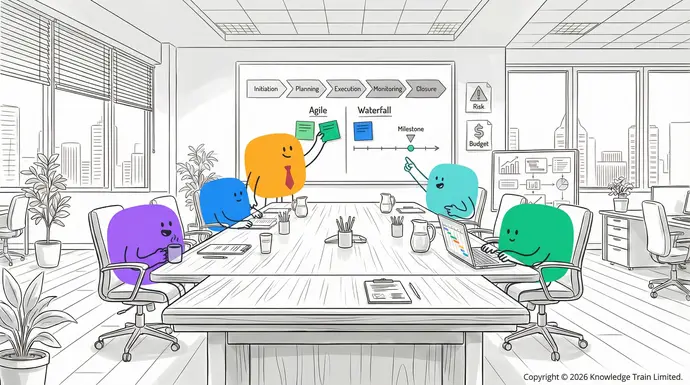
- AGILE BUSINESS ANALYSIS COURSESAgile methodology: Agile is an iterative, flexible approach emphasising collaboration, adaptability and rapid delivery; commonly used in software development and rapidly changing environments. Popular Agile frameworks such as Scrum are used by teams to deliver the products specified by the customer.
- Waterfall model: A sequential, linear process suited for projects with clear, fixed requirements, such as construction and manufacturing.
- Lean project management: Minimises waste and maximises value; ideal for manufacturing, service improvement, and efficiency-focused projects.
- Project Management Body of Knowledge (PMBOK): A set of standard terminology and guidelines from the Project Management Institute that covers all project management processes.
- PRINCE2: A highly structured methodology focussed on business justification, clear organisation and divided into manageable stages; widely adopted by UK public sector and internationally.
Project roles and responsibilities
Projects rely on well-defined roles and accountability:
- Project manager: Oversees planning, execution, monitoring, control and closing; manages risks, stakeholders, schedule, and budget.
- Stakeholders: Individuals or groups affected by the project or who can impact its outcome, such as clients, suppliers, and team members.
- Project team: Specialists responsible for delivering project tasks and deliverables.
- Project sponsor: Provides financial resources and strategic guidance.
- Project board/steering committee: High-level governance and decision making.
Effective stakeholder management and clear team communication are essential for project success. The project manager must align interests, resolve conflicts, and support collaborative team dynamics.
Essential project management skills
The skills required by project managers are varied.
| Skill | Description |
|---|---|
| Leadership | Inspiring and guiding teams towards common goals. |
| Communication | Conveying information clearly among stakeholders and team members. |
| Risk management | Identifying, analysing, and mitigating risks. |
| Scheduling | Planning timelines and managing deadlines using tools like Gantt charts and CPM. |
| Budgeting | Estimating, allocating, and controlling project finances. |
| Scope management | Defining and controlling what is included and excluded in the project. |
| Resource allocation | Assigning people, equipment and budget where needed. |
| Problem solving | Overcoming obstacles and finding effective solutions. |
| Negotiation | Reaching agreement among parties to resolve issues. |
| Critical thinking | Evaluating situations and implications for decision making. |
Project management tools & techniques
- Project management software: (e.g., Microsoft Project, Asana, Trello) aids collaboration, scheduling, task assignment, budgeting, and document management.
- Gantt chart: Visual timeline for planning and tracking progress.
- Work Breakdown Structure (WBS): Divides project into manageable sections.
- Critical Path Method (CPM): Identifies sequence of crucial tasks that determine project duration.
- Project portfolio management: Prioritising, balancing, and overseeing multiple projects aligning with organisational strategy.
Comparing project, programme, product management
- Project management: Focuses on delivering a unique, timebound outcome.
- Programme management: Oversees a group of related projects aligned to strategic objectives.Select your preferred training course below:
- Product management : Manages the lifecycle, strategy and development of a product.BUSINESS ANALYSIS QUALIFICATIONS
- Operations managementSelect your preferred qualification.: Manages ongoing processes for continuous delivery of products or services.
Best practicesBCS BUSINESS ANALYSIS COURSES
- PMBOKSelect your preferred training course below: ( Project Management Body of KnowledgeAGILE BUSINESS ANALYSIS COURSES): Comprehensive global standard for project management processes.Select your preferred training course below:
- PRINCE2 : Process-based methodology emphasising control and organisation.CHANGE MANAGEMENT QUALIFICATIONS
- Best practicesSelect your preferred qualification.: Align with global standards, stakeholder engagement, clear documentation, regular reviews, and continuous improvement.
Refer to the APMG CHANGE MANAGEMENT COURSESProject Management InstituteSelect your preferred training course below: and other authoritative sourcesPROGRAMME MANAGEMENT QUALIFICATIONS for further study.Select your preferred qualification.
Project management certifications
Professional MSP COURSEScertificationsSelect your preferred training course below: validate project management knowledge and competence:
- PMPPMI COURSES (Project Management Professional), Select your preferred training course below:CAPM (Certified Associate in Project Management) from PMI COURSESPMISelect your preferred training course below:
- Foundation and PRINCE2 COURSESPractitionerSelect your preferred training course below: level PRINCE2 certificationsAPM COURSES and Select your preferred training course below:PRINCE2 Agile certifications .AGILE PROJECT MANAGEMENT COURSES
- FoundationSelect your preferred training course below: and PractitionerPRINCE2 AGILE COURSES level Select your preferred training course below:AgilePM certifications from APMGBUSINESS CASE COURSES
Certifications are valued globally and support career advancement.Select your preferred training course below:
Project management career path
Career progressionAGILE COURSES often starts with project coordinator or assistant roles, advancing to project manager, senior project manager, programme manager, and portfolio manager positions. Skilled practitioners are in high demand in industries such as Select your self-paced training course topic.IT
Select your preferred training course below:PRINCE2, AgilePM or CAPM. Practical experience and networking are valuable for career advancement.
What are effective project management tools?
Popular tools include PROGRAMME MANAGEMENT COURSESproject management softwareSelect your self-paced training course topic.