
What is project management?
Project management is the application of knowledge, skills, tools, and techniques to project activities to meet project requirements (source: Project Management InstituteCopied!). It is structured around five core phases: Key takeawaysInitiating, Planning, Executing, Monitoring and Controlling,Different change models suit different scales of change and different human impacts. and Use Lewin’s three stages to frame straightforward organisational change from start to stabilisation.ClosingApply Kotter’s eight steps when coordinating large, complex transformation programmes..Use Senge’s systems view to understand how change spreads and affects individual staff over time.
Project managementBorrow Satir and Kubler Ross to anticipate emotional responses and reduce disruption during change. is a structured approach that guides a team or organisation in planning and controlling activities to achieve defined objectives and deliverables within agreed constraints of scope, schedule, cost and quality. A Use ADKAR to diagnose and build individual readiness through Awareness, Desire, Knowledge, Ability, and Reinforcement.projectApply McKinsey 7-S to align key organisational elements and track progress and issues clearly. is a temporary endeavour with a specific goal, differing from routine operations. Project management ensures successful delivery through systematic processes and best practices.
Project life cycle phases
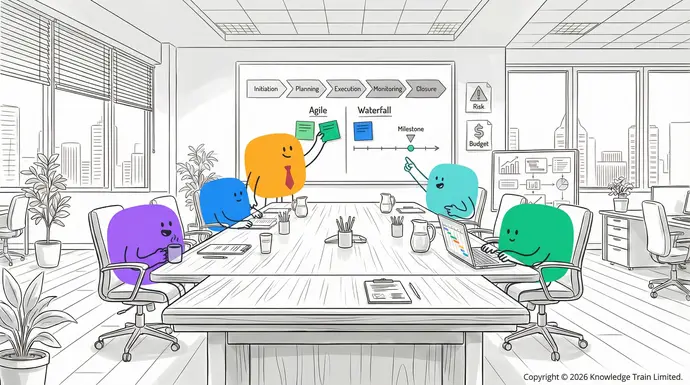
The project life cycleContents generally comprises five standard process groups:
- Initiating : Defining the project at a broad level, setting Contentsbusiness case , and identifying stakeholders.Introduction
- Planning : Establishing the scope, objectives, detailed schedule, risk management plan, budget, deliverables, and resource allocation.Lewin change model
- Executing : Coordinating people and resources, as well as meeting established milestones and deliverables.Kotter change model
- Monitoring and controlling : Tracking, reviewing, and regulating progress and performance, managing changes, and ensuring project stays on schedule and within scope.Peter Senge model
- Closing : Finalising all activities, handing over deliverables to the user/customer, releasing resources, and capturing Satir change modellessons learned .ADKAR model
Project management methodologies & frameworks
Multiple methodologies and models structure how McKinsey 7-S modelprojects are managed:Kubler Ross change curve
- Agile methodologyIntroduction: Some Agilechange management is an iterative, flexible approach emphasising collaboration, adaptability and rapid delivery; commonly used in software development and rapidly changing environments. Popular Agile frameworks such as models can be used to analyse change on an enterprise level. Others are best suited to understanding how change affects individual members of staff.ScrumBelow, we have information on some of the most popular are used by teams to deliver the products specified by the customer.change models
- Waterfall model. Click to see colourful infographics of each model.: A sequential, linear process suited for projects with clear, fixed requirements, such as construction and manufacturing.Lewin change model
- Lean project managementDeveloped by Kurt Lewin in the 19040’s, this model remains a cornerstone of : Minimises waste and maximises value; ideal for manufacturing, service improvement, and efficiency-focused projects.organisational change
- Project Management Body of Knowledge (PMBOK) – using a simple 3-step method to successfully implement change in organisations both large and small.: A set of standard terminology and guidelines from the Read more and see a colourful infographic about the Project Management InstituteLewin change management model that covers all here.project management processesEnhance your skills with our expert-led courses.
- PRINCE2 : A highly structured methodology focussed on business justification, clear organisation and divided into manageable stages; widely adopted by UK public sector and internationally.
Project roles and responsibilitiesInstructor-led
Projects rely on well-defined roles and accountability:Change Management Practitioner (with Foundation) course
- Project manager : Oversees planning, execution, monitoring, control and closing; manages risks, stakeholders, schedule, and budget.£1,699 +vat
- Stakeholders : Individuals or groups affected by the project or who can impact its outcome, such as clients, suppliers, and team members.See all dates
- Project team : Specialists responsible for delivering project tasks and deliverables.
- Project sponsor : Provides financial resources and strategic guidance.Self-paced
- Project board/steering committeeChange Management Practitioner (with Foundation) self-paced online: High-level governance and decision making.
Effective stakeholder management and clear team communication are essential for project success. The project manager must align interests, resolve conflicts, and support collaborative team dynamics.£1,299 +vat
Essential project management skills
The skills required by project managers are varied.Self-paced
| SkillChange Management Foundation self-paced online | Description |
|---|---|
| Leadership£799 +vat | Inspiring and guiding teams towards common goals.Kotter change model |
| CommunicationKotter’s 8-step model is suitable for large change initiatives in complex organisations. Kotter expanded on the work of Kurt Lewin to develop a more complex, more intricate model for the | Conveying information clearly among stakeholders and team members.management of change |
| Risk management. | Identifying, analysing, and mitigating risks.Read more and see a colourful infographic about the |
| SchedulingKotter change management model | Planning timelines and managing deadlines using tools like Gantt charts and CPM. here. |
| BudgetingPeter Senge model | Estimating, allocating, and controlling project finances.Peter Senge |
| Scope management looked at change in terms of biological and ecological metaphors. Using this perspective, he developed a robust model for the management of change, particularly regarding the effect on individual members of staff. | Defining and controlling what is included and excluded in the project.Read more and see a colourful infographic about the |
| Resource allocationSenge change management model | Assigning people, equipment and budget where needed. here. |
| Problem solvingSatir change model | Overcoming obstacles and finding effective solutions.Virginia Satir was an author and therapist. Satir’s model was made to help therapists understand the human response to death and trauma. Interestingly, this model was quickly appropriated by quick-thinking change managers and repurposed to help reduce the impact of change on businesses. |
| NegotiationRead more and see a colourful infographic about the | Reaching agreement among parties to resolve issues.Satir change model |
| Critical thinking here. | Evaluating situations and implications for decision making.ADKAR model |
Project management tools & techniquesThe ADKAR model breaks change into 5 component elements — Awareness, Desire, Knowledge, Ability, and Reinforcement. The ADKAR model is also a key element of the Prosci change management methodology.
- Project management softwareRead more and see a colourful infographic about the : (e.g., Microsoft Project, Asana, Trello) aids collaboration, scheduling, task assignment, budgeting, and document management.ADKAR model
- Gantt chart here.: Visual timeline for planning and tracking progress.Enhance your skills with our expert-led courses
- Work Breakdown Structure (WBS) : Divides project into manageable sections.
- Critical Path Method (CPM) : Identifies sequence of crucial tasks that determine project duration.Instructor-led
- Project portfolio managementChange Management Practitioner (with Foundation) course: Prioritising, balancing, and overseeing multiple projects£1,699 +vat aligning with organisational strategy.
Comparing project, programme, product managementSee all dates
- Project management : Focuses on delivering a unique, timebound outcome.
- Programme management : Oversees a group of related projects aligned to strategic objectives.Self-paced
- Product managementChange Management Practitioner (with Foundation) self-paced online: Manages the lifecycle, strategy and development of a product.
- Operations management£1,299 +vat: Manages ongoing processes for continuous delivery of products or services.
Best practices
- PMBOK (Self-pacedProject Management Body of KnowledgeChange Management Foundation self-paced online): Comprehensive global standard for project management processes.
- PRINCE2£799 +vat: Process-based methodology emphasising control and organisation.McKinsey 7-S model
- Best practicesThe McKinsey 7-S model is a technique used by change managers and business analysts alike. Based on academic research and practical experience, the McKinsey model helps change managers coordinate change : Align with global standards, stakeholder engagement, clear documentation, regular reviews, and continuous improvement.programmes
Refer to the , tracking their progress, resolve issues, and facilitate transparent, effective communication.Project Management InstituteRead more about the and McKinsey 7-S modelother authoritative sources here. for further study.Kubler Ross change curve
Project management certificationsAnother odd accompaniment to the change managers’ arsenal, the Kubler Ross curve, was designed to model the human reaction to loss and grief. Once again, change managers saw this as a good way to understand the impact of business change on human lives and appropriated the model for their own use.
Professional Read more and see a colourful infographic about the certificationsKubler Ross change curve validate project management knowledge and competence: here.
- PMPSubscribe to our exclusive offers and promotions (Project Management Professional), CAPM (Certified Associate in Project Management) from PMI
- Foundation and Practitioner level