BUSINESS ANALYSIS
BCS Business AnalysisSearchBusiness Analysis Foundation Learn the fundamentals of business analysis. Modelling Business Processes Gain practitioner certificate in modelling business processes. Business Analysis Practices Gain practitioner certificate in business analysis practices.United KingdomRequirements Engineering AustriaBelgiumBulgariaCroatia
CyprusCzech RepublicDenmark
Estonia
FinlandFrance
ItalyLatviaLithuaniaLuxemburg
MaltaAPMG Change ManagementNetherlandsFoundation PolandLearn the fundamentals of enterprise change management.
PortugalPractitioner RomaniaIncludes Foundation & Practitioner combined option.SlovakiaPROGRAMME MANAGEMENT
MSPSlovenia®SpainFoundation Sweden
Learn the fundamentals of programme management.Other countriesPractitioner HomeIncludes Foundation & Practitioner combined option.Agile
INFORMATION TECHNOLOGY (IT)Agile Project ManagementITILAgile Project Management Course®MOSCoW prioritisation
Foundation Learn the fundamentals of ITIL service management.{"@context":"http://schema.org","@type":"BreadcrumbList","itemListElement":[{"@type":"ListItem","position":1,"name":"Home","item":"https://www.knowledgetrain.co.uk/"},{"@type":"ListItem","position":2,"name":"Agile","item":"https://www.knowledgetrain.co.uk/agile"},{"@type":"ListItem","position":3,"name":"Agile Project Management","item":"https://www.knowledgetrain.co.uk/agile/agile-project-management"},{"@type":"ListItem","position":4,"name":"Agile Project Management Course","item":"https://www.knowledgetrain.co.uk/agile/agile-project-management/agile-project-management-course"},{"@type":"ListItem","position":5,"name":"MOSCoW prioritisation","item":"https://www.knowledgetrain.co.uk/agile/agile-project-management/agile-project-management-course/moscow-prioritisation"}]}Strategist DPI
3-day ITIL Strategist: Direct, Plan & Improve (DPI) course. Specialist: DSV 3-day ITIL Specialist: Drive Stakeholder Value (DSV) course.MoSCoW prioritisation method
Specialist: CDS 3-day ITIL Specialist: Create, Deliver and Support (CDS) course.Simon BuehringIT Learning Library (ITLL)™19 Feb 2026
BUSINESS LEARNING LIBRARY (BLL)™ Agile Learning Library (ALL)™ Business Analysis Learning Library (BALL)™
Compliance Learning Library (CLL)™ IT Learning Library (ITLL)™
PRINCE2 COURSESspan style="display: inline-block; width: 0px; overflow: hidden; line-height: 0;" data-mce-type="bookmark" class="mce_SELRES_start">
Select your preferred training course below:> The three pillars of sustainable project management APM COURSESSustainable project management is built upon three key pillars: environmental, social, and economic sustainability. These pillars work together to create a holistic approach to project management that benefits people, planet, and profit.
Select your preferred training course below: 1. Environmental sustainabilityCopied! Environmental sustainability is the first pillar of sustainable project management, which focuses on reducing negative impacts on the environment. This includes:Key takeawaysAGILE PROJECT MANAGEMENT COURSES Reducing carbon footprintMoSCoW helps teams make clear trade-offs so the most valuable work is delivered first.
Select your preferred training course below: : MoSCoW categorises requirements into Must, Should, Could, and Won’t to create shared priorities. ProjectsFocusing on Must items reduces risk by protecting the minimum needed for success.PRINCE2 AGILE COURSES should aim to minimise their greenhouse gas emissions throughout their lifecycle, which can be achieved with energy-efficient technologies, optimising transportation and logistics, and implementing renewable energy sources.Should and Could items provide flexibility when time, budget, or resources tighten.
Select your preferred training course below: Resource conservationWon’t items prevent scope creep by explicitly deferring low value work. : Efficient use of natural resources is crucial, and project managers should consider using recycled or sustainable materials, implementing water conservation measures, and designing products for longevity and reusability.Running a workshop with post-it notes and tracking outcomes on a Kanban board keeps alignment high.BETTER BUSINESS CASES COURSES Waste reduction
Select your preferred training course below: : Minimising waste generation and promoting a circular economy. This can be achieved by implementing recycling and composting programs, adopting lean manufacturing processes, and designing products for easy disassembly and recycling. 2. Social sustainability P3O COURSESSocial sustainability is the second pillar of sustainable project management, which ensures Copied!Contents
Select your preferred training course below:projectsKey takeaways have a positive impact on people and communities. This includes:DSDM is an agile framework that blends iterative delivery with built-in project management discipline. WORKSHOPSStakeholder engagementKeep decisions anchored to the business case by prioritising with MoSCoW and delivering within fixed timeboxes.Contents
Select your preferred workshop below:: Involving all affected parties in the decision-making processes by conducting thorough stakeholder analysis, implementing transparent communication channels, and addressing concerns and incorporating feedback.Build one collaborative team by involving business, technical staff and stakeholders throughout via workshops and empowered roles. Ethical labour practicesFix quality expectations early and protect them with continuous testing and frequent reviews.IntroductionAGILE QUALIFICATIONS: Ensuring fair treatment of workers throughout the project and supply chain. This includes fair wages and working conditions, diversity and inclusion initiatives, and training and development opportunities.Agree firm foundations upfront, then deliver increments that are regularly revalidated against viability and feedback.
Select your preferred qualification.CommunityMaintain control through clear communication, visible plans and progress measured by outcomes delivered, not activity.What is MoSCoW prioritisation? AGILE PROJECT MANAGEMENT COURSESimpact Why should I use it?
Select your preferred training course below:: Creating positive outcomes for local communities by supporting local economies and job creation, respecting cultural heritage and traditions, and contributing to community development initiatives. 3. Economic sustainabilityContentsHow to use itPRINCE2 AGILE COURSESDefinition: It means to make an organisation’s current activities do well in the long term. It also helps to create values in an environment that can continue in the long run. The main things included in economic sustainability are as follows:
Select your preferred training course below:Long-term financial viability Summary : Projects should aim to create lasting economic benefits and financial viability. This involves conducting a cost-benefit analysis, considering lifecycle costs and returns on investment, and aligning projects with organisational strategic goals.ContentsIntroductionSCRUM COURSESCost-effective solutions Read this article to learn more about the MoSCoW method and how to use it.
Select your preferred training course below:: Implementing efficient resource allocation and management. This can include adopting innovative technologies and processes, optimising supply chain management, and implementing effective project control measures.IntroductionWhat is MoSCoW prioritisation? Risk management MoSCoW analysis is a prioritisation technique commonly used on agile projects. It stands for: AGILE BUSINESS ANALYSIS COURSES: Identifying and mitigating potential economic risks. This involves conducting a comprehensive risk assessment, developing contingency plans, and implementing robust monitoring and control systems.DSDM (Dynamic Systems Development Method) - an agile methodM
Select your preferred training course below:By embracing these three pillars, ust project managersDSDM principles - the building blocksSBUSINESS ANALYSIS QUALIFICATIONS can establish a solid foundation for sustainability that not only benefits stakeholders but also safeguards the environment and ensures long-term economic viability. hould
Select your preferred qualification.Enhance your skills with our expert-led coursesThe 8 DSDM principlesC ould BCS BUSINESS ANALYSIS COURSES SummaryW
Select your preferred training course below: on’t. MoSCoW analysis helps teams understand which requirements or tasks they should focus on. MoSCoW was invented by Oracle employee Dai Clegg in 1994 and is the most common prioritisation technique used on agile projects. Self-pacedFAQsThough the MoSCoW method is often used to prioritise customer’s requirements on AGILE BUSINESS ANALYSIS COURSESAPM PFQ blended onlineIntroductionprojects
Select your preferred training course below: Learn the 8 DSDM principles and ensure they stick in your mind with this handy graphic and article. Ideal if you are working on DSDM projects at the moment or taking an , it can also be used outside of projects. For example, to prioritise business as usual work within an organisations or to prioritise jobs to do at home in your personal life. £749 +vatAgilePM courseIf you’re learning about CHANGE MANAGEMENT QUALIFICATIONS .agile project management
Select your preferred qualification. That’s because the Agile PM certification scheme is based upon the DSDM framework. So, by attending an on an Agile Project Management courseAgile PM courseAPMG CHANGE MANAGEMENT COURSESSelf-paced (Agile PM course) you will essentially be learning about DSDM., MoSCoW is one of the key agile techniques which you will learn.
Select your preferred training course below:PRINCE2 Agile Practitioner (with Foundation) self-paced onlineDSDM (Dynamic Systems Development Method) – an agile methodEnhance your skills with our expert-led courses DSDM (Dynamic Systems Development Method) is an iterative agile framework which was originally developed to deliver software projects iteratively, and in a more efficient way. DSDM is sometimes referred to as DSDM Atern. PROGRAMME MANAGEMENT QUALIFICATIONS£1,399 +vatDSDM became the first agile framework to incorporate agile project management aspects. Compared with
Select your preferred qualification. Scrum which focuses solely on product delivery during an iteration, DSDM also has built-in project management capabililties. DSDM therefore is quite different from other agile frameworks.Instructor-ledMSP COURSES DSDM is not only useful on software projectsAgilePM Practitioner (with Foundation) course
Select your preferred training course below:Self-pacedDSDM can be applied to AgilePM Practitioner (with Foundation) self-paced onlineprojects£1,699 +vatPMI COURSES other than software projects. It can also be applied on any product development projects. By delivering a workable product incrementally at the end of each timebox, DSDM can deliver business value early in the product development lifecycle.
Select your preferred training course below:£1,299 +vatDSDM provides agile project managementSee all dates Implementing sustainability in project management processesIn the UK, the Agile Business Consortium worked in partnership with APMG International to create Agile Project Management (AgilePM), an agile project management certification scheme with exams. agileKRC offers both classroom training in AgilePM, as well as e-learning solutions. Both training options include the PMI COURSESEnsuring sustainability within AgilePM exam
Select your preferred training course below:project management. processes demands a structured approach throughout every stage of the project life cycle. This section provides detailed guidelines for the integration of sustainability in the project management process.Enhance your skills with our expert-led coursesSelf-pacedProject initiation AgilePM Practitioner (with Foundation) self-paced online
Sustainability goals in project charter The project charter is a foundational document that guides the integration of sustainability. While developing the project charter, clearly define specific, quantifiable sustainability objectives that align with the overall strategy of the organisation. Identify and allocate resources specifically for sustainability efforts to ensure their effective execution. £1,299 +vatFor instance, a sustainability goal could be “Achieve a 25% reduction in carbon emissions associated with the project compared to previous similar projects”.Instructor-led
Stakeholder analysis and engagementAgilePM Practitioner (with Foundation) course Identifying and engaging stakeholders is a key aspect of sustainability in project management. This involves conducting a stakeholder analysis to identify their sustainability concerns and expectations and developing a stakeholder engagement plan that addresses these issues. The engagement plan should also include communication channels for stakeholders to provide input on sustainability considerations throughout the project lifecycle. Planning£1,699 +vatInstructor-led
Sustainable procurement strategies AgilePM Foundation courseLook for opportunities to incorporate sustainability into procurement processes. Develop sustainability criteria for supplier selection and evaluation and consider life cycle costing in procurement decisions. Work collaboratively with suppliers to enhance sustainability performance throughout the supply chain. These strategies can help you to achieve more resilient and sustainable project outcomes.See all dates Risk assessment for sustainability factors £1,299 +vat
Identify and plan for risks related to sustainability factors. Perform a sustainability-focused risk assessment and develop mitigation strategies for identified risks. Integrate these sustainability risks into your overall risk management plan. For example, if your project is in an area prone to drought, assess the risk of water scarcity and plan for potential impacts on project operations. Execution See all datesMonitoring sustainability metricsSelf-pacedWhy should I use it?
AgilePM Practitioner (with Foundation) self-paced onlineMoSCoW prioritisation is a highly effective way for a project team to prioritise its work. Focussing on the most important tasks means they can get the main components of the project finished quickly, before the fancy bits are added later. It keeps the entire team on the same page, ensuring everyone knows what is being worked on.£1,299 +vatUsing MoSCoW also means both customer and project team might decide that some requirements don’t even need to be there. It helps cut out unnecessary things and keeps things lean, agile and simple. MoSCoW analysis is one of the aspects of
agile that helps the team minimise wasted time, effort, resources and money. How to use it
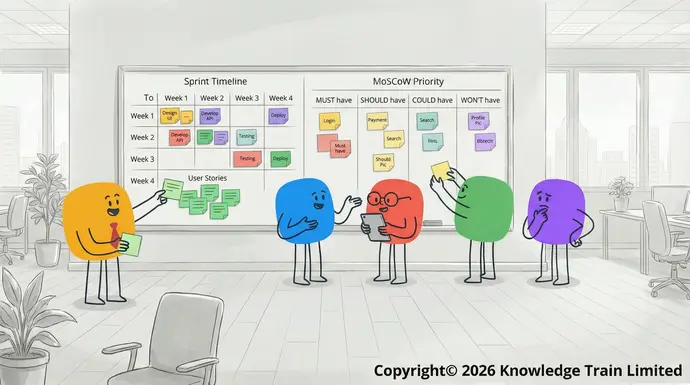
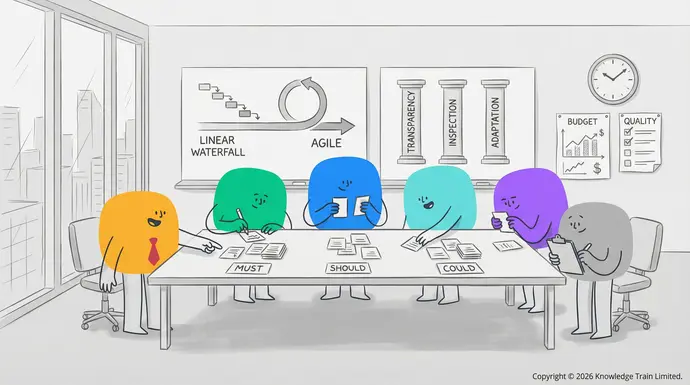
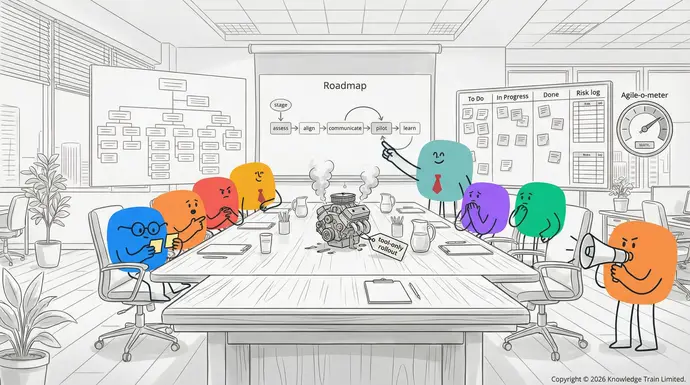
Instructor-ledthe MoSCoW prioritisation technique is simple to use. Firstly, you’ll need a list of the customer’s requirements. A great way to use MoSCoW is in a workshop with users. Brainstorm a list of requirements, writing each one on a post-it note and then apply MoSCoW.AgilePM Foundation courseIt is also commonly used during Scrum
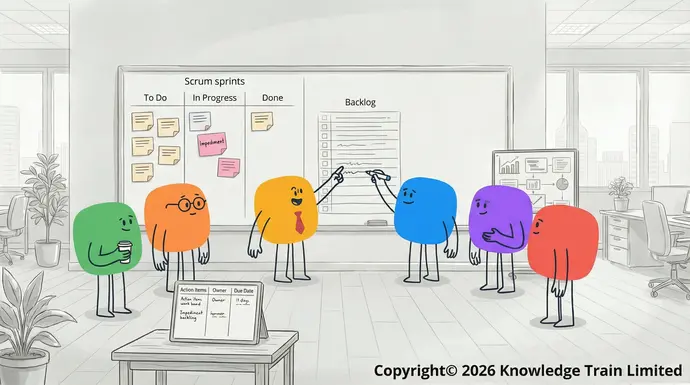
£1,299 +vat planning meetings to prioritise user storiesSee all dates for the next sprint.
DSDM principles – the building blocksSo, with your list of requirements, ask whether each requirement is one of the following:DSDM based upon principlesMustBased upon 8 principles and an underlying agile philosophy, DSDM became a popular agile approach amongst software developers seeking an alternative to rapid application development (RAD) approaches in the years after 2000. RAD approaches did not scale well for people collaborating on a team however. DSDM thus became one of the first agile approaches to be used within the software development community.A requirement which must be completed and is vital for the project’s success. Without this requirement, the project will likely fail.
ShouldWhilst these requirements are important, they can be delayed if time, resources or money are tight. They are not as time-critical as musts.Could
These requirements are not necessary, but they can be completed if there’s enough time.
MaltaAPMG Change ManagementNetherlandsFoundation PolandLearn the fundamentals of enterprise change management.
PortugalPractitioner RomaniaIncludes Foundation & Practitioner combined option.SlovakiaPROGRAMME MANAGEMENT
MSPSlovenia®SpainFoundation Sweden
Learn the fundamentals of programme management.Other countriesPractitioner HomeIncludes Foundation & Practitioner combined option.Agile
INFORMATION TECHNOLOGY (IT)Agile Project ManagementITILAgile Project Management Course®MOSCoW prioritisation
Foundation Learn the fundamentals of ITIL service management.{"@context":"http://schema.org","@type":"BreadcrumbList","itemListElement":[{"@type":"ListItem","position":1,"name":"Home","item":"https://www.knowledgetrain.co.uk/"},{"@type":"ListItem","position":2,"name":"Agile","item":"https://www.knowledgetrain.co.uk/agile"},{"@type":"ListItem","position":3,"name":"Agile Project Management","item":"https://www.knowledgetrain.co.uk/agile/agile-project-management"},{"@type":"ListItem","position":4,"name":"Agile Project Management Course","item":"https://www.knowledgetrain.co.uk/agile/agile-project-management/agile-project-management-course"},{"@type":"ListItem","position":5,"name":"MOSCoW prioritisation","item":"https://www.knowledgetrain.co.uk/agile/agile-project-management/agile-project-management-course/moscow-prioritisation"}]}Strategist DPI
3-day ITIL Strategist: Direct, Plan & Improve (DPI) course. Specialist: DSV 3-day ITIL Specialist: Drive Stakeholder Value (DSV) course.MoSCoW prioritisation method
Specialist: CDS 3-day ITIL Specialist: Create, Deliver and Support (CDS) course.Simon BuehringIT Learning Library (ITLL)™19 Feb 2026
BUSINESS LEARNING LIBRARY (BLL)™ Agile Learning Library (ALL)™ Business Analysis Learning Library (BALL)™
Compliance Learning Library (CLL)™ IT Learning Library (ITLL)™
PRINCE2 COURSESspan style="display: inline-block; width: 0px; overflow: hidden; line-height: 0;" data-mce-type="bookmark" class="mce_SELRES_start">
Select your preferred training course below:> The three pillars of sustainable project management APM COURSESSustainable project management is built upon three key pillars: environmental, social, and economic sustainability. These pillars work together to create a holistic approach to project management that benefits people, planet, and profit.
Select your preferred training course below: 1. Environmental sustainabilityCopied! Environmental sustainability is the first pillar of sustainable project management, which focuses on reducing negative impacts on the environment. This includes:Key takeawaysAGILE PROJECT MANAGEMENT COURSES Reducing carbon footprintMoSCoW helps teams make clear trade-offs so the most valuable work is delivered first.
Select your preferred training course below: : MoSCoW categorises requirements into Must, Should, Could, and Won’t to create shared priorities. ProjectsFocusing on Must items reduces risk by protecting the minimum needed for success.PRINCE2 AGILE COURSES should aim to minimise their greenhouse gas emissions throughout their lifecycle, which can be achieved with energy-efficient technologies, optimising transportation and logistics, and implementing renewable energy sources.Should and Could items provide flexibility when time, budget, or resources tighten.
Select your preferred training course below: Resource conservationWon’t items prevent scope creep by explicitly deferring low value work. : Efficient use of natural resources is crucial, and project managers should consider using recycled or sustainable materials, implementing water conservation measures, and designing products for longevity and reusability.Running a workshop with post-it notes and tracking outcomes on a Kanban board keeps alignment high.BETTER BUSINESS CASES COURSES Waste reduction
Select your preferred training course below: : Minimising waste generation and promoting a circular economy. This can be achieved by implementing recycling and composting programs, adopting lean manufacturing processes, and designing products for easy disassembly and recycling. 2. Social sustainability P3O COURSESSocial sustainability is the second pillar of sustainable project management, which ensures Copied!Contents
Select your preferred training course below:projectsKey takeaways have a positive impact on people and communities. This includes:DSDM is an agile framework that blends iterative delivery with built-in project management discipline. WORKSHOPSStakeholder engagementKeep decisions anchored to the business case by prioritising with MoSCoW and delivering within fixed timeboxes.Contents
Select your preferred workshop below:: Involving all affected parties in the decision-making processes by conducting thorough stakeholder analysis, implementing transparent communication channels, and addressing concerns and incorporating feedback.Build one collaborative team by involving business, technical staff and stakeholders throughout via workshops and empowered roles. Ethical labour practicesFix quality expectations early and protect them with continuous testing and frequent reviews.IntroductionAGILE QUALIFICATIONS: Ensuring fair treatment of workers throughout the project and supply chain. This includes fair wages and working conditions, diversity and inclusion initiatives, and training and development opportunities.Agree firm foundations upfront, then deliver increments that are regularly revalidated against viability and feedback.
Select your preferred qualification.CommunityMaintain control through clear communication, visible plans and progress measured by outcomes delivered, not activity.What is MoSCoW prioritisation? AGILE PROJECT MANAGEMENT COURSESimpact Why should I use it?
Select your preferred training course below:: Creating positive outcomes for local communities by supporting local economies and job creation, respecting cultural heritage and traditions, and contributing to community development initiatives. 3. Economic sustainabilityContentsHow to use itPRINCE2 AGILE COURSESDefinition: It means to make an organisation’s current activities do well in the long term. It also helps to create values in an environment that can continue in the long run. The main things included in economic sustainability are as follows:
Select your preferred training course below:Long-term financial viability Summary : Projects should aim to create lasting economic benefits and financial viability. This involves conducting a cost-benefit analysis, considering lifecycle costs and returns on investment, and aligning projects with organisational strategic goals.ContentsIntroductionSCRUM COURSESCost-effective solutions Read this article to learn more about the MoSCoW method and how to use it.
Select your preferred training course below:: Implementing efficient resource allocation and management. This can include adopting innovative technologies and processes, optimising supply chain management, and implementing effective project control measures.IntroductionWhat is MoSCoW prioritisation? Risk management MoSCoW analysis is a prioritisation technique commonly used on agile projects. It stands for: AGILE BUSINESS ANALYSIS COURSES: Identifying and mitigating potential economic risks. This involves conducting a comprehensive risk assessment, developing contingency plans, and implementing robust monitoring and control systems.DSDM (Dynamic Systems Development Method) - an agile methodM
Select your preferred training course below:By embracing these three pillars, ust project managersDSDM principles - the building blocksSBUSINESS ANALYSIS QUALIFICATIONS can establish a solid foundation for sustainability that not only benefits stakeholders but also safeguards the environment and ensures long-term economic viability. hould
Select your preferred qualification.Enhance your skills with our expert-led coursesThe 8 DSDM principlesC ould BCS BUSINESS ANALYSIS COURSES SummaryW
Select your preferred training course below: on’t. MoSCoW analysis helps teams understand which requirements or tasks they should focus on. MoSCoW was invented by Oracle employee Dai Clegg in 1994 and is the most common prioritisation technique used on agile projects. Self-pacedFAQsThough the MoSCoW method is often used to prioritise customer’s requirements on AGILE BUSINESS ANALYSIS COURSESAPM PFQ blended onlineIntroductionprojects
Select your preferred training course below: Learn the 8 DSDM principles and ensure they stick in your mind with this handy graphic and article. Ideal if you are working on DSDM projects at the moment or taking an , it can also be used outside of projects. For example, to prioritise business as usual work within an organisations or to prioritise jobs to do at home in your personal life. £749 +vatAgilePM courseIf you’re learning about CHANGE MANAGEMENT QUALIFICATIONS .agile project management
Select your preferred qualification. That’s because the Agile PM certification scheme is based upon the DSDM framework. So, by attending an on an Agile Project Management courseAgile PM courseAPMG CHANGE MANAGEMENT COURSESSelf-paced (Agile PM course) you will essentially be learning about DSDM., MoSCoW is one of the key agile techniques which you will learn.
Select your preferred training course below:PRINCE2 Agile Practitioner (with Foundation) self-paced onlineDSDM (Dynamic Systems Development Method) – an agile methodEnhance your skills with our expert-led courses DSDM (Dynamic Systems Development Method) is an iterative agile framework which was originally developed to deliver software projects iteratively, and in a more efficient way. DSDM is sometimes referred to as DSDM Atern. PROGRAMME MANAGEMENT QUALIFICATIONS£1,399 +vatDSDM became the first agile framework to incorporate agile project management aspects. Compared with
Select your preferred qualification. Scrum which focuses solely on product delivery during an iteration, DSDM also has built-in project management capabililties. DSDM therefore is quite different from other agile frameworks.Instructor-ledMSP COURSES DSDM is not only useful on software projectsAgilePM Practitioner (with Foundation) course
Select your preferred training course below:Self-pacedDSDM can be applied to AgilePM Practitioner (with Foundation) self-paced onlineprojects£1,699 +vatPMI COURSES other than software projects. It can also be applied on any product development projects. By delivering a workable product incrementally at the end of each timebox, DSDM can deliver business value early in the product development lifecycle.
Select your preferred training course below:£1,299 +vatDSDM provides agile project managementSee all dates Implementing sustainability in project management processesIn the UK, the Agile Business Consortium worked in partnership with APMG International to create Agile Project Management (AgilePM), an agile project management certification scheme with exams. agileKRC offers both classroom training in AgilePM, as well as e-learning solutions. Both training options include the PMI COURSESEnsuring sustainability within AgilePM exam
Select your preferred training course below:project management. processes demands a structured approach throughout every stage of the project life cycle. This section provides detailed guidelines for the integration of sustainability in the project management process.Enhance your skills with our expert-led coursesSelf-pacedProject initiation AgilePM Practitioner (with Foundation) self-paced online
Sustainability goals in project charter The project charter is a foundational document that guides the integration of sustainability. While developing the project charter, clearly define specific, quantifiable sustainability objectives that align with the overall strategy of the organisation. Identify and allocate resources specifically for sustainability efforts to ensure their effective execution. £1,299 +vatFor instance, a sustainability goal could be “Achieve a 25% reduction in carbon emissions associated with the project compared to previous similar projects”.Instructor-led
Stakeholder analysis and engagementAgilePM Practitioner (with Foundation) course Identifying and engaging stakeholders is a key aspect of sustainability in project management. This involves conducting a stakeholder analysis to identify their sustainability concerns and expectations and developing a stakeholder engagement plan that addresses these issues. The engagement plan should also include communication channels for stakeholders to provide input on sustainability considerations throughout the project lifecycle. Planning£1,699 +vatInstructor-led
Sustainable procurement strategies AgilePM Foundation courseLook for opportunities to incorporate sustainability into procurement processes. Develop sustainability criteria for supplier selection and evaluation and consider life cycle costing in procurement decisions. Work collaboratively with suppliers to enhance sustainability performance throughout the supply chain. These strategies can help you to achieve more resilient and sustainable project outcomes.See all dates Risk assessment for sustainability factors £1,299 +vat
Identify and plan for risks related to sustainability factors. Perform a sustainability-focused risk assessment and develop mitigation strategies for identified risks. Integrate these sustainability risks into your overall risk management plan. For example, if your project is in an area prone to drought, assess the risk of water scarcity and plan for potential impacts on project operations. Execution See all datesMonitoring sustainability metricsSelf-pacedWhy should I use it?
AgilePM Practitioner (with Foundation) self-paced onlineMoSCoW prioritisation is a highly effective way for a project team to prioritise its work. Focussing on the most important tasks means they can get the main components of the project finished quickly, before the fancy bits are added later. It keeps the entire team on the same page, ensuring everyone knows what is being worked on.£1,299 +vatUsing MoSCoW also means both customer and project team might decide that some requirements don’t even need to be there. It helps cut out unnecessary things and keeps things lean, agile and simple. MoSCoW analysis is one of the aspects of
agile that helps the team minimise wasted time, effort, resources and money. How to use it
Instructor-ledthe MoSCoW prioritisation technique is simple to use. Firstly, you’ll need a list of the customer’s requirements. A great way to use MoSCoW is in a workshop with users. Brainstorm a list of requirements, writing each one on a post-it note and then apply MoSCoW.AgilePM Foundation courseIt is also commonly used during Scrum
£1,299 +vat planning meetings to prioritise user storiesSee all dates for the next sprint.
DSDM principles – the building blocksSo, with your list of requirements, ask whether each requirement is one of the following:DSDM based upon principlesMustBased upon 8 principles and an underlying agile philosophy, DSDM became a popular agile approach amongst software developers seeking an alternative to rapid application development (RAD) approaches in the years after 2000. RAD approaches did not scale well for people collaborating on a team however. DSDM thus became one of the first agile approaches to be used within the software development community.A requirement which must be completed and is vital for the project’s success. Without this requirement, the project will likely fail.
ShouldWhilst these requirements are important, they can be delayed if time, resources or money are tight. They are not as time-critical as musts.Could
These requirements are not necessary, but they can be completed if there’s enough time.
The field of sustainable project management is likely to experience significant changes in the future.Emerging trends
Some of the key trends to look out for include:The integration of Artificial Intelligence
(AI) and other technologies for optimising resource allocation and predicting environmental impactsThe adoption of circular economy
principles as a standard approach to project design and implementation
A guide to project manager salaries: free ebook
Simon Buehring19 Feb 2026
Understand project manager salary scales with our free ebook. Discover what you could earn in various roles across the industry.
Interview with Madeleine Parsley Sevcan Yasa
19 Feb 2026 In this video, Madeleine Parsley describes how her career was helped by taking a PRINCE2 Foundation and Practitioner course with Knowledge Train.