Should I do PMP or Agile certification?

Key takeaways
Choose certification based on the environments and delivery constraints you expect to work in.
- Waterfall suits stable requirements, up front forecasting, and industries where change is costly.
- Agile suits uncertain requirements, frequent customer feedback, and incremental releases every few weeks.
- Most real projects are hybrid, blending predictive planning with iterative delivery and adaptation.
- PMP remains widely recognised and can carry extra weight due to stricter eligibility and exam difficulty.
- Holding both traditional and agile credentials can broaden roles, improve judgement, and strengthen marketability.
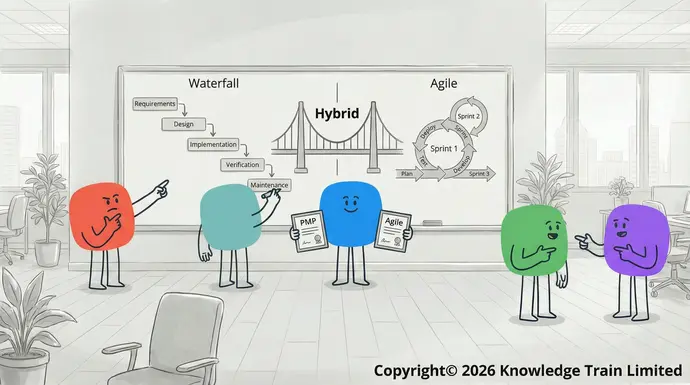
Introduction
For a long time, the only type of certification that carried with it an undisputed level of expertise has been traditional project management qualifications such as PRINCE2 or PMI. In the UK, Australia and Europe PRINCE2 has been the dominant qualification. In the USA and the rest of the world, PMI qualifications dominate.
This article is really aimed at people who are based outside of the UK, Europe and Australia who might be considering a PMI qualification.
In recent years, with the emergence of agile project management certifications, it can be difficult to choose which certification to obtain. This article seeks to answer this question.
Waterfall vs. Agile
To find which type of certification is best for you, you must first determine what kind of career you are seeking in the project management profession. Suffice to say that if you are considering the PMI-PMP® you have a few years of project management experience under your belt. So, what’s next?
Organizations choose either waterfall or Agile project management frameworks (see Agile vs Waterfall) based on which best suits their corporate culture, product development schemes, clients and a whole host of other factors.
The Project Management Professional (PMP)® syllabus is based largely on waterfall methods as described in the PMBoK® Guide, while the PMI Agile Certified Practitioner (ACP)® and other agile certifications are based on Agile principles.
What is waterfall?
Waterfall – sometimes referred to, broadly, as ‘traditional’ – project management involved a lengthy pre-planning process and follows a linear predetermined project schedule. While waterfall may have gained a bad name in some quarters, it actually has a lot of benefits:
- Waterfall projects are predictable, they have a definitive end-date and schedules can be easily built around this.
- It’s generally easier to create forecasts and predictions in waterfall projects because a lot of deadlines are made before development even starts.
- There are clear-cut, easily understood procedures that determine how tasks are planned, initiated, monitored, controlled and closed.
The advantages of the waterfall method make it ideal for certain industries that value the benefits it can bring. Waterfall methods are still used in the manufacturing industry where mid-project scope changes can be costly to the point that they are entirely unfeasible. Change to a project isn’t always desirable or practical, which is where to in-depth pre-planning of waterfall comes into its own.
Generally, businesses will use waterfall methods on their projects when:
- Repeating a similar type of project. Waterfall allows the easy re-use of old assets, making future repetitions much more cost-effective.
- Requirements are well-known at the start and are unlikely to change.
- It is necessary to deliver an up-front estimate of scope and requirements. Useful for development teams that have a small budget or limited resources.
- You need to deliver an estimate of the costs involved. Useful for large projects that are expensive, stakeholders and investors generally want some assurance that their money isn’t going to waste.
There are some reasons however, that business may not want to use a waterfall approach such as:
- Requirements are uncertain and likely to change or evolve.
- Gathering and documenting requirements in a way that is useful to a customer is difficult. Customers don’t always understand the specific details, provided early in the project, which are required with this approach.
- Clients sometimes misunderstand the application of a product from a requirements document. Prototypes can help, but there’s no guarantee that customers will be satisfied with the final product, having assumed they were getting something different.
What is Agile?
Agile is an iterative approach that helps project development teams deliver the highest-value product possible to customers in a rapidly changing economic environment.
Agile works to avoid the age-old issue of products becoming obsolete mid-development. Agile projects generally have no defined ‘end-date’ as product owners can at any point say, “Releasing the product at this time will give us the greatest return on investments.”
Agile aims to be adaptive and flexible. The quality of the developed product never changes, but its’ scope and features can.
The primary difference is that Agile delivers new components to customers every 2-4 weeks rather than at the end of the project. This way, customers can provide continuous feedback that helps dictate what the team will do in the next iteration to make the product that much better.
Agile tends to be used most often in the software development and IT industry to help businesses be first to market with their new, innovative products and solutions, giving them a competitive edge.
Generally, agile will be used when businesses:
- Don’t have a good idea of what customers want in a product.
- Don’t know how long it will take to make a competitive product.
- Don’t know how much it will cost to make a product that will sell.
- Know that change will have to be made, but not when or how.
Agile generally won’t be used if:
- The high degree of required customer involvement is not feasible due to a lack of time or interest.
- There’s little to no room in the budget for additions to be made to the scope. Sometimes it may be necessary to extend the development of a product. If there’s no room in the budget for error or scope-growth, using agile methods risks failure.
- Development teams can’t easily communicate due to not working in the same space or time-zone.
The future of project management
Job security is important to consider in any career. Some may think that the ‘old’ waterfall is being replaced by ‘new’ agile frameworks, but that simply isn’t the case. Yes, agile is pushing out traditional methods in some industries (I.e. IT and software industries) but, it many others, agile simply isn’t well-suited to industry needs.
Additionally, many basic principles of waterfall such as decomposition, rolling wave planning, continuous improvement and process tailoring (to name just a few) are also used in Agile. Waterfall is alive and well and will never become totally obsolete, due largely to the use of ‘hybrid’ approaches. These take the best of both waterfall and agile frameworks, combining them into a blend of best-practices to suit whatever context or project presented.
So, whichever qualification you choose, know that it will remain relevant for a long time to come. Every accredited and recognized project management method such as those belonging to PMI and Agile approaches such as Scrum have teams of dedicated and experienced practitioners working around the clock to update their respective methodologies with the latest tools.
Hybrid approaches
It’s not uncommon for project managers to obtain their PMI-PMP® before an agile certification, due to the fact that it’s globally recognized and (thanks to the difficulty of the exam and strict eligibility requirements) carries a little more ‘weight’ than other certifications.
Bear in mind however, that very few contemporary project environments or strictly agile or waterfall. Even those industries that once relied solely on waterfall methods such as construction, aerospace, medical device manufacturing now incorporate some agile principles and tools, tailoring their development schemes to utilize a hybrid approach.
The project management profession
There’s no ‘right’ answer when it comes to project management certifications, they’re all valid. Having said that, outside of the UK, Europe and Australia, if you are eligible for a PMI-PMP® or PMI-ACP® certification, they’re likely to make you more marketable than others simply due to the law of scarcity – there aren’t a lot of PMI certified project managed around because not everyone makes the cut. This makes PMI qualification holders really stand out in a crowd.
There’s no harm in acquiring both a PMI-PMP® and Agile qualification. In fact, we’d recommend it. As you may have noticed, both agile and traditional methods have their own strengths and weaknesses. When used together however, the strengths of one can help ‘cancel out’ the weaknesses of the other and vice-versa.
This doesn’t just apply to the application of project management frameworks in product development, having a good understanding of both traditional and agile methods can help you determine and address your own weaknesses as a project manager!
In summary, start out with a PMI qualification if you’re eligible. Then go on a to acquire an agile certification. PMI offers the PMI-ACP® which is equally renowned. If you’d like something a little more practical, an Agile PM course or Scrum training course will teach you an applicable agile framework and practices as opposed to a general education in agile methods.