
IntroductionProjects are complex and involve an ever-changing web of relationships. Successful projects establish an effective project management team structure to navigate this complexity (hence the principle ‘define roles, responsibilities, and relationships’).
Jargon-freeThe project management team must represent the interests of 3
Written in a similar tone and style to her previous 2 books, Practical Project Stakeholder Management, and Practical Remote Team Leadership, her latest offering is a welcome change from many jargon-heavy texts about stakeholder groupsproject management: .business
This concise book is packed with many of the core concepts and subjects that Emanuela covers in her popular (the commissioning organization), short project management coursesuser. (the organization which will use the project’s products to realize benefits), and
Standards and approachessenior supplier
Sometimes though, the plethora of is accountable for the quality of the specialist products which it delivers to the project.project management approachesThe such as project managerPRINCE2 role is responsible for the day-to-day management of the project and reports progress on a regular basis to the project board. The project manager is responsible for keeping issues and risks under control, monitoring progress, taking corrective action when there is a slippage from the plan, and escalating exceptions to the project board., and standards such as the Team managersPMBOK Guide manage teams of specialists who have the requisite skills to enable them to design and build the products which have been specified by the customer. They are responsible for delivering the specialist products, on time and within the agreed tolerances. They report on a regular basis to the project manager. can be a source of frustration to many people who don’t necessarily want to go down the road of The professional certificationproject assurance. role assures the project board independently of the project manager that the project is being conducted properly. Project assurance gives advice to the project manager and reviews documents prior to their approval by the project board.
Right at the start of the book, the author explains that it is not the choice of The project management methodproject support which delivers project success. Often, project failures come about because the focus was on a scripted methodology, rather than understanding the spirit of the methodology. role assists the project manager and team managers with administration, writing reports, monitoring of progress and tools.
It is this insight which informs the remainder of the book.On commercial projects, a
– it is important to understand the organizational ecosystem that the products of the project and any remaining project team member.
One of the examples of the author’s real-world experience is her recommendation to use a clarifications log. This seeks to eliminate ambiguity with the aim of seeking clarity. Over the years, this has proven to be one of the author’s ‘best friends’ when managing projects. Although it is a very simple concept, like many of the tools and techniques she recommends in the book, it is effective.s will be transitioning into. The three key aspects the project board must consider are products, people, and learning.
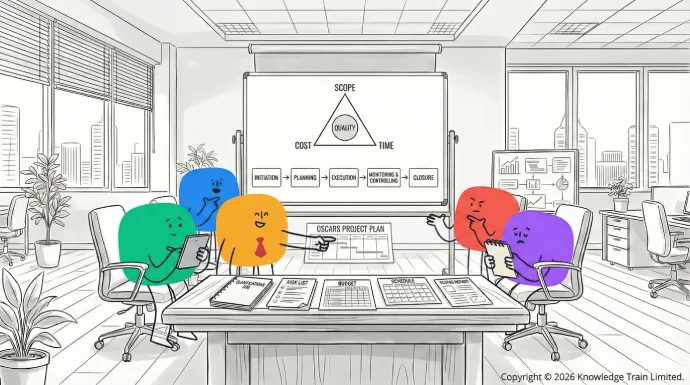
The book then moves on to explain the OSCARRSS (that’s her simple, sensible, scalable project plan). Knowing what to write into a Plansproject planThe is one of the greatest challenges that a purposeproject manager of this practice is to “to facilitate communication and control by defining: the products to be delivered (the ‘what’), and; the means to deliver them (the ‘who’, the ‘how’, the ‘where’, and estimates of the ‘when’ and for ‘how much’) to satisfy the project business case (the ‘why’)” [3]. needs to overcome on a project. This is covered in several chapters which explain how to set SMART objectives, how to define and prioritise scope, and clarify constraints and assumptions.Planning provides you with information about what is required, how to achieve it, by whom, when, and whether the targets for benefits, costs, time, quality, scope, sustainability, and risk are achievable. An approved plan forms a
Risk managementbaseline, stakeholder management and issue and against which progress will be measured.change managementIt is unrealistic to plan in detail too far into the future (beyond the are key aspects to any project, and these are covered in the book and all come with practical processes and templates.planning horizon
Remaining core elements of the project plan are covered, including how to make a realistic and achievable ). Plan in detail only until the end of the next stage. The division of the project into project schedulestages, and how to estimate and set a budget. The book then moves onto describing status reporting and how to track project progress and includes her 5 top tips for keeping a project on track. What to do when is determined by balancing the delivery method, sequence of activities, people and resources, key decision points, level of risk, and the time horizon. closing a projectStages is also covered. are sequential and form “stop-go” decision points for the project board. The work required to deliver one or more products in each stage are described in
The author finishes off the book with some practical advice about standardising on a project methodology. She includes her project management mantras based upon her own experience, and some pointers towards the key ‘work package description(s)soft-skills. They are used to pass responsibility for work formally to a team manager or member.’ which any project manager needs to be effective in their role.PRINCE2
As a quick and easy guide to recommends project management3 levels of plan to help you get up and running with your projects, this book is one of the best I have read. Free of jargon and with plenty of real-world examples, this book is a must-have addition to the toolkit of any aspiring or experienced to meet the needs of the 3 levels management:project managerproject plan. (used by the project board): a high-level plan containing project-level costs, timescales, and control points, updated at each stage end to reflect progress.