
Projects, programmes, and portfoliosPROGRAMME MANAGEMENT COURSES
Projects and programmes are the foundations of portfoliosSelect your self-paced training course topic.
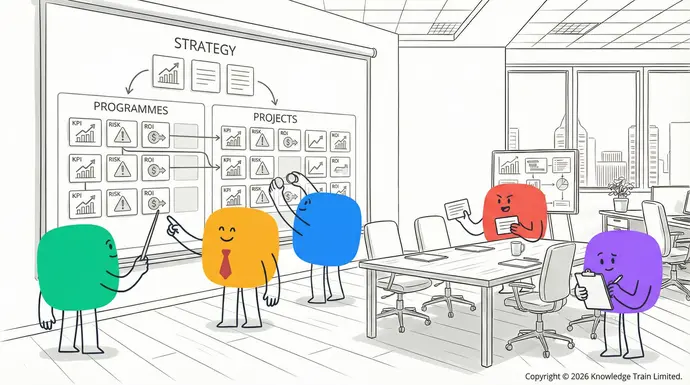
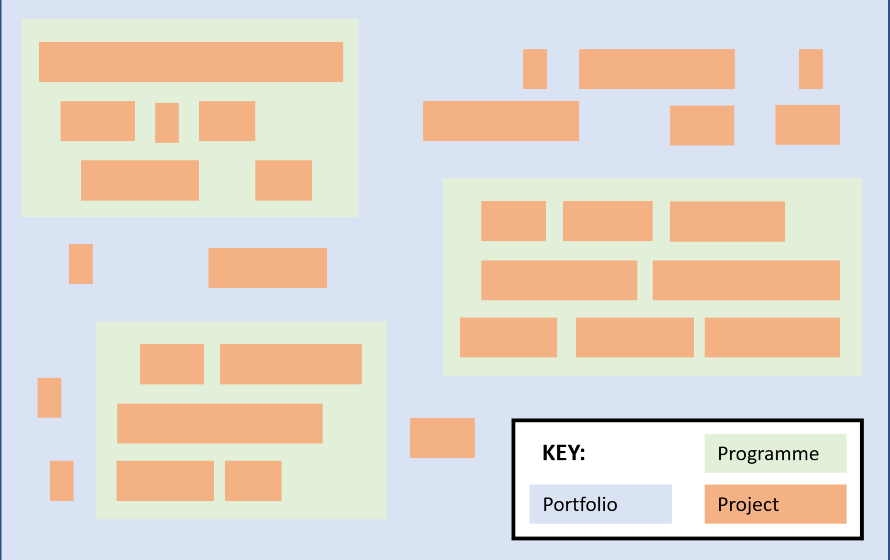
Programmes and MSP COURSESprojectsSelect your preferred training course below: serve as the foundational elements of portfoliosIT QUALIFICATIONS. Each programme or project integrated within a portfolio should be in sync with the organization’s strategic objectives. The cumulative performance of these programmes and projects is the yardstick for evaluating the portfolio’s success. Through the delivery of their distinct outputs (projects) and outcomes (programmes), they actively contribute to the realization of the strategic goals encapsulated within the portfolio.Select your preferred qualification.
Striking a balance between projects, programmes, and portfolios
Striking a balance and aligning projects, programmes, and portfolios is a strategic endeavour that guarantees the collective contribution of all initiatives toward the overarching business objectives. This entails the routinely assessing the portfolio and making requisite adaptations in response to shifts in business strategy, project performance, or the availability of resources.ITIL COURSES
Effective alignment and balance serve as key enablers for the optimal utilization of resources, the comprehensive management of risks at every level, and the organization’s ability to flexibly adapt to evolving circumstances while remaining steadfast on the path to achieving its strategic objectives.Select your preferred training course below:
Effective management of portfolios
Essential skills for portfolio managersIT QUALIFICATIONS
Effective management of portfolios requires a range of skills including:Select your preferred qualification.
- Strategic thinking to align initiatives with business strategy.
- Leadership to inspire and guide.ITIL COURSES
- Risk managementSelect your preferred training course below: to anticipate and mitigate risks across the portfolio.
- Communication skills to deliver clear, timely information to stakeholders at the highest levels in the organization.LEARNING LIBRARIES
- Soft skills such as negotiation, prioritization, the ability to see the bigger picture, as well as many other skills.Select your preferred training course topic.
Proficient portfolio managementAI QUALIFICATIONS & WORKSHOPS necessitates a diverse set of skills, including the ones below.Select your preferred qualification or workshop.
Strategic thinking
The capability to align initiatives with the organization’s overarching business strategy.AIPGF COURSES
LeadershipSelect your preferred training course below:
The capacity to inspire and provide guidance, driving initiatives toward success.
Communication skillsBCS AI COURSES
The ability to convey clear and timely information to stakeholders at the highest echelons of the organization.Select your preferred training course below:
Soft skills
This includes competencies like negotiation, prioritization, the aptitude to perceive the broader perspective, and a myriad of other skills that contribute to effective portfolio management.AIPGF COURSES
Risk managementSelect your preferred training course below:
The skill to anticipate and proactively mitigate risks spanning the entire portfolio.
Governance in portfolio management
Robust governance is indispensable for the effective management of portfolios. This entails several key components including the ones below.
Defining clear roles and responsibilities
Establishing unambiguous roles and responsibilities for portfolio management team members and stakeholders.
Project management office (PMO)
In recent years, progressively mature organizations have made significant investments in establishing Project Management Offices (PMOs) not only at the project level but also at the programme and portfolio levels.Staff development
PMOs offer a host of advantages to organizations, including the following:Compliance training
Standardization and consistencyApprenticeship training
Ensuring uniformity and consistency in project and Custom e-Learning developmentprogramme management practices.
Improved governanceFind out more
Enhancing oversight, control, and compliance with regulations and standards.
Resource optimization
Efficiently allocating and managing resources across various initiatives.
Knowledge management
Facilitating the capture, sharing, and application of knowledge and best practices.
Strategic alignmentCONTACT US
Ensuring that projects and programmes align with the overarching strategic goals of the organization.
Many of these organizations have adopted the best practice framework for Portfolio, Programme, and Project Offices ( P3O ® ) to support the successful delivery of their portfolio of change initiatives and projects, leveraging standardized and effective PMO practices.
Digital transformationName
Technology in management
The advent of digital transformation has significantly improved the coordination and collaboration in the management of portfolios, programmes, and projects. The utilization of project management softwareEmail, collaborative platforms, and cloud-based tools empowers real-time progress tracking, efficient resource allocation, and fosters enhanced communication among team members.
These innovative tools streamline the management of interdependencies, enhance decision-making processes, and enable seamless teamwork, irrespective of team members’ geographical locations.
Data-driven decision-makingPhone
Digital transformation has ushered in increased data accessibility, making it easier to embrace data-driven decision-making in portfolio, programme, and project management . Cutting-edge analytics and visualization tools empower managers to evaluate performance, detect trends, forecast potential risks, and arrive at well-informed decisions.How can we help?
Furthermore, machine learning and artificial intelligence algorithms offer insights and recommendations that elevate strategic decision-making within portfolios and enhance operational decision-making within projects and programmes.
Automation
Digital transformation has introduced automation to a multitude of management processes, resulting in heightened efficiency and precision. Activities like updating project statuses, monitoring alterations, scheduling meetings, or allocating resources can now be automated, liberating managers to concentrate on strategic matters.Submit
Moreover, digital platforms enable the efficient documentation and dissemination of knowledge, fostering a culture of learning and continuous improvement in portfolio, programme, and project management .OUR VALUES
Resource optimization
nagement across multiple projects and programmes, reducing redundancy and maximizing utilization.Business analysis aligns strategic goals with delivery by bridging stakeholders and technical teams.
Risk ManagementClear requirements and validation reduce project risk and improve solution fit, cost and feasibility.
By managing interdependencies across projects and programmes, they mitigate risks that may not be apparent at the project level.Techniques like SWOT, gap analysis, process modelling and data analysis expose opportunities and bottlenecks.
Change managementEmbedding analysis in governance strengthens planning, transparency and measurable outcomes.
They provide a framework for managing change across the organization, ensuring that project outcomes contribute to broader transformation goals.Rigour can be maintained alongside speed by using consistent standards, templates and lightweight frameworks.
Visibility and control
They offer a holistic view of all initiatives, allowing senior management to better monitor progress, performance, and benefits realization.