Portfolios and portfolio management

Key takeaways
Portfolio management connects strategy to delivery by choosing and steering the right mix of initiatives.Give us a call
- A portfolio groups projects, programmes, and operations to deliver strategic objectives, not just outputs.
- Portfolio management is a continuous cycle of selection, prioritisation, authorisation, and review as conditions change.
- Decisions should balance strategic fit, expected benefits, risk exposure, and constrained resources.+44 (0)207 148 5985
- Strong governance and performance monitoring improve transparency, accountability, and stakeholder confidence.
- PMOs, digital tools, analytics, and automation increase visibility of interdependencies and improve decision-making.Or chat with us using the link at the bottom of the screen.
| ®Purpose and objectives | Deliver specific, outputs within a set time and cost. Guide”, “PMP” and “CAPM” are registered marks of Project Management Institute, Inc. Knowledge Train Scrum Essentials™, Business Learning Library (BLL)™, Business Analysis Learning Library (BALL)™, Agile Learning Library (ALL)™, IT Learning Library (ITLL)™, and Compliance Learning Library (CLL)™ are trademarks of Knowledge Train Limited. All rights reserved. | Manage a group of related projects to achieve a broader set of strategic outcomes.Knowledge Train Ltd is an Introducer Appointed Representative of NewDay Cards Ltd for the Newpay finance product provided by NewDay Ltd. NewDay Cards Ltd acts as a credit broker, not a lender. We will introduce you exclusively to Newpay finance products provided by NewDay Limited under this Introducer Appointed Representative arrangement. Finance available from other lenders is not covered by this arrangement. NewDay Ltd and Newday Cards Ltd are authorised and regulated by the Financial Conduct Authority (ref nos 690292 and 682417 respectively). | Optimize the allocation of resources across multiple projects and programmes to achieve the organization’s strategic objectives. |
| Scope and timeframe | Have an agreed scope and timeframe. They start, deliver the scope, and then close. | Have a broader scope, involving multiple related projects. Their timeframe continues until all the desired outcomes are achieved. | Are ongoing, continuously adding and removing projects and programmes based on strategic alignment, resource availability, and performance. |
| Management approachSearch | Emphasizes delivering specific outputs, adhering to a project plan, whilst managing issues and risks. | Coordinates multiple related projects to achieve a common outcome. Focuses on managing interdependencies between projects and realizing benefits. | Focuses more on strategic decision-making by prioritizing initiatives, allocating resources, and balancing risk and reward across the portfolio. |
Portfolio management
Portfolio management is a fluid decision-making process through which an organization continually assesses and revises its roster of ongoing projects and programmes to align with its strategic goals. This process encompasses the identification, prioritization, authorization, and oversight of projects, programmes, and portfolios.
Key aspects of portfolio management encompass strategic alignment, risk mitigation, resource allocation, and the achievement of anticipated benefits.
Several established portfolio management frameworks, built upon industry best practices, are available for organizations to implement. These frameworks aid organizations in enhancing the management of their portfolios of change initiatives.
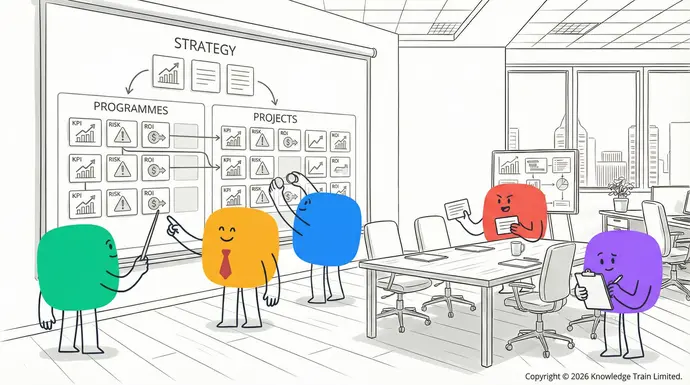
Critical bridge between strategy and execution
At a strategic level, portfolios serve as a critical bridge between the formulation of strategy and its execution. They assume a pivotal role in organizational governance by providing a comprehensive overview of all ongoing initiatives. This panoramic perspective empowers leaders to make well-informed decisions regarding resource allocation, optimizing value, risk management , and the attainment of strategic objectives.
Strategic alignment of portfoliosManage Consent
A primary objective of portfolio management is to guarantee that an organization’s projects and programmes remain aligned with its strategic goals. This entails regularly evaluating and adapting the portfolio to mirror shifts in the business landscape, strategic trajectory, and resource availability.
Through the harmonization of all initiatives with the overarching business strategy, portfolio management assists organizations in realizing their strategic vision, effectively To provide the best experiences, we use technologies like cookies to store and/or access device information. Consenting to these technologies will allow us to process data such as browsing behavior or unique IDs on this site. Not consenting or withdrawing consent, may adversely affect certain features and functions.managing risks , and maximizing returns on investment.
Projects, programmes, and portfolios
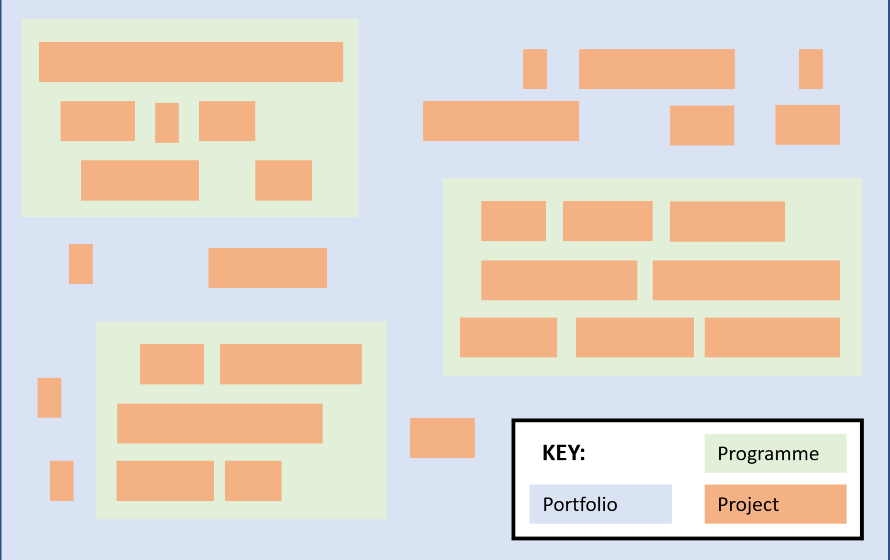
Projects and programmes are the foundations of portfolios
ProgrammesPreferences and projects serve as the foundational elements of portfoliosPreferences. Each programme or project integrated within a portfolio should be in sync with the organization’s strategic objectives. The cumulative performance of these programmes and projects is the yardstick for evaluating the portfolio’s success. Through the delivery of their distinct outputs (projects) and outcomes (programmes), they actively contribute to the realization of the strategic goals encapsulated within the portfolio.
Striking a balance between projects, programmes, and portfolios
- Soft skills such as negotiation, prioritization, the ability to see the bigger picture, as well as many other skills.Statistics
Proficient portfolio management necessitates a diverse set of skills, including the ones below.
Strategic thinking
Case study
Let’s now look at a case study of a fictional company which is utilizing portfolio management.
Company overview
ABC Enterprises is a leading global technology company operating in multiple markets. In recent years, the company has experienced rapid growth, expanding its product offerings and geographic reach. However, this growth has also brought about an increased complexity in managing a diverse portfolio of change initiatives.
The challenge
As ABC Enterprises continued to grow, the management team faced the challenge of efficiently coordinating and aligning various projects and programmes with the company’s overarching strategic objectives. There was a lack of visibility into resource allocation, and project interdependencies often went unnoticed until issues arose. This resulted in delays, resource bottlenecks, and a potential misalignment with the company’s strategic goals.
Implementing portfolio management
Recognizing the need for a structured approach, ABC Enterprises implemented a comprehensive portfolio management framework. They established a Portfolio Management Office (PMO) responsible for overseeing and optimizing their portfolio of change initiatives. Key steps included:
Strategic alignment
The PMO ensured that all projects and programmes were aligned with the company’s strategic objectives, prioritizing those initiatives that delivered the most value.
Resource optimization
Through portfolio management tools, ABC Enterprises gained real-time visibility into resource allocation, enabling efficient allocation and utilization of resources.
Risk management
The PMO systematically identified and managed risks across the portfolio, allowing proactive risk mitigation.
The results
With portfolio management in place, ABC Enterprises achieved remarkable results:
- Project delivery times were reduced by 20%, leading to faster time-to-market for new products.
- Resource utilization improved by 15%, resulting in cost savings.
- Improved visibility into interdependencies prevented bottlenecks and delays.
- The company experienced a 10% increase in customer satisfaction due to more effective project delivery.
Conclusion
ABC Enterprises’ adoption of portfolio management proved to be a strategic move. By aligning initiatives, optimizing resources, and enhancing risk management, they not only improved project outcomes but also maintained a sharp focus on their long-term strategic goals. The success of this approach has set a strong foundation for continued growth and innovation.
Final thoughts
Projects, programmes, and portfolios represent unique yet interlinked facets of strategic organizational management. Seamlessly integrating and aligning these components provides organizations with a competitive edge, enabling them to maximize value and enhance returns on investments.
Organizations that successfully unify their projects, programmes, and portfolios gain a distinct competitive advantage. This integration empowers them to deliver superior value and achieve more favourable returns on investments.
In the ever-evolving landscape of competitive markets, organizations that invest in standardized management practices for their portfolios, programmes, and projects stand to reap the most substantial benefits. This strategic commitment ensures efficiency, agility, and a heightened ability to thrive amid increasing competition.
Portfolios FAQs
Are all projects part of a portfolio?
No, not all projects are part of a portfolio. A portfolio is a collection of projects, programmes, subsidiary portfolios, and operations managed as a group to achieve strategic objectives. Some projects might be standalone or not aligned with the strategic objectives embodied by a specific portfolio.
Can a project be in multiple portfolios?
Typically, a project is included in only one portfolio to maintain clear governance, accountability, and strategic alignment. However, in complex organizations with multiple overlapping strategic objectives, it’s theoretically possible for a project to be represented in more than one portfolio. That said, such a scenario could lead to management challenges and is not generally recommended.
How do you prepare a portfolio?
How do you prepare a portfolio?
Preparing a portfolio involves a series of 5 strategic steps:
Define portfolio objectives
Align the portfolio with the strategic goals of the organization.
Identify potential projects or programmes
Collect a list of potential projects or programmes that could be included in the portfolio.
Evaluate and prioritize
Evaluate each project or programme based on its strategic alignment, potential benefits, risks, and resources required. Prioritize them based on this evaluation.
Select
Choose the most suitable projects or programmes for the portfolio to balance risk and return, while ensuring strategic alignment.
Manage and review
Continuously manage the portfolio, tracking performance of its components, and make adjustments as necessary. Regularly review the portfolio to ensure it remains aligned with strategic goals.
How many projects in a portfolio?
The number of projects in a portfolio can vary widely and depends on factors such as the size of the organization, its strategic objectives, available resources, and risk tolerance.
A portfolio should ideally include as many projects as can be effectively managed and aligned with the organization’s strategic goals, without overextending resources or increasing risk beyond an acceptable level.
Is a portfolio a project?
No, a portfolio is not a project. A portfolio is a collection of projects, programmes, subsidiary portfolios, and operations grouped together to facilitate effective management to meet strategic business objectives. It represents a higher level of organization that oversees and coordinates its constituent parts, which may include multiple projects and programmes.
Is a portfolio manager higher than a project manager?
Yes, typically a portfolio manager holds a higher-level position than a project manager. A portfolio manager oversees a collection of projects, programmes, and operations, ensuring alignment with strategic business objectives.
On the other hand, a project manager focuses on the execution of individual projects, managing resources, tasks, and stakeholders to deliver specified outcomes within time and budget constraints.
What are the benefits of a portfolio structure?
What are the benefits of a portfolio structure?
A portfolio structure offers 5 main benefits:
Strategic alignment
They ensure that projects and programmes are aligned with the organization’s strategic objectives, prioritizing resources and focus on initiatives that provide the most value.
Resource optimization
They allow for efficient resource allocation and management across multiple projects and programmes, reducing redundancy and maximizing utilization.
Risk Management
By managing interdependencies across projects and programmes, they mitigate risks that may not be apparent at the project level.
Change management
They provide a framework for managing change across the organization, ensuring that project outcomes contribute to broader transformation goals.
Visibility and control
They offer a holistic view of all initiatives, allowing senior management to better monitor progress, performance, and benefits realization.
What do you mean by portfolio?
In the context of project, programme, and portfolio management, a portfolio refers to a collection of projects, programmes, subsidiary portfolios, and operations grouped together to facilitate effective management to achieve strategic objectives. The projects or programmes in the portfolio may not necessarily be interdependent or directly related.
The main goal of portfolio management is to balance the trade-off of performance versus risk and align projects and programmes with the strategic objectives of the organization.
What is a major advantage of portfolio?
A major advantage of a project portfolio is strategic alignment. A project portfolio enables an organization to view and manage all its projects as a whole, aligning them with the strategic objectives.
This holistic view allows for efficient resource allocation, better risk management, and ensures that the organization is investing in projects that offer the best return on investment and contribute to strategic goals.
What is project portfolio assessment?
Project portfolio assessment is the process of evaluating and prioritizing the projects within a portfolio to ensure they align with an organization’s strategic objectives. This process involves assessing each project’s potential value, risks, resource requirements, and strategic fit.
The goal is to maintain a balanced portfolio that maximizes value while managing risk and resource constraints. Project portfolio assessment is a key part of portfolio management and plays a critical role in decision-making around project initiation, continuation, or termination.
What is project portfolio management in simple words?
In simple terms, project portfolio management is the process of prioritising, planning, managing, and optimizing a group of projects and programmes to ensure they align with an organization’s strategy, goals, and resources.
What is the difference between a programme and a portfolio?
A programme is a group of related projects managed in a coordinated manner to obtain benefits and control not available from managing them individually. Programmes may contain elements of work outside the scope of the discrete projects in it.
A portfolio, on the other hand, is a collection of projects, programmes, subsidiary portfolios, and operations managed as a group to achieve strategic objectives. The projects or programmes within the portfolio may not necessarily be interdependent or directly related.
A programme is about managing related projects collectively to reap benefits, whereas a portfolio is about selecting and managing the right mix of projects and programmes to align with the organization’s strategic objectives.
What is the difference between a programme manager and a portfolio manager?
The main difference between a programme manager and a portfolio manager is that a programme manager’s role is more tactical and focused on delivering a set of related projects, while a portfolio manager’s role is more strategic, focusing on aligning all projects and programmes with the organization’s strategy.
A programme manager oversees a group of related projects, ensuring they are coordinated and managed in a way that maximizes benefits and controls risks that wouldn’t be possible if the projects were managed individually. They are responsible for achieving the strategic goals set for the programme, managing interdependencies among the projects, and delivering the program’s overall benefits.
A portfolio manager oversees an organization’s portfolio, which includes multiple projects and programmes, potentially across different departments or areas of business. The portfolio manager’s role is more strategic, focusing on ensuring the portfolio aligns with the organization’s strategic objectives, managing resource allocation across the portfolio, balancing risks and returns among the different projects and programmes, and maximizing the value of the overall portfolio.
What is the difference between portfolio and project work?
The difference between portfolio and project work can be summarised as:
- Portfolio work involves managing a group of projects and programmes to achieve strategic objectives. Portfolio management encompasses the selection and oversight of projects.
- Project work focuses on the execution of a single project to achieve its specific objectives. Project management involves the execution and delivery of the project itself.
What is the difference between project and portfolio management?
The difference between project and portfolio management can be summarised as:
- Project management is the discipline of planning, organizing, and managing resources to successfully complete a specific project. It involves the applying knowledge, skills, tools, and techniques to meet project requirements and deliver desired outcomes within cost, scope, schedule, and quality constraints.
- Portfolio management is the strategic management of a collection of projects, programmes, subsidiary portfolios, and operations to achieve organizational goals. It involves selecting and prioritizing projects or programmes based on their alignment with strategic objectives, optimizing resource allocation, balancing risk, and maximizing value across the entire portfolio.
Why is project portfolio management important?
Why is project portfolio management important?
Project portfolio management is important for 5 main reasons:
Strategic alignment
It ensures that projects and programmes are aligned with the organization’s strategic goals and objectives. This alignment ensures that resources are allocated to initiatives that contribute the most value and support the organization’s overall strategy.
Optimized resource allocation
Project portfolio management helps organizations make informed decisions about resource allocation. By assessing project priorities, dependencies, and resource availability, it enables efficient allocation of resources, reducing bottlenecks and maximizing productivity.
Risk Management
A portfolio perspective allows organizations to assess and manage risks at a higher level. By evaluating project risks collectively, portfolio managers can identify and address risks that may not be apparent at the individual project level, making informed decisions to mitigate potential negative impacts.
Portfolio performance monitoring
Project portfolio management provides a comprehensive view of the performance of projects and programmes. It enables monitoring and tracking of key performance indicators, allowing organizations to assess the progress, make adjustments, and take corrective actions to ensure successful project delivery and desired outcomes.
Optimal decision-making
With project portfolio management, organizations can make data-driven decisions regarding project initiation, continuation, or termination. It provides a structured framework to evaluate project proposals, prioritize investments, and select the most valuable projects to pursue.