
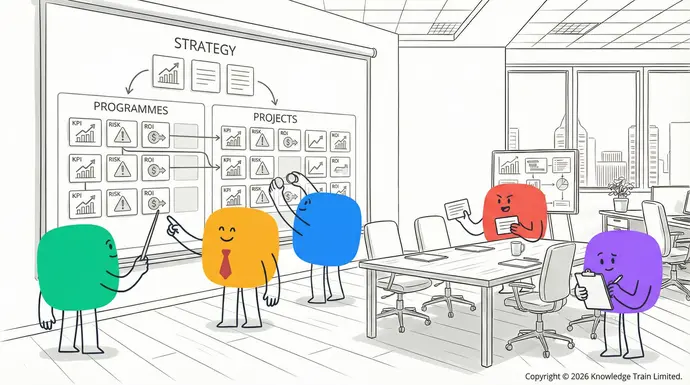
A , project scheduleprogrammes, and ongoing operational activities that are grouped together to fulfil strategic business goals.
In contrast to projects and programmes, which centre on execution and delivery, portfolios concentrate on the broader perspective. They involve making determinations regarding which initiatives to pursue, guided by considerations such as strategic alignment, risk assessment, return on investment, and other pertinent factors.
Differences between projects, programmes, and portfolios
This table shows the differences between projects, programmes, and portfolios.
| Focuses more on strategic decision-making by prioritizing initiatives, allocating resources, and balancing risk and reward across the portfolio.Provides clarity and direction |
Portfolio management: A project schedule offers a clear path for project execution, ensuring that all team members are aware of their responsibilities and deadlines.
Portfolio managementImproves time management is a fluid decision-making process through which an organization continually assesses and revises its roster of ongoing projects and programmes to align with its strategic goals. This process encompasses the identification, prioritization, authorization, and oversight of projects, programmes, and portfolios.: A schedule helps to prioritise tasks and allocate time efficiently, reducing the risk of missing deadlines.
Key aspects of portfolio management encompass strategic alignment, risk mitigation, resource allocation, and the achievement of anticipated benefits.Allows efficient resource allocation
Several established portfolio management frameworks, built upon industry best practices, are available for organizations to implement. These frameworks aid organizations in enhancing the management of their portfolios of change initiatives.: A project schedule enables the optimal distribution of personnel, equipment, and materials across project tasks.
Critical bridge between strategy and executionHelps in effective risk management
At a strategic level, portfolios serve as a critical bridge between the formulation of strategy and its execution. They assume a pivotal role in organizational governance by providing a comprehensive overview of all ongoing initiatives. This panoramic perspective empowers leaders to make well-informed decisions regarding resource allocation, optimizing value, : A project schedule helps to identify potential bottlenecks, and resource conflicts in advance, allowing for timely risk mitigation.risk managementBy utilising these advantages, , and the attainment of strategic objectives.project managers
Strategic alignment of portfolios can significantly improve the chances of project success and timely delivery.
A primary objective of portfolio management is to guarantee that an organization’s projects and programmes remain aligned with its strategic goals. This entails regularly evaluating and adapting the portfolio to mirror shifts in the business landscape, strategic trajectory, and resource availability.Six steps to create a project schedule
Through the harmonization of all initiatives with the overarching business strategy, portfolio management assists organizations in realizing their strategic vision, effectively A project schedule is a comprehensive document that outlines a project’s timeline. It is one of the most important project management tools. Scheduling is one of the key tasks in project management. To help you along, here are six steps that will allow you to create a solid schedule for your project.managing risks1. Define tasks and milestones, and maximizing returns on investment.List all the tasks that are necessary to complete the project. Then determine the
Projects, programmes, and portfoliosIdentify the resources needed for each task, then assign them to the relevant tasks. Be sure to consider team members’ skills and experience, availability and current workloads.
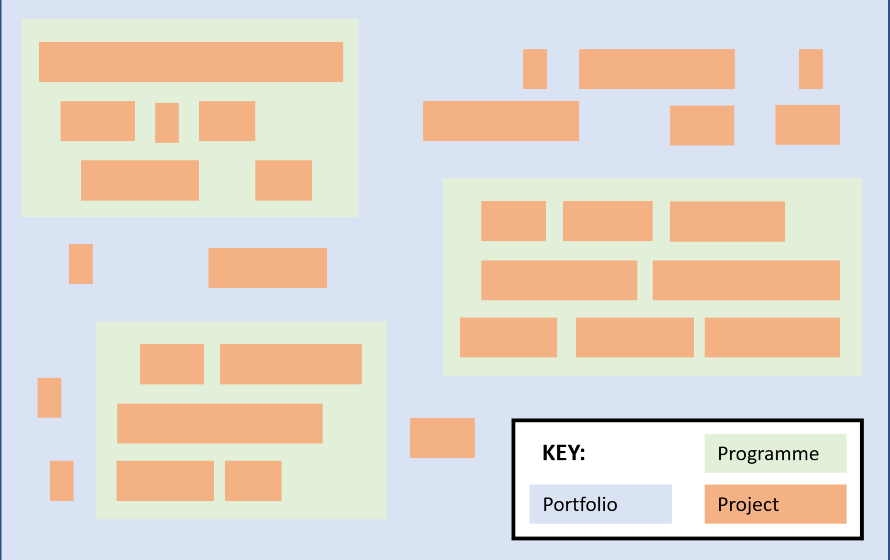
Projects and programmes are the foundations of portfolios5. Finalise the schedule
ProgrammesConfirm the draft schedule with the stakeholders and finalise it. Be sure that the schedule is realistic and it meets the project’s objectives and constraints and use the scheduling software to create a and Gantt chartprojects (or another visual representation). serve as the foundational elements of 6. Share and monitor progressportfoliosShare the finalised schedule with the team members and stakeholders and track and report on the progress. Consider using . Each programme or project integrated within a portfolio should be in sync with the organization’s strategic objectives. The cumulative performance of these programmes and projects is the yardstick for evaluating the portfolio’s success. Through the delivery of their distinct outputs (projects) and outcomes (programmes), they actively contribute to the realization of the strategic goals encapsulated within the portfolio.project management software
Striking a balance between projects, programmes, and portfolios for real-time updates and collaboration.
Striking a balance and aligning projects, programmes, and portfolios is a strategic endeavour that guarantees the collective contribution of all initiatives toward the overarching business objectives. This entails the routinely assessing the portfolio and making requisite adaptations in response to shifts in business strategy, project performance, or the availability of resources.Set up regular progress meetings
Effective alignment and balance serve as key enablers for the optimal utilization of resources, the comprehensive management of risks at every level, and the organization’s ability to flexibly adapt to evolving circumstances while remaining steadfast on the path to achieving its strategic objectives.Encourage team members to report the task completions as soon as they are done
Effective management of portfoliosUpdate the schedule if necessary to account for the actual progress.
Essential skills for portfolio managersWith these steps, you can create a comprehensive project schedule that will guide your team to successful project completion.
Effective management of portfolios requires a range of skills including:Enhance your skills with our expert-led courses
- Strategic thinking to align initiatives with business strategy.
- Leadership to inspire and guide.
- Risk management to anticipate and mitigate risks across the portfolio.Self-paced
- Communication skills to deliver clear, timely information to stakeholders at the highest levels in the organization.APM PFQ blended online
- Soft skills such as negotiation, prioritization, the ability to see the bigger picture, as well as many other skills.
Proficient £749 +vatportfolio management necessitates a diverse set of skills, including the ones below.
Strategic thinking
The capability to align initiatives with the organization’s overarching business strategy.Self-paced
LeadershipPRINCE2 Agile Practitioner (with Foundation) self-paced online
The capacity to inspire and provide guidance, driving initiatives toward success.
Communication skills£1,399 +vat
The ability to convey clear and timely information to stakeholders at the highest echelons of the organization.
Soft skills
This includes competencies like negotiation, prioritization, the aptitude to perceive the broader perspective, and a myriad of other skills that contribute to effective portfolio management.
Risk managementSelf-paced
The skill to anticipate and proactively mitigate risks spanning the entire portfolio.AgilePM Practitioner (with Foundation) self-paced online
Tools and techniques for portfolio management
An array of tools and techniques are instrumental in portfolio management, including the ones below.£1,299 +vat
Risk management toolsProject scheduling techniques
These help to identify and mitigate risks within the portfolio, ensuring proactive risk management.There are several techniques available for the effective creation and management of project schedules. Some of these techniques include Gantt charts, task lists, and calendars. This knowledge train will cover the definition and purpose of each of these techniques, the advantages and limitations of using each, when it is appropriate to use each, and benefits for smaller projects. The knowledge train aims to provide a comprehensive understanding of project scheduling techniques to help project managers make informed decisions about which techniques to use for their projects.
Communication platformsGantt charts
Efficient communication is facilitated through dedicated platforms, fostering seamless information exchange among stakeholders.Definition and purpose
Business analytical tools and modelsA
Tools like Gantt chartSWOT analysis is a type of bar chart that is commonly used in project management to visually represent a project schedule. It shows the start and end dates of project tasks, as well as their duration, as horizontal bars along a timeline. Gantt charts can also be used to display the dependencies between tasks., Advantages and limitationsPESTLE analysisAdvantages, and cost-benefit analysis play a pivotal role in supporting strategic decision-making within portfolio management, providing valuable insights and data-driven guidance.Provides a visual representation of task dependencies
Advantages and challenges in portfolio managementSimplifies the identification of the critical path
Effective portfolio management yields numerous advantages, such as:Capable of showing progress against the planned schedule.
Improved strategic alignmentLimitations
Ensuring that all initiatives are in harmony with the organization’s strategic direction.Can become cluttered and difficult to read for larger projects with many tasks
Optimized resource utilizationCan be time-consuming to create and maintain
Maximizing the efficient allocation of resources across various projects and programmes.Limited ability to show detailed task dependencies and resource allocation.
Better risk managementTask lists
Proactively identifying, assessing, and mitigating risks at the portfolio level.When to use task lists
Enhanced stakeholder satisfactionTask lists are often used in project management as a basic tool for organising and tracking project activities. They can be useful in the early stages of a project, or as a supplement to more advanced scheduling techniques. Task lists are appropriate to use when the project is relatively simple, and the team members are familiar with the tasks.
Meeting the expectations and needs of stakeholders, thus bolstering their satisfaction.Benefits for small projects
However, it also poses challenges, including:Simple to develop and maintain
Managing interdependenciesFacilitate clear communication of responsibilities
Handling the intricate relationships and dependencies among different projects and programmes.Allow quick changes and revisions.
Dealing with uncertaintiesCalendars
Navigating through uncertain situations and adapting to unforeseen circumstances.Uses in project scheduling
Balancing competing demandsCalendars are often used in project management to help visualise and plan the timeline of a project. They can be used to track important project dates, such as milestones, deadlines, and deliverables. Calendars can also be used to provide an overall view of the project’s timeline.
Prioritizing and managing competing demands and constraints within the portfolio.Limitations of calendar-based scheduling
Ensuring effective communicationInadequate representation of task dependencies
Facilitating clear and efficient communication across diverse levels and entities within the organization to maintain alignment and understanding.May lack necessary detail for more intricate projects
Governance in portfolio managementChallenges in depicting tasks with varying durations.
Robust governance is indispensable for the effective management of portfolios. This entails several key components including the ones below.Project scheduling techniques are an essential aspect of project management and choosing the right technique can greatly impact the success of a project. By understanding the advantages and limitations of each technique, as well as when and where to use them,
Defining clear roles and responsibilitiesproject managers
Establishing unambiguous roles and responsibilities for portfolio management team members and stakeholders. can effectively create and manage project schedules. Combining multiple techniques, such as using a Gantt chart to track progress and a calendar to visualise the timeline, can also be a useful strategy for managing project schedules.
Establishing decision-making frameworks
Creating structured decision-making processes to guide portfolio-related choices.
Implementing performance monitoring mechanisms
Setting up systems to monitor and evaluate the performance of projects, programmes, and the overall portfolio.Advanced scheduling concepts
Ensuring compliance with standards and regulationsThe more complex the
Adhering to relevant industry standards, regulations, and best practices.project
Strong governance serves as a pillar of support for transparency, accountability, and consistency. These attributes are instrumental in achieving strategic objectives and bolstering stakeholder confidence in the portfolio management process., the more benefit can be gained from advanced scheduling techniques. CPM and CCPM are methods to take your project planning to the next level.
Integrating with strategyBoth methods can provide useful insights for optimising project schedules and enhancing overall project management efficiency.
Integrating projects, programmes, and portfolios into business strategy is a reciprocal process. On one hand, strategic objectives serve as guiding principles, influencing the choice and ranking of projects and programmes within the portfolio.Tools for project scheduling
Conversely, the outputs from projects, outcomes from programmes, and the achievement of benefits offer valuable insights that can shape and enhance the business strategy.If you’re going to be doing project scheduling on a regular basis, you might find it useful to consider using specialist software to help you with this. A quick search online will pull up a range of tools. Some popular options include:
This interconnectedness ensures that strategic objectives are translated into tangible initiatives, and the journey toward these objectives is systematically monitored and assessed for progress.Project management software options
Role of leadershipJira
Leadership assumes a pivotal role in cultivating synergy among projects, programmes, and portfolios. Leaders are instrumental in several aspects including the following.:
Setting directionAgile project management
They establish the course and provide a clear sense of purpose. software with customisable workflows and reporting.
Communicating visionMicrosoft Project
Leaders convey the overarching vision, ensuring alignment and understanding among all stakeholders.: Software for creating detailed project schedules and resource management.
Fostering collaborationOther popular options
They create an environment that encourages cooperation, teamwork, and knowledge-sharing.: Trello, Asana, Basecamp, etc. All these offer various levels of functionality and can accommodate a range of project sizes.
Ensuring alignmentKey features to look for in scheduling software
Leaders guarantee that the goals of individual projects harmonize with programme objectives, and that all programme objectives contribute to the strategic goals embodied in the portfolio.When it comes to choosing a scheduling software, there are some key features that you should ensure it has. Here are some of the most critical ones:
Through effective leadership, organizations can enhance coordination, manage complex interdependencies, and drive collective success across their projects, programmes, and portfolios.Gantt chart creation and customisation
Realising valueResource management
Achieving success in portfolios hinges on the effective realization of anticipated benefits. This process entails ongoing monitoring and assessment of performance against predetermined criteria or key performance indicators (KPIs).Task dependencies
These evaluations encompass both tangible metrics, such as cost savings or revenue growth, and intangible factors, like heightened customer satisfaction or an enhanced brand reputation. A thorough assessment of success and value realization empowers organizations to demonstrate the return on investment (ROI) of their initiatives, glean valuable insights from their experiences, and enhance their performance in future endeavours.Real-time collaboration
Project management office (PMO)Integration with other business tools
In recent years, progressively mature organizations have made significant investments in establishing Project Management Offices (PMOs) not only at the project level but also at the programme and portfolio levels.Reporting and analytics.
PMOs offer a host of advantages to organizations, including the following:If you can find a tool that covers all these bases, you’ll be well on your way to more streamlined and effective project scheduling.
Standardization and consistencyEnhance your skills with our expert-led courses
Ensuring uniformity and consistency in project and programme management practices.
Improved governanceSelf-paced
Enhancing oversight, control, and compliance with regulations and standards.APM PFQ blended online
Resource optimization
Efficiently allocating and managing resources across various initiatives.£749 +vat
Knowledge management
Facilitating the capture, sharing, and application of knowledge and best practices.
Strategic alignment
Ensuring that projects and programmes align with the overarching strategic goals of the organization.Self-paced
Many of these organizations have adopted the best practice framework for Portfolio, Programme, and Project Offices (PRINCE2 Agile Practitioner (with Foundation) self-paced onlineP3O ®£1,399 +vat) to support the successful delivery of their portfolio of change initiatives and projects, leveraging standardized and effective PMO practices.
Digital transformation
Technology in management
The advent of digital transformation has significantly improved the coordination and collaboration in the management of portfolios, programmes, and projects. The utilization of Self-pacedproject management softwareAgilePM Practitioner (with Foundation) self-paced online, collaborative platforms, and cloud-based tools empowers real-time progress tracking, efficient resource allocation, and fosters enhanced communication among team members.
These innovative tools streamline the management of interdependencies, enhance decision-making processes, and enable seamless teamwork, irrespective of team members’ geographical locations.£1,299 +vat
Data-driven decision-makingBest practices for effective project scheduling
Digital transformation has ushered in increased data accessibility, making it easier to embrace data-driven decision-making in portfolio, programme, and As with all things, there are several best practices you can follow that will help you improve the quality of your project scheduling. Here are some of the most important ones:project managementCollaborate with team members. Cutting-edge analytics and visualization tools empower managers to evaluate performance, detect trends, forecast potential risks, and arrive at well-informed decisions.Get your team involved in the scheduling process. Their input can be invaluable in terms of providing more accurate estimates for task durations and helping you to identify potential issues. This approach can also be helpful in terms of getting your team to
Furthermore, machine learning and artificial intelligence algorithms offer insights and recommendations that elevate strategic decision-making within portfolios and enhance operational decision-making within projects and programmes.buy-in
Automation to the schedule.
Digital transformation has introduced automation to a multitude of management processes, resulting in heightened efficiency and precision. Activities like updating project statuses, monitoring alterations, scheduling meetings, or allocating resources can now be automated, liberating managers to concentrate on strategic matters.Break large tasks into smaller, manageable pieces
Moreover, digital platforms enable the efficient documentation and dissemination of knowledge, fostering a culture of learning and continuous improvement in portfolio, programme, and Break complex tasks into smaller and more manageable subtasks. This method, called project managementWork Breakdown Structure. (WBS), makes it easier to estimate the time, track progress, and allocate resources.
Evaluate and prioritize
Evaluate each project or programme based on its strategic alignment, potential benefits, risks, and resources required. Prioritize them based on this evaluation.
Select
Choose the most suitable projects or programmes for the portfolio to balance risk and return, while ensuring strategic alignment.
Manage and review
What are the benefits of a portfolio structure?
A portfolio structure offers 5 main benefits:
Strategic alignment
They ensure that projects and programmes are aligned with the organization’s strategic objectives, prioritizing resources and focus on initiatives that provide the most value.
Resource optimization