Change management qualifications explained

Key takeaways
Qualifications signal credible capability to lead organisational change using recognised methods.Senge’s system thinking model and change management
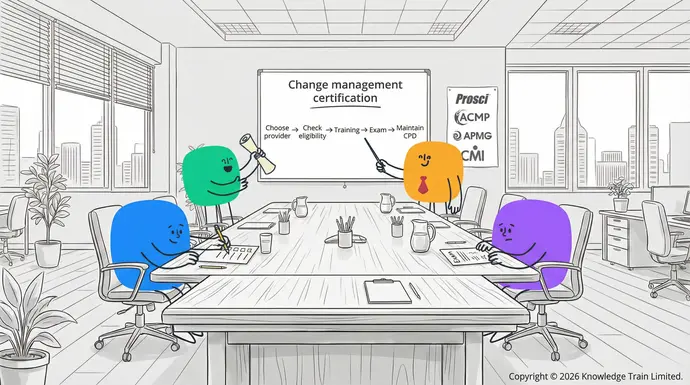
- Choose a provider whose framework and recognition match your role goals, such as APMG, Prosci, ACMP, or CMI.
- Check entry requirements early, as some qualifications require verified experience.Simon Buehring
- Pass the relevant exam or assessment to qualify.8 Sep 2026
- Senge’s model improves change outcomes by treating organisations as connected systems, not isolated events.
- Qualifications can improve employability, credibility, and progression into change, project, and leadership roles.Systems thinking links the other four disciplines and helps reveal feedback loops, delays, and recurring patterns.
Leading providers and their programmesSystems thinking
APMG InternationalSystems thinking, which Senge named ‘The Fifth Discipline’ in his 1990 book, integrates the other four disciplines. It examines how systems interconnect and change over time through feedback loops, system archetypes and delays. By recognising patterns and relationships, organisations can address root causes rather than symptoms.
APMG International provides Systems thinking provides a comprehensive framework for analysing complex issues, making it the cornerstone of Senge’s model.FoundationInterconnectedness of the disciplines and Synergistic effectsPractitionerThe integration of these five disciplines leads to synergistic effects that enhance organisational effectiveness. When combined, they provide a holistic approach to tackling challenges. Each discipline complements the others, creating a dynamic interplay that fosters resilience and adaptability. This synergy helps organisations navigate complex environments more successfully. change management qualifications based on the Change Management Institute’s (CMI) Body of Knowledge. Qualifications can be taken through an accredited organisation, with assessments in exam format.Discipline
- £1,699 +vat
Steps to obtain a qualification
Here are the typical steps to obtain a qualification:See all dates
- Review qualification providers and eligibility
- Undertake required training
- Complete application and documentation
- Pass examination or assessmentSelf-paced
- Receive and maintain your qualification.Change Management Practitioner (with Foundation) self-paced online
Benefits of change management qualifications
- Validates your expertise in the change management process and best practices£1,299 +vat
- Enhances career prospects for roles such as change manager or project managerSelf-paced
- Recognised by employers as evidence of professional skills and commitment to Change Management Foundation self-paced onlineorganisational change
- Broadens knowledge of £799 +vatchange management modelsApplications of Senge’s system thinking model, tools, and frameworksOrganisational strategy and change management
- Helps to develop a broad range of Strategic planningchange management skillsSystem thinking plays a crucial role in strategic planning by offering a comprehensive view of organisational dynamics. It encourages leaders to consider the long-term effects of their decisions. By recognising patterns and feedback loops, organisations can develop robust strategies that anticipate potential challenges. This approach ensures that plans are adaptable and aligned with the organisation’s vision.
- May result in higher remuneration and increased leadership opportunities within Change managementproject managementIn change management, system thinking provides a framework for understanding the complexities of organisational transitions. It helps identify underlying causes of resistance and facilitates smoother implementation of change initiatives. By focusing on relationships and interdependencies, leaders can craft strategies that address concerns and engage stakeholders effectively. This holistic view reduces disruptions and enhances the success of change efforts., Problem-solving and decision-makingchange managementEnhanced problem-solving, and organisational developmentSystem thinking significantly improves problem-solving by shifting the focus from symptoms to root causes. It enables teams to identify and address the underlying issues affecting performance. By analysing the connections between various elements, organisations can develop solutions that are both effective and sustainable. This approach minimises recurring problems and fosters a culture of continuous improvement.
- Keeps you up to date with current standards and emerging trends.Informed decision-making
Compare change management qualification optionsInformed decision-making benefits greatly from system thinking, as it promotes a thorough understanding of the implications of decisions. By considering the wider impact, leaders can make choices that align with long-term goals and values. This method reduces the likelihood of unintended consequences and enhances organisational resilience. It also encourages transparency and accountability, leading to more ethical and sustainable practices.
| OptionPractical applications and psychological benefits | FormatThe practical applications of system thinking in workplace settings are extensive. It enhances collaboration by encouraging open communication and shared understanding. Teams can work more effectively by recognising their interdependence and focusing on common objectives. This collective mindset fosters innovation and adaptability, essential for thriving in complex environments. | ProsSystem thinking can enhance understanding of organisational dynamics. When team members better understand their role in the larger system, they often report improved engagement and clarity of purpose. Employees feel more engaged and motivated when they understand how their efforts contribute to the bigger picture. This clarity enhances job satisfaction and overall well-being, creating a positive organisational culture. | ConsIn summary, applying Senge’s system thinking model in strategic planning, change management, problem-solving, and decision-making leads to more efficient and resilient organisations. By embracing this holistic approach, businesses can navigate challenges with confidence and create sustainable success. |
|---|---|---|---|
| Online learningBenefits and challenges of implementing Senge’s model | Remote, self-paced or live virtual classes | Flexible scheduling, accessible worldwide, good for working professionals | Requires motivation, less networking potentialKey benefits |
| In-personImproved efficiency and innovation | Classroom settings hosted at accredited centres or organisationsImplementing Senge’s model can significantly enhance organisational efficiency and innovation. By fostering a holistic understanding of processes, it enables teams to optimise workflows and reduce waste. This comprehensive view encourages creative problem-solving and the development of innovative solutions. As a result, organisations are better equipped to adapt to changing environments and seize new opportunities. | Hands-on learning, direct peer and instructor interactionEnhanced collaboration | Limited locations/dates, higher travel costsThe model also promotes enhanced collaboration by breaking down silos and encouraging open communication. By aligning team members around a shared vision, it fosters trust and mutual respect. This collaborative culture improves information flow and accelerates decision-making. As teams work together more effectively, they achieve collective goals and drive organisational success. |
| Free learningChallenges and limitations | Available as short courses, MOOC platforms, or provider taster sessionsImplementation barriers | Low barrier to entry, basic knowledge, good introductionDespite its benefits, adopting system thinking presents several implementation barriers. Organisations often face resistance from employees accustomed to traditional methods. The shift to a more interconnected approach requires changes in mindset and behaviour, which can be difficult to achieve. Additionally, the complexity of system thinking may overwhelm those unfamiliar with its principles. | Limited credibility, often not fully accredited, may lack robust examinationOvercoming resistance |
Review available To overcome resistance, organisations can employ several strategies. Providing comprehensive training and support helps employees understand the value of system thinking. Encouraging small-scale pilot projects allows teams to experience its benefits firsthand. Leadership plays a crucial role in modelling the desired behaviours and reinforcing the importance of the new approach. By creating a supportive environment, organisations can cultivate a system thinking culture.change management coursesWhile implementing Senge’s model can enhance efficiency, innovation, and collaboration, it requires overcoming significant challenges. By addressing these barriers and fostering a culture of openness and learning, organisations can realise the full potential of system thinking. This transformation not only improves performance but also contributes to a more resilient and adaptable organisational culture. to start your learning journey and develop your Case studies and real-world exampleschange management skillsetSuccessful implementations.Corporate examples
FAQsSeveral companies have successfully integrated Senge’s system thinking model into their operations. For instance, Royal Dutch Shell applied systems thinking through scenario planning in the 1970s and 1980s, which helped them prepare for major oil market changes. Similarly, Unilever adopted system thinking to improve sustainability practices, resulting in significant reductions in waste and resource consumption.
What are change management qualifications?Sector-specific applications
Change management qualifications are professional credentials proving your ability to plan and deliver change initiatives. It indicates knowledge of recognised frameworks and models, such as In the healthcare sector, system thinking has been applied to streamline patient care pathways, improving outcomes and reducing costs. Educational institutions have also embraced this model to foster collaborative learning environments, enhancing both teaching methods and student engagement. These sector-specific applications demonstrate the versatility of Senge’s model across different fields.ADKARLessons learned, and those by Key takeawaysSengeThe key takeaway from these examples is the importance of aligning the organisation’s vision with system thinking principles. Successful implementations often involve a strong commitment from leadership and a willingness to challenge existing mental models. Organisations that foster a culture of learning and open communication tend to reap the most benefits., By focusing on the interconnectedness of processes, companies can achieve improved efficiency and innovation. Moreover, the psychological benefits, such as reduced stress and increased job satisfaction, contribute to a more positive organisational culture. These lessons highlight the potential of Senge’s model to transform diverse workplace settings.LewinImplementing Senge’s system thinking, Learning how to implement Senge’s system thinking model, as well as learning other Satirchange management skills, can be made easier for change managers who attend a Kübler-Rosschange management course, and . Such courses often lead to a Kotterchange management qualification, or those defined by professional bodies., but they equip change managers with the skills and tools to deliver change initiatives successfully.
How do I become qualified in change management?If you are seeking to become a change manager, read
Select a recognised provider (e.g. APMG, Prosci, ACMP, CMI), ensure you meet the eligibility criteria, and pass the exam. Some qualifications also require documentation of experience.How to become a change manager
What is the best change management qualification?.
The best qualification depends on your career goals, experience, and employer requirements. Leading options include APMG International, Prosci, ACMP’s CCMP, and CMI accreditations, each with distinct methodologies and recognition.Conclusion
Are change management qualifications worth it?Senge’s system thinking model offers a holistic framework that enhances efficiency, innovation, and collaboration. By integrating personal mastery, mental models, shared vision, team learning, and systems thinking, organisations can address complex challenges effectively.
Yes, change management qualifications are worth it for professionals seeking Futurechange managerThe future of system thinking in organisational development is promising. As businesses navigate increasing complexity, this model’s principles will become even more relevant. By fostering a culture of continuous learning and adaptability, organisations can not only improve performance but also enhance employee well-being, leading to sustainable success. or FAQsproject managerWhat is Senge’s system thinking model?. Qualifications are valued by organisations, enhancing career prospects, and boosting knowledge and credibility in managing organisational change.A framework for understanding organisational complexity through five interconnected disciplines. The model emphasises how personal mastery, mental models, shared vision, team learning, and systems thinking work together to create sustainable
Which change management qualification is best?organisational change
In the UK, .APMG Change Management certificationHow can system thinking improve organisational performance? is best because APMG International is a globally recognised accreditation body with a successful history of managing qualification schemes for businesses and professionals.By enhancing efficiency, collaboration, and innovation. The approach helps organisations identify root causes of problems, understand feedback loops, and develop more sustainable solutions through holistic analysis.
The APMG qualifications were developed in collaboration with the What are the challenges in implementing Senge’s model?Change Management Institute (CMI)Resistance to change and the need for mindset shifts. Organisations often struggle with moving from event-oriented thinking to recognising patterns and systemic structures, requiring sustained leadership commitment and cultural transformation. and aligned to the Institute’s Can Senge’s model be applied in small businesses?Change Management Body of Knowledge (CMBoK)Yes, it is adaptable to different organisational sizes. Small businesses can particularly benefit from systems thinking by understanding interconnections between different business functions and making more informed strategic decisions..What are some real-world examples of system thinking?
Related resourcesRoyal Dutch Shell applied systems thinking for scenario planning in oil market changes. Other examples include Unilever’s sustainability initiatives and healthcare organisations improving patient care through systems approaches. These cases demonstrate how systems thinking can lead to better strategic planning and operational improvements.
- Change management coursesHow does system thinking affect decision-making processes?
- Project management coursesIt promotes informed and sustainable decisions. Systems thinking helps leaders consider long-term consequences, understand feedback loops, and recognise how different parts of the organisation influence each other before making strategic choices.