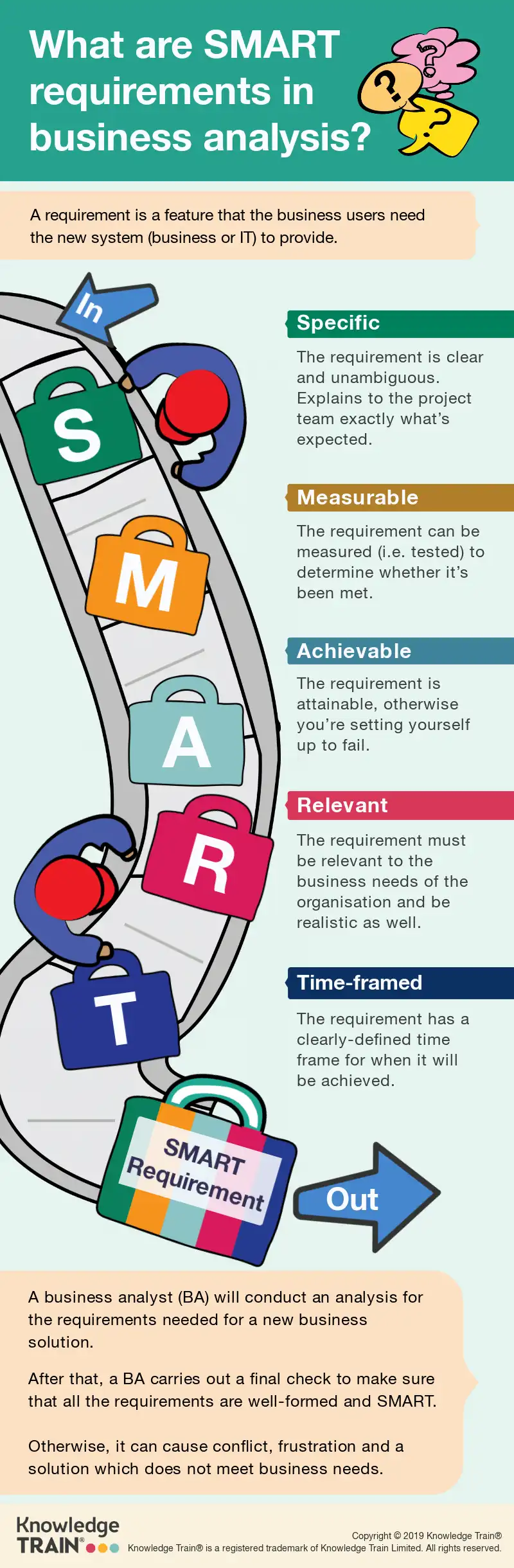

The Process of writing SMART goalsavoid (risk response)
Step-by-step guideThis is a risk response to a threat, either removing the potential impact of the threat or ensuring the threat no longer occurs.
Initial brainstormingBack to top: Begin by identifying what you truly wish to achieve. Gather your thoughts and list all potential goals.baseline
This stage is about exploring possibilities without constraints. Use prompts to consider various aspects and perspectives, ensuring a comprehensive view of your ambitions.The reference points against which an entity is monitored and managed.
Refining goalsbaseline management product: Once you’ve identified potential goals, refine them to align with the This refers to a management product defining certain aspects of the project and once approved, is subject to change control. See .
change controlApplying SMART goals in different contexts
Personal developmentThe process ensuring that all changes potentially affecting the project’s agreed objectives are identified, evaluated and then approved, rejected, or deferred.
SMART goals are invaluable for change managementpersonal developmentThe means by which an organization transitions from its current state to a target state. See , providing a clear framework to achieve self-improvement. For instance, an individual aiming to enhance their communication skills might set a goal to “Attend a public speaking course in the next three months.” By being specific and time-bound, such goals facilitate structured self-growth and ensure progress is measurable and relevant.change management
Business and professional settings.
In checkpointbusiness and professional environmentsA time-driven review of progress at the team-level., SMART goals drive productivity and innovation. A case study example is a marketing team setting a goal to “Increase social media engagement by 20% over the next quarter.” This specificity and measurability help teams focus efforts and allocate resources effectively, ensuring that objectives are met within defined time frames and align with broader business strategies.checkpoint report
Educational contextsA progress report given by a team to the project manager at a checkpoint, providing reporting data as defined in the work package. See
In checkpoint reporteducational settings., SMART goals can benefit both students and teachers. For students, a goal like “Improve mathematics grades by one letter by the end of the semester” can provide motivation and a clear focus. Teachers might set goals to “Integrate three new teaching technologies into the curriculum by year-end,” ensuring continuous professional development and enhanced educational delivery.closure recommendation
Health and fitnessA recommendation prepared by the project manager for the project board to issue a project closure notification when they are satisfied that the project can be closed.
SMART goals are particularly effective in the realm of co-creationhealth and fitnessA collaborative process where multiple stakeholders, often including customers, partners, or users, actively participate in the development, design, or innovation of products and agreed ways of working to ensure they are adopted by the project and organizational ecosystems.. Setting objectives such as “Run 5 kilometres in under 30 minutes within two months” provides clarity and motivation. By being specific, measurable, and time-bound, such goals encourage individuals to follow structured training plans, leading to tangible improvements in fitness levels.collaboration
The application of SMART goals across various contexts not only enhances focus and accountability but also reduces stress. By providing a structured approach to goal setting, individuals and organisations can embark on meaningful pursuits with confidence and clarity.The act of working jointly with others across the project ecosystem to achieve shared goals or objectives. It involves the exchange of ideas, resources, and efforts among participants to enhance productivity, creativity, and the overall effectiveness of a project.
Conclusioncommunication management approach
SMART is one of many A description of how team members will actively engage with and support each other and how relationships will be developed across the project ecosystem. See business analysis techniquescommunication management approach available to business analysts. SMART goals offer a structured and effective approach to achieving ambitions. By ensuring that goals are specific, measurable, achievable, relevant, and time-bound, individuals and organisations can enhance focus, reduce stress, and improve resource management..
This method encourages a clear path to success, fostering motivation and accountability. Now is the time to apply this powerful framework.concern
Start setting your own SMART goals today and experience the benefits of structured goal setting in your personal and professional life.An issue whose timeliness and impact must be assessed.
FAQsconcession
What are SMART goals?An off-specification that is accepted by the project board without the need for corrective action.
SMART goals are objectives that are constraintsSpecificThese are the limitations or restrictions that the project must operate within., corrective actionMeasurableA set of measures to resolve a threat to a plan’s tolerances or a defect in a product., cost toleranceAchievableThe permissible variation in a plan’s cost before the deviation needs to be escalated to the next level of management. Cost tolerance is documented in the respective plan., cultureRelevantThe collection of shared attitudes, values, goals, and operational approaches that define and characterize a group of individuals or an organization. Culture plays a fundamental role in shaping behaviour and interactions within the project and organizational ecosystems., and customerTime-boundThe person or group who initiated and commissions the project and will benefit from the end results. ‘Customer’ is only used where there is a commercial relationship between the business and the supplier. Otherwise, it is known as the business., providing a clear and structured way to achieve targets.Back to top
How do you measure the success of SMART goals?daily log
Success is measured by evaluating if the goal meets its specific criteria and timeline. Regular progress tracking and outcome assessment are essential to determining achievement.This is a record maintained to keep track of informal issues or concerns that fall under the jurisdiction of the project manager. See
Can SMART goals be adjusted over time?daily log
Yes, SMART goals can be adapted as circumstances change. It’s important to review and modify goals to maintain their relevance and achievability, ensuring alignment with evolving priorities..
What are some common challenges when setting SMART goals?dashboard
Challenges include setting overly ambitious targets, failing to define clear metrics, and overlooking deadlines. Addressing these can enhance goal effectiveness and reduce stress.A visual representation of extensive decision-support data that provides a real-time, concise summary, typically presented in a graphical and user-friendly format. Dashboards offer key insights into progress and performance, facilitating quick and informed decision-making.
Infographicdata analytics