BCS Business Analysis framework and career pathway

Key takeaways
- The BCS (The Chartered Institute for IT) is a UK accreditation body for IT professionals and engineers.
- BCS offers certifications in IT and management subjects such as Business Analysis (BA).
- BCS Business Analysis qualifications are the gold standard for UK business analysis professionals.
- BCS Business Analysis certifications validate core business analysis competencies from Foundation to Expert levels.
What is the BCS Business Analysis framework?
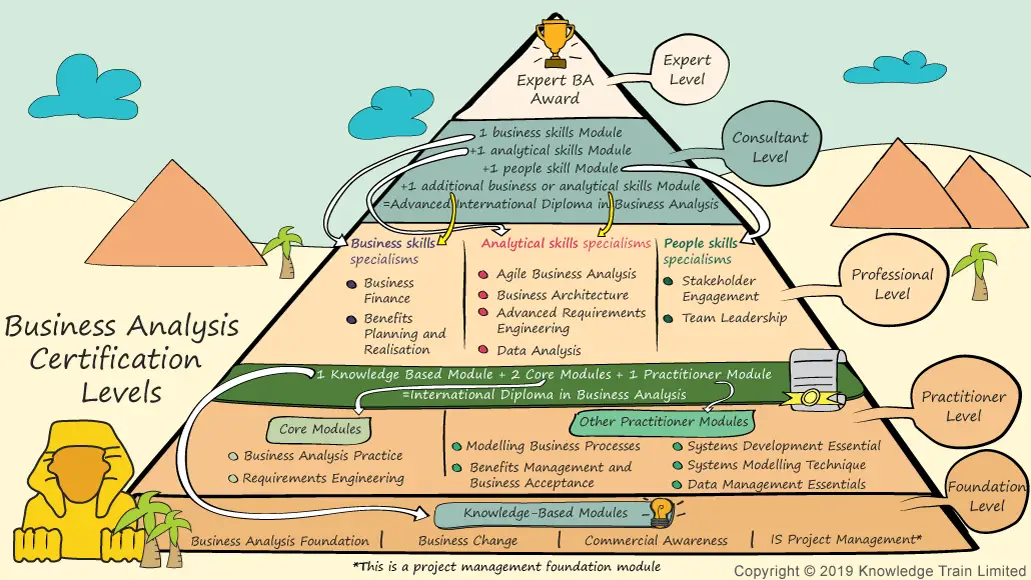
BCS business analyst qualifications are available from Foundation to Expert level. Each level is mapped according to the SFIAplus industry-standard framework.
The BCS Business Analysis framework is worth considering if you want to become a business analyst. The qualifications are modular and can be tailored to your specific career path. In addition, many business analyst roles in the UK job market are required to have a formal business analyst certification.
BCS Business Analysis levels
The BCS Business Analysis framework levels are:
Foundation (SFIAplus level 3) – for people wanting to understand the basics of business analysis. There are no entry pre-requisites for this certification.
Practitioner (SFIAplus level 4) – for people already holding a foundation level certification and wanting to move on to demonstrate specialist practical skills. These modules accumulate to gain a BCS International Diploma in Business Analysis.
Professional (SFIAplus level 5) – for people to show they have developed specialist analytical, business and personal skills. These modules accumulate to gain a BCS Advanced International Diploma in Business Analysis.
Consultant (SFIAplus level 6) – for senior business analysts with an extensive range of skills and experience. Once completed, candidates will be eligible for the fast-track application route for Chartered IT Professional (CITP) registration.
Expert (SFIAplus level 7) – for senior business analysts looking to gain the highest level of certification to demonstrate their higher skill levels and expertise.
Skills and topics in the BCS Business Analysis framework
Foundation
The BCS Foundation Certificate in Business Analysis syllabus covers:
- The role and competencies of a business analyst.
- How to identify and evaluate options for improving your business.
- Investigative techniques, including interviews, workshops, prototyping and scenarios.
- How to categorise, analyse and manage stakeholders.
- Making a business case and assessing feasibility.
- How to document, manage and validate requirements.
Practitioner
Business Analysis Practice
BCS Business Analysis Practice (core module) helps business analysts develop their practical skills in business analysis. It covers:
- The strategic context.
- How to analyse stakeholder perspectives.
- How to analyse and model business activities.
- How to identify potential solutions.
- How to make the business case.
Requirements Engineering
BCS Requirements Engineering (core module) helps you to define and deliver business requirements for projects. It covers:
- How to elicit, analyse, evaluate, document and manage requirements and techniques to use.
- How to collaborate and communicate with stakeholders in the requirements process.
- How to write a user story.
- Validating, prioritising and quality assurance in the requirements process.
BCS Modelling Business Processes
BCS Modelling Business Processes (selective module) helps you to identify, model and improve business processes in your organisation. It covers:
- The context for business processing modelling.
- The organisational model for processes.
- How to model business processes.
- How to document tasks.
- Evaluating and improving business processes.
Benefits Management and Business Acceptance
Benefits Management and Business Acceptance (selective module) helps you understand how a rigorous approach to benefits management ensures successful software solutions delivery. It covers:
- How to make a business case, ensure a strategic fit, indicate critical success factors, and key performance indicators.
- How to distinct categories of benefits and potential roles in benefits management and management processes.
- How to define a framework and prerequisites for effective acceptance testing.
Data Management Essentials
Data Management Essentials (selective module) helps you understand good practices in data management. It covers:
- What is required for the administration of data and database management.
- The roles and skills required in data and database administration, and repository administration.
- How to contribute to technology direction evaluation when creating a data charter.
- How to develop procedures for managing an organisation’s corporate data resource.
- How to understand and employ data analysis, and privacy, security and recovery procedures.
International Diploma in Business Analysis
The BCS International Diploma in Business Analysis is a popular target for many business analysts wanting to demonstrate their detailed understanding of business analysis.
To gain the Diploma you will need to pass an oral examination and 4 BCS Business Analysis modules including:
- Foundation
- 2 core Practitioner modules
- 1 selective Practitioner module.
Professional
This level is for senior business analysts and is a stepping stone to the Consultant level, In the Professional qualification level, you get to study the following modules:
Analytical skills specialisms:
- Business architecture.
- Advanced requirements engineering.
- Data analysis.
- Agile business analysis.
Business skills specialisms:
- Business finance.
- Benefits planning and realisation.
People skill specialisms:
- Stakeholder engagement.
- Team leadership.
Consultant
This level is for senior business analysts, and it recognises business analysis experience and expertise.
You could be awarded an Advanced International Diploma in Business Analysis if you:
- Have a minimum of five years’ experience in business analysis.
- Contribute to the business analysis community.
- Pass an oral exam.
- Complete four professional modules from the following:
- One analytical skills specialism.
- One business skills specialism.
- One people skill specialism.
- One analytical skills or business skills specialism of your choice.
Expert
This award is the highest level in BCS Business Analysis. It recognises your high skills and expertise. It validates a business analyst’s ability to:
- Conduct complex business analysis activities.
- Engage with senior stakeholders.
- Improve the organisation at a strategic level.
To gain the Expert award you will undergo:
- A formal assessment.
- A project assignment.
- An interview.
Ready to get accredited?
Select one of these popular BCS Business Analysis options.
The BCS Business Analysis level of choice for UK business analysts. Includes all 4 prerequisite courses.
The starting level for UK business analysts and a prerequisite for the Diploma.
Choose a Practitioner module for more focused understanding.
This BCS Business Analysis Practitioner core module helps business analysts develop their practical skills in business analysis.
This BCS Business Analysis Practitioner core module helps business analysts define and deliver business requirements.
This BCS Business Analysis Practitioner selective module helps you to identify, model and improve business processes at work.
Browse all BCS Business Analysis options if you’re still not decided.
Browse all BCS Business Analysis courses and compare training options, schedules and pricing.