Unlocking organisational potential with the POPIT model

Key takeawaysSimon Buehring
The POPIT model helps organisations align change across the whole operating system, not just one area.25 Sep 2026
- Use POPIT to assess People, Organisation, Processes and IT together, so fixes in one area do not create problems elsewhere.Key takeaways
- Run gap analysis by comparing the current state with the desired future state in each POPIT element.The right certification depends on the environment you work in and the experience you can show.
- Strengthen planning by pairing POPIT with SWOT for internal factors and PESTLE for external pressures.BCS qualifications are widely favoured in the UK and offer a flexible pathway from foundation to diploma level.
- Review and update the POPIT view regularly to stay aligned with shifting priorities and project learning.AgileBA suits characters working in agile teams, progressing from overview knowledge to applied practitioner capability.
- Engage a broad mix of stakeholders early to improve insight, commitment and implementation success.PMI-PBA is highly respected outside of the UK, but has strict eligibility requirements, making it a strong differentiator for experienced candidates.
Introduction to the POPIT model as a discipline has evolved from work previous allotted to project managers as businesses have grown more complex, and projects more multi-faceted.
What is the POPIT model?As such,
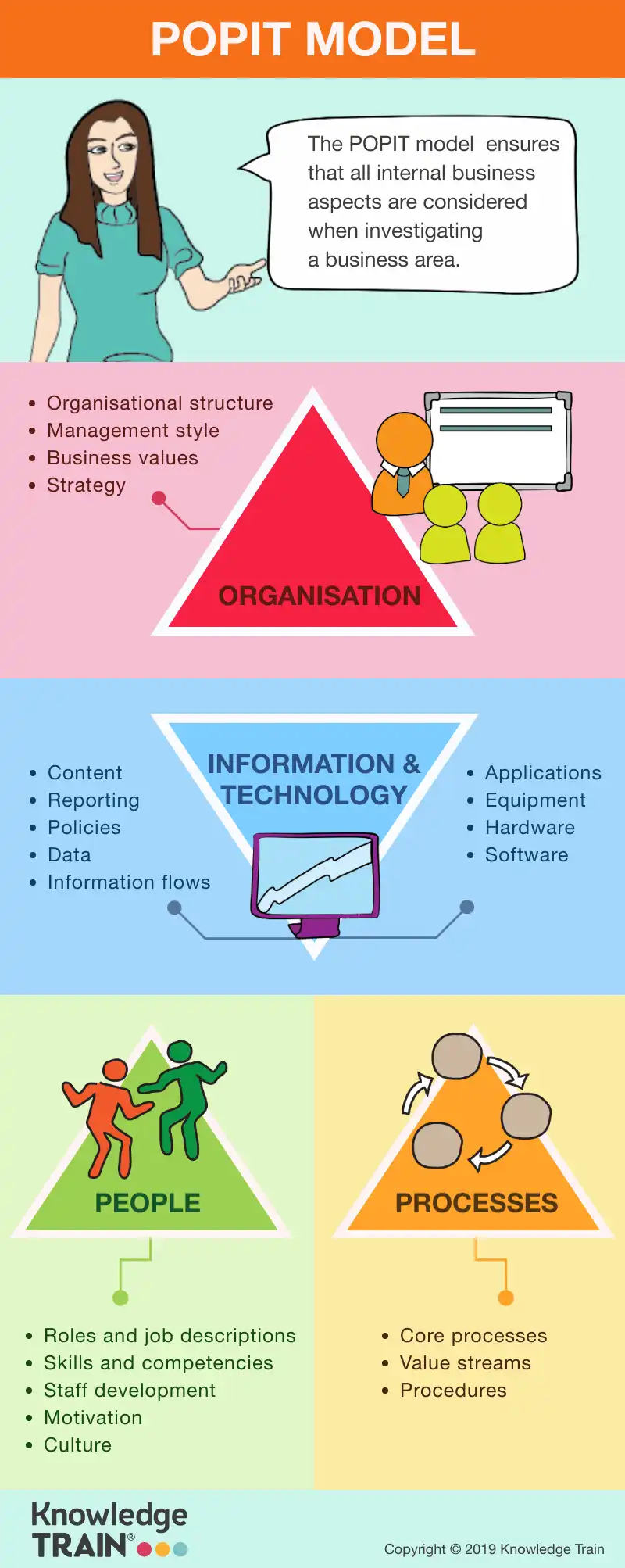
The business analystsPOPIT model (BAs) can expect to work closely with is a strategic framework used to analyse and improve organisational structures and processes. It stands for project managersPeople, stakeholders and related project support roles. Some have likened the techniques used in business analysis to those of systems analysis., Business analysis however focuses more on overall business goals than specific technology or systems design. The role of a business analyst is to deliver an understanding of users and the general business environment.OrganisationWhen developing your business analyst career, a key decision is choosing the right business analyst qualification to help you develop your skills, and to showcase to employers your credentials. This article will explore the main business analyst qualifications on offer in the UK and help you choose the right one., If you are right at the start of your BA career and need more guidance, read: ProcessesHow to become a business analyst, and .Information Technology.Comparing BCS, AgileBA, and PMI-PBA The model provides insights into the interplay between these elements, helping organisations identify needs, opportunities, and desired changes.We offer 3 internationally recognised business analysis qualification schemes to aid your career progression in the business analysis profession. Each is tailored to suit a different type of candidate and as such, there’s no ‘best’ qualification.
By offering a structured perspective, POPIT aids in solving business problems and enhancing decision-making processes. It serves as a comprehensive tool for understanding and aligning different organisational aspects.For more information on each individual course read on!
Historical context and developmentBCS Business Analysis
The BCS business analysis certificationsPOPIT model are unique in that evolved as a practical tool for BCSbusiness analysts offers a structured training and career progression path. seeking to address complex organisational challenges. Originally developed as a holistic model for BCS business analysis qualifications range from entry-level business analysisBCS Business Analysis Foundation, it provides a comprehensive view of a business’s operational landscape. Over time, it has become a staple in strategic analysis, particularly useful for conducting gap analyses. certification which requires no previous experience in business analysis, to the more advanced
By continually reviewing and adapting the model, organisations can ensure that their strategies remain relevant and comprehensive, leading to improved outcomes.BCS Business Analysis Diploma
To learn more about how to use the POPIT model, subscribe to our certification.Business Analysis Learning Library (BALL)Owing to the flexibility of their training scheme, and the fact that you never have to venture outside the BCS scheme throughout your entire business analysis career, it’s no wonder BCS remains a firm favourite among business owners and practicing business analysts in the UK.™We offer a range of online Foundation and Practitioner BCS BA modules including: where you can learn 26 different business analysis techniques including POPIT.BCS Foundation Certificate in Business Analysis
Components of the POPIT modelBCS Practitioner Certificate in Business Analysis Practice
PeopleBCS Requirements Engineering
In the BCS Modelling Business ProcessesPOPIT modelEach of these modules helps candidates work towards the highly regarded , BCS International Diploma in Business Analysispeople. are the core drivers of organisational success. They include employees, management, and stakeholders who influence and execute business strategies.This qualification validates the experience you gain through our individual training modules and is designed for business and IT professionals who want to demonstrate they have a detailed understanding of business analysis tools, techniques, strategies and best practices.
Understanding their roles, motivations, and skills is crucial for aligning them with organisational goals. By focusing on people, businesses can foster a supportive culture, enhance productivity, and facilitate successful If you’re looking to begin a career in business analysis and change managementdon’t, ultimately impacting the organisation’s overall performance. want to work in an agile environment, there’s no better choice than a BCS BA Diploma.
OrganisationAgile BA
The Offered by APMG International, the organisationAgileBA certification scheme component examines the structure and culture within a company. It evaluates how tasks are divided, departments are structured, and how culture influences decision-making. is designed to help BAs work within agile environments.
A well-defined organisational structure ensures clarity in roles and responsibilities, while a positive culture promotes collaboration and innovation. By analysing these aspects, organisations can identify areas for improvement and align their structure with strategic objectives.APMG courses are generally favoured by agile practitioners because, in addition to giving an overall understanding of
ProcessesAgile
Processes, they train candidates in the use of practical business analysis tools and techniques that you will go on to use in your career. are vital for ensuring efficient and effective operations within an organisation. They encompass the workflows and procedures that guide daily activities and decision-making.We offer this qualification at two levels:
By evaluating and optimising processes, businesses can reduce inefficiencies, improve quality, and respond swiftly to market changes. This component of the POPIT model ensures that operations are streamlined and contribute to achieving strategic goals.AgileBA Foundation
Information Technology – this entry-level qualification focuses on connecting strategy, stakeholder engagement, and value-driven delivery. It is best suited for
Information Technology (Product Owners, Scrum Masters and project managers who require an understanding of ITagile business analysis). supports all other components of the POPIT model by providing the necessary tools and systems for communication, data management, and process automation. Its role is to enhance productivity, facilitate data-driven decision-making, and support strategic initiatives. By integrating IT effectively, organisations can improve operational efficiency and maintain a competitive edge while ensuring alignment between technology investments and business needs.Business analysts who wish to move into an agile environment.
Integrating the POPIT model with other tools
Using POPIT for gap analysis
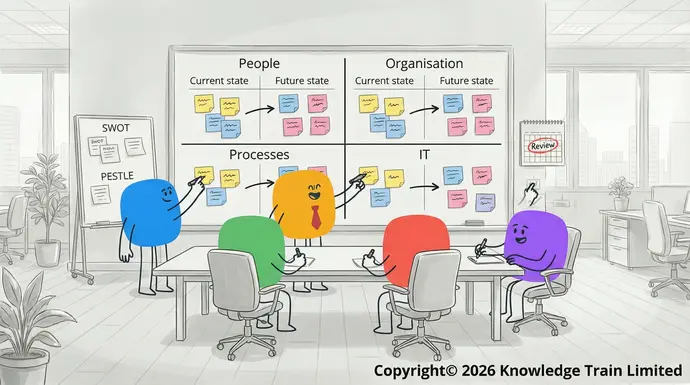
The POPIT modelSelf-paced serves as an effective framework for conducting BCS International Diploma in Business Analysis self-paced onlinegap analysis within an organisation. It enables analysts to identify discrepancies between current operations and desired future states. By examining each component – People, Organisation, Processes, and Information Technology – businesses can pinpoint areas needing improvement.£2,199 +vat
This structured approach highlights gaps, allowing organisations to devise targeted strategies for closing them. Regularly reviewing the POPIT model ensures that all aspects of the organisation are considered, facilitating comprehensive change management and strategic alignment.
Complementary tools SWOT and PESTLESelf-paced
Combining the POPIT model with other BCS Business Analysis Practice self-paced onlinebusiness analysis techniques such as SWOT and PESTLE analysis strengthens strategic planning. £749 +vatSWOT analysisEntry-level vs. advanced certifications provides insights into internal strengths and weaknesses, while Let’s now look at entry, mid and advanced qualifications.PESTLEEntry-level qualifications examines external influences. These insights complement the detailed focus of the POPIT model.Here, the only real choice is between BCS and AgileBA. PMI does not offer an entry-level qualification.
By combining these tools, organisations can achieve a well-rounded understanding of their strategic environment. This integrated approach enhances decision-making by providing clarity and a cohesive plan for achieving organisational goals.BCS Foundation
Best practices for implementing the POPIT modelIn the UK, this is certainly the level that most business analysts start with. The
Continuous review and adaptationBCS Foundation certificate in Business Analysis
Regularly updating the offers a broad introduction which helps students understand the role of BA, and the main business analysis techniques which they typically employ on projects.POPIT modelBCS Foundation is an excellent way to start learning the basics of business analysis and is the starting point for all higher BCS BA qualifications. Passing this knowledge based module is also a prerequisite for the advanced International Diploma. is crucial for reflecting organisational changes and evolving project needs. As the project progresses, revisit each component – People, Organisation, Processes, and Information Technology – to ensure they align with current objectives and strategies.AgileBA Foundation
Continuous review allows organisations to remain flexible, adapting to new challenges and opportunities. This ongoing process ensures that strategic decisions are informed by the latest insights, reducing uncertainty and enhancing organisational resilience.AgileBA Foundation
Engaging stakeholders is a growing qualification, especially in the UK and is particularly suited to those working in agile environments.
Involving key Most agile frameworks do not explicitly explain the business analyst role in agile projects because the role is expected to be performed by a member of an agile team. AgileBA Foundation fills this gap by helping students understand the context of the BA’s role on agile projects.stakeholdersIt is suitable for business analysts, product owners, project managers, and agile team members. in the POPIT analysis process is vital for achieving comprehensive outcomes. Engage a diverse group, including employees, management, and external partners, to gather varied perspectives. This collaboration fosters a shared understanding of goals and enhances commitment to the strategic plan.Mid-level qualifications
Encourage open communication and feedback to identify potential issues early. By actively involving stakeholders, organisations can ensure that the analysis is thorough and that the resulting strategies enjoy broad support, ultimately leading to more effective implementation.BCS offers a set of practitioner courses which build upon the knowledge gained at the BCS Foundation certificate level. The practitioner courses are more specialised and therefore provide a much deeper level of understanding and practical skills.
FAQsBCS Business Analysis Practice
How does the POPIT model differ from other strategic frameworks?BCS BA Practice
The is for people who already have a business analysis role and want to gain a deeper understanding of business analysis strategy and application.POPIT modelIt is suitable for business analysts, business managers and members of their team, business change managers and project managers. offers a holistic approach by focusing on People, Organisation, Processes, and IT, providing a comprehensive view distinct from other frameworks.This is one of two core modules you must hold before proceeding to the International Diploma.
Can the POPIT model be applied to small businesses?BCS Requirements Engineering
Yes, the BCS Requirements EngineeringPOPIT model is for people wanting to gain an understanding of the role that business, customer and requirements play within professional business contexts. is scalable and can be tailored to suit the specific needs and constraints of small enterprises.It is suitable for business analysts, project managers, systems analysts, product owners, product managers and those involved in business change processes and/or projects.
What industries benefit most from the POPIT model?This is one of two core modules you must hold before proceeding to the International Diploma.
Industries undergoing rapid change, such as technology and healthcare, greatly benefit from the structured analysis provided by the BCS Modelling Business ProcessesPOPIT modelModelling Business Processes. is for people who want to understand a range of business process modelling and analysis techniques, know how they are used and identify when to use them.
Are there software tools to assist with the POPIT model?It is suitable for business analysts, business managers and members of their team, business change managers and project managers.
Various This forms one of four optional module you must hold before proceeding to the International Diploma.business analysisAgileBA Practitioner and diagramming tools can support POPIT model analysis through visual mapping and documentation.AgileBA Practitioner
Infographic is for those wanting to apply agile business analysis principles, manage requirements, and drive value in complex organizational projects.