The what, why and how of AI governance in projects with Emanuela Giangregorio

Key takeaways
AI governance in projects becomes clearer when it is treated as a practical discipline for decision-making, risk control and responsible delivery.
- AI governance in projects is often poorly understood, which can lead to weak oversight and inconsistent decisions.
- Practical frameworks such as AIPGF help organisations apply AI more ethically, effectively and efficiently.
- AI governance can work alongside established methods such as PRINCE2, Agile and PMBOK rather than replacing them.
- Good practice supports those delivering change by clarifying responsibilities, controls and key risks.
- Structured training helps teams embed responsible AI use into real project and programme environments.
Introduction
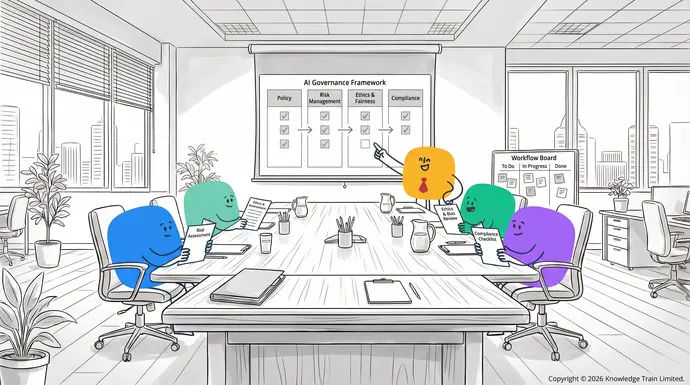
This webinar, developed with APMG International, explores why AI governance in projects is often poorly understood and what effective practice looks like. It offers practical guidance for people who are responsible for delivering change and managing risk. Whether you are starting to use AI in projects or reviewing existing approaches, it will help you think more clearly about what needs to be in place.
Video
Access the presentation, audio version, or read the full transcript.
About the speaker
Emanuela Giangregorio is an emerging authority in AI governance and the creator of the AI Project Governance Framework (AIPGF). She has over two decades of experience in strategic management consulting and project management and now works internationally as a trainer, coach and author. As an External Verifier for the triple accredited Em Normandie Business School, she has supported organisations since 2023 in embedding AI responsibly within project environments.
Her background spans private, public and third sectors across industries including energy, financial services, healthcare, logistics, media, manufacturing, PR and telecommunications. Her client portfolio ranges from small UK based businesses to large international corporations and influential NGOs. She has trained thousands of people around the world and has a knack for explaining complex topics simply.
Transcript
Here’s the full transcript of the webinar.
00:00:00 Sevcan Valiyeva : Feel free to introduce yourself and tell us where you come from.
00:00:03 Sevcan Valiyeva : I’m just going to give a few minutes while people enter.
00:00:21 Sevcan Valiyeva : I can actually see some regular, so that’s always nice.
00:01:11 Sevcan Valiyeva : Someone joined from the UK.
00:01:16 Emanuela Giangregorio : Looks like you’ve got a good turnout here today, Sevcan.
00:01:19 Sevcan Valiyeva : Yeah, definitely.
00:01:33 Sevcan Valiyeva : Dubai.
00:01:37 Sevcan Valiyeva : Okay, so just to give a bit of a background before I head over to Emanuela, I’m Sevcan. I’m the marketing executive for Knowledge Train.
00:01:44 Sevcan Valiyeva : We have Emanuela with us. She is the creator of AI project governance framework. We also have Alex with us. He is from APMG International.
00:01:55 Sevcan Valiyeva : So both, thank you so much for joining. Really appreciate it.
00:01:58 Sevcan Valiyeva : Just a few things.
00:02:00 Sevcan Valiyeva : Just a few things before.
00:02:02 Sevcan Valiyeva : So this session will be recorded. That is probably the most popular question I always get.
00:02:07 Sevcan Valiyeva : You will receive the recording, you will receive the audio version of the webinar alongside the transcription and the PDF version of the slides all in your inbox, most probably next week.
00:02:19 Sevcan Valiyeva : If you don’t, please e-mail me and I’ll make sure that you receive it.
00:02:24 Sevcan Valiyeva : So Emanuela, off to you.
00:02:27 Emanuela Giangregorio : Great, thanks very much for having me here, Knowledge Train and Sevcan particularly, and it’s great to have Alex joining as well.
00:02:35 Emanuela Giangregorio : So in terms of the agenda, what we’re going to be covering today is I’ll just tell you a little bit about me, the scheme owner, why the AI project governance framework is important now, an overview of the framework, who’s it for, and then a little bit about the certification scheme and Sevcan, you can come in there as well.
00:02:54 Emanuela Giangregorio : So just at a high level, I’ve been working in project management for some time, but my career actually started in a governance role.
00:03:02 Emanuela Giangregorio : And subsequently from there, I pivoted into project management, which I’ve been doing for more than 20 years as a management consultant and project manager, working around the world pretty much like many people here as well.
00:03:14 Emanuela Giangregorio : And I’ve published several books. But you know, in 2023 and 2024, and a bit of 25, I was teaching my clients how to use AI in projects to help them improve project workflows and so on. And I think we did a webinar, didn’t we, Sevcan, I think sometime in January 2025 about AI in projects.
00:03:35 Emanuela Giangregorio : My biggest concern then was there was just no governance and this is where my governance, I didn’t see any governance.
00:03:41 Emanuela Giangregorio : And so people started asking questions about it as well.
00:03:44 Emanuela Giangregorio : And so I decided to look for a framework that I could teach around.
00:03:48 Emanuela Giangregorio : There was nothing.
00:03:49 Emanuela Giangregorio : So I spent the best part of a year building from the ground up the AI project governance framework. And it’s essentially really about bringing into the project world how we can make the best use of AI and also make sure that we’re doing it in a well risk managed way.
00:04:08 Emanuela Giangregorio : So you’ve got the poll questions, haven’t you, Sevcan?
00:04:13 Alex Barbara : Yes, there we go.
00:04:14 Alex Barbara : That’s the first one.
00:04:15 Alex Barbara : So I’ll jump in and we’d love to get everyone’s feedback on this as well.
00:04:19 Alex Barbara : So the first poll, are you or your organisation using AI tools in project management?
00:04:24 Alex Barbara : I can see people are already flying in with the answers there.
00:04:33 Alex Barbara : Okay.
00:04:37 Alex Barbara : It’s pretty close with the second two.
00:04:42 Alex Barbara : Minor AI assistance, okay.
00:04:45 Alex Barbara : That seems to be the top.
00:04:50 Emanuela Giangregorio : That’s really interesting, Alex.
00:04:53 Emanuela Giangregorio : So we’ve got, not sure, some people not sure, some again, no AI assistance.
00:04:59 Emanuela Giangregorio : We’ve got minor some.
00:05:02 Emanuela Giangregorio : And then substantial, no one using it substantially.
00:05:07 Emanuela Giangregorio : So I’d say sort of the, you give it to minor and some, right?
00:05:09 Emanuela Giangregorio : Alex, if you look at those two together, gives us 50, about 80%, more than 80% are using some assistance and minor assistance.
00:05:17 Alex Barbara : Yeah, for sure.
00:05:18 Alex Barbara : I know Brian in the chat, he said that they’re using Copilot.
00:05:20 Alex Barbara : I think we also use a little bit of Copilot as well.
00:05:23 Alex Barbara : So I mean, that is technically AI assistance, right?
00:05:26 Emanuela Giangregorio : Yeah, absolutely.
00:05:27 Emanuela Giangregorio : And I think you guys can put in the chat box as well, maybe which tools you are using.
00:05:32 Emanuela Giangregorio : And I know many of my clients, maybe that’s true for some of you as well, the company only allows you to use Copilot because the idea is that it’s safer.
00:05:40 Emanuela Giangregorio : Is that the same for you guys, Alex?
00:05:42 Alex Barbara : Yeah, that’s exactly right.
00:05:43 Alex Barbara : We use it primarily because it’s the safer one to use.
00:05:48 Emanuela Giangregorio : Yeah.
00:05:49 Emanuela Giangregorio : These other tools are also bringing in more safety measures. And the problem that I’m seeing is some organisations are saying you can only use a particular tool.
00:05:58 Emanuela Giangregorio : And if that tool doesn’t have the full ability to assist in ways that maybe some of the other tools are able to provide some assistance, one of two things is happening or both.
00:06:09 Emanuela Giangregorio : In fact, one thing that happens is maybe people are not using the tool that much because you know what, it’s just quick.
00:06:13 Emanuela Giangregorio : If I do it myself, the tool’s not that great.
00:06:16 Emanuela Giangregorio : And then the other thing is this thing called shadow AI.
00:06:19 Emanuela Giangregorio : Do you know what shadow AI is?
00:06:20 Alex Barbara : I haven’t heard of that one though.
00:06:23 Emanuela Giangregorio : Yeah, shadow AI is basically where people are using tools that are not allowed.
00:06:27 Emanuela Giangregorio : So for example, if the company says you can only use Copilot, and that’s the official line, and instead people are actually using Claude or ChatGPT because they feel they’re getting better results, that’s called shadow AI.
00:06:38 Emanuela Giangregorio : What that means is the company doesn’t know what people are using and governance becomes even more difficult then.
00:06:43 Alex Barbara : Interesting.
00:06:44 Alex Barbara : OK, didn’t know that.
00:06:46 Emanuela Giangregorio : Right.
00:06:46 Emanuela Giangregorio : So that’s kind of leading into, why do we need the AI project governance framework now?
00:06:52 Emanuela Giangregorio : There are already quite a lot of certifications in the AI space.
00:06:58 Emanuela Giangregorio : I think, Alex, you’re familiar with the two about AI-driven project manager and what’s the other one?
00:07:04 Alex Barbara : Yeah, there’s two that we, I mean, there’s a few there, but two that I primarily have had some work with. So that’s AI-driven project manager, which is that’s a one-day certification that just trains project managers how to apply AI tools. The other one that I’ve also worked with is the artificial intelligence practitioner.
00:07:23 Alex Barbara : Thank you for the little arrow there.
00:07:24 Alex Barbara : And that’s a little bit different.
00:07:26 Alex Barbara : That’s a self-paced certification and that helps build really a broader use of AI.
00:07:31 Alex Barbara : So these two though, however, I would say completely different to AIPGF, wouldn’t you, Manny?
00:07:37 Emanuela Giangregorio : Absolutely, yeah.
00:07:37 Emanuela Giangregorio : So these tools are like how to use AI and where the AIPGF comes in is how to ensure that it’s governed in a project context.
00:07:47 Emanuela Giangregorio : So there are, you know, international standards around AI governance. There is the EU AI Act in America. There’s the NIST, the North American, basically a risk management framework.
00:08:00 Emanuela Giangregorio : So there’s a lot of overarching frameworks, standards, regulations. The EU AI Act is, you know, by law needs to be enforced. But they’re also very much at the enterprise level. And until I built the AI project governance framework, there was nothing that shows projects, people like PMOs and project managers, how to practically activate what those things are saying at the higher level within projects and programs.
00:08:27 Emanuela Giangregorio : So that’s essentially really what it’s aiming to do. And it’s important because, you know, if you all think about it, organisations have their strategic priorities that they need to deliver. And senior managers are accountable to the board for delivering those strategic priorities. Most often the organisation’s strategy is executed through projects and programs.
00:08:48 Emanuela Giangregorio : So that’s where it’s all happening. And so if projects and programs are using AI, and most often, it’s great providing fantastic assistance, but if it’s not well governed, that’s where risks creep in. And that’s really why it’s very, very important to get it right.
00:09:04 Emanuela Giangregorio : We also know that AI adoption is increasing rapidly. Not only AI adoption, but AI automation.
00:09:12 Emanuela Giangregorio : You know, back in 2024, I only got back as far as 24 even, you know, there were things that, you know, ChatGPT and the tools that maybe you were playing with couldn’t generate slides.
00:09:23 Emanuela Giangregorio : Now they can do that. There was so much that the tools couldn’t do. And back in 24 and 25, new models were being released perhaps every month, every quarter, then every month. Now, if you’re paying attention to what’s going on, new models are released every week. And it’s really difficult to keep up to date.
00:09:40 Emanuela Giangregorio : So not only new models, but new capabilities within the models that you might be using. So the level of adoption is increasing. The level of complexity and also automation is increasing as well. And you might have heard of agentic AI, which is where agents are kind of doing the work and delegating to other agents too. So automation increases as well.
00:10:01 Emanuela Giangregorio : And governance of how AI is used in projects is getting more attention at board level because it’s becoming an important thing where boards need to show that they are able to provide evidence of the governance. And so really this is what the AI project evidence framework aims to do.
00:10:19 Emanuela Giangregorio : Now, people sometimes do ask me what is the difference between, for example, the ISO standard, the framework, and then also things like the project management, the AI project management training that Alex mentioned.
00:10:32 Emanuela Giangregorio : So you can have, you can learn how to use AI in projects, right?
00:10:36 Emanuela Giangregorio : So think of standards and also regulations, but standards like the ISO 24001, like think of it as a global best practice standard providing rules for any means of transportation. So these are the rules for any means of transportation, whether it’s planes, automobiles, drones, what’s happened to cars, ships and all these different things. These are the rules for any means of transportation.
00:11:02 Emanuela Giangregorio : Think of the AI project governance framework as basically the guidance on how to drive well on the roads, right? That’s really what it is. So it’s just about how the road, the rules for the road.
00:11:16 Emanuela Giangregorio : Whereas training on how to use AI is basically at the car level. So we’ve got all these different cars, in other words, all these different AIs. How do you drive the cars? And the difficulty there is the cars keep changing or the car ‘s ability keeps on upscaling. So you kind of have to refresh yourself each time you learn how to use one of these cars, whether it’s Claude or ChatGPT, etc.
00:11:38 Emanuela Giangregorio : The AI project governance framework is a fairly reasonable set of guidance around those rules essentially. And it’s not going to change. In fact, the way it was built was designed to ensure that it can actually be adaptable as the technologies change as well.
00:11:55 Emanuela Giangregorio : Does that analogy make sense, Alex?
00:11:57 Emanuela Giangregorio : Maybe if you can.
00:11:58 Alex Barbara : I like that.
00:11:59 Alex Barbara : Yeah, no, I like that.
00:11:59 Alex Barbara : I think how we also explained it here was the other, the AI tools that we already have or that we’re working with on certifications is how to use AI.
00:12:08 Alex Barbara : AIPGF is what you’re using AI already, but how do you add the layer of governance over the top of it?
00:12:14 Alex Barbara : That’s why I think it’s just so different to what we’ve already got in the portfolio as well.
00:12:18 Emanuela Giangregorio : Yeah, that’s a really good summary.
00:12:20 Emanuela Giangregorio : So I mentioned the EU AI Act. There’s also standards and more regulation is happening.
00:12:27 Emanuela Giangregorio : Also evidence of AI governance in project management is and will be a competitive differentiator, not only against competitor organisations, but also organisations are competing for the best talent.
00:12:40 Emanuela Giangregorio : And so people want to know that they are going to be working in a forward-thinking organisation where there are career paths and looking at other ways, better ways of working.
00:12:49 Emanuela Giangregorio : And it’s great to see now as well when I first launched the framework in January 2025, I didn’t see jobs that sort of put project management and governance together.
00:12:59 Emanuela Giangregorio : And now, I don’t know if you can see on the slide, it’s a bit small, but there’s, you know, there are jobs like this one here, which is the AI governance and project management specialist. So people can already start thinking about, if you want to stay ahead in your career in project management, or if you want to pivot and specialise, then it provides you the opportunity to do that.
00:13:20 Alex Barbara : Right, okay, so this is the second poll of today.
00:13:23 Alex Barbara : Thank you.
00:13:24 Alex Barbara : So if your organisation was audited today, would they be able to demonstrate that every AI use in projects is purposely planned, monitored and evaluated?
00:13:34 Alex Barbara : So what’s the first we’ve got?
00:13:35 Alex Barbara : Definitely, we would pass, partially,
00:13:38 Alex Barbara : And no, we’d be in trouble.
00:13:40 Alex Barbara : OK, let’s have a look.
00:13:43 Alex Barbara : There’s quite a lot of we’d be in trouble there.
00:13:49 Emanuela Giangregorio : Yeah, and bear in mind the polls, these are confidential as in we don’t get to see who’s.
00:13:54 Alex Barbara : Yeah, Interesting though to see, isn’t it?
00:13:57 Alex Barbara : Interesting.
00:13:58 Emanuela Giangregorio : Yeah, you know,
00:14:00 Emanuela Giangregorio : I’m not surprised because when I speak to my clients, that’s exactly now hosted roundtables and all these things. And when I ask this question, this seems to come, this seems to be generally the profile.
00:14:11 Emanuela Giangregorio : Hey, it’s great to see, definitely we would pass.
00:14:14 Emanuela Giangregorio : That’s wonderful.
00:14:16 Emanuela Giangregorio : Maybe the person or the people in the chat box could indicate like what type of organisation it is, because that’s really wonderful to see that people are starting to take this seriously.
00:14:26 Emanuela Giangregorio : We’ve got 42% partially, there would be some findings and then about 1/3, just less than 1/3, now we’d be in trouble.
00:14:35 Emanuela Giangregorio : So the good thing is that the governance gap is starting to close, right?
00:14:40 Emanuela Giangregorio : But if you put the partially and the not, so the 30 and the 40 together, over 70% really kind of aren’t able to kind of demonstrate it to the extent that they should. And it’s because the mechanisms aren’t always there, right? It’s really important to understand how to do that.
00:14:59 Emanuela Giangregorio : Also, people don’t have time sometimes, you know, people work in very lean teams, whether it’s PMO or project teams and so on.
00:15:06 Emanuela Giangregorio : And, you know, some people think, okay, well, the fact that we have an AI policy at enterprise level and the fact that we can only use Copilot means the governance box is ticked.
00:15:15 Emanuela Giangregorio : But that’s not the case at all, as we know.
00:15:21 Alex Barbara : Okay, interesting.
00:15:22 Alex Barbara : There we go.
00:15:24 Emanuela Giangregorio : Shall we go then into an overview of the framework?
00:15:27 Emanuela Giangregorio : So first of all, people think that AI governance is just about controlling access. It’s more than that, right? If you think about the risks, what can go wrong?
00:15:39 Emanuela Giangregorio : Of course, there are risks relating to getting, the AIs getting access to data that they shouldn’t or this confidential data being sort of exposed or manipulated, etc.
00:15:49 Emanuela Giangregorio : There’s also those types of risks. There are risks relating to incorrect decisions being made or poor quality deliverables being sort of that go out to clients or to senior managers in organisations, etc. But also a risk is to do with inefficiency.
00:16:05 Emanuela Giangregorio : In other words, we’re wasting time.
00:16:07 Emanuela Giangregorio : And so the aim is to use AI to help improve project productivity. But if it’s actually detracting from that, then that’s a risk to the project too.
00:16:15 Emanuela Giangregorio : So remember the three things. AI governance, the scope of AI governance is about ethical use, effective use and efficient use. And these three together in any framework really should kind of make sure that we can provide assurance to senior managers, auditors and so on that this is in place.
00:16:34 Emanuela Giangregorio : So the framework is built on a foundation of three key principles. And the first one, of course, no surprise being human centricity. And what that means is regardless of the degree of AI automation, and AI independence even, regardless of that degree, there always needs to be some sort of human checking.
00:16:56 Emanuela Giangregorio : So that you might have heard of the human in the loop rule, always the human in the loop rule stays, right?
00:17:01 Emanuela Giangregorio : So again, in some situations, we have lots of granular checks, but as these tools become more agentic and start doing more and more, you know, building complete project schedules and raid logs, etc., and updating things in real time,
00:17:17 Emanuela Giangregorio : The risk is always that people get less involved because they’re busy focusing on other things, but we need to make sure that we check everything as well.
00:17:24 Emanuela Giangregorio : So human centricity, transparency, and this is about making sure that if we are challenged, back to the previous poll question that Alex had there, but if we are challenged, we are able to show how a decision was made, how a deliverable was created, who checked what, etc. And so that’s really important that we have that audit trail available.
00:17:43 Emanuela Giangregorio : There’s something called explainable AI, XAI, and some of the AI tools have that built in.
00:17:48 Emanuela Giangregorio : So their creators, some of the frontier labs like Anthropic who have Claude, build that in. So you can actually see like its thought process and you can actually have that as a record if you need to keep it in terms of how it got to a decision or a particular rationale.
00:18:02 Emanuela Giangregorio : And then the third principle is adaptability. And this is really for the framework’s design. So it is human-centric, it’s building in the transparency, but also needs to be adaptable to the organisation context.
00:18:15 Emanuela Giangregorio : So some organisations have a small number of projects, others have many projects. Some organisations are still in the early stages of standardising their project governance. In other words, having a standard set of project templates and tools that people can use. Others are way down the line.
00:18:31 Emanuela Giangregorio : They’ve got very mature project processes. So the organisation context needs to be tailored to that. Also tailored to the degree of AI adoption, as I said, the degree of AI automation, but also the degree of maturity regarding AI governance.
00:18:46 Emanuela Giangregorio : So the person or the people that said, actually, we would be fine if we were audited, that means you have a high level of AI governance maturity.
00:18:53 Emanuela Giangregorio : Those on the other end have a low level of AI governance maturity, which means more needs to be done to put these things into place.
00:19:01 Emanuela Giangregorio : And so the framework is a combination of mindset and method. The mindset part is the principles. It has five core values and then the core behaviors that help teams understand what’s important. Whereas the method part is we have 3 life cycle stages, foundation, activation, and evaluation, and these map onto any existing project management approach that you have. And in each of those stages, we have aims, activities and deliverables.
00:19:32 Emanuela Giangregorio : So actual templates that show teams what you can bring in to your project process to help bring in the governance for that.
00:19:40 Emanuela Giangregorio : And this slide is really just showing a mapping very simply to, for example, iterative delivery methods like Agile, where, you know, how does the framework map to that, where you have more iterative delivery compared to some maybe more waterfall style approaches, PRINCE2, PMBOK
00:19:59 Emanuela Giangregorio : And hybrid approaches as well, so essentially, regardless of the actual project methodology that you’re using, this integrates with that.
00:20:06 Emanuela Giangregorio : So, if your organisation already has a project management framework that it’s using, what we do is build in the activities and deliverables within that framework so that they can bring the governance. In some cases, the artifacts or deliverables are individual documents on their own for very complex types of projects and programs. In other cases, they are just embedded within your document.
00:20:28 Emanuela Giangregorio : So for example, if you have a project charter, you might have one heading that says AI assistance plan and you build it into that process. And I’ve spoken about the flexibility around that as well. So I won’t go too much on this slide because I’d like to make sure we have enough time for questions as well.
00:20:46 Emanuela Giangregorio : In addition, the framework is accompanied by a capability and maturity model. And this is really important because there are four pillars of measurement. And these four pillars are AI strategy and governance, AI tools and infrastructure, human capability and accountability, and data readiness and quality.
00:21:05 Emanuela Giangregorio : So this instrument essentially is a set of 16 questions, 4 questions per pillar. So you’ve got 16 questions across the four pillars. And when you answer those questions, you get to see really where you are within that capability maturity model.
00:21:21 Emanuela Giangregorio : Like most CMMs, it’s got 5 levels, ad hoc, initialised, standardised, enterprise, and optimised. So ad hoc is pretty much like everyone’s doing their own thing. There’s no governance in place.
00:21:33 Emanuela Giangregorio : Initialised, we’re starting to think about it. In fact, we have some ways of bringing governance into projects.
00:21:39 Emanuela Giangregorio : Standardised is at least within, let’s just say you work for a very large organisation, at least within one part of the organisation or one team, we have a standardised approach to governing how AI is used in projects, maybe using the AI project governance framework or something similar.
00:21:55 Emanuela Giangregorio : At the enterprise level, basically across the organisation, this is now embedded.
00:21:59 Emanuela Giangregorio : And then finally at the optimised level, we’ve got the governance sorted and we’re continuously improving as the AI tools evolve and we’re kind of building in these checks. People at the optimised level become sort of leaders in the field when it comes to AI governance in projects.
00:22:15 Emanuela Giangregorio : So there’s a link that you can go to complete the assessment.
00:22:20 Emanuela Giangregorio : But first, what we’re going to do is switch to a poll.
00:22:25 Alex Barbara : Yep, AIPG, there’s the overview.
00:22:27 Alex Barbara : So this is the poll number 3, I think the final one, if I’m not mistaken.
00:22:30 Alex Barbara : But where would you score your organisation’s AI governance maturity in projects?
00:22:36 Alex Barbara : And you’ve got the four levels there.
00:22:38 Alex Barbara : It’d be interesting to see what people come back with on this one.
00:22:44 Emanuela Giangregorio : Yeah, I’m really keen to see this because we had a pulse report.
00:22:47 Emanuela Giangregorio : So data gathered between January and May 2026 would be the pulse report, which you can find on the website as well.
00:22:56 Emanuela Giangregorio : And that showed that most of the people were at the initialised level.
00:23:01 Emanuela Giangregorio : So we had like 77% at the initialised, small number at standardised, actually no one at enterprise and very many also at the level one, which was the ad hoc level.
00:23:14 Alex Barbara : That doesn’t that doesn’t surprise me.
00:23:15 Alex Barbara : Does that surprise you, Manny, that it’s at level one?
00:23:18 Alex Barbara : Most of the most of the people voting.
00:23:20 Emanuela Giangregorio : It’s kind of almost like a tie between level one and level 2.
00:23:23 Alex Barbara : Yeah.
00:23:24 Emanuela Giangregorio : Level 1 increasing here.
00:23:26 Emanuela Giangregorio : Yeah.
00:23:27 Emanuela Giangregorio : And thanks for your honesty, everyone, too.
00:23:29 Emanuela Giangregorio : Also good to see some people sort of more at the.
00:23:33 Emanuela Giangregorio : Enterprise level.
00:23:33 Emanuela Giangregorio : So do, yeah, take your time.
00:23:34 Emanuela Giangregorio : We’re not rushing.
00:23:35 Emanuela Giangregorio : Read the definition so you’re very clear.
00:23:37 Emanuela Giangregorio : And sometimes you might be between levels.
00:23:39 Emanuela Giangregorio : When you are, when you complete the actual assessment tool, you can put like a 1.5 because sometimes you go like, we’re not quite one, we’re not quite two, we’re 1.5, so you could be between.
00:23:49 Emanuela Giangregorio : But in this poll, we just wanted to keep it simple.
00:23:51 Alex Barbara : Yeah.
00:23:54 Emanuela Giangregorio : Oh, we lost it there.
00:23:55 Emanuela Giangregorio : So, Sev, do you mind bringing the back up again for us?
00:23:57 Emanuela Giangregorio : Is it still available to see?
00:23:59 Emanuela Giangregorio : Oh no, I’m not sure.
00:24:00 Emanuela Giangregorio : Let me check.
00:24:01 Emanuela Giangregorio : Oh, never mind.
00:24:02 Emanuela Giangregorio : Okay, we’ve got the snapshot there.
00:24:03 Emanuela Giangregorio : Thank you everybody for your contributions to that.
00:24:06 Emanuela Giangregorio : But again, you know, so a small number at enterprise level and maybe that links in with the previous poll.
00:24:12 Emanuela Giangregorio : I wouldn’t be surprised if it does.
00:24:14 Emanuela Giangregorio : And in fact, actually the two polls, polls two and three actually do have an alignment, don’t they?
00:24:19 Emanuela Giangregorio : So what does that mean?
00:24:21 Emanuela Giangregorio : If you’re at level one that you know you’re not going to sort of aim to get to enterprise straight away, you really need to think about the activities that you can take just to jump to level 2.
00:24:29 Emanuela Giangregorio : If you’re at level 2, there’s a list of things you can do to jump to level 3 and so on, level 3 to level 4.
00:24:35 Emanuela Giangregorio : So with each of these, again, I encourage you, if you want to, go to the official website, put in the chat box when we start looking at questions and complete the self-assessment. It will be, you get a two-page report
00:24:52 Emanuela Giangregorio : I’m just putting it in the chat box now so you’ve all got the link, but please don’t go ahead and do it now because we want your attention until we get to the end of the session.
00:24:58 Emanuela Giangregorio : So there it’s in the link while I remember it’s in the chat box.
00:25:01 Emanuela Giangregorio : But you’ll get a two-page report which shows where you’re at and also some guidance on how to kind of get to the next level as well.
00:25:08 Emanuela Giangregorio : The whole point with this is it’s all very well having a framework that shows how to govern how AI is used, but one of the core values is continuous improvement. And sometimes we need to demonstrate to the organisation or make a case for like why we need to put more effort into it.
00:25:22 Emanuela Giangregorio : If we can show, look, we’ve evaluated where we’re at.
00:25:26 Emanuela Giangregorio : We’re at 1.5. This is the work we need to get to level 2. You can start making a case for that. And also then as you start maturing, you can also demonstrate that assurance as well.
00:25:37 Emanuela Giangregorio : Who should complete this?
00:25:39 Emanuela Giangregorio : It’s great if you complete it yourself, but actually maybe people do challenge independence and objectivity. So it might be good for maybe a group of people to do it together or independent functions like internal audit or people that are not going to be biased in their assessment as well. That is helpful too.
00:25:57 Alex Barbara : Okay, so we are #4 now.
00:25:59 Alex Barbara : So yeah, I was just thinking this in my brain and who is the, who is AIPGF for?
00:26:04 Alex Barbara : So who is the ideal target audience for this one?
00:26:08 Emanuela Giangregorio : Right.
00:26:08 Emanuela Giangregorio : And it’s not everyone, right?
00:26:10 Emanuela Giangregorio : So it’s not like everyone who uses AI.
00:26:12 Emanuela Giangregorio : I’ve categorised into three key sort of roles.
00:26:16 Emanuela Giangregorio : One is those people who have some sort of project portfolio or strategic oversight role. So PMOs or SPOs, strategic programs, offers people to people in those roles, people who play roles as a project sponsor, those sort of strategic oversight roles. And they essentially would be the ones to champion AI governance, because if people are just told you need to bring governance into your project, but there’s no championing from sort of the top, it becomes very difficult because you need the time and the space to do that. So that’s really sort of the first layer.
00:26:47 Emanuela Giangregorio : Then of course, within project and program delivery in all the delivery roles, because they are the ones that are actually activating the governance activities.
00:26:57 Emanuela Giangregorio : And then there’s governance and assurance roles, compliance roles. So these would be the ones that we’d be auditing that. So in other words, they now know what good looks like and then they can go then have a look independently and objectively and appraise the degree of AI governance. So it’s quite a lot of people if you think about job functions, but it’s not everyone, right? It’s just, it’s really basically focusing in the world of AI governance in projects and programs.
00:27:20 Emanuela Giangregorio : Does that make sense?
00:27:21 Alex Barbara : Yeah, exactly right.
00:27:25 Emanuela Giangregorio : So for organisations, by adopting some sort of framework like this one, it helps them stay ahead with AI governance in projects. And also my clients that are putting this in place now are very much aware that regulation is going to increase and eventually these things will be by law you have to have these things in place.
00:27:43 Emanuela Giangregorio : And then it becomes like a chaotic catch up amongst everything else.
00:27:46 Emanuela Giangregorio : It’s basically staying ahead of the curve. And then when you are challenged to evidence things, it’s going to be easy to do that. And also we’ve got the capability maturity benchmark, which really helps organisations show where they are and what they’re aiming to get to and how.
00:28:03 Emanuela Giangregorio : For candidates, really good for you to be able to show leadership and staying ahead in your career. And as I said earlier, a new or pivoted career path or job security.
00:28:14 Emanuela Giangregorio : You know, you’ve heard so many people talk about, you know, people, you’re not going to lose your job to AI, you’re going to lose your job to people who know how to use AI the best.
00:28:22 Emanuela Giangregorio : But not only that, those are able to show the governance too. Because that’s really where people are going to be held more accountable.
00:28:30 Emanuela Giangregorio : I’d say in 2025, a lot of the LinkedIn posts, and I suppose it depends what the algorithm feeds as well, very much so, but I often search for things, but there was a lot on what the tools can do.
00:28:41 Emanuela Giangregorio : And I’d say best part of this year so far, there’s been a lot more, a lot of awareness on governance because it’s becoming an important topic.
00:28:51 Alex Barbara : And #5, the certification scheme, very important one.
00:28:55 Alex Barbara : I think it’s over to Sevcan, is that right?
00:28:59 Emanuela Giangregorio : Yes, Sev, perhaps you can talk about it from a Knowledge Train perspective because APMG International have
00:29:07 Emanuela Giangregorio : looked at the framework for it looks actually really quite robust and rigorous.
00:29:11 Emanuela Giangregorio : And so let’s have a two-tier certification.
00:29:13 Emanuela Giangregorio : So there’s the foundation, which is a theoretical understanding of the framework and its elements.
00:29:18 Emanuela Giangregorio : And then there’s the practitioner, which is really, if you pass the practitioner, you’re showing you know how to practically tailor it to different contexts and how to use it in the real world.
00:29:30 Emanuela Giangregorio : How is knowledge?
00:29:30 Emanuela Giangregorio : What is Knowledge Train offering around this?
00:29:33 Sevcan Valiyeva : That’s well said.
00:29:34 Sevcan Valiyeva : I mean, who can say it better than the scheme owner?
00:29:37 Sevcan Valiyeva : I mean, so as Emmanuela mentioned, we have both foundation and the practitioner.
00:29:44 Sevcan Valiyeva : We have the option to do a live classroom. So that is with an instructor, an accredited instructor.
00:29:52 Sevcan Valiyeva : So that’s that.
00:29:53 Sevcan Valiyeva : We also have the option to do it as an in-house training where it can be fully bespoke. We can come to your organisation or it can be a specific location.
00:30:03 Sevcan Valiyeva : That’s absolutely fine.
00:30:04 Sevcan Valiyeva : Or alternatively, we can also set it online for organisations as well.
00:30:10 Sevcan Valiyeva : Our next public course will be on the 12th of October. That’s the foundation one.
00:30:16 Sevcan Valiyeva : If you do have any questions, I’m going to pop my e-mail.
00:30:23 Sevcan Valiyeva : Slow typo.
00:30:26 Sevcan Valiyeva : Yeah, okay.
00:30:29 Sevcan Valiyeva : Feel free to e-mail me with any questions about the course or about the webinar or generally anything, even other courses if you wish as well.
00:30:37 Sevcan Valiyeva : So that’s my e-mail and I think we can move on to the Q&A.
00:30:41 Emanuela Giangregorio : Fantastic.
00:30:42 Emanuela Giangregorio : I don’t see any questions in the chat box unless you saw them.
00:30:44 Emanuela Giangregorio : So you can have a look, but I just want to focus on a comment.
00:30:47 Emanuela Giangregorio : Thank you.
00:30:48 Emanuela Giangregorio : Generative AI training is mandatory for all employees in our company. And the company introduced enterprise generative AI, which is fantastic.
00:30:57 Emanuela Giangregorio : You know, a lot of my clients, they get the tools, but they don’t get the training. And it’s great that a GenAI training is compulsory for everybody because then at least people know how to use the tools or at least, you know, the basics of the tools.
00:31:08 Emanuela Giangregorio : So that’s really great to see.
00:31:10 Emanuela Giangregorio : You’ve also
00:31:11 Emanuela Giangregorio : I also got to say these help to educate and limit the AI tools that employees can use.
00:31:15 Emanuela Giangregorio : Therefore, I think they can pass the audit.
00:31:18 Emanuela Giangregorio : I’d like to maybe say I don’t know for sure.
00:31:23 Emanuela Giangregorio : We’d have to see.
00:31:24 Emanuela Giangregorio : So just because people know how to use the tools and what they can and can’t do doesn’t mean that necessarily that they will pass the audit. Because what the audit is going to look for is things around like if they’re an audit trial for like let’s just say, and again, we’re thinking more, GenAI tools, which for everyone to know, GenAI is tools like that you might be using, like Copilot, ChatGPT, Gemini, Claude, etc., where they’re generating content for you. Not any documents, but it could be code, all these different things.
00:31:54 Emanuela Giangregorio : So, you know, you’ll pass the audit if you can show, if you are challenged, if you show an audit trail of how a deliverable was created and who signed it off.
00:32:03 Emanuela Giangregorio : Right?
00:32:04 Emanuela Giangregorio : So is there a human to sign it off?
00:32:05 Emanuela Giangregorio : And if you show the human in the loop checking, so you can say, okay, this is the final deliverable.
00:32:10 Emanuela Giangregorio : This is the human that checked it and approved it, and they are accountable, and this is how it was created, then you’ll pass the audit.
00:32:17 Emanuela Giangregorio : So that’s really how I want you to think about it. And it’s more than that as well, because remember I said it’s ethical, efficient, and effective use.
00:32:23 Emanuela Giangregorio : So those four pillars that we had around the capability maturity model, AI strategy and governance is, there guidance to project teams regarding how they need to govern AI in projects? So have they been practically given some sort of framework and guidance in terms of how to do that and the rules around that, what they can and cannot do? And I think this comment in the chat box is saying pretty much that.
00:32:46 Emanuela Giangregorio : Then the next pillar was about AI tools and infrastructure. So the tools now are becoming more agentic because as I said, some of these can interface with other parts of the organisation’s infrastructure.
00:32:58 Emanuela Giangregorio : So is that done in a well-managed and secure way?
00:33:01 Emanuela Giangregorio : And I would say from what I’ve seen, most often that security is taken very seriously and most often that’s done really well.
00:33:07 Emanuela Giangregorio : The third pillar was human capability. Something to do with people’s ability. And the comment about everyone’s getting GenAI training, fantastic.
00:33:16 Emanuela Giangregorio : So people know how to use the tools, but they also understand the core values in terms of accountability.
00:33:22 Emanuela Giangregorio : So always a human accountable.
00:33:24 Emanuela Giangregorio : Sensibility, so knowing what you’re looking at and being able to check it. Collaborating well with tools, in other words, knowing how to work with the tools well. And then the curiosity, which is about finding new use cases and continuous improvement.
00:33:38 Emanuela Giangregorio : So that’s that part.
00:33:39 Emanuela Giangregorio : And the 4th one, which is the one often lets people down is around data.
00:33:43 Emanuela Giangregorio : So a tool is only as good as two things most often.
00:33:47 Emanuela Giangregorio : One is it’s as good as the users know how to use it. And if you’re getting the training, you know how to use it well, that’s great.
00:33:53 Emanuela Giangregorio : The second thing, it needs data. So if it doesn’t have access to quality data, it can’t produce quality results. And what I mean by that is most organisations don’t keep previous projects lessons learned logs, if they do lessons learned, risk logs, issue logs, change logs, project charters or PIDs, project initiation, we have this was our baseline plan, this is what actually happened. So if you kept all that information and had that available to your AI assistant, it can help you so much more because it knows the backstory.
00:34:24 Emanuela Giangregorio : Now at the moment it’s in people’s heads, but if you have quality data available to the AI tools, they can then help you so much more and you can then have a stronger element of efficient and effective use of AI.
00:34:36 Emanuela Giangregorio : Okay, I’m going to have a look at the chat box.
00:34:40 Alex Barbara : Yeah, we’ve got a few questions.
00:34:41 Alex Barbara : I did actually see an interesting comment from Brian is they actually have a person assigned to AI compliance, which I think is a good thing, right?
00:34:50 Emanuela Giangregorio : Yeah, absolutely.
00:34:51 Emanuela Giangregorio : And quite many organisations do.
00:34:52 Emanuela Giangregorio : I’d be interested to know if they actually look within projects and programs as well.
00:34:57 Emanuela Giangregorio : So quite often we have an AI compliance person and it’s kind of giving guidance at the enterprise level.
00:35:04 Emanuela Giangregorio : But is there clarity on how to do it at the project and program level specifically where the action is happening?
00:35:11 Emanuela Giangregorio : With the time we have available, Alex, I’m going to let you ask me the questions.
00:35:14 Alex Barbara : Yeah, I’ll shoot through.
00:35:15 Alex Barbara : We’ve got a couple here.
00:35:16 Alex Barbara : So Miriam said, if you were starting from scratch with AI in a PMO, what would be your first step?
00:35:23 Emanuela Giangregorio : I would say the first thing I would do, so we’re starting from scratch within a PMO, and then that’s sort of the key, the place to start, is understand what level you’re at. Right?
00:35:35 Emanuela Giangregorio : And so something you might just know intuitively, we’re at level 1 ad hoc or level 2 initialise, so kind of know where you’re at. Also be, maybe take an audit of all the tools that are being used and encourage people to be honest as well.
00:35:46 Emanuela Giangregorio : So if there is a shadow AI, understand why, right? So we kind of want to start with that.
00:35:51 Emanuela Giangregorio : So maybe start with like, where are we at in terms of the level of governance?
00:35:55 Emanuela Giangregorio : What are the tools that are being used?
00:35:57 Emanuela Giangregorio : And then also, obviously, your organisation might have an overarching policy. So we always need to comply with whatever that policy might be.
00:36:04 Emanuela Giangregorio : So start with where are we now?
00:36:07 Emanuela Giangregorio : And then think about where do you want to be, right?
00:36:08 Emanuela Giangregorio : So we aim to get to this next level, which looks like this. So these are the key things that we need to do. And then that becomes your priority actions to sort of embed that in.
00:36:19 Emanuela Giangregorio : You can take the AI project governance framework, which actually lists out the actions you can do. So at each of the stages in your project. So if you have already within your PMO a standardised project management framework, maybe just tailor that, but not fully, because people might freak out just maybe a few things, right?
00:36:36 Emanuela Giangregorio : So what do we do in the sort of first stage of the project?
00:36:39 Emanuela Giangregorio : What little bit of extra governance can we inject to evidence that governance is being built into that?
00:36:44 Emanuela Giangregorio : So maybe an AI assistance plan. And you can look at the example in the book. And so what I would do is maybe light touch governance, because we know when you try to introduce too much people and think that that’s too much bureaucracy. And this fact is not even designed that way. It’s actually is very much sort of light to touch throughout.
00:37:04 Emanuela Giangregorio : But I would say be very clear where you are, examine where you want to be realistically, and then have that short list of actions that you can take and bring into your governance model.
00:37:16 Alex Barbara : That’s great, Manny.
00:37:17 Alex Barbara : Thank you.
00:37:18 Alex Barbara : Thanks for the question, Miriam.
00:37:19 Alex Barbara : So a question from Brian, he said, are there specific regulations or guidelines around AI use in the healthcare industry?
00:37:26 Alex Barbara : Interesting question that.
00:37:28 Emanuela Giangregorio : Yeah, thanks.
00:37:29 Emanuela Giangregorio : So there’s, if you’re in healthcare, you’ll be familiar with GMP, Good Manufacturing Practice and those sort of things around the regulations.
00:37:37 Emanuela Giangregorio : In healthcare, you work in a very highly regulated industry. I’m not familiar with any AI standards or
00:37:47 Emanuela Giangregorio : or regulations specifically to do with AI in healthcare.
00:37:52 Emanuela Giangregorio : So, if your organisation is operating in the EU, then you will be having to comply with the EU AI Act. And the EU AI Act has two parts of it. It’s the one aspect is around people that are developing AI solutions and those that are deploying AI solutions. Developing is that if they’re creating, for example, AI powered healthcare solutions, that’s developers and then deployers, people that are using AI.
00:38:17 Emanuela Giangregorio : In fact, one of the rules, one of the regulations is AI literacy. Everybody who’s using AI needs to be AI literate.
00:38:23 Emanuela Giangregorio : But I’m sorry to go on too much on that one, but yeah, I’m not aware of an AI, of a healthcare industry specific AI guidance.
00:38:32 Alex Barbara : Okay, interesting.
00:38:33 Alex Barbara : Thanks for that question, Brian.
00:38:34 Alex Barbara : So James says here, we have set up workshops within a firm to understand people’s experience and where the company can engage in using AI in our work streams.
00:38:43 Alex Barbara : Very much an employee-driven process right now.
00:38:46 Alex Barbara : So not a good lot of question, but an interesting point. And quite often that’s, the case.
00:38:52 Emanuela Giangregorio : And I actually think sometimes people wait for, top levels to kind of push the stuff down. I think sometimes it happens better when it’s employee driven as well. You’re close to the coalface. You are the ones that are kind of, you know, operationalising all the work that needs doing.
00:39:07 Emanuela Giangregorio : So, you know, I quite love an employee driven approach. I think you need both really. You need the permission and the mandate and the requirement and then the, you know, the desire and the understanding why it’s important.
00:39:19 Emanuela Giangregorio : important for it to be employer driven.
00:39:21 Emanuela Giangregorio : It’s great to have both, but if you don’t, it’s great to see that we have employee driven initiatives.
00:39:27 Alex Barbara : Definitely.
00:39:27 Alex Barbara : Thanks.
00:39:28 Alex Barbara : Thanks for that one, James.
00:39:28 Alex Barbara : So on to the next.
00:39:30 Alex Barbara : So Rebecca says, I’m the only one in my team using Copilot in projects.
00:39:33 Alex Barbara : I’ve already started using audit trails to ensure that anyone else looking at the data can understand the results that have been given.
00:39:39 Alex Barbara : So that’s interesting and well done as well.
00:39:42 Emanuela Giangregorio : And maybe just one thing to do if you haven’t done so yet, is what you want to do is then also just like put whichever documentations you are using, put the like approved by or reviewed by and the human, the person’s name, right? And sometimes you can say, reviewed by, I don’t know, Copilot and approved by yourself.
00:39:58 Emanuela Giangregorio : So always, part of your audit trail, it’s great that you’ve got that and have an overt human approver.
00:40:05 Emanuela Giangregorio : In the AI Project Governance Framework book, in the front matter, I’ve actually declared the tools that I’ve used to help assist, but also statements around review and approval by humans as well. So I just think that element is important.
00:40:20 Alex Barbara : Yeah, for sure.
00:40:20 Alex Barbara : Thanks, Rebecca.
00:40:22 Alex Barbara : The other one is not so much a question, but Lisa’s just asked if she was running late.
00:40:26 Alex Barbara : So yeah, we will do a recording, won’t we, Sevcan?
00:40:28 Alex Barbara : That’s going to be sent out.
00:40:29 Alex Barbara : So Lisa, you will get the recording as well.
00:40:31 Alex Barbara : If you’ve got any questions, feel free to throw them in the chat.
00:40:36 Alex Barbara : Oh, you’ve already answered.
00:40:36 Alex Barbara : So I’m just scrolling down as I’ve just seen that you’ve answered that one.
00:40:40 Alex Barbara : Brian said any information regarding the UK regs would be helpful.
00:40:44 Emanuela Giangregorio : Yeah, so Brian, actually the UK government at the moment haven’t got a regulation is something that’s required by law.
00:40:51 Emanuela Giangregorio : The stance that they’ve taken to date is that they are wanting to give sort of guidance and but there’s no regulation yet, in the UK specifically.
00:41:00 Emanuela Giangregorio : So there’s the EU AI Act for any organisation that is either developing or deploying solutions. Even if you are in the UK, but you’re selling to people in the EU, you need to be aware of that.
00:41:13 Emanuela Giangregorio : But in the UK, there is no UK AI regulation yet. I do keep checking. We have statements on principles. There are statements on the guidance statements and all that sort of thing, but no regulation at the moment, Brian.
00:41:30 Alex Barbara : Awesome.
00:41:31 Alex Barbara : I think that’s it with the questions.
00:41:33 Alex Barbara : I’m just reading through now.
00:41:35 Alex Barbara : Rebecca said, thanks for the tip.
00:41:37 Alex Barbara : She has the human intervention steps included.
00:41:39 Alex Barbara : So there you go.
00:41:40 Alex Barbara : And Brian just come back with in Bermuda, we have a blend of regs based on UK, Canada and the US.
00:41:48 Alex Barbara : Interesting blend.
00:41:49 Emanuela Giangregorio : Yeah, that’s great.
00:41:50 Emanuela Giangregorio : And obviously, definitely you’d have to have the Canada and the US as well, because obviously in the region that you’re in.
00:41:57 Emanuela Giangregorio : So that’s what you’re going to see. And more and more regional regulations, blended regulations, regional regulations.
00:42:05 Emanuela Giangregorio : Singapore, for example, they’ve got their regulations as well. And so you have all these different regulations.
00:42:12 Emanuela Giangregorio : There was a meeting in China two or three days ago where Xi Jinping with some other countries signed an agreement around good AI use as well. It’s not quite regulation yet, but it’s kind of some sort of agreement around how
00:42:26 Emanuela Giangregorio : So regulations, standards, guidance, frameworks, all these different things are happening.
00:42:34 Emanuela Giangregorio : Really what we want to, the focus of today’s session was how do you do it practically in projects? And really what you want to do is think about, you know, some people have sent you building in the order trails. Some of you are required to ensure that everyone’s doing the training, etc. And that’s really the starting process of AI governance at the practical project and program level.
00:42:55 Alex Barbara : Awesome.
00:42:56 Alex Barbara : Thanks, Manny.
00:42:56 Alex Barbara : Well, that’s it.
00:42:57 Alex Barbara : It seems there’s no more questions, unless I’ve missed any or if there’s any more coming through.
00:43:02 Alex Barbara : I think that’s it.
00:43:03 Emanuela Giangregorio : Thanks everybody for giving up your time.
00:43:06 Emanuela Giangregorio : Thank you so much.
00:43:07 Emanuela Giangregorio : You’ll get your lunchtime.
00:43:08 Emanuela Giangregorio : Those of you from around the world, thank you very much for being here.
00:43:10 Emanuela Giangregorio : Good evening, good afternoon, good morning, wherever you are.
00:43:13 Emanuela Giangregorio : Have a great weekend when it arrives.
00:43:17 Alex Barbara : Likewise.
00:43:17 Alex Barbara : Thanks everybody.
00:43:18 Alex Barbara : Much appreciated.
00:43:19 Alex Barbara : Have a good one.
00:43:20 Alex Barbara : See ya.
00:43:21 Emanuela Giangregorio : Thank you.
00:43:21 Emanuela Giangregorio : Bye.