
Key takeaways
Projects deliver defined outputs, while programmes coordinate multiple projects to realise strategic benefits.
- Project management focuses on scope, time, and cost to deliver agreed deliverables to a set standard.
- Programme management aligns interrelated projects to organisational strategy and tracks benefits realisation over time.
- Programme timelines and plans remain flexible to adapt to changing priorities while maintaining strategic direction.
- Stakeholder, risk, and change management become broader and more complex at programme level due to dependencies.
- Strong governance, clear reporting, and cross-team collaboration improve resource use, buy-in, and organisational agility.
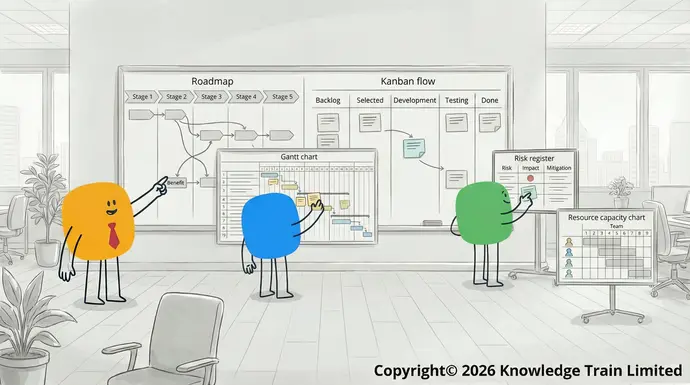
Programmes , in contrast, can span longer timeframes . They often have more fluid timelines that can adapt to shifts in strategy and priorities. Evaluation and adjustment are ongoing processes, and programmes may continue for as long as they are delivering benefits.
Programme managers have a long-term perspective and balance short-term project requirements with future opportunities.
Stakeholder management
Project level
Project stakeholder management is a targeted approach that focuses on individuals or groups directly impacted by the project. This includes managing expectations within the project’s scope and ensuring communication of project-specific information.
Project managers build and maintain relationships critical to the project’s immediate success.
Programme level
Programme stakeholder management is a broader approach that involves engaging a wider range of stakeholders across multiple projects within a programme. Balancing the conflicting interests and priorities of these stakeholders and fostering long-term relationships beyond the lifecycle of individual projects is a key aspect of programme stakeholder management.
Programme managers navigate complex stakeholder networks to maintain support for the programme.
Risk management
Project risks
Project risk management centres on specific risks and opportunities associated with a project. This includes identifying risks within the project’s scope, developing risk response strategies for known risks, and continuously monitoring and controlling risk impacts on project objectives.
Project managers aim to minimise uncertainty and potential threats to project outcomes.
Programme risks
Programme risk management takes a broader perspective and considers the interconnected risks across multiple projects. This involves managing strategic risks that can impact organisational goals and adapting to emerging risks and opportunities that arise during the programme’s lifecycle.
Programme managers have a holistic view of risk and consider its implications on the entire programme.
Microsoft Project, Asana, and Trello are examples of software
- : Software to help manage multiple projects and programmes.Kanban
Challenges in programme managementSelect your preferred training course below:
In the world of programme managementBETTER BUSINESS CASES COURSES, there are a variety of challenges that programme managers face. It is important to understand the most common challenges to have the best chance at overcoming them. Here are the top four challenges to be aware of.Select your preferred training course below:
Balancing multiple projects and priorities
In any given programme, it is important to P3O COURSESkeep track of and prioritiseSelect your preferred training course below: multiple projectsWORKSHOPS. This means that resources must be allocated appropriately across projects, different project timelines and milestones must be managed, and project objectives need to be met.Select your preferred workshop below:
Managing complexity and uncertainty
ProgrammeAGILE QUALIFICATIONS managers often have to manage a variety of different, Select your preferred qualification.complex projects . These can include projects with interdependencies and business environments that are constantly changing. As a result, there are risks involved with each project that must be mitigated.AGILE PROJECT MANAGEMENT COURSES
Ensuring effective communication across projectsSelect your preferred training course below:
To ensure that all stakeholders are on the same page and have a clear understanding of the project, it is important to have effective communicationPRINCE2 AGILE COURSES at all levels. This can be done by establishing an information flow between stakeholders, aligning messages across projects, and avoiding information silos or miscommunication.Select your preferred training course below:
The most effective way to ensure communication is to have an established programme manager role who has the skills, tools, and processes in place to manage all communication effectively.
Acknowledging and addressing these challenges empowers programme managers to effectively steer their teams towards success and create value for their organisations.SCRUM COURSES
Best practices for successful programme managementSelect your preferred training course below:
Ensuring the success of programme management requires the adoption of proven strategies and methodologies. In this section, we will discuss 4 best practices for successful programme management.
Establishing clear programme governanceAGILE BUSINESS ANALYSIS COURSES
Setting up a Select your preferred training course below:strong programme governance framework is crucial for effective programme management. This involves establishing clear roles and responsibilities for all programme stakeholders, developing a decision-making framework to address programme-level issues, and creating escalation paths to handle conflicts and create programme-specific policies and procedures.BUSINESS ANALYSIS QUALIFICATIONS
A well-defined governance structure provides clarity and accountability throughout the programme lifecycle.Select your preferred qualification.
Developing a robust benefits realisation plan
To effectively track and deliver programme value, it is important to have a robust BCS BUSINESS ANALYSIS COURSESbenefits realisationSelect your preferred training course below: plan in place:
APMG CHANGE MANAGEMENT COURSES
Strong collaboration and communication help enhance overall programme performance and minimise conflicts.Select your preferred training course below:
Implementing effective reporting and monitoring systems
Robust PROGRAMME MANAGEMENT QUALIFICATIONSreporting and monitoringSelect your preferred qualification. mechanisms are vital for effective programme oversight. This involves, developing standardised reporting templates to ensure consistent and structured information collection, implementing real-time dashboards to track programme progress and key performance indicators, setting up regular review cycles to assess programme health and alignment, and utilising data analytics to identify trends and potential issues in a timely manner.
With these systems in place, organisations can make informed decisions and manage their programmes proactively.MSP COURSES
Organisations can benefit greatly by adopting these best practices to enhance their programme management and achieve success.Select your preferred training course below:
Conclusion
A clear distinction between project and programme management is essential for achieving success in organisational objectives. While PMI COURSESproject managementSelect your preferred training course below: primarily focuses on the efficient delivery of specific outputs within constraints, programme managementPMI COURSES takes a more strategic approach towards realising benefits across multiple initiatives. The key differences between the two methodologies can be seen in scope and focus, time frame and duration, Stakeholder and Select your preferred training course below:risk management approaches, and PRINCE2 COURSESchange managementSelect your preferred training course below: strategies.
Aligning both project and programme management approaches can result in enhanced achievement of strategic goals for organisations. Optimised resource allocation can be achieved, along with improved stakeholder engagement and increased adaptability to market changes.APM COURSES
By leveraging the strengths of both methodologies, organisations can effectively navigate complexities and drive sustainable growth in their respective industries.Select your preferred training course below:
How do you measure the success of a programme?BUSINESS ANALYST COURSES
Programme success is measured through benefits realisation, strategic alignment, and long-term value creation for the organisation.Select your self-paced training course topic.
What are some common programme management methodologies?
Common programme management methodologies include BCS BUSINESS ANALYST COURSESMSPSelect your preferred training course below: ( Managing Successful ProgrammesCHANGE MANAGEMENT COURSES), PgMP (Programme Management Professional), and Scaled Agile Framework (SAFe).Select your self-paced training course topic.
How does programme management support organisational strategy?
Programme management supports organisational strategy by aligning multiple projects with strategic objectives, ensuring efficient resource allocation, and driving long-term value creation.APMG CHANGE MANAGEMENT COURSES
