
Understanding the project context
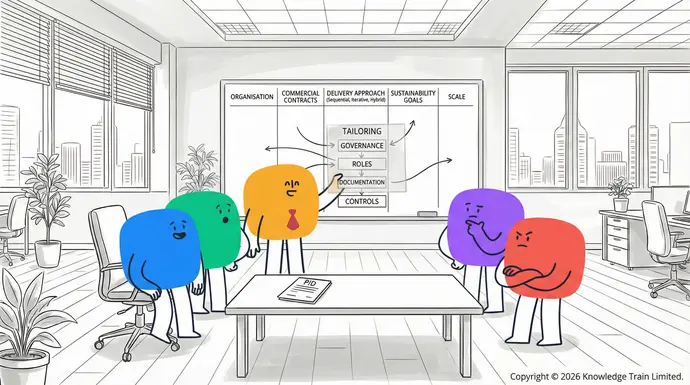
We can think of the project context in five main ways:PRINCE2
- Organizational context every week..The
- Commercial contextpopularity of PRINCE2. means there are lots of PRINCE2 accredited training organizations and courses to choose from. Choosing the right PRINCE2 study format is important if you want to learn in ways that suits you best.
- Read on to learn the pros and cons of the the four main .PRINCE2 study formats
- Sustainability context. We will list these in decreasing order of cost, so the most expensive method is first..PRINCE2 traditional classroom
- ScaleWe will start with the traditional way which is .PRINCE2 classroom training
The rest of this article will explore each of these five elements and describe the implications for tailoring the with an PRINCE2 methodexperienced trainer.. This requires you to travel to a venue and join a class of students all learning together.
Organizational contextPros
PRINCE2 doesn’t assume any particular organizational context. On any project there will be business leaders who will provide the project’s justification and commit the necessary resources to the project. There will be users who define the expected outcomes (known as products in PRINCE2), and there will be suppliers who contribute resources and their expertise to design and build these products.Certification is achievable in a few days.
PRINCE2Support is immediately available from the trainer. doesn’t dictate specific organizational ties between these users, suppliers, and business leaders. They might all belong to the same organization or from different ones, potentially linked by commercial contracts.Motivation can be greater when learning with other students.
In the You learn face to face.PRINCE2 frameworkCons, the business leaders are from the entity initiating the project (the commissioning organization, or You must travel to the classroom location.businessLearning speed is the same for all students, no matter their individual abilities.). Their decisions align with the organization’s strategy, goals, and policies.The most expensive learning method.
It’s also possible that the Requires computer and internet (virtual classroom).projectConsiderations is part of a The quality of courses can vary enormously between providers. The duration of courses also varies with providers offering 2-day or 3-day courses for the same qualification.programmeThe main factors that can affect the learning experience include: or Venue quality.portfolioNumber of students in the class. within the organization, or it may be a standalone project. In all these cases, PRINCE2 can be applied successfully.Trainer’s experience and expertise.
Commercial contextQuality of the training materials.
The business might establish a commercial relationship with a supplier to provide products that meet the users’ requirements, as highlighted in the project’s Customer service.business caseRead the guide to . The entity delivering the project (the supplier) aims to address a specific need recognized by the business (the customer).selecting the best PRINCE2 course provider
The business might divide the project into various elements, with different elements being delivered by different suppliers. Meanwhile, some elements might be internally managed, for instance, by departments like before choosing a traditional classroom training provider.ITEnhance your skills with our expert-led courses or facilities.
From a supplier’s perspective, the deliverables might be under a legally binding agreement stemming from a procurement process. To meet these deliverables, the supplier could engage subcontractors, each of whom would deliver sub-deliverables.
In a commercial context, commercial relationships might exist amongst suppliers. Instead of a straightforward two-party customer-supplier relationship, projectsInstructor-led could encompass several organizations bound by multiple contracts. A single customer might have a commercial relationship with a single main contractor, or there could be multiple customers and suppliers, each having distinct motives for their involvement in the project.PRINCE2 Practitioner (with Foundation) course
All such contracts between the organizations describe how the customer(s) and supplier(s) will jointly execute the project. The obligations and rights outlined in a contract should be reflected in how the project is managed which in turn requires the PRINCE2 methodology£1,899 +vat to be tailored accordingly.
Delivery methodSee all dates
The delivery method of describes how a project’s work is carried out. A project might use a single deliver method, or multiple, depending upon its needs. The three most common methods include the following.
Sequential approach
Here, every bit of work needed to design and build the product follows a set order. The product emerges either during the project or at its closure. A construction project exemplifies this, where design follows requirements gathering before actual construction begins.
Iterative-incremental approachSelf-paced
Typically (but not always) this approach is used for product development. This method involves repeated cycles of requirements gathering, designing, development or coding, and testing throughout the project’s lifespan. It’s frequently dubbed the ‘agile’ method.PRINCE2 Practitioner (with Foundation) self-paced online
Hybrid approach
This method merges both previous approaches. Certain aspects of the project might adopt a sequential method, while others adopt an iterative-incremental one. For instance, infrastructure development for a service might follow the sequential pattern, whereas creating a user portal for accessing that service could be iterative-incremental.£1,399 +vat
PRINCE2 establishes a structured environment suitable for various delivery methods. It doesn’t dictate or presuppose any specific method. Any delivery approach can be used, providing the work of managing the project is separated from the work of delivering the products.
Sustainability context
Businesses typically have sustainability goals and commitments which a project must align with or support. These sustainability considerations shape the project’s objectives and its management. PRINCE2 caters to these sustainability requirements by counting sustainability among its seven key performance indicators for Instructor-ledproject managementPRINCE2 Foundation course. The method also incorporates sustainability in its roles (assigning sustainability duties), its documentation (for example plans and reports), its practices (for example the business case£1,299 +vat), and its processes (for example activities verifying sustainability requirements).
While ‘sustainability’ is commonly equated with environmental concerns, its interpretation can vary among organizations. For some, it’s about the project’s environmental footprint; for others, it considers the total lifetime costs of the products the project delivers and their operational resilience. Certain projects, like solar panel installations, might be intrinsically focused on sustainability.See all dates
In the PRINCE2 virtual classroomPRINCE2 manualVirtual classroom PRINCE2 training, ‘sustainability’ refers to any combination of the 17 Sustainable Development Goals as outlined by the United Nations. takes place over the internet. Students require a computer with audio. This form of study became popular during the Covid-19 pandemic and has remained popular ever since.
ScalePros
The Certification is achievable in a few days.PRINCE2 methodologySupport is immediately available from the trainer. is flexible in that it can be adapted for straightforward, small projects or for complex, large ones.Motivation can be greater when learning with other students.
It’s important to note that the perceived size of a project is subjective to its host organization. For a global corporation, what is deemed a minor project might overshadow what a smaller entity classifies as a major one. It’s often more insightful to categorize projects as ‘simple’ rather than ‘small’ and ‘complex’ instead of ‘large’. Typically, it boils down to the organization’s assessment of the project’s risk and significance in comparison to its routine operations.You learn from home.
You learn at your own pace and take the Management stages
The number of management stages and work packages into which a project is divided.
Performance targets
Establishing the project’s performance targets and their permissible variances (tolerances).
Tailoring PRINCE2PRINCE2 Practitioner (with Foundation) course
In PRINCE2 ‘tailoring’ refers to the steps taken by the project management team£1,899 +vat to the practices, processes, roles, and management productsSee all dates to ensure that it meets the needs of a project’s context.
‘Tailor to suit the project’ context is one of the seven principles of PRINCE2 . The goal of tailoring is to establish Self-pacedproject management processesPRINCE2 Practitioner (with Foundation) self-paced online and governance to a degree that does not overburden the project team. The aim is to offer a suitable level of governance, planning, and control which are in line with PRINCE2’s principles£1,399 +vat, with a level of risk which is deemed acceptable.
Tailoring responsibility
The project manager is responsible for identifying and documenting the degree of tailoring for the project. Tailoring influences the management of the project, so it should be incorporated into the project initiation documentation (PID), evaluated by relevant stakeholders, and authorized by the project board. Project assurance should provide advice to both the project board and the project managerInstructor-led about the degree of tailoring that is appropriate for a project.PRINCE2 Foundation course
Agreeing the tailoring requirements
During the ‘initiating a project’ process the project manager documents the tailoring approach for the project.£1,299 +vat
When doing this, the project manager often must modify the guidance and oversight of a project to accommodate internal and external influences impacting the project’s execution. Any departure from the company’s typical project management style should be recorded and agreed upon.
Aspects to be tailoredSee all dates
There are main areas of PRINCE2 that may be tailored.PRINCE2 self-study
- PRINCE2 processesThis form of study is where you source the materials yourself – usually from the internet. The most important source is the can be merged or modified.PRINCE2 manual
- PRINCE2 practices, but other free materials on the internet are of dubious quality and integrity. might be applied using techniques suitable for the project.Pros
- RolesCheapest way of learning.
Managing the method
Although every PRINCE2 project must be tailored, many similar projects within the same organization might share many similar tailoring provisions. In this case, the organization can benefit from having a standard approach to tailoring across multiple projects.Simon Buehring
If an organization embarks on the path of adopting a customized version of 19 Feb 2026PRINCE2 across the organization, the method still requires management and maintenance. The method should therefore include guides, procedures, or processes to explain how it is managed, along with corresponding roles and role descriptions.Explore the changes in PRINCE2 7th edition and why they are significant for project management professionals. Discover the updates by reading more.
The roles should incorporate one for managing the overall method architecture, ensuring the process model and its elements function collectively. Another role would involve the management of each element of the method, which would enable the method architect to delegate different individuals to manage each component.
Tailoring rules and guidelines
Any method derived from PRINCE2 should incorporate its seven principles , including the ‘tailor to suit the project’ principle. This means the method should contain tailoring guidelines.
Organizations may consider categorize their projects by complexity and provide guidance on how each category should be tailored. The goal is to guide project practitioners in determining what constitutes ‘just enough’ project management to ensure project success.
For all projects, a project manager must guarantee there is an efficient and secure method of storing and distributing information. For more simple projects, a logbook and wall display might be enough, but for more complex projects, information systems must be developed and implemented.
Embedding the tailored methodKnowledge Train’s PRINCE2 exam results
There are benefits to be obtained for the organization from looking at maturity models such as P3M3Simon Buehring and seeking to 19 Feb 2026embed PRINCE2 within an organization. Embedding PRINCE2 would require a change management approach to enable all practitioners to apply the method in a consistent way across all projects.Understand why Knowledge Train's PRINCE2 exam pass rates exceed the national average and how their approach can benefit you. Scroll down for insights.