Key takeaways
Strong project managers blend delivery discipline with leadership and business judgement.Give us a call
- Create clear project plans with scope, milestones, owners, and an agreed delivery approach.
- Use time, cost, and quality controls to spot variance early and act before issues escalate.
- Identify risks early, maintain a risk register, and choose appropriate responses for each threat.+44 (0)207 148 5985
- Communicate with intent, listen actively, and manage conflict to keep teams aligned and motivated.
- Align projects to organisational strategy using data, KPIs, and informed decision-making.Or chat with us using the link at the bottom of the screen.
- Build capability through training, certifications, mentoring, and continuous learning with modern tools.Contact us with questions about the courses on this page, or about which project management certification or training is best for you.

project management . To create a successful risk register, you should first identify possible threats to the project. Methods you could use include:
- SWOT analysis
- Team brainstorming
- Review of similar past projectsFunctional
- Expert interviews.
Developing mitigation strategies Always active
As part of a good risk management strategy, you will need to develop risk responses. This involves determining an appropriate way to deal with each identified risk. The four main strategies are:
- Avoid: Remove the threat entirely
- Mitigate: Decrease the likelihood or impact
- Transfer: Allocate the risk to a third party
- Accept: Recognise and monitor the risk.
Budgeting and cost control
Creating and managing project budgets
Accurate budgeting is vital for financial success. Consider these steps:The technical storage or access is strictly necessary for the legitimate purpose of enabling the use of a specific service explicitly requested by the subscriber or user, or for the sole purpose of carrying out the transmission of a communication over an electronic communications network.
- Estimate costs for each project element
- Add contingency for unexpected expensesPreferences
- Get stakeholder approval for the budget
- Set a baseline for future comparisons.
Monitoring and controlling expenses
Monitor expenses to stay within budget:Preferences
- Use Earned Value Management (EVM)
- Review costs regularly
- Leverage project management software for real-time tracking
- Act quickly on variances to avoid overruns.
Quality management
Implementing quality assurance processesThe technical storage or access is necessary for the legitimate purpose of storing preferences that are not requested by the subscriber or user.
Ensure project deliverables meet required standards by:
- Defining clear quality metricsStatistics
- Performing regular quality audits
- Conducting peer reviews and inspections
- Using quality control tools (e.g., Pareto charts, control charts).
The technical storage or access that is used exclusively for anonymous statistical purposes. Without a subpoena, voluntary compliance on the part of your Internet Service Provider, or additional records from a third party, information stored or retrieved for this purpose alone cannot usually be used to identify you.Understanding organisational goals and objectives
By honing these skills, project managers become strategic partners in their organisations, significantly enhancing their contribution to overall business success.
Technical proficiency
To efficiently work on projects as well as to effectively lead and manage teams, project managers need to have technical skills that are relevant to the digital world of today.
Project management software and tools
Popular project management software options
Familiarise with the top software tools used for project management. Some of the most popular ones are:
- Microsoft Project: Use Microsoft Project to plan, schedule, and monitor project tasks and resources
- Jira: Master Jira for Agile project management and issue tracking
- Trello: Learn Trello for visual task management using boards and cards
- Asana: Get proficient in Asana for team collaboration and workflow management.
Collaboration and communication tools
Equip yourself with tools that enhance communication and collaboration within your team and with stakeholders. Some of the most essential tools are:
- Slack: Use Slack for real-time messaging, file sharing, and team collaboration
- Microsoft Teams: Learn Microsoft Teams for video conferencing and document collaboration
- Zoom: Get familiar with Zoom for virtual meetings and webinars
- Google Workspace: Become proficient in Google Workspace for cloud-based document creation and sharing.
Data analysis and reporting
Creating and interpreting project reports
Gain the ability to create and interpret project reports. Here are some of the essential skills:
- Generating project status reports using project management software
- Creating visual representations of data (charts, graphs)
- Customising reports for different stakeholders
- Interpreting Key Performance Indicators (KPIs) and metrics.
Data-driven decision-making
Develop skills to make data-informed decisions to guide projects towards success. Here are some steps to achieve that:
- Collect and analyse project performance data
- Use statistical tools to identify trends and patterns
- Employ predictive analytics for risk assessment
- Present data-driven recommendations to stakeholders.
Project managers can enhance their ability to streamline processes, improve communication, and make informed decisions based on accurate data analysis by developing proficiency in these technical skills.
Developing your project management skills
As a project manager, you may wish to build or enhance your knowledge of this valuable role. There are several ways in which this can be achieved:
Formal education and training
Enrol in advanced degrees or specialised courses in project management:
- A master’s degree in project management
- Specialised courses or workshops on a particular methodology (such as Agile or PRINCE2)
- Upon online learning platforms like GainCert.
Professional certifications
Certifications are industry-recognised credentials that validate your knowledge and skills in project management. Some examples of project manager certifications include:
- Project Management Professional (PMP) by the Project Management Institute (PMI)
- PRINCE2 Practitioner
- Certified ScrumMaster (CSM).
On-the-job experience and mentoring
Hands-on experience is one of the most effective ways of building and honing your skills as a project manager. You can gain experience by:
- Taking on challenging projects
- Learning from others with experience
- Working on cross-functional projects
- Seeking out a mentor to help you grow.
Continuous learning and self-improvement
The field of project management is constantly evolving, so it’s important to keep up with the latest trends and best practices. To do this, you can:
- Read books, blogs, and other project management publications
- Attend conferences and networking events
- Join professional associations such as PMI and APM.
Incorporate a combination of these strategies to continuously develop your project management skills and advance your career in this ever-evolving field.
Conclusion
Project management skills are essential in today’s competitive world. Project Managers must have:
- Technical skills
- Leadership skills
- Business skills
- Interpersonal skills.
As a project manager you can provide great project that is full of organisational value. You must also build your project management skills, you will become an effective project manager in the future. So never hesitate to take part in the following activities:
- Academic programs
- Professional certifications
- Practical experiences
- Self-development activities.
Develop your project management skills and you will be able to efficiently and effectively handle challenging projects while successfully leading a team. Dedicate yourself to continual skill development.
FAQs
What are the most important skills for a project manager?
Key project management skills include:
- Communication
- Leadership
- Planning and organisation
- Risk management
- Problem-solving
- Technical proficiency
- Adaptability.
A combination of these skills allows project managers to lead teams and deliver successful projects.
How can I improve my project management skills?
To improve your project management skills, you can:
- Take formal education or training courses
- Obtain professional certifications
- Seek mentorship from experienced project managers
- Volunteer for challenging projects to gain practical experience
- Stay updated on industry trends and best practices
- Continuously reflect on and learn from your experiences.
What software tools are essential for project managers?
Essential project management tools include:
- Planning and scheduling software, such as Microsoft Project or Primavera
- Collaboration platforms like Slack or Microsoft Teams
- Task management tools, like Trello or Asana
- Data analysis and reporting software like Excel or Power BI.
The exact tools you need will depend on your project and organisation.
How do project management skills differ across industries?
While many project management skills are transferable, some industry-specific knowledge is usually required. For example:
- IT projects often require expertise in Agile methodologies
- Construction projects may place more emphasis on cost and resource management
- Healthcare projects may have a focus on regulatory compliance and patient safety.
To be successful in different industries, you must adapt your skills to the specific needs of each one.
What certifications are valuable for project managers?
Valuable project management certifications include:
- Project Management Professional (PMP)
- PRINCE2 Practitioner
- Certified ScrumMaster (CSM)
- Agile Certified Practitioner (PMI-ACP)
- ITIL Foundation.
Choose certifications that align with your career goals and industry requirements.
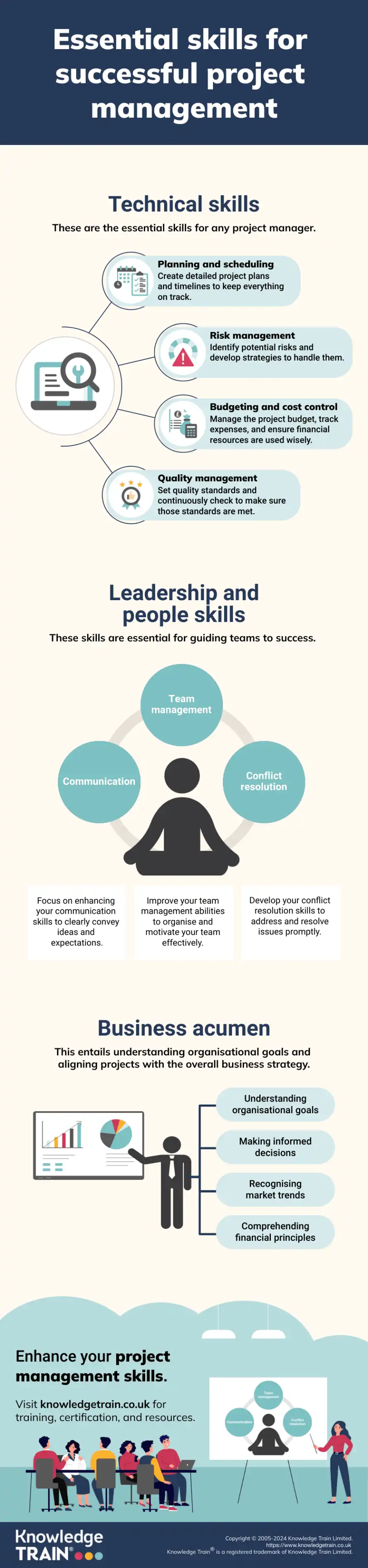
Infographic