Essential project management skillsKotter change management

Key takeaways
Strong project managers blend delivery discipline with leadership and business judgement.
- Create clear project plans with scope, milestones, owners, and an agreed delivery approach.
- Use time, cost, and quality controls to spot variance early and act before issues escalate.
- Copied!
- Communicate with intent, listen actively, and manage conflict to keep teams aligned and motivated.Key takeaways
- Align projects to organisational strategy using data, KPIs, and informed decision-making.Kotter’s 8-step model helps organisations deliver change that sticks by building urgency, alignment, and momentum.
- Build capability through training, certifications, mentoring, and continuous learning with modern tools.Start with evidence-based urgency drawn from real market and competitive pressures.
IntroductionFAQs
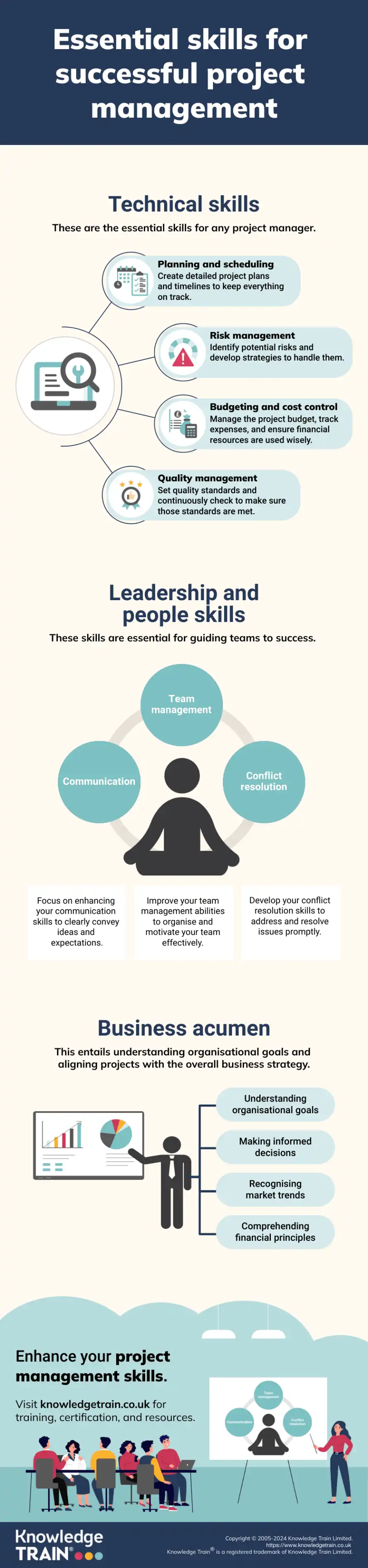
Project management skills are increasingly in demand in the modern business world. Organisations are becoming more projectised, with more senior stakeholders relying on professionals to drive successful outcomes. In fact, the demand for capable project managers is on the rise across a range of sectors. Companies are on the lookout for individuals with a wide variety of skills to handle increasingly complex initiatives.Infographic
Key project management capabilities include:Introduction to Kotter’s change model
- Technical skillsWhy organisations need change
- Leadership skillsChange is essential for organisational success. The current business environment requires adaptation for sustained growth and competitive advantage. Organisations must embrace change to stay relevant, enhance efficiency, and meet evolving customer demands. Without change, stagnation can lead to obsolescence.
- Business skills.Overview of Kotter’s 8-step model
In combination, these traits allow project managers to:John
- Plan and implement Kotterprojects, a renowned expert in
- Lead team memberschange management
- Deliver value and business objectives., introduced his 8-step change model to guide organisations through transformation. Featured in his seminal book, ‘Leading Change,’ this model is grounded in extensive research and practical application. It provides a structured approach to implementing change, ensuring each step builds on the last. The model emphasises creating urgency, forming a powerful coalition, and maintaining momentum. By adhering to Kotter’s principles, organisations can navigate complex change processes with confidence, ensuring long-term success and resilience. This framework is widely used across various industries, reflecting its versatility and effectiveness.
As the professional world changes, so do the skills necessary for Critical implementation principlesproject managementThe success of Kotter’s model relies on proper implementation. Organisations must follow the steps in sequence, as each stage builds upon the previous one. Attempting to skip steps to achieve faster results often leads to failure.. In this article we will look at some of the The model functions as a continuous cycle rather than a linear process. Organisations might need to revisit earlier steps as they progress, particularly when facing new challenges or resistance. Leaders should monitor progress carefully, as significant mistakes at any stage can derail the entire change initiative and reduce staff engagement.essential project management skillsCommon implementation errors include to prepare you for the workplace. By improving these attributes, you can stand out as a project professional and create a rewarding career for yourself in the field. Most importantly, you can help to bring value to your business.Moving forward before establishing genuine urgency
Technical project management skillsDeclaring victory too early
Technical skills are project management skills that relate to the execution and control of projects. Some of the key technical project management skills are as follows:Failing to anchor changes in organisational culture
Planning and schedulingUnderestimating the importance of vision.
Creating comprehensive project plansEnhance your skills with our expert-led courses
Project plans are a vital tool for ensuring that initiatives are completed on time and on budget. A well-designed plan should include:
- Project objectives
- Scope of the workInstructor-led
- Work Breakdown StructureChange Management Practitioner (with Foundation) course ( WBS£1,699 +vat)
- Resource planSee all dates
- Milestones and deliverables.
Use a recognised project management approaches , like Self-pacedAgileChange Management Practitioner (with Foundation) self-paced online or waterfall£1,299 +vat, to inform the structure of your plan.
Effective time management techniques
Effective time management is crucial to maintaining control over a projectSelf-paced. Here are some techniques that you may want to utilise:Change Management Foundation self-paced online
- Critical Path Method (CPM)
- Gantt charts£799 +vat
- Time-boxingThe 8 steps in Kotter’s change model
- Progress tracking and reporting.Step 1: Create a sense of urgency
Risk managementEstablishing a true sense of urgency serves as the crucial first step for change. This urgency must stem from genuine market and competitive realities rather than manufactured crises.
Identifying potential risksMarket analysis and risk assessment
Risk management is an essential part of examine genuine competitive threats and market shifts that require immediate organisational response.project managementStakeholder engagement. To create a successful risk register, you should first identify possible threats to the project. Methods you could use include: requires direct discussions with leadership and key team members to establish the reality of market conditions. These conversations must focus on evidence-based reasons for change rather than hypothetical scenarios.
- SWOT analysisStep 2: Build a guiding coalition
- Team brainstormingA strong coalition is essential for steering the change process. This team will provide leadership and direction.
- Review of similar past projectsAssembling a powerful team:
- Expert interviews. Identify individuals with influence across various levels of the organisation. Ensure the team comprises diverse skills and perspectives to enhance decision-making.
Developing mitigation strategiesCoalition development
As part of a good risk management strategy, you will need to develop risk responses. This involves determining an appropriate way to deal with each identified risk. The four main strategies are: demands a team with enough power and influence to guide the change effort effectively. Members must establish consistent working relationships based on trust.
- Avoid: Remove the threat entirelyStep 3: Develop a vision and strategy
- Mitigate: Decrease the likelihood or impactVision creation
- Transfer: Allocate the risk to a third party needs to be clear, concise and achievable. The strategy must explain how to achieve that vision in straightforward steps that connect to organisational outcomes.
- Accept: Recognise and monitor the risk.Strategic planning
Budgeting and cost control requires specific, measurable actions that support the vision. These actions must include timelines, responsibilities and resource allocation to ensure practical implementation.
Creating and managing project budgetsStep 4: Communicate the vision
Accurate budgeting is vital for financial success. Consider these steps:Clear, consistent communication across all levels ensures understanding and acceptance of the vision. The vision must be shared frequently through multiple channels and demonstrated by leadership behaviour.
- Estimate costs for each project elementCommunicating the vision effectively:
- Add contingency for unexpected expenses Use various platforms to share the vision widely. Ensure the message is consistent and reaches all parts of the organisation.
- Get stakeholder approval for the budgetMotivating employees:
- Set a baseline for future comparisons. Inspire employees by connecting the vision to individual values. Provide opportunities for them to contribute actively to the change process.
Monitoring and controlling expensesStep 5: Enable action by removing barriers
Monitor expenses to stay within budget:Removing obstacles is vital for seamless change implementation. It helps to maintain momentum and prevent frustration.
- Use Earned Value Management (EVM)Process assessment
- Review costs regularly requires systematic identification of structural, cultural and resource barriers that hinder change implementation. Teams must develop targeted solutions for each obstacle whilst maintaining momentum.
- Leverage Barrier removalproject management software requires changing systems or structures that undermine the vision. This includes addressing resource constraints, reporting relationships and reward systems that discourage change. for real-time trackingStep 6: Create short-term wins
- Act quickly on variances to avoid overruns.Short-term wins are crucial for maintaining momentum. They provide evidence that the change is working.
Quality managementSetting achievable targets:
Implementing quality assurance processes Identify and prioritise goals that can be met quickly. These should be significant enough to validate the effort and encourage continued support.
Ensure project deliverables meet required standards by:Recognising and rewarding success:
- Defining clear quality metrics Celebrate achievements to reinforce positive behaviour. Public recognition can serve as motivation for further efforts.
- Performing regular quality auditsStep 7: Sustain acceleration
- Conducting peer reviews and inspectionsSustaining momentum is essential for long-term success. It involves building on initial successes to drive deeper change.
- Using quality control tools (e.g., Pareto charts, control charts).Building on change momentum:
Continuous improvement strategies Leverage early wins to tackle more significant challenges. Use the credibility gained to push for additional, more substantial changes.
Promote a culture of continuous enhancement:Encouraging ongoing progress:
- Perform post-project reviews Continuously communicate achievements and progress. Keep the focus on the end goal while acknowledging the journey.
- Encourage team feedback and Step 8: Institute changelessons learnedFor change to last, it must become part of the organisational culture. Institutionalising change ensures its permanence.
- Implement process improvements based on insightsAnchoring new approaches
- Stay informed on industry best practices. in the culture requires showing people how specific behaviours and attitudes have helped improve performance. New practices must grow deep roots to ensure their continuation despite the pressure of future changes in leadership.
By refining these technical project management skills, professionals can enhance their capabilities and increase the likelihood of delivering successful Ensuring continuous improvement:projects Establish mechanisms for ongoing review and improvement. Encourage a culture of learning and adaptability to sustain the change over time.Kotter’s model offers a
Leadership and interpersonal skillsBy identifying market threats and opportunities, organisations highlight the necessity for immediate action, motivating stakeholders.
Project managers need to have What are some common challenges when implementing Kotter’s change model?strong leadershipNot establishing enough urgency and declaring victory too soon are the most critical mistakes organisations make during implementation. and interpersonal skills, apart from the hard-core technical skills.How can short-term wins help sustain change momentum?
CommunicationAchieving short-term wins provides evidence of progress, boosting morale and reinforcing commitment to the change.
Verbal and written communication techniquesWhy is employee engagement crucial in Kotter’s model?
Effective communication is the foundation of successful project management. Enhance your verbal and written communication techniques by:Engaging employees fosters ownership and reduces resistance, ensuring smoother implementation and sustained change.
- Tailoring your message to your audience and purposeInfographic
- Utilising concise language and avoiding jargon or technical termsThe Kotter change curve has been summarised on this colourful infographic.
- Incorporating visual aids or graphics to emphasise key pointsSubscribe to our exclusive offers and promotions
- Practising public speaking and presentation skills to deliver information clearly and confidently.
Active listening and feedbackSubscribe now
Communication is a two-way process, and active listening plays a vital role in effective communication. Hone your active listening and feedback skills by:
- Paying attention to the speaker without interruptions
- Asking clarifying questions to ensure understanding{"@context":"https://schema.org","@type":"ImageObject","contentUrl":"https://www.knowledgetrain.co.uk/training-courses/change-management-model-john-kotter-with-infographic-890x501.webp","description":"Kotter change management model.","license":"https://www.knowledgetrain.co.uk/license","acquireLicensePage":"https://www.knowledgetrain.co.uk/license","creditText":"Knowledge Train","uploadDate":"2023-05-16T09:59:38.000Z","copyrightNotice":"© 2023 Knowledge Train Limited. All rights reserved.","creator":{"@type":"Organization","name":"Knowledge Train","url":"https://www.knowledgetrain.co.uk"}}
- Summarising the main points to confirm comprehension
- Providing constructive feedback in a timely manner to facilitate improvement.{"@context":"https://schema.org","@type":"ImageObject","contentUrl":"https://www.knowledgetrain.co.uk/training-courses/res/images/change-management/kotters-8-stage-change-management-model-800x1527.webp","description":"Kotter change curve infographic.","license":"https://www.knowledgetrain.co.uk/license","acquireLicensePage":"https://www.knowledgetrain.co.uk/license","creditText":"Knowledge Train","uploadDate":"2023-05-16T09:59:38.000Z","copyrightNotice":"© 2023 Knowledge Train Limited. All rights reserved.","creator":{"@type":"Organization","name":"Knowledge Train","url":"https://www.knowledgetrain.co.uk"}}
Team management
Delegation and task assignmentRelated articles
Efficient team management often involves delegating tasks and responsibilities. Master the art of delegation and task assignment by:
- Evaluating team members’ strengths, weaknesses, and workloads
- Aligning tasks with individual skills and expertise
- Providing clear instructions, deadlines, and expectations
- Establishing accountability and setting up follow-up mechanisms for progress monitoring.
Motivating and inspiring team members
A motivated team is more likely to be productive and engaged. Learn how to motivate and inspire team members by:
- Recognising and celebrating individual and team achievements
- Offering opportunities for professional growth and development
- Encouraging open communication, collaboration, and idea-sharing
- Leading by example with enthusiasm, commitment, and a positive attitude.
Conflict resolution
Identifying and addressing conflicts
Conflicts are inevitable in teams, but effective conflict resolution can prevent them from escalating. Develop your conflict resolution skills by:Unveiling the impact of Senge’s system thinking model on change management
- Recognising early warning signs of conflicts or disagreements
- Addressing conflicts promptly and directly
23 Feb 2026
To efficiently work on projects as well as to effectively lead and manage teams, project managers need to have technical skills that are relevant to the digital world of today.
Project management software and toolsThinking about change management training? Learn what these courses involve and decide if it’s the right fit for you by reading further.
Popular project management software options
Familiarise with the top software tools used for project management. Some of the most popular ones are:
- Microsoft Project : Use Microsoft Project to plan, schedule, and monitor project tasks and resources
- Jira : Master Jira for Agile project management and issue trackingWhat is a business change manager?
- Trello : Learn Trello for visual task management using boards and cardsSimon Buehring
- Asana19 Feb 2026: Get proficient in Asana for team collaboration and workflow management.
Collaboration and communication toolsDive deep into the role of a business change manager and what you can learn on change management courses. Discover more by reading on.
Equip yourself with tools that enhance communication and collaboration within your team and with stakeholders. Some of the most essential tools are:
- Slack : Use Slack for real-time messaging, file sharing, and team collaboration
- Microsoft Teams : Learn Microsoft Teams for video conferencing and document collaboration
- Zoom : Get familiar with Zoom for virtual meetings and webinars
- Google WorkspaceHow to become a change manager: Become proficient in Google Workspace for cloud-based document creation and sharing.
Data analysis and reportingSimon Buehring
Creating and interpreting project reports23 Feb 2026
Gain the ability to create and interpret project reports. Here are some of the essential skills:
- Generating project status reports using Ever wondered how to become a change manager? This article outlines the necessary steps and skills. Learn more by scrolling down.project management software
- Creating visual representations of data (charts, graphs)
- Customising reports for different stakeholders
- Interpreting Key Performance Indicators (KPIs) and metrics.
Data-driven decision-making
Develop skills to make data-informed decisions to guide projects towards success. Here are some steps to achieve that:
- Collect and analyse project performance data
- Use statistical tools to identify trends and patternsThriving in Change – Webinar with Luz Flores Lee
- Employ predictive analytics for risk assessment
- Present data-driven recommendations to stakeholders.Sevcan Yasa
Project managers can enhance their ability to streamline processes, improve communication, and make informed decisions based on accurate data analysis by developing proficiency in these technical skills.19 Feb 2026
Developing your project management skills
As a project manager, you may wish to build or enhance your knowledge of this valuable role. There are several ways in which this can be achieved:Watch this insightful webinar with Luz Flores Lee to master Agile strategies for navigating change in your career. Scroll down to enhance your skills and advance your professional journey.
Formal education and training
Enrol in advanced degrees or specialised courses in project management :
- A master’s degree in project management
- Specialised courses or workshops on a particular methodology (such as Agile or PRINCE2 )
- Upon online learning platforms like GainCert.
Professional certifications
Certifications are industry-recognised credentials that validate your knowledge and skills in project management. Some examples of project manager certifications include:
- Project Management Professional (PMP) by the Project Management Institute ( PMI
- Learning from others with experience
- Working on cross-functional projects
- Seeking out a mentor to help you grow.
Continuous learning and self-improvementGive us a call
The field of project management is constantly evolving, so it’s important to keep up with the latest trends and best practices. To do this, you can:
- Read books, blogs, and other project management publications
- Attend conferences and networking events+44 (0)207 148 5985
- Join professional associations such as PMIOr chat with us using the link at the bottom of the screen. and Contact us with questions about the courses on this page, or about which project management certification or training is best for you.APMFinance FAQs