Key takeaways
Strong project managers blend delivery discipline with leadership and business judgement.
- Create clear project plans with scope, milestones, owners, and an agreed delivery approach.
- Use time, cost, and quality controls to spot variance early and act before issues escalate.
- Identify risks early, maintain a risk register, and choose appropriate responses for each threat.
- Communicate with intent, listen actively, and manage conflict to keep teams aligned and motivated.
- Align projects to organisational strategy using data, KPIs, and informed decision-making.
- Build capability through training, certifications, mentoring, and continuous learning with modern tools.
- – Agile Business AnalysisProviding constructive feedback in a timely manner to facilitate improvement.
Team managementFoundation training
Delegation and task assignmentLearn the fundamentals of Agile Business Analysis.
Efficient team management often involves delegating tasks and responsibilities. Master the art of delegation and task assignment by:Practitioner
- Evaluating team members’ strengths, weaknesses, and workloads4-day course including Foundation.
- Aligning tasks with individual skills and expertisePMI
- Providing clear instructions, deadlines, and expectations®
- Establishing accountability and setting up follow-up mechanisms for progress monitoring.PMI-PBA
Motivating and inspiring team membersSelf-paced course to prepare you for the exam (exam not included).
A motivated team is more likely to be productive and engaged. Learn how to motivate and inspire team members by:Business Analysis Learning Library (BALL)™
- Recognising and celebrating individual and team achievementsCHANGE MANAGEMENT
- Offering opportunities for professional growth and developmentAPMG Change Management
- Encouraging open communication, collaboration, and idea-sharingFoundation
- Leading by example with enthusiasm, commitment, and a positive attitude.Learn the fundamentals of enterprise change management.
Conflict resolutionPractitioner
Identifying and addressing conflictsIncludes Foundation & Practitioner combined option.
Conflicts are inevitable in teams, but effective conflict resolution can prevent them from escalating. Develop your conflict resolution skills by:PROGRAMME MANAGEMENT
- Recognising early warning signs of conflicts or disagreementsMSP
- Addressing conflicts promptly and directly®
- Encouraging open and respectful communication between conflicting partiesFoundation
- Remaining impartial and focusing on finding mutually beneficial solutions.Learn the fundamentals of programme management.
Negotiation and mediation techniquesPractitioner
Conflicts often require negotiation and mediation skills to reach a resolution. Acquire the necessary techniques by:Includes Foundation & Practitioner combined option.
- Practising active listening to understand all perspectives involvedINFORMATION TECHNOLOGY (IT)
- Identifying common ground and shared interestsITIL
- Proposing creative solutions that can benefit all parties®
- Seeking win-win outcomes whenever possible.Foundation
Conflict resolutionLearn the fundamentals of ITIL service management.
Identifying and engaging stakeholdersStrategist DPI
Stakeholders play a critical role in project success, so it’s essential to manage them effectively. Learn to identify and engage stakeholders by:3-day ITIL Strategist: Direct, Plan & Improve (DPI) course.
- Conducting a comprehensive stakeholder analysisSpecialist: DSV
- Developing a stakeholder engagement plan outlining communication strategy3-day ITIL Specialist: Drive Stakeholder Value (DSV) course.
- Establishing regular and appropriate communication channelsSpecialist: CDS
- Involving key stakeholders in decision-making processes when applicable.3-day ITIL Specialist: Create, Deliver and Support (CDS) course.
Managing expectations and relationshipsIT Learning Library (ITLL)™
Maintaining positive stakeholder relationships is key to successful project management. Hone your skills in managing expectations and relationships by:BUSINESS LEARNING LIBRARY (BLL)™
- Clearly communicating project goals, timelines, and constraintsAgile Learning Library (ALL)™
- Providing regular updates on project progress, achievements, and challengesBusiness Analysis Learning Library (BALL)™
- Promptly addressing concerns, issues, and expectationsCompliance Learning Library (CLL)™
- Actively seeking feedback and incorporating valuable suggestions whenever possible.IT Learning Library (ITLL)™
By refining leadership and interpersonal skills, Business solutionsproject managers_blank can create a positive team environment, foster collaboration, and lead projects to success through effective communication and stakeholder management.Free tools
Business acumen and strategic thinkingAbout
Effective project managers also have a deep understanding of business principles and strategic thinking. These competencies allow project managers to align projects with organisational objectives and drive value._blank
Understanding organisational goals and objectivesBlog
Project managers can align their efforts with organisational success by:
- Becoming familiar with the organisation’s mission and visionEXPLORE SUBJECTS
- Keeping up-to-date with industry trends and market conditionsSelect your preferred subject.
- Recognising the competitive landscape of the organisation
- Periodically reviewing financial statements and key performance indicators (KPIs).PROJECT MANAGEMENT QUALIFICATIONS & WORKSHOPS
Aligning projects with business strategySelect your preferred qualification or workshop.
Ensuring that projects support the overall business strategy is crucial:
- Identify how each project aligns with and contributes to strategic goalsPRINCE2 COURSES
- Prioritise projects based on their strategic importanceSelect your preferred training course below:
- Communicate the strategic value of projects to stakeholders
- Adjust APM COURSESproject plansSelect your preferred training course below: as necessary when business strategies change.
Decision-making and problem-solvingAGILE PROJECT MANAGEMENT COURSES
Project managers must be skilled in making informed decisions and solving complex problems:Select your preferred training course below:
- Gather and analyse relevant data before making decisions
- Consider multiple alternatives and weigh their potential consequencesPRINCE2 AGILE COURSES
- Use structured problem-solving techniques (e.g., root cause analysis)Select your preferred training course below:
- Balance short-term project needs with long-term strategic objectives.
Adaptability and change managementBETTER BUSINESS CASES COURSES
In a dynamic business environment, adaptability is key:Select your preferred training course below:
- Anticipate and prepare for potential changes in the business landscape
- Develop contingency plans for various scenariosP3O COURSES
- Foster a culture of flexibility and innovation within project teamsSelect your preferred training course below:
- Implement change managementWORKSHOPS strategies to support organisational transitions.Select your preferred workshop below:
Developing these skills in business acumen and strategic thinking can help project managers:
- Make better-informed decisionsAGILE QUALIFICATIONS
- Align projects more effectively with organisational goalsSelect your preferred qualification.
- Adapt to changing business conditions
- Drive meaningful value for their organisations.AGILE PROJECT MANAGEMENT COURSES
By honing these skills, project managers become strategic partners in their organisations, significantly enhancing their contribution to overall business success.Select your preferred training course below:
Technical proficiencyCHANGE MANAGEMENT QUALIFICATIONS
To efficiently work on projects as well as to effectively lead and manage teams, project managers need to have technical skills that are relevant to the digital world of today.Select your preferred qualification.
Project management software and tools
Popular project management software optionsAPMG CHANGE MANAGEMENT COURSES
Familiarise with the top software tools used for project management. Some of the most popular ones are:Select your preferred training course below:
- Microsoft Project : Use Microsoft Project to plan, schedule, and monitor project tasks and resourcesPROGRAMME MANAGEMENT QUALIFICATIONS
- JiraSelect your preferred qualification.: Master Jira for Agile project managementMSP COURSES and issue trackingSelect your preferred training course below:
- Trello : Learn Trello for visual task management using boards and cardsPMI COURSES
- AsanaSelect your preferred training course below:: Get proficient in Asana for team collaboration and workflow management.
Collaboration and communication toolsPMI COURSES
Equip yourself with tools that enhance communication and collaboration within your team and with stakeholders. Some of the most essential tools are:Select your preferred training course below:
- Slack : Use Slack for real-time messaging, file sharing, and team collaborationPRINCE2 COURSES
- Microsoft TeamsSelect your preferred training course below:: Learn Microsoft Teams for video conferencing and document collaboration
- ZoomAPM COURSES: Get familiar with Zoom for virtual meetings and webinarsSelect your preferred training course below:
- Google Workspace : Become proficient in Google Workspace for cloud-based document creation and sharing.AGILE PROJECT MANAGEMENT COURSES
Data analysis and reportingSelect your preferred training course below:
Creating and interpreting project reports
Gain the ability to create and interpret project reports. Here are some of the essential skills:PRINCE2 AGILE COURSES
- Generating project status reports using Select your preferred training course below:project management software
- Creating visual representations of data (charts, graphs)BUSINESS CASE COURSES
- Customising reports for different stakeholdersSelect your preferred training course below:
- Interpreting Key Performance Indicators (KPIs) and metrics.
Data-driven decision-makingAGILE COURSES
Develop skills to make data-informed decisions to guide projects towards success. Here are some steps to achieve that:Select your self-paced training course topic.
- Collect and analyse project performance data
- Use statistical tools to identify trends and patternsAGILE PROJECT MANAGEMENT COURSES
- Employ predictive analytics for risk assessmentSelect your preferred training course below:
- Present data-driven recommendations to stakeholders.
Project managers can enhance their ability to streamline processes, improve communication, and make informed decisions based on accurate data analysis by developing proficiency in these technical skills.PRINCE2 AGILE COURSES
Developing your project management skillsSelect your preferred training course below:
As a project manager, you may wish to build or enhance your knowledge of this valuable role. There are several ways in which this can be achieved:
Formal education and trainingSCRUM COURSES
Enrol in advanced degrees or specialised Select your preferred training course below:courses in project management :LEAN SIX SIGMA COURSES
- A master’s degree in project managementSelect your preferred training course below:
- Specialised courses or workshops on a particular methodology (such as AgileBUSINESS ANALYST COURSES or Select your self-paced training course topic.PRINCE2 )BCS BUSINESS ANALYST COURSES
- Upon online learning platforms like GainCert.Select your preferred training course below:
Professional certifications
Certifications are industry-recognised credentials that validate your knowledge and skills in project management. Some examples of project manager certifications include:CHANGE MANAGEMENT COURSES
- Project Management ProfessionalSelect your self-paced training course topic. (PMP) by the Project Management Institute (APMG CHANGE MANAGEMENT COURSESPMISelect your preferred training course below:)
- PRINCE2 PractitionerPROGRAMME MANAGEMENT COURSES
- Certified ScrumMaster (CSM).Select your self-paced training course topic.
On-the-job experience and mentoring
Hands-on experience is one of the most effective ways of building and honing your skills as a project manager. You can gain experience by:MSP COURSES
- Taking on challenging projectsSelect your preferred training course below:
- Learning from others with experience
- Working on cross-functional projectsIT QUALIFICATIONS
- Seeking out a mentor to help you grow.Select your preferred qualification.
Continuous learning and self-improvement
The field of project management is constantly evolving, so it’s important to keep up with the latest trends and best practices. To do this, you can:ITIL COURSES
- Read books, blogs, and other project management publicationsSelect your preferred training course below:
- Attend conferences and networking events
- Join professional associations such as IT QUALIFICATIONSPMISelect your preferred qualification. and
To improve your project management skills, you can:
- Take formal education or training courses
- Obtain professional certifications
- Seek mentorship from experienced project managersKnowledge Train is a Better Business Cases Accredited Training Organization.
- Volunteer for challenging projects to gain practical experience
- Stay updated on industry trends and best practicesKnowledge Train is an AgilePM Accredited Training Organization.
- Continuously reflect on and learn from your experiences.
What software tools are essential for project managers?Knowledge Train is a PRINCE2 Agile Accredited Training Organization.
Essential project management toolsKnowledge Train is a Lean Six Sigma Accredited Training Organization. include:
- Planning and scheduling software, such as Microsoft Project or PrimaveraBCS accredited training partner for Business Analysis.
- Collaboration platforms like Slack or Microsoft Teams
- Task management tools, like Trello or AsanaKnowledge Train is a Change Management Accredited Training Organization.
- Data analysis and reporting software like Excel or Power BI.
The exact tools you need will depend on your project and organisation.Knowledge Train is an MSP Accredited Training Organization.
How do project management skills differ across industries?
While many project management skills are transferable, some industry-specific knowledge is usually required. For example:AXELOS Peoplecert accredited training organisation for ITIL (IT Infrastructure Library).
- IT projects often require expertise in Agile methodologiesAXELOS Peoplecert accredited training organisation for ITIL (IT Infrastructure Library).
- Construction projects may place more emphasis on cost and resource management
- Healthcare projects may have a focus on regulatory compliance and patient safety.Knowledge Train is an AIPGF Accredited Training Organization.
To be successful in different industries, you must adapt your skills to the specific needs of each one.
What certifications are valuable for project managers?Knowledge Train is an AIPGF Accredited Training Organization.
Valuable project management certificationsBCS accredited training partner for Business Analysis. include:
- Project Management ProfessionalWHAT YOU WILL GET (PMP)Our courses and workshops include:
- PRINCE2 PractitionerCertification exam(s) where applicable
- Certified ScrumMaster (CSM)Accredited training course materials
- Agile Certified PractitionerExpert, experienced trainers to support you (PMI-ACP)Course manual where applicable.
- ITIL Foundation .SELF-PACED ONLINE TRAINING COURSES
Choose Self-paced online training courses (e-learning) include:certificationsCertification exam(s) where applicable that align with your career goals and industry requirements.Accredited training course materials
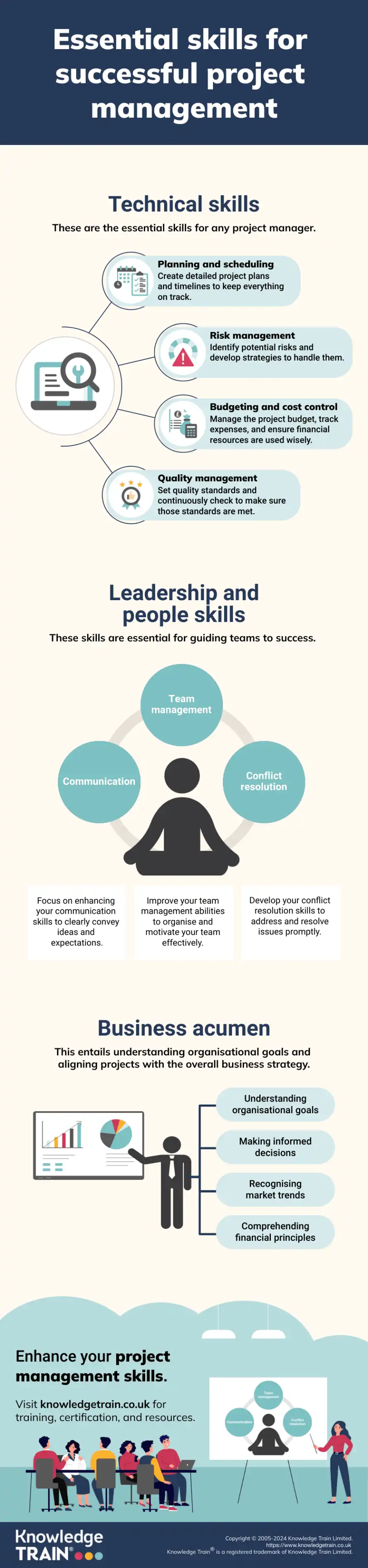
InfographicSupport from expert, experienced trainers