PRINCE2 methodologyAGILE PROJECT MANAGEMENT COURSES

Key takeaways
PRINCE2 is a structured, tailorable method that keeps projects focused on benefits, products, and clear decision-making.
- PRINCE2 succeeds by maintaining continued business justification and stopping projects that no longer justify investment.
- Stage-based governance creates stop or continue decision points with updated forecasts, risks, and benefits.
- Manage by exception delegates authority within tolerances and escalates only when limits are threatened.
- Product-based planning clarifies what must be delivered before scheduling time and cost activities.
- Defined roles and tailored management products improve accountability, reporting, and stakeholder buy-in.BUSINESS ANALYST COURSES
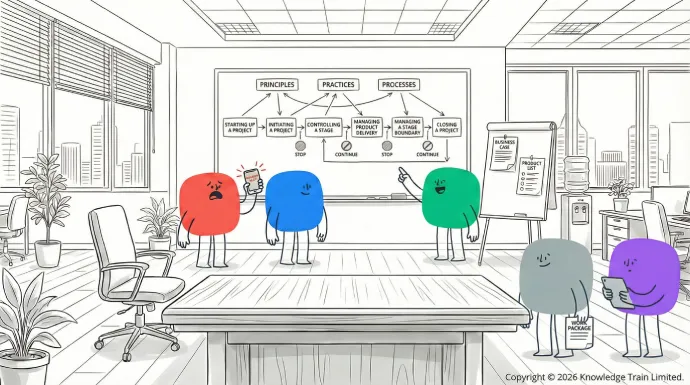
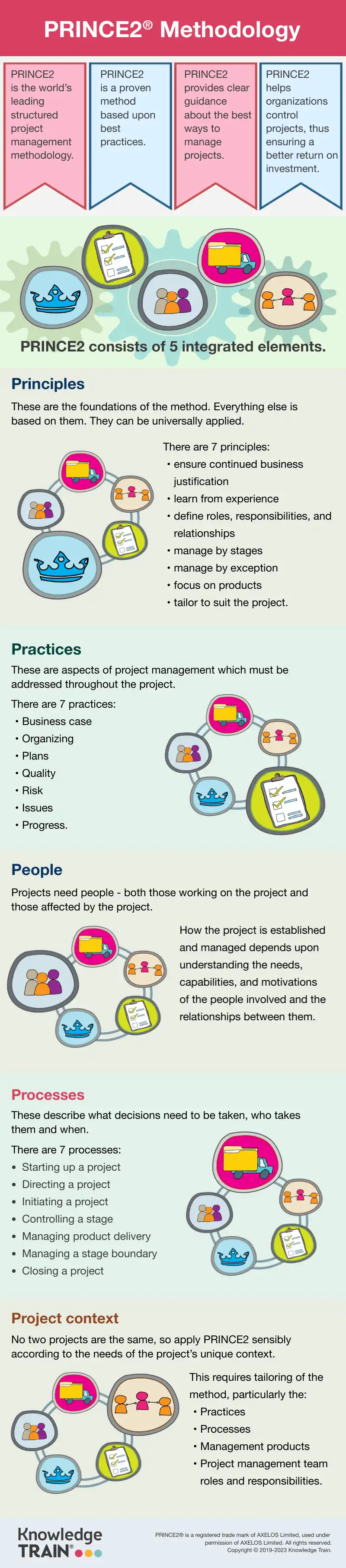
PRINCE2 principles is a requirement if a project is to be a PRINCE2 project. The principles act as immutable laws that cannot be removed from a project.Knowledge Train is a Change Management Accredited Training Organization.
The 7 principles within the methodology are described below.
Ensure continued business justificationKnowledge Train is an MSP Accredited Training Organization.
A project is only successful if it realizes the expected benefits in return for its investment of money, time, and resources. Therefore, it is imperative that all investment decisions are based upon where the project is on course to achieve these objectives. If it isn’t, then it should be closed.
Learn from experienceAXELOS Peoplecert accredited training organisation for ITIL (IT Infrastructure Library).
The experience of previous projects should be used to guide the practices on the current, and later projects.
Define roles, responsibilities, and relationshipsAXELOS Peoplecert accredited training organisation for ITIL (IT Infrastructure Library).
Everyone involved in the project management teamKnowledge Train is an AIPGF Accredited Training Organization. must be clear what they are accountable and responsible for.
Manage by stagesKnowledge Train is an AIPGF Accredited Training Organization.
A project is broken down into 2 more management stages which form ‘stop/continue’ decision points. Any decision to continue necessitates the commitment of money and resources to the next stage.
Manage by exceptionBCS accredited training partner for Business Analysis.
Authority to take decisions is granted by a higher authority to a lower authority which is an efficient use of senior managers’ time. The higher authority can be kept informed of progress via regular reports, but at the same time, the lower management level can manage with the delegated boundaries. If these boundaries are forecast to be exceeded, this exception is escalated to the higher level for a decision.
Focus on productsWHAT YOU WILL GET
Focusing on delivering on time and within budget cannot be done without first understanding what is to be delivered. All planning starts by focusing on products to understand what the plan should deliver.Our courses and workshops include:
Tailor to suit the projectCertification exam(s) where applicable
Every project is different, therefore the methodology must be applied differently and sensibly in all situations.Accredited training course materials
PeopleExpert, experienced trainers to support you
Projects involve Course manual where applicable.people , both direct participants and those impacted by a project. Recognizing their needs, skills, motivations, and the relationships among them is essential for setting up and managing the project effectively. The methodology describes how the people impacted by the project’s outcomes, must ‘buy in’ to the proposed changes, otherwise the changes will be unsuccessful, and the project will be a wasted investment.SELF-PACED ONLINE TRAINING COURSES
PracticesSelf-paced online training courses (e-learning) include:
The Certification exam(s) where applicablepracticesAccredited training course materials within the methodology are aspects of project management that are addressed throughout a project. They encompass areas like time, cost, risk, issues, quality, sustainability, and scope, common in other project management standards. These practices offer a decision-making framework, ensuring the project’s viability, desirability, and achievability from start to finish.Support from expert, experienced trainers
For anyone familiar with the Latest educational technology.Project Management Body of Knowledge (PMBOK)BUSINESS SOLUTIONS® , the PRINCE2 practices are very similar to the knowledge areas of the PMBOK ®[2]TO HELP ORGANISATIONS IMPROVE.We offer solutions to help improve team performance including:
The 7 practices in the PRINCE2 methodology are described below.Consultancy services
Business caseStaff development
This practice focuses on applying the ‘ensure business justification’ principle. It describes documenting the project’s rationale, initially in an outline business case, which is detailed further during the first management stage. The Compliance trainingbusiness caseApprenticeship training includes a cost-benefit analysis comparing project benefits against costs, timescales, and risks. It’s updated at each management stage’s end to guide the decision to continue or stop the project.Custom e-Learning development
Organizing
This practice details the various project management team roles. Within PRINCE2Find out more, the project board is the top decision-making body, consisting of the project executive, senior user, and senior supplier.
It tasks the project manager with the day-to-day project management, who operates within set tolerances. The project manager, in turn, assigns work packages for delivery by a team manager.
The board operates on a ‘manage by exception’ principle, eliminating regular meetings with the project manager by receiving regular reports. Project assurance monitors project performance and advises both the project board and project manager.
PlansCONTACT US
PRINCE2 recommends distinct plans for each level of the project management team. The project board uses a high-level project plan to oversee project progress stage by stage. The project manager relies on a more detailed stage plan for in-stage progress, while team managers need detailed team plans to monitor their work package. Each plan is approved by the next highest management level.
For planning, PRINCE2 suggests using product-based planning, emphasizing the ‘focus on products’ principles to identify products before using activity-based tools like Gantt charts.
Plans outline the “what, when, who, and how much?” Once approved, plans are set as baselines and are subject to change control.
QualityName
The project produces products which will later be used by users operating within the regular business operations. To achieve the expected outcomes and benefits, users need the correct products based on agreed specifications. PRINCE2 emphasizes planning to meet the anticipated quality standards, which must be actively overseen and managed.
Event-driven controls arise in response to specific events. For instance, an exception report is created when a tolerance threat is predicted. These reports inform decision-making in response to events and are directed to the management level with decision-making authority.
When to use the PRINCE2 methodology?
The PRINCE2 methodology is versatile, suitable for planning, managing, and controlling any project across all sectors. It ensures desired outcomes and benefits, applicable to both Self-pacedagile and traditional projects. For maximum effectiveness, begin using PRINCE2 just before a project’s onset and continue until its completion.
For agile projects, PRINCE2 Agile is advised.PRINCE2 course (online or classroom)
Why is the PRINCE2 methodology helpful?Choose from Foundation, Practitioner, or combined courses – accredited, exam-inclusive, and available online, in the classroom, or as flexible self-paced learning.
The PRINCE2 methodology aids organizations in maximizing their investments by preventing wasted resources on low-yield projects. It guides decision-makers through pivotal questions, such as:
- What’s our goal?
- Are the outcomes worth the investment?
- Do we have clarity on our objectives and the means to achieve them?
- Do we need external help?4.9/5 average rating
- Estimated duration and cost?
- What resources are required?