
What is project management?Expert certifications are still rare. There are only a handful, and those that do exist are less of a learning opportunity and more a badge of excellence rewarded to project managers who take a keen interest in project management theory.
Project managementChoose from these project management certifications is the application of knowledge, skills, tools, and techniques to project activities to meet project requirements (source: Project Management Institute ). It is structured around five core phases: Initiating, Planning, Executing, Monitoring and Controlling,Self-paced and APM PFQ blended onlineClosing .£749 +vat
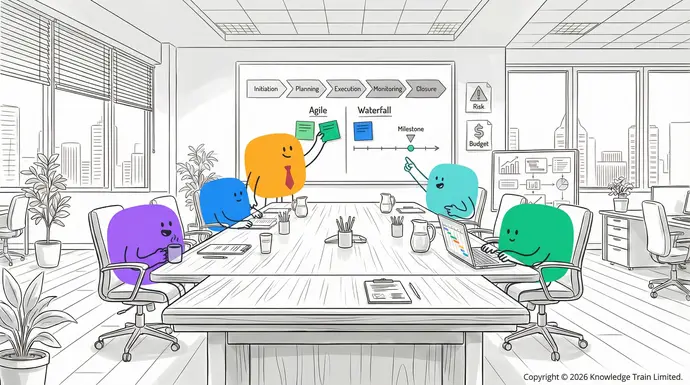
Project management is a structured approach that guides a team or organisation in planning and controlling activities to achieve defined objectives and deliverables within agreed constraints of scope, schedule, cost and quality. A project is a temporary endeavour with a specific goal, differing from routine operations. Project management ensures successful delivery through systematic processes and best practices.Self-paced
Project life cycle phasesPRINCE2 Agile Practitioner (with Foundation) self-paced online
The project life cycle£1,399 +vat generally comprises five standard process groups:
- Initiating : Defining the project at a broad level, setting business caseSelf-paced, and identifying stakeholders.AgilePM Practitioner (with Foundation) self-paced online
- Planning : Establishing the scope, objectives, detailed schedule, risk management plan, budget, deliverables, and resource allocation.£1,299 +vat
- ExecutingBeginner project management certifications: Coordinating people and resources, as well as meeting established milestones and deliverables.This category includes only those certifications that have no entry requirements and are suitable for new project managers or those who have some prior experience in project management and want to gain their first certification.
- Candidates gain the APM PFQ certificate by learning basic project management concepts and terminology which will help you make a positive contribution towards any project.: Finalising all activities, handing over deliverables to the user/customer, releasing resources, and capturing This certificate is becoming very popular in the UK because it comes from the lessons learnedAPM., the Chartered Institute for Project Management.
Project management methodologies & frameworksTo gain your APM PFQ certificate, the typical learning path is to take
Multiple methodologies and models structure how APM PFQ trainingprojects which takes 2 days, or 25 hours if studying online. are managed:PRINCE2 Foundation
- Agile methodologyIn the UK, a PRINCE2 certification is considered the industry standard in project management. The : PRINCE2 FoundationAgile certification tests your knowledge of the PRINCE2 principles, practices, processes, and terminology of the is an iterative, flexible approach emphasising collaboration, adaptability and rapid delivery; commonly used in software development and rapidly changing environments. Popular Agile frameworks such as PRINCE2 methodologyScrum. are used by teams to deliver the products specified by the customer.
- Waterfall modelThe certification is ideal for anyone who is new to project management making it a popular choice for employers and new project managers alike.: A sequential, linear process suited for projects with clear, fixed requirements, such as construction and manufacturing.The PRINCE2 Foundation certificate is by far the most common project management certification in the UK.
- Lean project managementTo gain your PRINCE2 Foundation certificate, the typical learning path is to take : Minimises waste and maximises value; ideal for manufacturing, service improvement, and efficiency-focused projects.PRINCE2 Foundation training
- Project Management Body of Knowledge (PMBOK) which takes 2 days, or 20 hours if studying online.: A set of standard terminology and guidelines from the PRINCE2 Agile FoundationProject Management InstituteIn the UK, PRINCE2 Agile certifications are becoming increasingly popular as more projects operate within an agile environment. that covers all PRINCE2 Agile Foundation certification is like PRINCE2 Foundation, except that it is aimed at people working in agile environments. The exam tests you on your knowledge of the core PRINCE2 methodology and agile concepts and terminology.project management processesTo gain your PRINCE2 Agile Foundation certification, the typical learning path is .PRINCE2 Agile Foundation training
- PRINCE2 which takes 2 days, or 12 hours if studying online.: A highly structured methodology focussed on business justification, clear organisation and divided into manageable stages; widely adopted by UK public sector and internationally.AgilePM Foundation
Project roles and responsibilitiesAnother UK certification which is suitable if you are working primarily in an agile environment is the AgilePM Foundation certification from the Agile Business Consortium. This is the most popular agile project management certification in the world, not just in the UK.
Projects rely on well-defined roles and accountability:AgilePM is based upon DSDM, one of the first agile methodologies, and for this certification you are assessed on your knowledge of the underlying agile project framework.
- Project managerTo gain your AgilePM Foundation certification, the typical learning path is : Oversees planning, execution, monitoring, control and closing; manages risks, stakeholders, schedule, and budget.AgilePM Foundation training
- Stakeholders which takes 3 days, or 20 hours if studying online.: Individuals or groups affected by the project or who can impact its outcome, such as clients, suppliers, and team members.PMI CAPM
- Project teamThe Project Management Institute offers the : Specialists responsible for delivering project tasks and deliverables.Certified Associate in Project Management
- Project sponsor (CAPM)® certification. This certificate tests your knowledge of the fundamentals of project management and common project terminology.: Provides financial resources and strategic guidance.Eligibility for this certification requires that you already possess a secondary degree and requires that you attain at least 23 hours of project management education completed before the exam. This certificate needs to be renewed every 5 years.
- Project board/steering committeeIt should be noted that the CAPM certification is mostly popular in the USA, Canada, Africa, and Asia, rather than the UK.: High-level governance and decision making.To gain your CAPM certificate, a typical learning path is
Effective stakeholder management and clear team communication are essential for project success. The project manager must align interests, resolve conflicts, and support collaborative team dynamics.CAPM training
Essential project management skills which takes 35 hours of online study.
The Intermediate project management certificationsskills required by project managersIntermediate project certifications usually have some entry requirements. We’ll start with the easiest and make our way up to the hardest. are varied.Intermediate certifications require that you have a more detailed understanding of what project management is all about. These certifications test you on your ability to apply project management principles, practices, and techniques to life-like project scenarios.
| SkillAPM PMQ | DescriptionThe Association for Project Management offers the |
|---|---|
| LeadershipProject Management Qualification | Inspiring and guiding teams towards common goals. which tests whether you have a deeper understanding of project management. The |
| CommunicationAPM PMQ | Conveying information clearly among stakeholders and team members. certification is usually taken by students having a few years’ experience of project management. |
| Risk managementThere is no prerequisite for this certification, so you do not need to hold the APM PFQ certificate already. | Identifying, analysing, and mitigating risks.To gain your APM PMQ certificate, the typical learning path is |
| SchedulingAPM PMQ training | Planning timelines and managing deadlines using tools like Gantt charts and CPM. which takes 5 days, or 35 hours if studying online. |
| BudgetingPRINCE2 Practitioner | Estimating, allocating, and controlling project finances.A |
| Scope managementPRINCE2 Practitioner | Defining and controlling what is included and excluded in the project. certification requires that you first hold the PRINCE2 Foundation certificate. The Practitioner certification tests you on your ability to apply PRINCE2 to life-like project scenarios. More particularly, it tests whether you can apply the PRINCE2 principles, practices, and processes to a fictional project scenario. |
| Resource allocationAfter PRINCE2 Foundation, the PRINCE2 Practitioner certification is probably the top project management certification in the UK. | Assigning people, equipment and budget where needed.To gain your PRINCE2 Practitioner certificate, the typical learning path is |
| Problem solvingPRINCE2 Practitioner training | Overcoming obstacles and finding effective solutions. which takes 2 days, or 15 hours if studying online. Training can also be combined with the Foundation certification. In this case, training takes 4 days, or 35 hours if studying online. |
| NegotiationIt should be noted that since the release of | Reaching agreement among parties to resolve issues.PRINCE2 7 |
| Critical thinkingth | Evaluating situations and implications for decision making. edition |
Project management tools & techniques, the prerequisites for the Practitioner certification have changed. You must now hold one of the following certificates:
- Project management softwarePRINCE2 Foundation or PRINCE2 Practitioner (6: (e.g., Microsoft Project, Asana, Trello) aids collaboration, scheduling, task assignment, budgeting, and document management.
- Gantt chart: Visual timeline for planning and tracking progress.
- Work Breakdown Structure (WBS)th: Divides project into manageable sections. edition)
- Critical Path Method (CPM)
which takes 1 day, or 15 hours if studying online. Training can also be combined with the AgilePM Foundation in which case, it takes 4 days, or 35 hours if studying online.Project Management Institute and CompTIA Project+other authoritative sourcesCompTIA offers some of the leading IT qualifications in the world. CompTIA Project+ for further study.®
Project management certifications focuses on managing smaller, less complex projects within the IT industry. This certification tests student’s knowledge of the specific industry tools used for documentation and requirements analysis.
Professional This certification has no prerequisites, but without the recommended 135 hours of IT project development experience, you might find yourself a bit lost.certificationsPMI PMP validate project management knowledge and competence:PMI’s
- PMPProject Management Professional (Project Management Professional), (PMP)CAPM® (Certified Associate in Project Management) from certification is the most challenging one on this list. To be eligible for this certification you must have 3 years of project management experience and a 4-year college/university degree. Without a degree you require 5 years of project management experience. In both cases you also need at least 35 hours of project management education completed before the exam.PMIThe PMI PMP
- Foundation® and exam covers every aspect of project management from your ability to plan projects to monitoring and controlling project tasks.PractitionerMaintaining your PMI PMP level ®PRINCE2 certifications qualification requires you continuously accumulate Professional Development Units (PDUs), which are one-hour blocks of time that you spend learning, teaching others, or volunteering. and If you want to gain your PMP certificate, a typical learning path is to take PRINCE2 Agile certificationsPMP training. which takes 35 hours of online study.
- FoundationChoose from these project management certifications and Practitioner level AgilePM certificationsSelf-paced from APMGAPM PFQ blended online
Certifications are valued globally and support career advancement.
Project management career path£749 +vat
Career progression often starts with project coordinator or assistant roles, advancing to project manager, senior project manager, programme manager, and portfolio manager positions. Skilled practitioners are in high demand in industries such as IT , construction, engineering, healthcare, and finance.Self-paced
Best project management softwarePRINCE2 Agile Practitioner (with Foundation) self-paced online
- Software tools support scheduling, resource allocation, collaboration, documentation, risk management£1,399 +vat