Project management: fundamentals, methodologies and best practices

Key takeaways
- PMI publishes the definitive CAPM eligibility criteria. Use PMI’s Stakeholders: Individuals or groups affected by the project or who can impact its outcome, such as clients, suppliers, and team members.CAPM page
- Project team as your primary source and apply exactly as stated there.: Specialists responsible for delivering project tasks and deliverables.Eligibility checklist
- Project sponsorEducation prerequisite:: Provides financial resources and strategic guidance. Meet PMI’s stated minimum education requirement for CAPM (confirm the exact wording on PMI’s CAPM page).
- Project board/steering committeeProject management training hours:: High-level governance and decision making. Complete the required number of hours of project management education/training as specified by PMI.
Effective stakeholder management and clear team communication are essential for project success. The project manager must align interests, resolve conflicts, and support collaborative team dynamics.Agreement to policies:
Essential project management skills Accept PMI’s certification and exam policies during the PMI application (certification application).
The Documentation readiness:skills required by project managers Be prepared to provide training details and to comply with any audit requests. are varied.Note:
| Skill Eligibility rules can change. Always rely on PMI’s current published requirements before you pay or book. | DescriptionHow to get CAPM certified |
|---|---|
| LeadershipConfirm eligibility | Inspiring and guiding teams towards common goals.: Read PMI’s current CAPM requirements and confirm your education and training hours meet the criteria. |
| CommunicationCreate a PMI account | Conveying information clearly among stakeholders and team members.: Set up or sign in to your account on the PMI website. |
| Risk managementSubmit your PMI application (certification application) | Identifying, analysing, and mitigating risks.: Enter your personal details, education, and project management training. |
| SchedulingPay the fee | Planning timelines and managing deadlines using tools like Gantt charts and CPM.: Pay the CAPM exam fee (PMI membership is optional but can change pricing). |
| BudgetingSchedule the exam | Estimating, allocating, and controlling project finances.: Book via PMI’s instructions and take the exam through |
| Scope managementPearson VUE (exam delivery/testing) | Defining and controlling what is included and excluded in the project. at a test centre or as an |
| Resource allocationonline proctored exam | Assigning people, equipment and budget where needed. where available. |
| Problem solvingPrepare | Overcoming obstacles and finding effective solutions.: Study the CAPM ECO domains and revise PMBOK Guide aligned concepts, then practise with timed questions. |
| NegotiationTake the exam | Reaching agreement among parties to resolve issues.: Follow test day rules for ID and online proctoring setup if relevant. |
| Critical thinkingReceive results and digital credential | Evaluating situations and implications for decision making.: View your result per PMI’s process and access your digital badge if issued. |
Project management tools & techniquesExam format and domains
- Project management softwareThe CAPM exam blueprint is governed by the : (e.g., Microsoft Project, Asana, Trello) aids collaboration, scheduling, task assignment, budgeting, and document management.CAPM Exam Content Outline (ECO)
- Gantt chart. Exam delivery is handled via : Visual timeline for planning and tracking progress.Pearson VUE
- Work Breakdown Structure (WBS) according to PMI policy.: Divides project into manageable sections.See:
- Critical Path Method (CPM)PMI CAPM certification: Identifies sequence of crucial tasks that determine project duration.PMI CAPM exam preparation and ECO access
- Project portfolio managementPearson VUE PMI programme page: Prioritising, balancing, and overseeing multiple What you need to knowprojectsDetails (verify with PMI) aligning with organisational strategy.Domains and topic coverage
Comparing project, programme, product managementDefined by the
- Project managementCAPM ECO: Focuses on delivering a unique, timebound outcome.. Expect a mix of project management fundamentals, the project lifecycle, predictive (waterfall) methodologies, agile project management, and business analysis fundamentals, plus key practices such as risk management, schedule management, cost management, stakeholder management, and quality management.
- Programme managementApproximate weighting: Oversees a group of related projects aligned to strategic objectives.PMI publishes domain weightings in the CAPM ECO. Use the latest ECO to avoid outdated percentages.
- CAPM costs depend on whether you hold Best practices: Align with global standards, stakeholder engagement, clear documentation, regular reviews, and continuous improvement.PMI membership
Refer to the , whether you need training, and whether you require a retake. Prices change, so use this as a planning guide and confirm live pricing on PMI’s CAPM page before purchase.Project Management InstituteSee: and other authoritative sourcesPMI CAPM certification (fees and policies) for further study.Cost item
Project management certificationsWhat to expect
Professional NotescertificationsPMI membership (optional) validate project management knowledge and competence:Annual membership fee set by PMI
- PMPMembership may reduce exam fees and provides access to PMI resources. Confirm current UK pricing on PMI. (Project Management Professional), CAPM exam feeCAPMDifferent member vs non member pricing (Certified Associate in Project Management) from Check current fees on PMI (pricing varies by membership status).PMIRetake fee (if applicable)
- FoundationSet by PMI and Retake rules and fees are defined by PMI policy for the current exam cycle.PractitionerTraining course level Varies widely by provider and formatPRINCE2 certificationsExpect a range based on live vs online, tutor support, and included practice exams. Ensure the course counts towards PMI’s required training hours. and Study planPRINCE2 Agile certificationsUse the .CAPM Exam Content Outline (ECO)
- Foundation as your study map, then reinforce with and PMBOK GuidePractitioner aligned learning. The plans below assume you will practise timed questions and regularly revisit weak areas such as risk management, schedule management, cost management, quality management, and stakeholder management. level Fast track plan (2 to 6 weeks)AgilePM certificationsWeek 1 from APMG: Read the ECO end to end. Build notes on project lifecycle, roles, and key documents. Start light practice questions.
Certifications are valued globally and support career advancement.Week 2
Project management career path: Predictive (waterfall) methodologies focus: schedule management, cost management, quality management. Do 2 timed practice sets.
Career progressionWeek 3 often starts with project coordinator or assistant roles, advancing to project manager, senior project manager, programme manager, and portfolio manager positions. Skilled practitioners are in high demand in industries such as : Agile project management focus: agile roles, planning cadence, and delivery concepts. Add stakeholder management scenarios.ITWeek 4, construction, engineering, healthcare, and finance.: Business analysis fundamentals: requirements, traceability, and change control linkages. Add risk management and issue handling questions.
Best project management softwareWeek 5
- Software tools support scheduling, resource allocation, collaboration, documentation, : Mixed review by ECO domains. Take 1 full mock exam under time pressure and analyse errors.risk managementWeek 6, and reporting – common options include Microsoft Project, Jira, Trello, Asana, Smartsheet, and Monday.com.: Final revision: formulae and terminology refresh, targeted drills for weak topics, then one final timed set 48 to 72 hours before exam day.
FAQsSteady plan (8 to 12 weeks)
What are the five stages of project management?Weeks 1 to 2
The five standard stages are Initiating, Planning, Executing, Monitoring and Controlling, and Closing. Each phase plays a vital role in ensuring project objectives are met efficiently.: Foundations. Learn project management fundamentals and the project lifecycle. Create a glossary and flashcards.
What does a project manager do?Weeks 3 to 4
A : Predictive focus. Deepen schedule management and cost management, then quality management and stakeholder management. Weekly quiz and review log.project managerWeeks 5 to 6 is responsible for planning, executing, and closing : Risk management and communications related scenarios. Build a one page summary per ECO domain.projectsWeeks 7 to 8. They coordinate tasks, manage the project team, oversee scheduling and budgeting, handle risks, and communicate with stakeholders to ensure successful delivery.: Agile project management. Compare agile vs predictive (waterfall) approaches and practise situational questions.
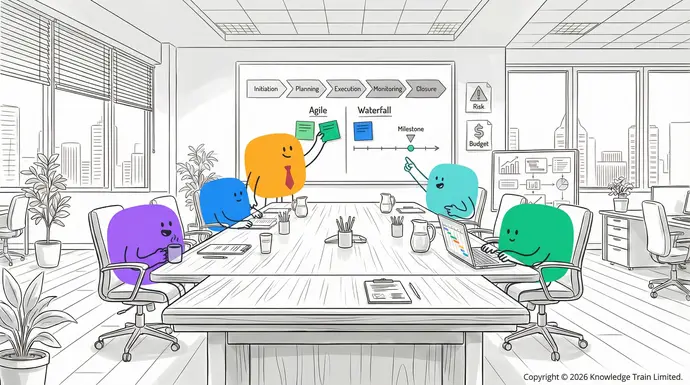
What is the difference between Agile and waterfall in project management?Weeks 9 to 10
Agile: Business analysis fundamentals. Requirements concepts, validation, and change impacts. Add mixed domain practice sets. is an iterative approach that emphasises flexibility, frequent feedback and continuous improvement, best for evolving projects. Weeks 11 to 12Waterfall: Exam readiness. Take 2 full mock exams, review wrong answers by domain, and finalise test day plan for Pearson VUE (test centre or online proctored exam). is a linear, sequential model suited to projects with well-defined requirements.CAPM vs PMP vs PRINCE2
How do I become a project manager?If you are comparing credentials, choose based on your experience level, the methodologies used in your organisation, and role expectations. CAPM is usually positioned before PMP because PMP requires substantial project management experience.
Start by gaining experience in team-based roles, develop relevant skills, and pursue Credentialproject management certificationsBest fit audience such as Typical prerequisitesPRINCE2Difficulty (relative), Typical rolesAgilePMCAPM (PMI) or CAPM. Practical experience and networking are valuable for career advancement.Entry level and early career
What are effective project management tools?Education plus PMI required project management training hours
Popular tools include Foundational to intermediateproject management softwareProject coordinator, junior project manager, PMO analyst (Microsoft Project, Asana), Gantt charts, Project Management Professional (PMP) (PMI)WBSExperienced project managers, and CPM – all of which assist in planning, scheduling, allocating resources, and communication.Significant project leadership experience plus training (per PMI)