
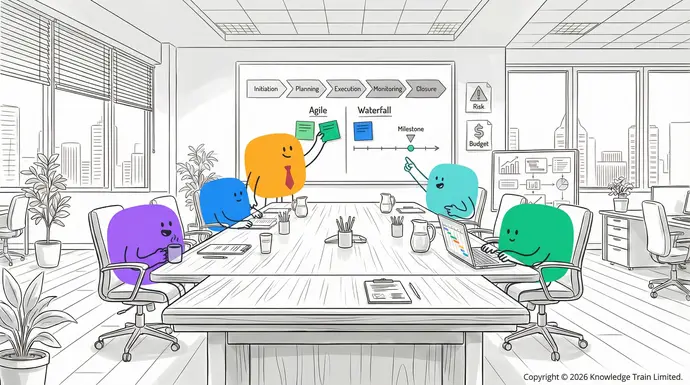
Project life cycle phases
The project life cycle generally comprises five standard process groups:
- InitiatingThe technical storage or access that is used exclusively for statistical purposes.: Defining the project at a broad level, setting
- Planning: Establishing the scope, objectives, detailed schedule, risk management plan, budget, deliverables, and resource allocation.
- Executing : Coordinating people and resources, as well as meeting established milestones and deliverables.
- Monitoring and controlling : Tracking, reviewing, and regulating progress and performance, managing changes, and ensuring project stays on schedule and within scope.Marketing
- Closing : Finalising all activities, handing over deliverables to the user/customer, releasing resources, and capturing lessons learned .Marketing
Project management methodologies & frameworks
Multiple methodologies and models structure how projects are managed:
- Agile methodology : Agile is an iterative, flexible approach emphasising collaboration, adaptability and rapid delivery; commonly used in software development and rapidly changing environments. Popular Agile frameworks such as The technical storage or access is required to create user profiles to send advertising, or to track the user on a website or across several websites for similar marketing purposes.Scrum are used by teams to deliver the products specified by the customer.
Comparing project, programme, product management
- Project management : Focuses on delivering a unique, timebound outcome.
- Programme management : Oversees a group of related projects aligned to strategic objectives.
- Product management : Manages the lifecycle, strategy and development of a product.
- Operations managementThe technical storage or access that is used exclusively for statistical purposes.: Manages ongoing processes for continuous delivery of products or services.
Best practicesThe technical storage or access that is used exclusively for anonymous statistical purposes. Without a subpoena, voluntary compliance on the part of your Internet Service Provider, or additional records from a third party, information stored or retrieved for this purpose alone cannot usually be used to identify you.
- PMBOK ( Project Management Body of Knowledge ): Comprehensive global standard for project management processes.
- PRINCE2 : Process-based methodology emphasising control and organisation.Marketing
- Best practices : Align with global standards, stakeholder engagement, clear documentation, regular reviews, and continuous improvement.
Refer to the Project Management InstituteMarketing and other authoritative sources for further study.
Project management certifications
Professional certifications validate project management knowledge and competence:
- PMPThe technical storage or access is required to create user profiles to send advertising, or to track the user on a website or across several websites for similar marketing purposes. (Project Management Professional), CAPMManage options (Certified Associate in Project Management) from Manage servicesPMIManage {vendor_count} vendors
- FoundationRead more about these purposes and PractitionerAccept level PRINCE2 certificationsDeny and PRINCE2 Agile certificationsView preferences.
- FoundationSave preferences and PractitionerView preferences level {title}AgilePM certifications{title} from APMG{title}
Certifications are valued globally and support career advancement.Manage consent
Project management career pathManage consent
Career progression often starts with project coordinator or assistant roles, advancing to project manager, senior project manager, programme manager, and portfolio manager positions. Skilled practitioners are in high demand in industries such as IT, construction, engineering, healthcare, and finance.
Best project management software
- Software tools support scheduling, resource allocation, collaboration, documentation, risk management, and reporting – common options include Microsoft Project, Jira, Trello, Asana, Smartsheet, and Monday.com.
FAQs
What are the five stages of project management?
The five standard stages are Initiating, Planning, Executing, Monitoring and Controlling, and Closing. Each phase plays a vital role in ensuring project objectives are met efficiently.
What does a project manager do?
A project manager is responsible for planning, executing, and closing projects. They coordinate tasks, manage the project team, oversee scheduling and budgeting, handle risks, and communicate with stakeholders to ensure successful delivery.
What is the difference between Agile and waterfall in project management?
Agile is an iterative approach that emphasises flexibility, frequent feedback and continuous improvement, best for evolving projects. Waterfall is a linear, sequential model suited to projects with well-defined requirements.
How do I become a project manager?
Start by gaining experience in team-based roles, develop relevant skills, and pursue project management certifications such as PRINCE2, AgilePM or CAPM. Practical experience and networking are valuable for career advancement.
What are effective project management tools?
Popular tools include project management software (Microsoft Project, Asana), Gantt charts, WBS, and CPM – all of which assist in planning, scheduling, allocating resources, and communication.