Project management: fundamentals, methodologies and best practices

Key takeaways
Strong project delivery comes from clear lifecycle control, the right framework, and disciplined communication.
- Project management guides a temporary endeavour through initiating, planning, executing, monitoring and controlling, and closing.
- Match methodology to context: Agile suits changing needs, while Waterfall and PRINCE2 fit defined scope and governance.
- Clear roles, especially sponsor, stakeholders, and project manager, reduce conflict and speed decisions.
- Use practical tools like Gantt charts, critical path, and software dashboards to manage time, cost, and risk.
- Courses and certifications build leadership, communication, and analytical skills that improve career prospects and delivery outcomes.
What is project management?
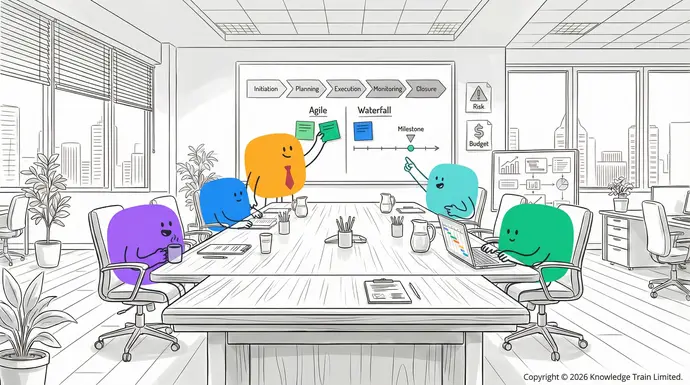
Project management is the application of knowledge, skills, tools, and techniques to project activities to meet project requirements (source: Project Management Institute ). It is structured around five core phases: Initiating, Planning, Executing, Monitoring and Controlling, and Closing .
Project management is a structured approach that guides a team or organisation in planning and controlling activities to achieve defined objectives and deliverables within agreed constraints of scope, schedule, cost and quality. A project is a temporary endeavour with a specific goal, differing from routine operations. Project management ensures successful delivery through systematic processes and best practices.
Project life cycle phases
The project life cycle generally comprises five standard process groups:
- Initiating : Defining the project at a broad level, setting business case , and identifying stakeholders.
- Planning : Establishing the scope, objectives, detailed schedule, risk management plan, budget, deliverables, and resource allocation.
- Executing : Coordinating people and resources, as well as meeting established milestones and deliverables.
- Monitoring and controlling : Tracking, reviewing, and regulating progress and performance, managing changes, and ensuring project stays on schedule and within scope.
- Closing : Finalising all activities, handing over deliverables to the user/customer, releasing resources, and capturing lessons learned .
Project management methodologies & frameworks
Multiple methodologies and models structure how projects are managed:
- Agile methodology : Request a quoteAgile is an iterative, flexible approach emphasising collaboration, adaptability and rapid delivery; commonly used in software development and rapidly changing environments. Popular Agile frameworks such as Scrum[email protected] are used by teams to deliver the products specified by the customer.
- Waterfall model +44 (0)207 148 5985: A sequential, linear process suited for projects with clear, fixed requirements, such as construction and manufacturing.Courses
- Lean project managementPROJECT MANAGEMENT: Minimises waste and maximises value; ideal for manufacturing, service improvement, and efficiency-focused projects.PRINCE2
- Project Management Body of Knowledge (PMBOK)®: A set of standard terminology and guidelines from the Foundation Project Management InstituteLearn the fundamentals of the PRINCE2 method. that covers all Practitioner
Refer to the Includes Foundation & Practitioner combined option.Project Management InstituteScrum and Scrum Essentials other authoritative sourcesSelf-paced training course to learn the essentials of Scrum. for further study.Scrum Master
Project management certificationsChoose Scrum Alliance or Scrum.org Scrum Master training courses.
Professional Scrum Product Owner certificationsChoose Scrum Alliance or Scrum.org Product Owner training courses. validate project management knowledge and competence:AgileBA
- PMP® (Project Management Professional), – Agile Business AnalysisCAPMFoundation (Certified Associate in Project Management) from Learn the fundamentals of Agile Business Analysis.PMIPractitioner
- Foundation4-day course including Foundation. and Lean Six SigmaPractitionerYellow Belt level Self-paced training course to gain LSS Yellow Belt.PRINCE2 certificationsPMI and ®PRINCE2 Agile certificationsPMI-ACP .Self-paced course to prepare you for the exam (exam not included).
- FoundationKanban and Estimating for Agile FoundationPractitionerAgile Learning Library (ALL)™ level BUSINESS ANALYSISAgilePM certificationsBCS Business Analysis from APMGBusiness Analysis Foundation
Certifications are valued globally and support career advancement.Learn the fundamentals of business analysis.
Project management career pathModelling Business Processes
Career progressionGain practitioner certificate in modelling business processes. often starts with project coordinator or assistant roles, advancing to project manager, senior project manager, programme manager, and portfolio manager positions. Skilled practitioners are in high demand in industries such as Business Analysis Practices ITGain practitioner certificate in business analysis practices., construction, engineering, healthcare, and finance.Requirements Engineering
Best project management softwareGain practitioner certificate in requirements engineering.
- Software tools support scheduling, resource allocation, collaboration, documentation, Business Analysis International Diploma risk managementAll 4 courses bundled into this Diploma certification package., and reporting – common options include Microsoft Project, Jira, Trello, Asana, Smartsheet, and Monday.com.AgileBA
FAQs®
What are the five stages of project management? – Agile Business Analysis
The five standard stages are Initiating, Planning, Executing, Monitoring and Controlling, and Closing. Each phase plays a vital role in ensuring project objectives are met efficiently.Foundation training
What does a project manager do?Learn the fundamentals of Agile Business Analysis.
A Practitioner project manager4-day course including Foundation. is responsible for planning, executing, and closing PMIprojects®. They coordinate tasks, manage the project team, oversee scheduling and budgeting, handle risks, and communicate with stakeholders to ensure successful delivery.PMI-PBA
What is the difference between Agile and waterfall in project management?Self-paced course to prepare you for the exam (exam not included).
AgileBusiness Analysis Learning Library (BALL)™ is an iterative approach that emphasises flexibility, frequent feedback and continuous improvement, best for evolving projects. CHANGE MANAGEMENTWaterfallAPMG Change Management is a linear, sequential model suited to projects with well-defined requirements.Foundation
How do I become a project manager?Learn the fundamentals of enterprise change management.
Start by gaining experience in team-based roles, develop relevant skills, and pursue Practitioner project management certificationsIncludes Foundation & Practitioner combined option. such as PROGRAMME MANAGEMENTPRINCE2MSP, ®AgilePMFoundation or CAPM. Practical experience and networking are valuable for career advancement.Learn the fundamentals of programme management.
What are effective project management tools?Practitioner
Popular tools include Includes Foundation & Practitioner combined option.project management softwareINFORMATION TECHNOLOGY (IT) (Microsoft Project, Asana), Gantt charts, ITILWBS®, and CPM – all of which assist in planning, scheduling, allocating resources, and communication.Foundation