Project management vs programme management

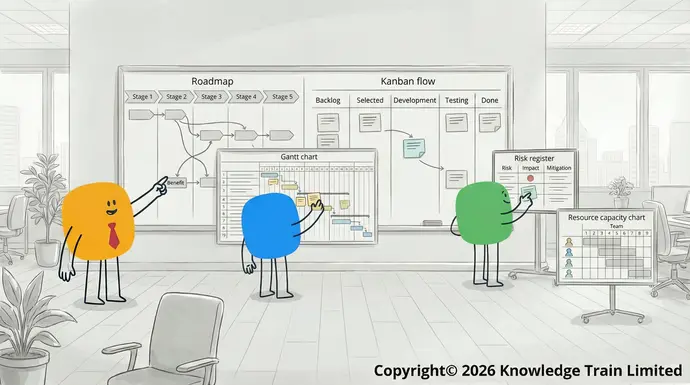
IntroductionInfographic
Project managementIntroduction and Project managementprogramme management is the application of knowledge, skills, tools and techniques to meet project requirements. It’s a critical discipline that enables organisations to deliver value. are two distinct approaches to managing work within organisations. While both disciplines aim to deliver successful outcomes, they differ in scope, objectives, and methods.Project management principles
Project management are fundamental guidelines and approaches that underpin effective project management practices. These principles provide a framework for project planning, execution and control. They are applicable across various industries and project types. is a well-known practice that focuses on achieving specific outputs or deliverables within predefined constraints such as time, cost, and scope. On the other hand, In this article, we’ll cover:programme managementKey project management principles takes a broader perspective, coordinating and overseeing multiple related projects to realise strategic benefits for the organisation. Understanding the differences between project and programme management is crucial for effective resource allocation, stakeholder management, risk mitigation, and organisational agility.How to apply these principles
By grasping the nuances of these two management approaches, organisations can better navigate the complexities of the modern business environment, improve their success rates, and drive sustainable growth.How to overcome common project management challenges.
Understanding projects and programmesProject management principles are essential for successful project outcomes. By understanding and applying these principles,
What is a project?project managers
A can enhance their effectiveness and deliver greater value to stakeholders. After reading this article, you may be interested in learning about the projectPRINCE2 principles is a temporary endeavour undertaken to create a unique product, service, or result. It is a fundamental unit of work within organisations, often characterised by a specific purpose and an end goal. and what this widely used project management methodology says.
: Clear objectives help prevent misunderstandings, reduce the risk of scope creep and keep the project focused. model is a common framework that identifies three key factors:Alignment with company objectives
- Time: It’s important to ensure project goals support the broader goals and objectives of the company.: Projects must adhere to deadlines and milestonesDocumentation and approval
- Cost: Requirements should be documented and formally approved by all relevant stakeholders.: Projects must stay within budget allocationsBenefit
- ScopeDescription: Projects must deliver agreed-upon features and functions.Focus
Project managersGuides team efforts towards specific outcomes must balance these constraints to ensure successful project delivery.Measurement
What is a programme?Provides benchmarks for assessing progress
- The engagement of a project sponsor can be vital in delivering project success:: Programmes involve the coordinated management of several interrelated projectsRole
- Longer duration: Acts as the overall champion and supporter of the project: Programmes typically last several years or may be ongoingBenefits
- Strategic focus: Ensures the availability of resources, removes roadblocks and promotes the project.: Programmes are aligned with the organisation’s goalsStrategies
- Evolving nature: Stay updated, communicate clearly and involve the sponsor in key decisions.: Programmes adapt to changing business needs.Defining these important fundamentals,
Programme objectives and strategic alignmentproject managers
Programmes focus on realising can lay a strong foundation for project success and delivery.strategic benefitsBy effectively managing scope and changes, project managers can ensure projects remain on track while accommodating necessary adjustments. This balance promotes project success and stakeholder satisfaction. for the organisation. They are concerned with creating value and supporting business objectives. Key aspects of programmes include:Defining roles and responsibilities
- Value creationClearly defining roles and responsibilities within a project is essential for its success. This section will delve into aspects of team accountability and the role of the project manager.: Delivering outcomes that contribute to the organisation’s strategic goalsTeam accountability
- Change managementCreating accountability structures is important to ensure that each team member understands their responsibilities and expectations.: Facilitating organisational transformations and initiativesRACI/RASCI matrix
- Stakeholder engagementRACI: Managing complex relationships across multiple projects (Responsible, Accountable, Consulted, Informed) or
- Risk mitigationRASCI: Addressing broader and long-term risks. (with Sign-off) matrices are useful tools to clearly define roles and responsibilities for each task or decision in a project:
Programme managers are responsible for ensuring that individual projects within the programme contribute to the overall strategic objectives. They maintain flexibility to adapt to changing business environments while maximising benefits realisation.Responsible
In conclusion, understanding the distinctions between projects and programmes is critical for effective management and organisational success. By recognising the differences in scope, objectives, and management approaches, organisations can better allocate resources, manage stakeholders, and navigate the complexities of the modern business landscape.: Who will do the task?
Key differences between project and programme managementAccountable
It is of crucial importance for the representatives of organisational leadership to have a good awareness of key difference between project and programme management, which will be further elaborated by focusing on five areas.: Who is ultimately responsible for task completion?
Scope and focusConsulted
Self-pacedProject risk management centres on PRINCE2 Agile Practitioner (with Foundation) self-paced onlinespecific risks and opportunities associated with a project. This includes identifying risks within the project’s scope, developing risk response strategies for known risks, and continuously monitoring and controlling risk impacts on project objectives.£1,399 +vat
Project managers aim to minimise uncertainty and potential threats to project outcomes.
Programme risks
Programme risk management takes a broader perspectiveSelf-paced and considers the interconnected risks across multiple projects. This involves managing strategic risks that can impact organisational goals and adapting to emerging risks and opportunities that arise during the programme’s lifecycle.AgilePM Practitioner (with Foundation) self-paced online
Programme managers have a holistic view of risk and consider its implications on the entire programme.
Change management£1,299 +vat
ProjectsManaging project scope and changes
Change management within projects is often focused on Managing project scope and change carefully helps you to manage change within your project.minimising disruptionsScope creep prevention and changes to the project’s scope and plan. The goal is to maintain stability and adhere to the defined project constraints and objectives.Defining project boundaries
Project managers often implement strict change control procedures to prevent scope creep and stay on track.It is important to clearly define project boundaries to avoid scope creep. To do this, one must document specific project deliverables, explicitly identify exclusions and set measurable acceptance criteria.
ProgrammesChange management processes
Change management within programmes, on the other hand, is more Robust adaptive and flexible
- Clear communicationMonitor and reassess periodically: Both roles exchange regular updates and information.Medium
- Aligned objectivesDevelop specific response strategies: Project goals support and align with the programme’s desired outcomes.High
- Resource optimisationCreate detailed action plans and allocate resources: They coordinate resource allocation across projects for efficiency.Ongoing
- Risk mitigationrisk management: Potential cross-project risks are identified and addressed collaboratively. is critical for successful outcomes. It involves careful tracking and refinement of the risk management process. Identifying and addressing project risks early can significantly improve project resilience and success rates.
- Change managementMonitoring and measuring project progress: Adaptations are made to changes in programme strategy.Monitoring and measuring progress are crucial aspects of project management that help ensure project success. This section will cover various aspects of monitoring and measuring project progress, including the use of key performance indicators (KPIs) and performance management baselines.
- Stakeholder engagementKey Performance Indicators (KPIs): Communication at different levels is coordinated.Selecting appropriate KPIs
Working in unison, project and programme managers create synergy that elevates the organisation’s overall performance.Selecting the right KPIs is important to ensure effective monitoring and measuring of project progress. The KPIs should be aligned with the project objectives and should provide insights into the project’s performance. Some of the commonly used KPIs include:
Tools and methodologiesSchedule Performance Index
Project and programme management often require specialised tools and methodologies to succeed. This section highlights some of the most prominent tools and techniques used in both fields, including approaches like (SPI)AgileCost Performance Index and (CPI)DevOpsQuality metrics.Stakeholder satisfaction scores
Project management tools and techniques.
Project managers have a wide array of Tracking and reporting methods
risk management approaches, and change management strategies.{"@context":"https://schema.org","@type":"ImageObject","contentUrl":"https://www.knowledgetrain.co.uk/training-courses/project-management-principles-infographic-v1.0.webp ","description":"Project management principles infographic ","license":"https://www.knowledgetrain.co.uk/license","acquireLicensePage":"https://www.knowledgetrain.co.uk/license","creditText":"Knowledge Train","uploadDate":"2024-10-18T09:00:53.000Z","copyrightNotice":"© 2024 Knowledge Train Limited. All rights reserved.","creator":{"@type":"Organization","name":"Knowledge Train","url":"https://www.knowledgetrain.co.uk"}}
Aligning both project and programme management approaches can result in enhanced achievement of strategic goals for organisations. Optimised resource allocation can be achieved, along with improved stakeholder engagement and increased adaptability to market changes.
By leveraging the strengths of both methodologies, organisations can effectively navigate complexities and drive sustainable growth in their respective industries.Related articles
