
Key takeawaysAGILE BUSINESS ANALYSIS COURSES
Strong delivery comes from choosing and combining techniques that fit your project’s uncertainty, scale, and stakeholders.Select your preferred training course below:
- Use a Work Breakdown Structure to define scope clearly and create reliable estimates and ownership.
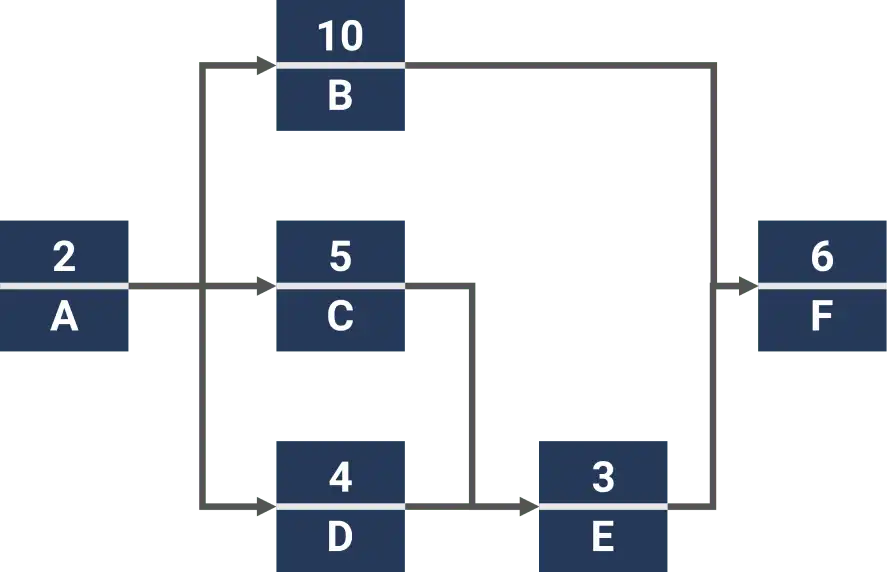
- Use Gantt charts and network diagrams to visualise sequencing, dependencies, and progress.BUSINESS ANALYSIS QUALIFICATIONS
- Apply CPM and PERT to identify critical work, quantify schedule risk, and test scenarios.Select your preferred qualification.
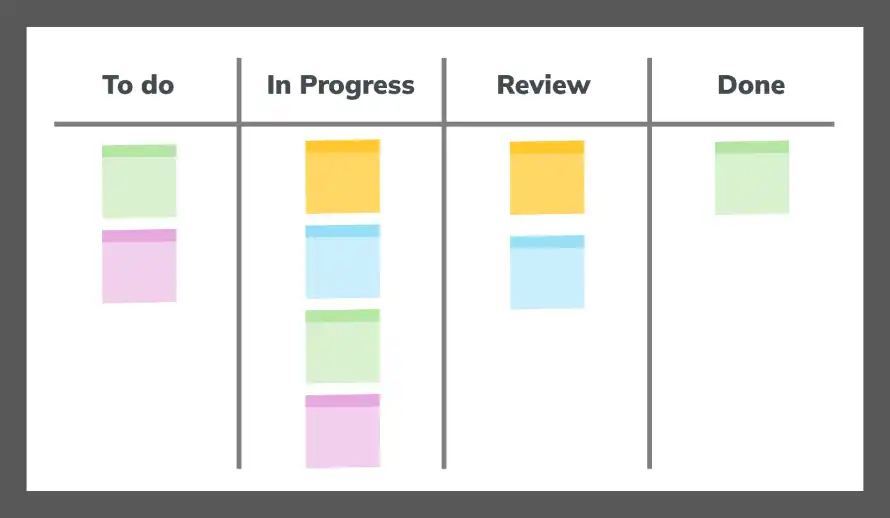
- Use Kanban to manage flow, limit work in progress, and surface blockers early.
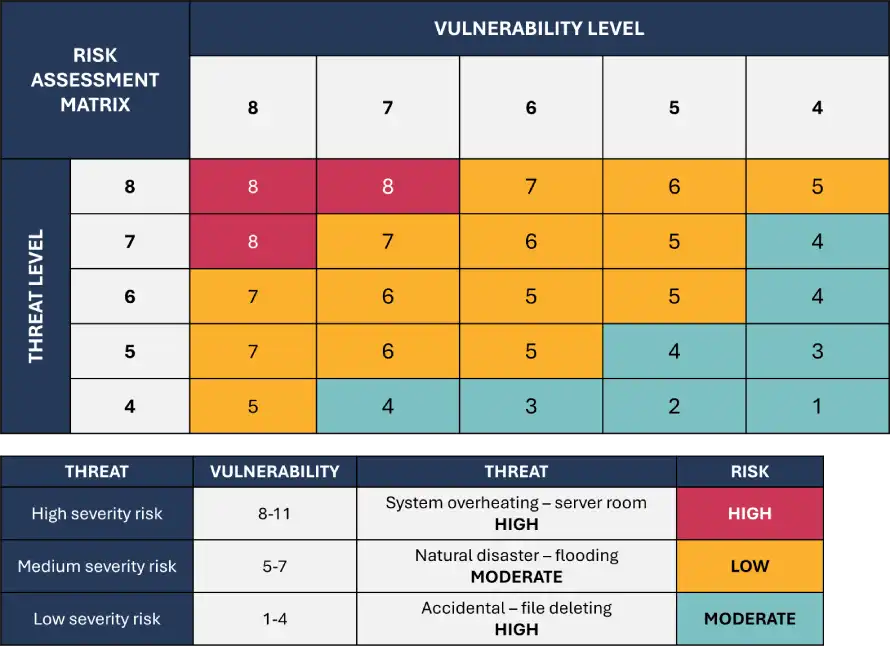
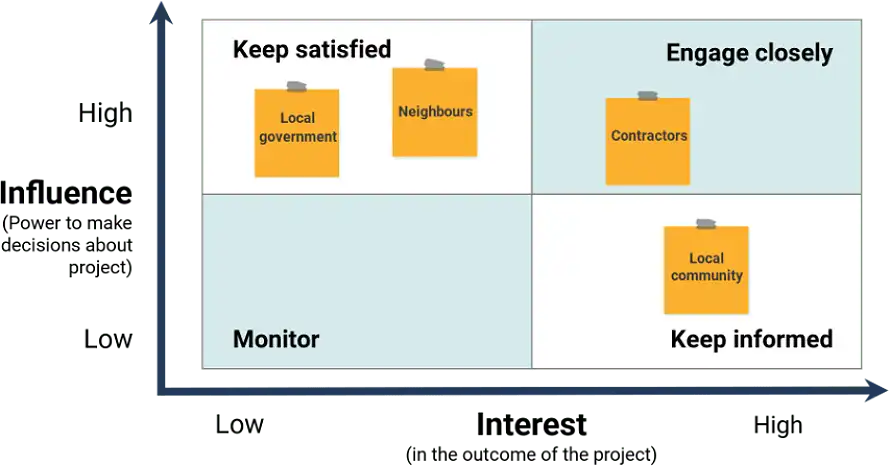
- Prioritise uncertainty with a risk matrix and stakeholder mapping to guide action and communication.BCS BUSINESS ANALYSIS COURSES
- Track delivery health with EVM and cost-benefit analysis to support timely, evidence-based decisions.Select your preferred training course below:
Introduction to project management techniquesPRINCE2 COURSES
Project management techniques have become an essential aspect of modern businesses, allowing organisations to achieve their objectives, meet deadlines, and deliver value to their stakeholders. These techniques refer to the tools and methodologies that project managers and teams use to plan, execute, and control projects efficiently. Select your preferred training course below:Project management techniques have been in existence for centuries, and they have evolved to meet the changing needs of businesses and the latest technological developments.APM COURSES
The history of project management techniques dates to ancient times when large-scale projects such as the construction of the pyramids and the Great Wall of China were undertaken. However, modern project management started to emerge in the mid-20th century with the development of techniques such as the Gantt chart and the Critical Path Method (CPM). As businesses became more complex and globalised, new methodologies emerged to address the diverse project needs of different industries.Select your preferred training course below:
Today, there are many project management techniques that project managers can use to achieve success. In this article, we will discuss 11 essential project management techniques that every project managerAGILE PROJECT MANAGEMENT COURSES should know. Each technique has its benefits and is suitable for different types of projects and organisational cultures. Project managers need to understand the various project management techniques available and choose the ones that best fit their projects and organisational cultures. They should also be adaptable to change as Select your preferred training course below:project needs and circumstances evolve.PRINCE2 AGILE COURSES
Project planning and visualisationSelect your preferred training course below:
Work Breakdown Structure (WBS)
The BUSINESS CASE COURSESWork Breakdown StructureSelect your preferred training course below: (WBS) is a project management technique that involves breaking down a project into smaller, more manageable components. It is a hierarchical decomposition of the total scope of work and provides a visual representation of all the tasks required to complete a project.
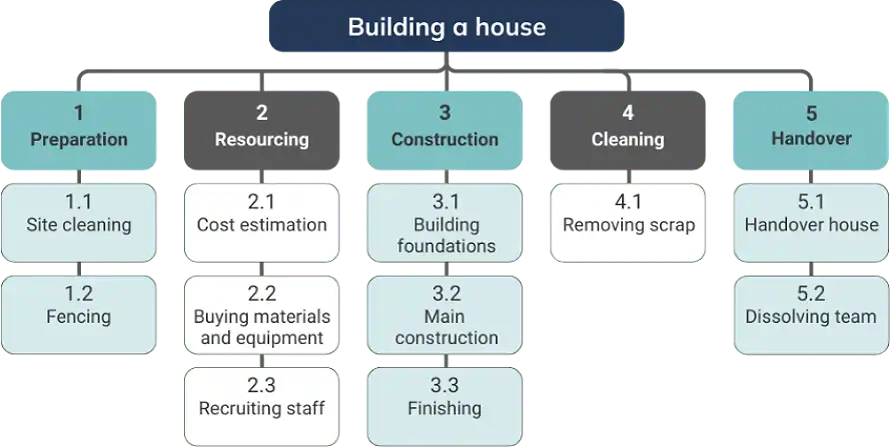
The essence of a WBS is to break down the final deliverable into smaller, more manageable components called work packages. It starts with the final deliverable at the top and is subdivided in a tree structure, where each level of detail represents an increasingly granular level of the project components. These components are typically organised into phases, deliverables, and work packages. By definition, WBS becomes more detailed as you go deeper into the tree. In AGILE COURSESproject managementSelect your self-paced training course topic., WBS is used to:
- Define and organise the total scope of a projectAGILE PROJECT MANAGEMENT COURSES
- Ensure all the work required is included, and nothing outside the scope is addedSelect your preferred training course below:
- Create a foundation for estimating costs, duration, and resources
- Assign responsibilities to team membersPRINCE2 AGILE COURSES
- Develop a Select your preferred training course below:project schedule and budget.SCRUM COURSES
Developing a Select your preferred training course below:WBS typically requires input from the project team and stakeholders to ensure it is comprehensive and accurate. A WBS is usually presented as a tree diagram or outline, with each level representing an increased level of detail and each item on the same level representing a similar type of work. Note that the term ‘tree’ is used by many software systems and it is not necessarily drawn as a tree.LEAN SIX SIGMA COURSES
A WBS becomes the foundation for other Select your preferred training course below:project management processes , including risk assessment, task assignments, and progress tracking. It helps the project team to provide a common structure for the whole project, and other details and activities are based on the work breakdown structure.BUSINESS ANALYST COURSES
Gantt chartsSelect your self-paced training course topic.
Gantt charts are one of the most widely used and recognised project management techniques. They provide a visual timeline for the project and can display the relationships and dependencies between different tasks or activities. Gantt charts have a long history, with their use dating back to the early 1900s when they were popularised by Henry Gantt, a mechanical engineer and management consultant. In recent years, Gantt charts have transitioned from physical, hand-drawn charts to digital project management tools.BCS BUSINESS ANALYST COURSES
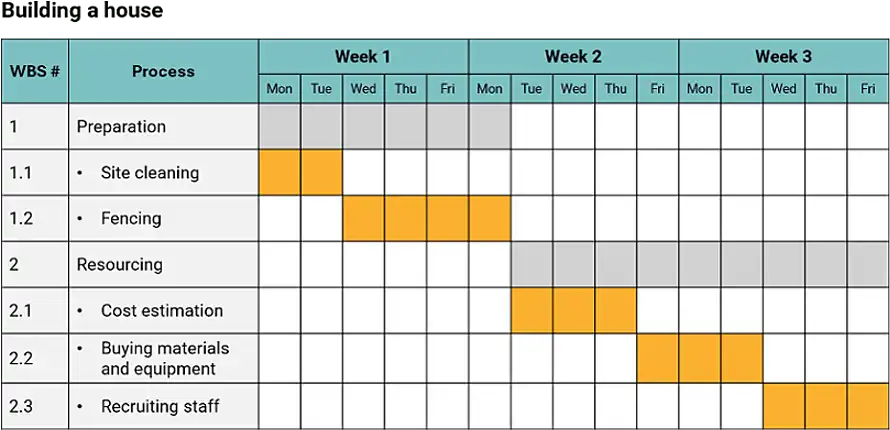
A Gantt chart typically consists of a horizontal bar chart with the project tasks listed on the vertical axis on the left side and the time periods spread across the top. The project tasks are then represented by horizontal bars spanning the time periods in which they are scheduled to be performed. The length of the bar indicates the duration of each task. This format allows Select your preferred training course below:project managers and team members to:CHANGE MANAGEMENT COURSES
- Clearly visualise the project timeline and the duration of each taskSelect your self-paced training course topic.
- Identify dependencies and relationships between tasks
- Track progress against the planned scheduleAPMG CHANGE MANAGEMENT COURSES
- Allocate resources to tasksSelect your preferred training course below:
- What is Agile? Agile Methodology, Principles, and Frameworks
OUR VALUES
Our 6 core values are everything we do. They include:Integrity
Diversity
Some of the charities we have helped over the years:
- Identify both positive and negative stakeholders.
- Customise communication plans for different stakeholder groups.
- Engage team members in the mapping process for a broader view.
Common pitfalls
- Missing less apparent stakeholders. AWARDS
- Not reassessing stakeholder positions over time. We don’t go seeking awards, but here are two of the awards we have received for our training.
- Ignoring low-power stakeholders.
- Request a quote
United Kingdom
- Austria
- Belgium
- Bulgaria
Croatia
- Cyprus
- Copied!
- Key takeaways
- Scope, time and cost move together, so every change needs a conscious trade-off.
Any shift in scope, schedule, or budget typically forces an adjustment in at least one other constraint.
- Imbalances often show up as rushed work, under-resourcing, or overambitious deliverables that reduce quality.
- Pick at least one flexible constraint early so you can respond to issues without losing control.
- Use prioritisation and formal change control to prevent scope creep and keep decisions objective.
- Monitor risks and progress continuously, and communicate trade-offs clearly to stakeholders.
FAQs
What are the most essential project management techniques? Infographic
Some of the most important and effective ones include Gantt charts, IntroductionWork Breakdown Structure The , CPM, Kanban boards and Risk Analysis. project management triangle
How do Gantt charts help in project management? , also known as the triple constraint model, is a concept that visualises the constraints of
Gantt charts are versatile project management tools. A Gantt chart could help in many ways: from getting you started on your tasks and giving you deadlines to plotting out your timeline and tracking your progress, all the way to giving you an eagle eye on task dependencies and seeing bottlenecks. scope
What is the Work Breakdown Structure (WBS), and why is it important? ,
A Work Breakdown Structure or a WBS is a project management technique that decomposes a project into smaller pieces for easier management. A timeWBS , and is critical for task organisation, time and cost estimation and more it allows you to build a clear scope for your project and help you to not get overwhelmed and not forget anything important. cost
How can Kanban boards improve project workflow? in
Kanban boards are visual tools that can help you and your team to visualise and manage tasks and workflows. Kanban boards will help your team collaborate, limit work-in-progress, and manage processes more efficiently, they also help you to see the bottlenecks easily. Kanban boards are a more popular tool for recurring processes and project managementAgile project management . It highlights the interconnected nature of these three aspects in delivering a successful project.. The triangle model is a crucial tool for project managers to understand and balance the competing demands of a
What is the Critical Path Method (CPM), and how does it help in scheduling? project
The Critical Path Method or CPM is a project scheduling technique that analyses your project in terms of tasks’ sequence and duration. CPM will help you to identify the longest chain of dependent tasks in your project, the so-called critical path, which would then help you in your decision-making: it will allow you to see what your project’s minimal duration is and what tasks can be delayed or rescheduled without affecting the project in general. The CPM is very useful in resource planning and allocation, as well as ensuring you have a solid deadline. . The scope refers to the project’s requirements, objectives, and deliverables. Time refers to the schedule and deadlines. Cost encompasses the budget and resources. The challenge is to optimise all three to meet project goals.
What is Scrum, and how does it fit into Agile project management? Each corner of the triangle is dependent on the other two. A change in one element typically results in a change in at least one other. By understanding and managing these constraints, project teams can make informed decisions and adjustments to ensure project success.
Scrum The project management triangle is a fundamental concept that helps is an Agile project management framework that organises the work into short iterative cycles (sprints). Scrum relies on defined roles (Product Owner, Development Team and project managers Scrum Master visualise and optimise the key constraints of any project. By balancing scope, time, and cost, project teams can deliver successful outcomes that meet stakeholder expectations.), events (sprint planning, daily stand-ups) and tools (sprint backlog). Scrum helps teams to plan and manage their work, adapt to changing requirements, and deliver value quickly. Understanding the project management triangle
How does Agile project management differ from traditional methods? The three constraints explained
Agile The project management triangle is made up of three main constraints: is an iterative and incremental approach to product development that values flexibility, collaboration, and customer satisfaction over following a rigid plan. Agile teams embrace change even late in the project, and they focus on delivering working solutions regularly rather than following a fixed set of requirements. Agile is all about continuous improvement and responding to feedback, and there are different ways (frameworks) to do it. scope
Infographic ,
