11 essential project management techniques

Key takeaways
Strong delivery comes from choosing and combining techniques that fit your project’s uncertainty, scale, and stakeholders.
- Use a Work Breakdown Structure to define scope clearly and create reliable estimates and ownership.
- Use Gantt charts and network diagrams to visualise sequencing, dependencies, and progress.
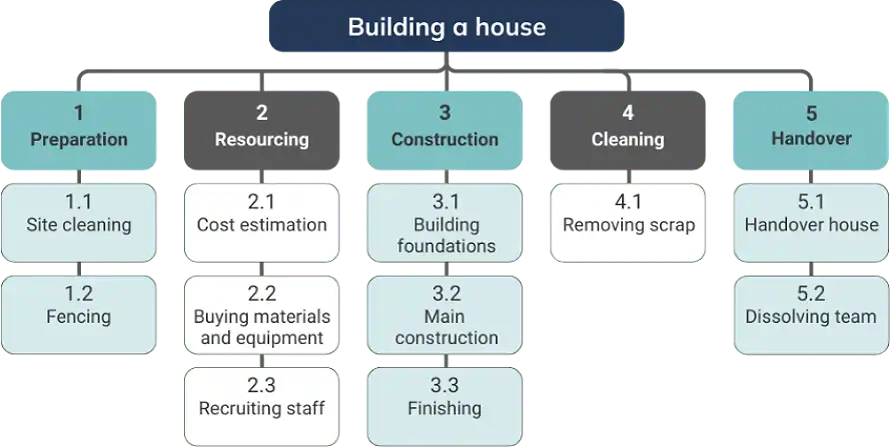
typically requires input from the project team and stakeholders to ensure it is comprehensive and accurate. A WBS is usually presented as a tree diagram or outline, with each level representing an increased level of detail and each item on the same level representing a similar type of work. Note that the term ‘tree’ is used by many software systems and it is not necessarily drawn as a tree.
A WBS becomes the foundation for other project management processes , including risk assessment, task assignments, and progress tracking. It helps the project team to provide a common structure for the whole project, and other details and activities are based on the work breakdown structure.
Gantt charts
Gantt charts are one of the most widely used and recognised project management techniques. They provide a visual timeline for the project and can display the relationships and dependencies between different tasks or activities. Gantt charts have a long history, with their use dating back to the early 1900s when they were popularised by Henry Gantt, a mechanical engineer and management consultant. In recent years, Gantt charts have transitioned from physical, hand-drawn charts to digital project management tools.
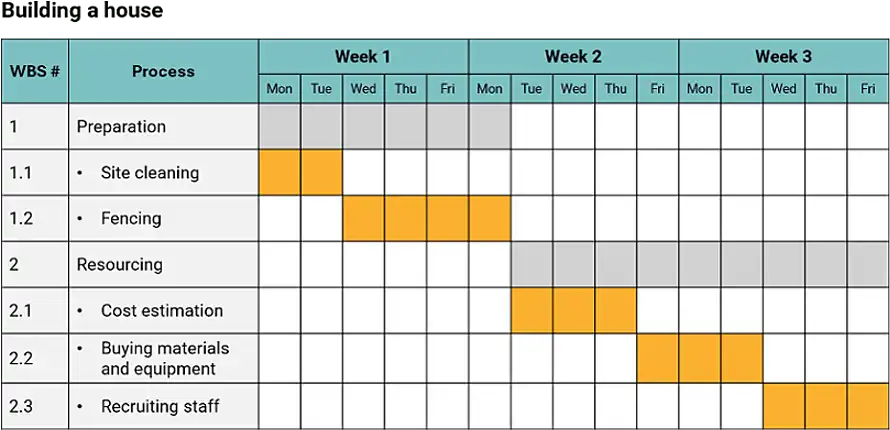
A Gantt chart typically consists of a horizontal bar chart with the project tasks listed on the vertical axis on the left side and the time periods spread across the top. The project tasks are then represented by horizontal bars spanning the time periods in which they are scheduled to be performed. The length of the bar indicates the duration of each task. This format allows project managers and team members to:
- Clearly visualise the project timeline and the duration of each task
- Identify dependencies and relationships between tasks
- Track progress against the planned schedule
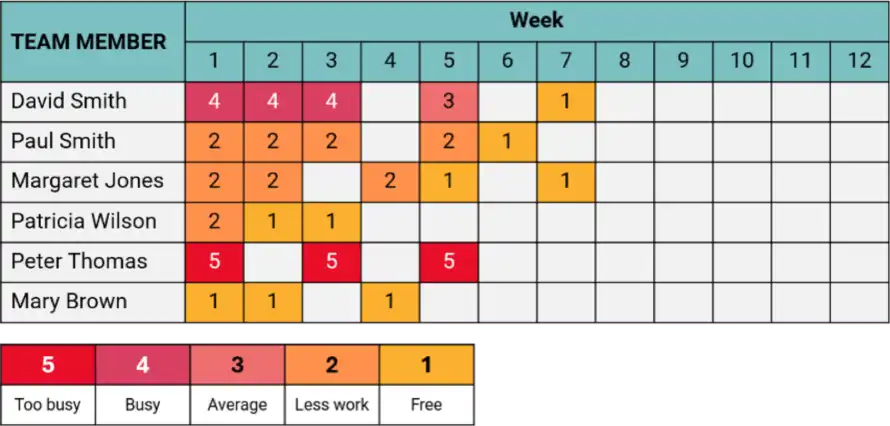
- Allocate resources to tasks
- Communicate the project timelines to stakeholders.
Some modern Gantt chart software provides additional features such as colour-coding of tasks, milestone markers, and linking of dependent tasks. Some tools also allow for resource allocation and workload management directly from the Gantt view.
Gantt charts are most useful when you want to provide an overview of the entire project. However, for large and complex projects, they may become cluttered and difficult to read. Despite this, Gantt charts remain a popular tool for project managers because of their intuitive design and ability to communicate complex scheduling information quickly and clearly.
Project network diagrams
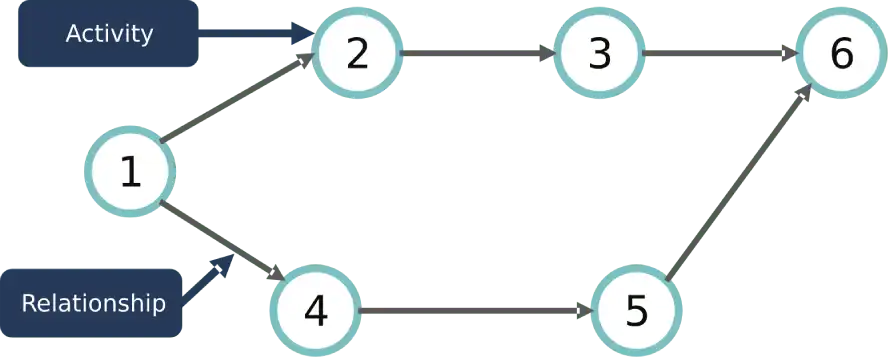
Project Network Diagrams , as the name implies, are graphical representations of a project’s tasks and their relationships, showing how the project activities are sequenced and interrelated. These diagrams provide a visual depiction of the project flow and are commonly used in project management methodologies that include Critical Path Method (CPM) and Program Evaluation and Review Technique (PERT).
Network diagrams typically use nodes to represent tasks or activities and arrows to indicate dependencies between these tasks. They allow for a clear visualisation of task sequences and can help project managers identify potential bottlenecks or critical paths in the
Scheduling and time management
Critical Path Method (CPM)
The Critical Path Method (CPM) is a fundamental project management technique used to determine the longest sequence of dependent tasks that must be completed for a project to be finished on time. This sequence of tasks is known as the critical path. The CPM was first developed in the late 1950s and has since been widely adopted for project scheduling and control in various industries.
CPM involves the following key steps:
- Identifying all project tasks
- Determining task dependencies
- Estimating task durations
- Calculating the earliest and latest start and finish times for each task
- Identifying the critical path and the float time for non-critical tasks.
The critical path represents the sequence of tasks that directly affects the project’s overall duration. Any delay in a critical path task will result in a delay in the project completion date, unless the delay is addressed through corrective action.
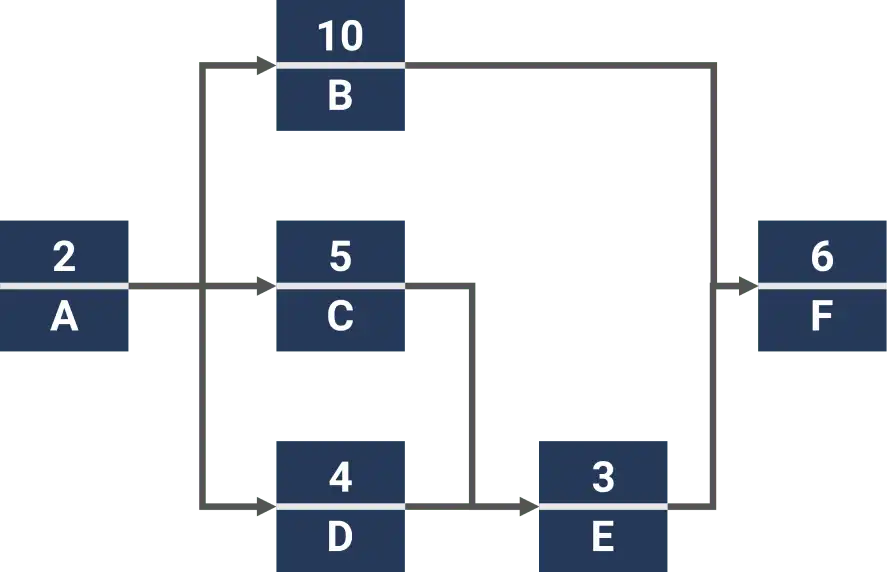
CPM offers several benefits:
- Provides a visual overview of project schedules
- Highlights tasks that have the most significant impact on project duration
- Helps optimise resource allocation
- Enables “what-if” scenario analysis.
Common pitfalls
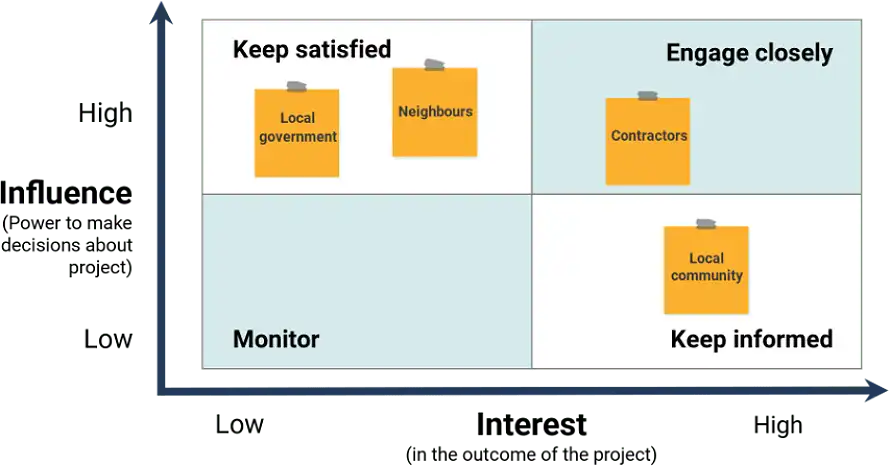
Project success can be achieved by carefully identifying and communicating with key project stakeholders. The concept of a stakeholder map can be explained as the graphical representation of project stakeholders. The process to be performed for conducting a stakeholder mapping analysis is very crucial for the project success. When starting with a new project, the first phase in stakeholder mapping analysis is to conduct a stakeholder identification process. The stakeholder identification process in a project involves categorising the identified stakeholders based on their impact on the project and their level of influence in the project.
Financial and resource management
Earned Value Management (EVM) +44 (0)207 148 5985
Earned Value ManagementCourses (EVM) is a project management technique that uses scope, schedule, and cost data to assess a project’s progress and performance. It integrates scope, schedule, and cost measures to provide a comprehensive view of the project’s health. EVM compares the planned work with the actual completed work and the actual costs incurred, offering insights into both the status and future projections of the project.PROJECT MANAGEMENT
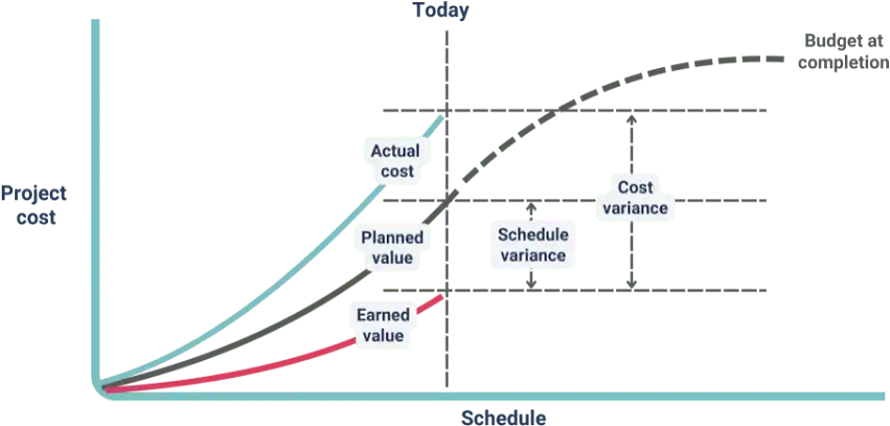
The key components of EVM are:PRINCE2
- Planned Value (PV): The budgeted cost of work scheduled to be done®
- Earned Value (EV): The budgeted cost of work performedFoundation
- Actual Cost (AC): The actual cost incurred for work performed.Learn the fundamentals of the PRINCE2 method.
EVM is used to compute the following metrics:Practitioner
- Schedule Variance (SV) = EV – PVIncludes Foundation & Practitioner combined option.
- Cost Variance (CV) = EV – ACAssociation for Project Management (APM)
- Schedule Performance Index (SPI) = EV / PVProject Fundamentals Qualification (PFQ)
- Cost Performance Index (CPI) = EV / ACStart your APM project management career.
Key takeawaysProject Management Qualification (PMQ)
- Offers early warning signs for potential project performance issuesAdvance your APM project management expertise.
- Allows for accurate prediction of project costs and completion datesProject Risk Single Certificate Level 1
- Facilitates data-driven decision making.Enhance your project risk management skills.
Quick tipsAgilePM
- Set a clear project baseline before implementing EVM®
- Utilise – Agile Project Managementproject management softwareFoundation to automate EVM calculationsLearn the key principles of Agile Project Management.
- Regularly review and analyse EVM metricsPractitioner
- Effectively communicate EVM results to stakeholders.Includes Foundation & Practitioner combined option.
BCS Business Analysis
What is the Work Breakdown Structure (WBS), and why is it important?Business Analysis Foundation
A Work Breakdown Structure or a WBS is a project management technique that decomposes a project into smaller pieces for easier management. A Learn the fundamentals of business analysis.WBSModelling Business Processes is critical for task organisation, time and cost estimation and more it allows you to build a clear scope for your project and help you to not get overwhelmed and not forget anything important.Gain practitioner certificate in modelling business processes.
How can Kanban boards improve project workflow?Business Analysis Practices
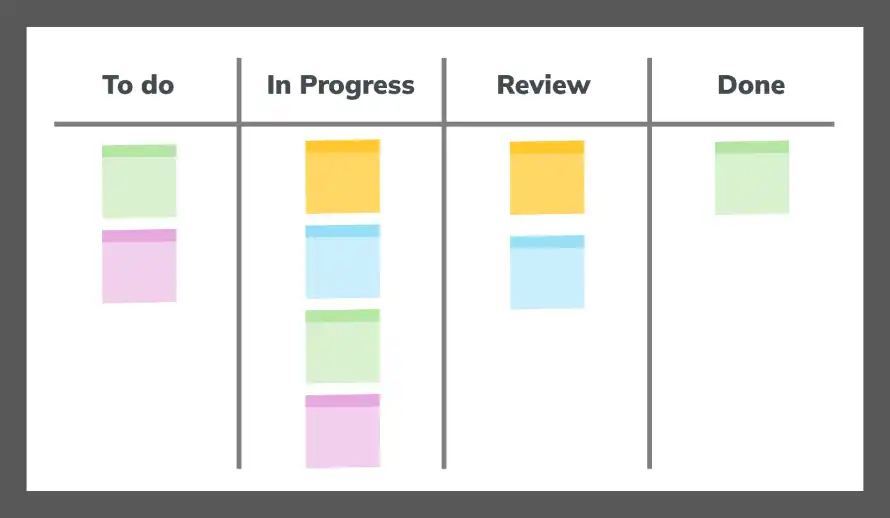
Kanban boards are visual tools that can help you and your team to visualise and manage tasks and workflows. Kanban boards will help your team collaborate, limit work-in-progress, and manage processes more efficiently, they also help you to see the bottlenecks easily. Kanban boards are a more popular tool for recurring processes and Gain practitioner certificate in business analysis practices.Agile project managementRequirements Engineering .Gain practitioner certificate in requirements engineering.
What is the Critical Path Method (CPM), and how does it help in scheduling?Business Analysis International Diploma
The Critical Path Method or CPM is a project scheduling technique that analyses your project in terms of tasks’ sequence and duration. CPM will help you to identify the longest chain of dependent tasks in your project, the so-called critical path, which would then help you in your decision-making: it will allow you to see what your project’s minimal duration is and what tasks can be delayed or rescheduled without affecting the project in general. The CPM is very useful in resource planning and allocation, as well as ensuring you have a solid deadline.All 4 courses bundled into this Diploma certification package.
What is Scrum, and how does it fit into Agile project management?AgileBA
Scrum® is an Agile project management framework that organises the work into short iterative cycles (sprints). Scrum relies on defined roles (Product Owner, Development Team and – Agile Business AnalysisScrum MasterFoundation training ), events (sprint planning, daily stand-ups) and tools (sprint backlog). Scrum helps teams to plan and manage their work, adapt to changing requirements, and deliver value quickly.Learn the fundamentals of Agile Business Analysis.
How does Agile project management differ from traditional methods?Practitioner
Agile4-day course including Foundation. is an iterative and incremental approach to product development that values flexibility, collaboration, and customer satisfaction over following a rigid plan. Agile teams embrace change even late in the project, and they focus on delivering working solutions regularly rather than following a fixed set of requirements. Agile is all about continuous improvement and responding to feedback, and there are different ways (frameworks) to do it.PMI
Infographic®
