11 essential project management techniquesAgileBA

Introduction to project management techniquesPRINCE2 COURSES
Project management techniques have become an essential aspect of modern businesses, allowing organisations to achieve their objectives, meet deadlines, and deliver value to their stakeholders. These techniques refer to the tools and methodologies that project managers and teams use to plan, execute, and control projects efficiently. Select your preferred training course below:Project management techniques have been in existence for centuries, and they have evolved to meet the changing needs of businesses and the latest technological developments.APM COURSES
The history of project management techniques dates to ancient times when large-scale projects such as the construction of the pyramids and the Great Wall of China were undertaken. However, modern project management started to emerge in the mid-20th century with the development of techniques such as the Gantt chart and the Critical Path Method (CPM). As businesses became more complex and globalised, new methodologies emerged to address the diverse project needs of different industries.Select your preferred training course below:
Today, there are many project management techniques that project managers can use to achieve success. In this article, we will discuss 11 essential project management techniques that every project managerAGILE PROJECT MANAGEMENT COURSES should know. Each technique has its benefits and is suitable for different types of projects and organisational cultures. Project managers need to understand the various project management techniques available and choose the ones that best fit their projects and organisational cultures. They should also be adaptable to change as Select your preferred training course below:project needs and circumstances evolve.PRINCE2 AGILE COURSES
Project planning and visualisationSelect your preferred training course below:
Work Breakdown Structure (WBS)
The BETTER BUSINESS CASES COURSESWork Breakdown StructureSelect your preferred training course below: (WBS) is a project management technique that involves breaking down a project into smaller, more manageable components. It is a hierarchical decomposition of the total scope of work and provides a visual representation of all the tasks required to complete a project.
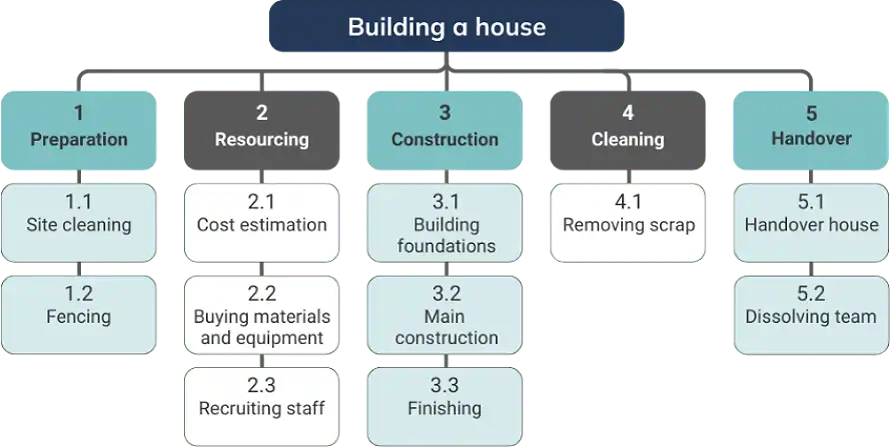
The essence of a WBS is to break down the final deliverable into smaller, more manageable components called work packages. It starts with the final deliverable at the top and is subdivided in a tree structure, where each level of detail represents an increasingly granular level of the project components. These components are typically organised into phases, deliverables, and work packages. By definition, WBS becomes more detailed as you go deeper into the tree. In P3O COURSESproject managementSelect your preferred training course below:, WBS is used to:
- Define and organise the total scope of a projectWORKSHOPS
- Ensure all the work required is included, and nothing outside the scope is addedSelect your preferred workshop below:
- Create a foundation for estimating costs, duration, and resources
- Assign responsibilities to team membersAGILE QUALIFICATIONS
- Develop a Select your preferred qualification.project schedule and budget.AGILE PROJECT MANAGEMENT COURSES
Developing a Select your preferred training course below:WBS typically requires input from the project team and stakeholders to ensure it is comprehensive and accurate. A WBS is usually presented as a tree diagram or outline, with each level representing an increased level of detail and each item on the same level representing a similar type of work. Note that the term ‘tree’ is used by many software systems and it is not necessarily drawn as a tree.PRINCE2 AGILE COURSES
A WBS becomes the foundation for other Select your preferred training course below:project management processes , including risk assessment, task assignments, and progress tracking. It helps the project team to provide a common structure for the whole project, and other details and activities are based on the work breakdown structure.SCRUM COURSES
Select your preferred qualification.
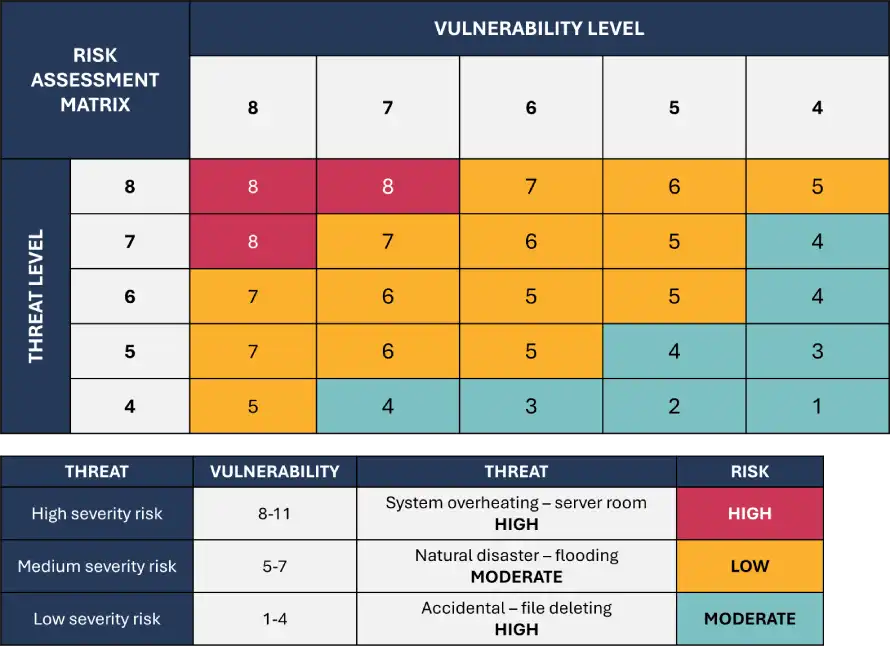
Essential elements in a Risk Management Matrix:Knowledge Train is a Better Business Cases Accredited Training Organization.
- Probability: The chance of a risk happening (typically rated as low, medium, high)
- Impact: The severity of the outcome if the risk occurs (usually ranked from minor to major)Knowledge Train is an AgilePM Accredited Training Organization.
- Risk score: A value obtained by multiplying the probability and impact assessments.
Advantages of employing a Risk Management Matrix:Knowledge Train is a PRINCE2 Agile Accredited Training Organization.
- Facilitates a clear, visual summary of potential project risks.
- Assists in prioritising risk responses.Knowledge Train is a Lean Six Sigma Accredited Training Organization.
- Improves risk communication with stakeholders.
- Aids in making more informed decisions.BCS accredited training partner for Business Analysis.
- Update the matrix regularly as new risks emerge or situations evolve.Knowledge Train is a Change Management Accredited Training Organization.
Accredited training course materials
- Expert, experienced trainers to support you
- Course manual where applicable.
- SELF-PACED ONLINE TRAINING COURSES
- Self-paced online training courses (e-learning) include:
Certification exam(s) where applicable
- Accredited training course materials
- Support from expert, experienced trainers
- Latest educational technology.
- BUSINESS SOLUTIONS
Name
- Phone
- How can we help?
- Submit
- OUR VALUES
- Our 6 core values are everything we do. They include:
Integrity
- Diversity
- FairnessQualityInnovation
- Social responsibility
SOCIAL RESPONSIBILITY
- Some of the charities we have helped over the years:
AWARDS
- We don’t go seeking awards, but here are two of the awards we have received for our training.
- Request a quote
[email protected]
- United Kingdom