
- Knowledge Train is an Agile BA Accredited Training Organization.
- Knowledge Train is a Change Management Accredited Training Organization.
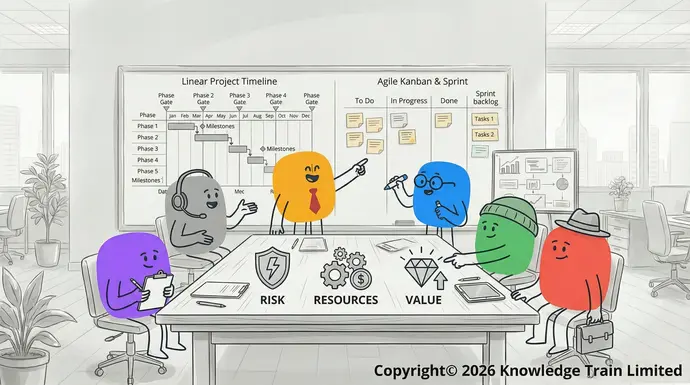
Copied!Key takeawaysBusiness analysis turns business needs into clear requirements and evidence-based decisions.Business analysis aligns strategic goals with delivery by bridging stakeholders and technical teams.Clear requirements and validation reduce project risk and improve solution fit, cost and feasibility.Techniques like SWOT, gap analysis, process modelling and data analysis expose opportunities and bottlenecks.
Embedding analysis in governance strengthens planning, transparency and measurable outcomes.
Rigour can be maintained alongside speed by using consistent standards, templates and lightweight frameworks.
Contents
- Contents
Business analysis: definition and overview
- The objectives and value of business analysis
Key responsibilities of a business analyst
Main business analysis processes
Common business analysis techniques
- Business analysis tools and methodologies
- Essential skills and competencies for business analysts
Certification and career progression
- Related concepts
with stakeholders. Project managers should communicate regularly with stakeholders to keep them informed and manage their expectations. It can also help to keep stakeholders engaged and on board with the project. There are several best practices for communicating with stakeholders, including the following:FAQsSchedule regular meetings with stakeholders to discuss the project.Business analysis: definition and overviewProvide stakeholders with a visual representation of the triangle. This can help them to understand the trade-offs that are being made.Business analysis
Facilitating workshops, interviews, and surveys to gather needs from stakeholders
Requirements documentation: Creating clear business and technical requirements using various formats (e.g., user stories
, use cases)
Gap analysis and feasibility studies:
Assessing current and desired future states to highlight improvements and evaluate solution viabilityStakeholder engagement:
- Communicating with diverse stakeholders to ensure requirements are validated and aligned
- Process mapping and
- business process modelling
- :
- Visualising workflows for process improvement opportunities
- Solution assessment and validation:
Reviewing proposals to ensure solutions address documented
requirements
and deliver value
Change management
:
- Supporting the transition of solutions into the business and managing effects on people and processes
- Main business analysis processes
- Process
Description
BulgariaPRINCE2 (PRojects IN Controlled Environments)These examples illustrate successful applications of the project triangle in diverse industries and projects. They show how effective management of scope, time, and cost can overcome challenges and deliver value.Building relationships with all parties affected by the change to ensure their needs are met
Framework overviewCroatiaEnhance your skills with our expert-led coursesProcess improvement
PRINCE2Cyprus Analysing existing workflows and recommending enhancements for efficiency is a process-based method that emphasises organisation and control. Its key features include division into manageable stages, defined roles and responsibilities, product-based planning approach and a strong focus on business justification.Czech Republic Solution assessment
When to use PRINCE2Denmark Evaluating potential solutions against requirements
PRINCE2 is well-suited for large-scale government projects, IT implementations, business transformations and EstoniaInstructor-ledChange managementprojectsFinlandIntroduction to Project Management courseSupporting successful adoption of new processes or systems with a need for strict governance.France Common business analysis techniques
Project Management Body of Knowledge (PMBOK)Germany£499 +vatSWOT analysis
Core principles and processesGreece :
PMBOKIrelandSee all dates Identifying strengths, weaknesses, opportunities, and threats related to a business area or solution is a comprehensive guide that offers best practices across five process groups:Italy Gap analysis:
- InitiatingLatvia Comparing current and target states to identify improvement areas
- PlanningLithuania Use case modelling:
- ExecutingLuxemburgInstructor-led Mapping user interactions with systems to define requirements
- Monitoring and ControllingMaltaProject Management EssentialsBusiness process modelling:
- Closing.Netherlands Creating diagrams (such as BPMN) to visualise business processes
It also encompasses ten knowledge areas, including scope, time, cost, and Poland£999 +vatStakeholder analysis:quality managementPortugal Identifying stakeholder interests, influence, and engagement needs.RomaniaSee all datesUser stories
Applications in various industriesSlovakiaConclusion:
PMBOK principles can be applied in information technology, healthcare, finance and banking, engineering and construction, and education industries, among others.SloveniaThe project management triangle is a simple yet powerful tool for understanding and managing project constraints such as Documenting concise functional requirements, typically in Agile projects
These traditional methodologies provide reliable frameworks for managing projects. They work best in situations where requirements are well-defined, and stability is preferred over flexibility. However, they can face challenges in rapidly changing environments or when continuous stakeholder feedback is essential.SpainscopeFeasibility study:
Ultimately, the choice of methodology depends on the specific needs of your Sweden, Analysing proposed solutions for practicality and viabilityprojectOther countriestimeData analysis:, the capabilities of your team, and the organisational culture you operate within. In some cases, a combination of different approaches may be the most effective solution.Home, and Using quantitative and qualitative data to inform decision-making
Agile project management methodologies costBusiness analysis tools and methodologies
Agile methodologies Agile. By learning this concept, project managers can make informed decisions when trade-offs are required and ensure that they deliver high-quality results.Key toolsemphasise flexibility, collaboration, and rapid delivery of value. These approaches have gained significant popularity, particularly in software development and other dynamic industries.Agile trainingWe hope that our blog post on the project management triangle has provided you with a clear and concise understanding of the concept. Remember, project management is not just about executing tasks but also involves communication with stakeholders, ongoing monitoring and adjustment of project parameters, team collaboration, and accountability, and continuous process improvement. Balancing these constraints is critical for project success, regardless of the industry or project type. As the case studies have shown, the effective application of the project management triangle can lead to exceptional outcomes.Requirements management software (for example, Jira, Confluence, or Azure
Scrum We encourage you to apply these principles to your projects and experience the benefits of successful project management. With the right mindset, tools, and techniques, you will be able to navigate through challenges, meet stakeholder expectations, and consistently deliver successful outcomes. Embrace the project management triangle as an invaluable part of your project management toolkit.DevOps
Roles, events, and artifacts{"@context":"http://schema.org","@type":"BreadcrumbList","itemListElement":[{"@type":"ListItem","position":1,"name":"Home","item":"https://www.knowledgetrain.co.uk/"},{"@type":"ListItem","position":2,"name":"Agile","item":"https://www.knowledgetrain.co.uk/agile"},{"@type":"ListItem","position":3,"name":"Agile courses and certifications","item":"https://www.knowledgetrain.co.uk/agile/agile-training"}]}FAQs)
Scrum What is the iron triangle in project management?Process mapping tools (such as Visio, Lucidchart) is a lightweight framework that helps teams work together effectively. It consists of: The iron triangle is another name for the project management triangle, emphasising theMind mapping and collaboration software
A business analyst identifies business problems, elicits requirements, engages stakeholders, and ensures that proposed solutions align with business goals. They act as a bridge between business and IT functions.
What are the key techniques in business analysis?
Common
business analysis techniques
include
SWOT analysis
, gap analysis, requirements elicitation, process mapping, use case modelling, and stakeholder analysis.
- What are the main types of requirements in business analysis?
- Business analysts work with
- business requirements
- (organisational goals),
- stakeholder requirements
, and
technical requirements
- (system or IT needs).
Discover how fishbone diagrams can help identify root causes of complex issues. Read on to gain insights and practical tips for using this essential problem-solving tool effectively.
- Harnessing the power of SWOT analysis for effective strategies
- Simon Buehring
- 19 Feb 2026
Discover how SWOT analysis can enhance your strategic planning. This guide provides valuable insights and techniques. Scroll down to refine your approach to assessing strengths and opportuni
Knowledge Train Ltd is an Introducer Appointed Representative of NewDay Cards Ltd for the Newpay finance product provided by NewDay Ltd. NewDay Cards Ltd acts as a credit broker, not a lender. We will introduce you exclusively to Newpay finance products provided by NewDay Limited under this Introducer Appointed Representative arrangement. Finance available from other lenders is not covered by this arrangement. NewDay Ltd and Newday Cards Ltd are authorised and regulated by the Financial Conduct Authority (ref nos 690292 and 682417 respectively). Search
Request a quote
