
- Lean improves delivery by maximising customer value and removing waste, and Lean Six Sigma adds data-driven quality control.{"@context":"http://schema.org","@type":"BreadcrumbList","itemListElement":[{"@type":"ListItem","position":1,"name":"Home","item":"https://www.knowledgetrain.co.uk/"},{"@type":"ListItem","position":2,"name":" Change Management","item":"https://www.knowledgetrain.co.uk/change-management"},{"@type":"ListItem","position":3,"name":" Change management courses","item":"https://www.knowledgetrain.co.uk/change-management/change-management-courses"},{"@type":"ListItem","position":4,"name":"APMG Change Management courses","item":"https://www.knowledgetrain.co.uk/change-management/change-management-courses/apmg-change-management-course"}]}
- Hybrid approaches like Scrumban blend structure and flow to cope with shifting priorities and unexpected work.
- Method selection should reflect project complexity, stakeholder involvement, risk, and organisational culture, and be reviewed at key milestones.
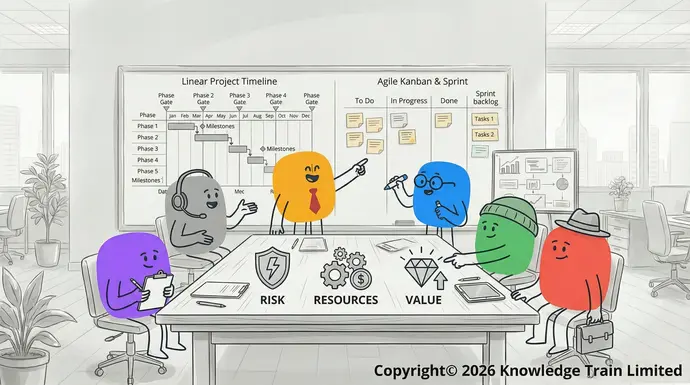
Core project management philosophies
Project management methodologies may be classified into two broad categories, based on their fundamental philosophies. These are Why uslinear and iterative . It’s important to be aware of these core strategies when choosing the best approach for your project.
Linear (Waterfall) approach
Description and key principlesFAQs
The Waterfall strategy is a linear approach where a project is broken down into distinct phases, and each phase is completed before progressing to the next. Core tenets of this approach include detailed upfront planning, comprehensive documentation at each phase, rigorous change control processes, and a strong emphasis on following the planned path.
Advantages and disadvantagesClick or scroll
Advantages:APMG Change Management at a glance
- Clear structure and defined milestonesAPMG Change Management qualifications provide a structured approach to leading and supporting change, focusing on people, organisational culture, and effective communication.
- Well-defined deliverablesBy progressing from Foundation to Practitioner, you learn both the core concepts and how to apply change management techniques to real programmes, projects, and transformation initiatives.
- Easier costs and timelines estimation.Compare course options
Disadvantages:Proven framework
- Limited flexibility to accommodate changesUse a structured framework to plan, communicate, and embed change more effectively across your organisation.
- Late identification of issues or misalignmentsPeople-focused
- Potentially longer development cycles.Gain tools for understanding stakeholder needs, managing resistance, and building engagement during change.
Iterative (Agile) approachCareer-ready skills
Description and key principlesStrengthen your profile for change manager, project, and HR roles by proving your ability to support complex change.
AgileCompare APMG Change Management courses methodologies, on the other hand, emphasise flexibility, collaboration, and the rapid delivery of working products. Core tenets of Agile approaches include iterative development cycles (known as sprints), continuous feedback and adaptation, close collaboration with stakeholders, and a focus on delivering value early and frequently. Choose the APMG Change Management Foundation course to build your knowledge, then progress to Practitioner to apply the concepts and techniques in real change initiatives.
Advantages and disadvantages
Advantages:
Traditional project management methodologiesChange Management Foundation certificate
In this article, we will dive deep into several traditional project managementFoundation methodologies. These have been in use for years, and if you are new to the field or are simply curious to learn more, read on!
WaterfallPractitioner
Process and stagesSee course
Waterfall methodology follows a linear and sequential approach consisting of the following stages:
- Requirements gathering
- DesignFoundation certificate holders who want to progress to the Practitioner level.
- Implementation
- TestingChange Management Foundation
- Deployment
- Maintenance.2 days or 10 hours
Each stage must be completed before proceeding to the next, with an emphasis on documentation and clear milestones.
Best use casesInstructor-led, self-paced
Construction projects, manufacturing processes, large-scale infrastructure projects and projects with well-defined and stable requirements are particularly suitable for Waterfall.
Pros and consChange Management Practitioner exam
Pros:
- Clear structure and timeline
- Easy to understand and manageChange Management Practitioner certificate
- Detailed documentation at each stage.
Cons:Practitioner
- Limited flexibility for changes
- Late identification of issuesCombined
- Potentially lengthy development cycles.See course
Critical Path Method (CPM)
Key concepts and implementation
CPM is a scheduling technique for project activities. It involves identifying all necessary tasks, task dependencies, calculating the longest path of planned activities, and determining the minimum project duration.Change professionals and project leaders who want to apply change management tools and techniques to real programmes and projects.
Suitable projects and industries
CPM is commonly used in construction projects, product development, research initiatives, and event planning.None
PRINCE2 (PRojects IN Controlled Environments)
Framework overview5 days or 22 hours
PRINCE2 is a process-based method that emphasises organisation and control. Its key features include division into manageable stages, defined roles and responsibilities, product-based planning approach and a strong focus on business justification.
When to use PRINCE2
PRINCE2 is well-suited for large-scale government projects, IT implementations, business transformations and projects
- {"@context":"http://schema.org","@type":"EducationEvent","name":"Change Management Foundation course","startDate":"2026-06-15","endDate":"2026-06-17","description":"Change Management Foundation course","url":"https://www.knowledgetrain.co.uk/change-management/change-management-courses/apmg-change-management-course/change-management-foundation","eventStatus":"EventScheduled","eventAttendanceMode":"OnlineEventAttendanceMode","audience":{"@type":"Audience","name":"Crystal Red.<
ul>Each variant is designed for different team sizes and project criticality.<
li>Core principles and adaptability<
span>Anyone interested in understanding the basic principles of achieving successful organisational change, transition, or transformationCrystal methodologies share common principles, such as frequent delivery, reflective improvement, osmotic communication, personal safety and focus.
>The framework is highly adaptable, allowing teams to customise their approach based on project needs.
>Feature Driven Development (FDD)<
li>Five processes of FDD<
span>Team members involved in organisational change, transition, or transformation projectsFDD consists of five main processes:
- >Develop an overall model
- >Build a features list<
- li>Plan by feature<
- span>Professionals pursuing the Change Management Practitioner certificate – for which the Change Management Foundation certificate is a prerequisite.Design by feature
- >Build by feature
>Advantages for client-focused projects
>Lean project management
Leanli>< is a philosophy that originated in the manufacturing industry, particularly in the production system of Toyota. The primary principle of Lean is to maximise customer value while minimising waste. Lean thinking has been adapted to other industries, including span>Transformation managers
Business change managers
Change programme managers
Operational line managers. - "},"aggregateRating":{"@type":"AggregateRating","ratingValue":"4.8","reviewCount":"227"},"location":{"@type":"VirtualLocation","url":"https://www.knowledgetrain.co.uk/change-management/change-management-courses/apmg-change-management-course/change-management-practitioner"},"image":["https://www.knowledgetrain.co.uk/training-courses/res/logos/apmg-change-management-accredited-training-organisation-logo.svg"],"offers":{"@type":"Offer","url":"https://www.knowledgetrain.co.uk/change-management/change-management-courses/apmg-change-management-course/change-management-practitioner","price":"","priceCurrency":"","availability":"http://schema.org/InStock","validFrom":"2026-06-12"},"performer":{"@type":"Person","name":"Susan Tuttle"},"organizer":{"@type":"Organization","name":"Knowledge Train","url":"https://www.knowledgetrain.co.uk/change-management/change-management-courses/apmg-change-management-course/change-management-practitioner"}}
- Extra-processing.
By reducing these wastes, teams can improve efficiency and provide more value to stakeholders.
Lean Six Sigma
Combining Lean and Six Sigma methodologies18 Jun - 19 Jun
Lean Six Sigma combines Change Management Practitioner course (Online)Lean principles with Six Sigma’s data-driven approach to quality improvement. The goal is to reduce waste and variation in processes. £1,099
DMAIC process
Lean Six Sigma projects use a process called DMAIC, which stands for Define, Measure, Analyse, Improve, and Control:£1,299
- Define: Identify the problem and project goalsEnrol now
- Measure: Collect data on the current process
- Analyse: Identify root causes of problems
- Improve:{"@context":"http://schema.org","@type":"EducationEvent","name":"Change Management Practitioner course","startDate":"2026-06-18","endDate":"2026-06-19","description":"Change Management Practitioner course","url":"https://www.knowledgetrain.co.uk/change-management/change-management-courses/apmg-change-management-course/change-management-practitioner","eventStatus":"EventScheduled","eventAttendanceMode":"OnlineEventAttendanceMode","audience":{"@type":"Audience","name":"< Implement and verify solutionsul>
Leanli>< is a philosophy that originated in the manufacturing industry, particularly in the production system of Toyota. The primary principle of Lean is to maximise customer value while minimising waste. Lean thinking has been adapted to other industries, including span>Transformation managers
Business change managers
Operational line managers. - "},"aggregateRating":{"@type":"AggregateRating","ratingValue":"4.8","reviewCount":"227"},"location":{"@type":"VirtualLocation","url":"https://www.knowledgetrain.co.uk/change-management/change-management-courses/apmg-change-management-course/change-management-practitioner"},"image":["https://www.knowledgetrain.co.uk/training-courses/res/logos/apmg-change-management-accredited-training-organisation-logo.svg"],"offers":{"@type":"Offer","url":"https://www.knowledgetrain.co.uk/change-management/change-management-courses/apmg-change-management-course/change-management-practitioner","price":"","priceCurrency":"","availability":"http://schema.org/InStock","validFrom":"2026-06-12"},"performer":{"@type":"Person","name":"Susan Tuttle"},"organizer":{"@type":"Organization","name":"Knowledge Train","url":"https://www.knowledgetrain.co.uk/change-management/change-management-courses/apmg-change-management-course/change-management-practitioner"}}
- Extra-processing.
By reducing these wastes, teams can improve efficiency and provide more value to stakeholders.
Lean Six Sigma
Combining Lean and Six Sigma methodologies18 Jun - 19 Jun
Lean Six Sigma combines Change Management Practitioner course (Online)Lean principles with Six Sigma’s data-driven approach to quality improvement. The goal is to reduce waste and variation in processes. £1,099
DMAIC process
Lean Six Sigma projects use a process called DMAIC, which stands for Define, Measure, Analyse, Improve, and Control:£1,299
- Define: Identify the problem and project goalsEnrol now
- Measure: Collect data on the current process
- Analyse: Identify root causes of problems
- Improve:{"@context":"http://schema.org","@type":"EducationEvent","name":"Change Management Practitioner course","startDate":"2026-06-18","endDate":"2026-06-19","description":"Change Management Practitioner course","url":"https://www.knowledgetrain.co.uk/change-management/change-management-courses/apmg-change-management-course/change-management-practitioner","eventStatus":"EventScheduled","eventAttendanceMode":"OnlineEventAttendanceMode","audience":{"@type":"Audience","name":"< Implement and verify solutionsul>
Business change managers
<(DSDM)Structured Agile approachspan>Change programme managers
- {"@context":"http://schema.org","@type":"EducationEvent","name":"Change Management Foundation course","startDate":"2026-07-20","endDate":"2026-07-22","description":"Change Management Foundation course","url":"https://www.knowledgetrain.co.uk/change-management/change-management-courses/apmg-change-management-course/change-management-foundation","eventStatus":"EventScheduled","eventAttendanceMode":"OnlineEventAttendanceMode","audience":{"@type":"Audience","name":"Project scope<
- ul>Cycle plan<
- li>Cycle build<
- span>Anyone interested in understanding the basic principles of achieving successful organisational change, transition, or transformationClient checkpoint
- >
<: Larger, complex projects may benefit from a more structured approach like span>Professionals pursuing the Change Management Practitioner certificate – for which the Change Management Foundation certificate is a prerequisite. "},"aggregateRating":{"@type":"AggregateRating","ratingValue":"4.8","reviewCount":"227"},"location":{"@type":"VirtualLocation","url":"https://www.knowledgetrain.co.uk/change-management/change-management-courses/apmg-change-management-course/change-management-foundation"},"image":["https://www.knowledgetrain.co.uk/training-courses/res/logos/apmg-change-management-accredited-training-organisation-logo.svg"],"offers":{"@type":"Offer","url":"https://www.knowledgetrain.co.uk/change-management/change-management-courses/apmg-change-management-course/change-management-foundation","price":"","priceCurrency":"","availability":"http://schema.org/InStock","validFrom":"2026-06-12"},"performer":{"@type":"Person","name":"Susan Tuttle"},"organizer":{"@type":"Organization","name":"Knowledge Train","url":"https://www.knowledgetrain.co.uk/change-management/change-management-courses/apmg-change-management-course/change-management-foundation"}}. - Team size and expertise : Smaller, highly skilled teams may thrive using A20 Jul - 24 Julgile methods .Change Management Practitioner (with Foundation) course (Online)
- Industry standards and requirements : Some industries have established preferences or regulations for specific methodologies. £2,299
- Stakeholder involvement : Iterative methods like Scrum can work well when stakeholder involvement is high.Enrol now
- Risk tolerance and adaptability : Adaptive methodologies are more appropriate when the project requirements are uncertain or evolving.
Importance of organisational culture fit
The methodology you choose should align with your organisation’s culture, values, and working style. Mismatch can result in resistance and decreased effectiveness.
Remember, there is no one-size-fits-all methodology. Consider your project’s unique requirements and be flexible enough to adapt your approach as the project evolves.{"@context":"http://schema.org","@type":"EducationEvent","name":"Change Management Practitioner (with Foundation) course","startDate":"2026-07-20","endDate":"2026-07-24","description":"Change Management Practitioner (with Foundation) course","url":"https://www.knowledgetrain.co.uk/change-management/change-management-courses/apmg-change-management-course/change-management-practitioner","eventStatus":"EventScheduled","eventAttendanceMode":"OnlineEventAttendanceMode","audience":{"@type":"Audience","name":"
Importance of continuous learning and adaptation
Project management is an ever-evolving field. To be successful, project managers must stay updated on new methodologies, tools, and industry best practices. The ability to adapt your approach based on the specific needs of your projects and teams is crucial.23 Jul - 24 Jul
It’s important to emphasise that no methodology is perfect for every situation. The key to success lies in understanding different methodologies and choosing the most appropriate one for each unique project.
FAQsChange Management Practitioner course (Online)
What is the difference between Agile and Waterfall methodologies?
Agile methodologies are iterative and flexible, while Waterfall is linear and sequential. £1,599
How do I know which project management methodology is best for my team?
Consider factors like project complexity, team size, industry standards, and organisational culture.Enrol now
Can I combine different project management methodologies?
Yes, hybrid methodologies like Scrumban incorporate elements from multiple methodologies.
What are the key benefits of using an Agile methodology?
Agile methodologies offer benefits such as flexibility, faster delivery, and improved stakeholder satisfaction.
How does Lean project management differ from traditional approaches?{"@context":"http://schema.org","@type":"EducationEvent","name":"Change Management Practitioner course","startDate":"2026-07-23","endDate":"2026-07-24","description":"Change Management Practitioner course","url":"https://www.knowledgetrain.co.uk/change-management/change-management-courses/apmg-change-management-course/change-management-practitioner","eventStatus":"EventScheduled","eventAttendanceMode":"OnlineEventAttendanceMode","audience":{"@type":"Audience","name":"
span>Those performing key roles in the design, development, and delivery of organisational change programmesIt’s a good practice to regularly evaluate the effectiveness of your methodology, especially during project milestones or when encountering new challenges.
>Remember, the best project management methodology is the one that suits your project’s specific needs and your team. Don’t be afraid to adapt and refine your approach as necessary.
>Infographic<
