Project controls – your driver to project successPrivacy

Key takeaways, ITIL
Project controls turn project data into decisions that protect time, cost, and outcomes.®
- Use baselines for scope, schedule, and budget to measure progress consistently., P3O
- Track milestones, KPIs, and Earned Value to spot deviation early and act quickly.®
- Manage cost through realistic estimates, regular variance analysis, and clear reporting., PRINCE2
- Reduce disruption with disciplined scope control and documented change requests.®
- Identify and prioritise risks, then apply practical mitigation plans owned by clear roles. Agile, RESILIA
- Choose tools that fit your workflow, train users, and standardise data inputs for accuracy.®
Introduction
- Avoid budget overruns
- Meet deadlines.To provide the best experiences, we use technologies like cookies to store and/or access device information. Consenting to these technologies will allow us to process data such as browsing behavior or unique IDs on this site. Not consenting or withdrawing consent, may adversely affect certain features and functions.
In this article, we will look at the definition and importance of project controls. We will examine some techniques and implementation approaches. We will see how controls can be beneficial and what their impact is on the success of a project. We will also discuss the tools, software and career opportunities in this field. By the end of this article, you will know how project controls can improve your project management practices.
Understanding project controls
Comprehensive definition
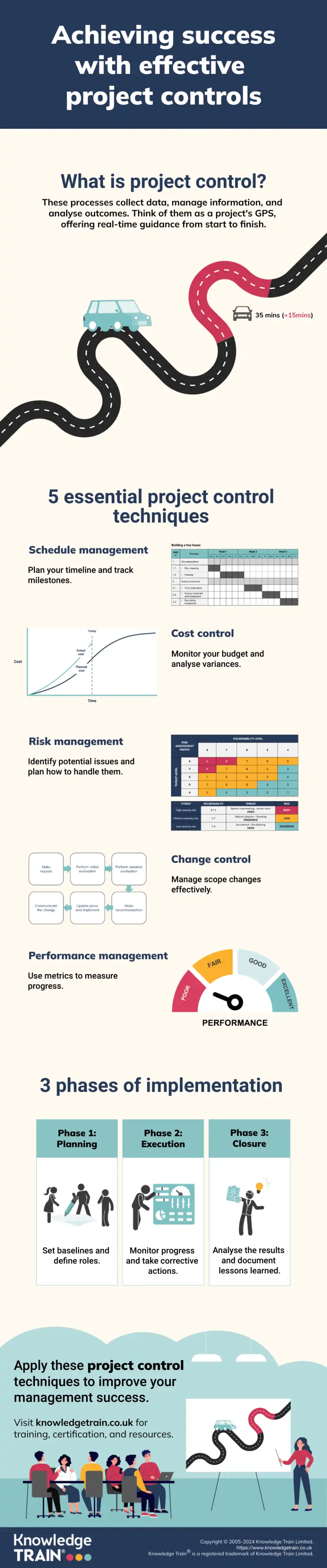
Project controls are methods and processes that help you collect data, process it and analyse results. They help you predict, understand and positively influence time and cost aspects of a projectFunctional. They provide valuable information to make decisions throughout the project lifecycle.
Role within project management
Project controls are the navigational system in project management. They help project managers :Functional
- Know project status at any time
- Forecast outcomes Always active
- Spot deviations from the plan
- Recommend actions to correct the course.
Key components of project controls
These are the main components of project controls:
- Planning and scheduling
- Cost estimation and control
- Risk assessment and managementThe technical storage or access is strictly necessary for the legitimate purpose of enabling the use of a specific service explicitly requested by the subscriber or user, or for the sole purpose of carrying out the transmission of a communication over an electronic communications network.
- Change control
- Performance monitoring and reporting.
Differences between project controls and project management
While project managementPreferences is the top level of the project, project controls focus on:
- Time and cost aspects
- Data processing and reporting
- Performance measurementPreferences
- Predictive modelling.
Project controls provide project managers with valuable insights and recommendations. This allows project managers to make informed decisions and steer projects towards successful completion.
Essential project control techniques
Schedule managementThe technical storage or access that is used exclusively for anonymous statistical purposes. Without a subpoena, voluntary compliance on the part of your Internet Service Provider, or additional records from a third party, information stored or retrieved for this purpose alone cannot usually be used to identify you.
Timeline development
Effective timeline development means creating a project schedule. This involves identifying tasks, estimating durations and developing dependencies. Use a Gantt chart to visualise the project timeline and the critical path.Marketing
Milestone tracking
Track milestonesMarketing to see how your project progresses towards its objectives. Review and update milestones regularly to see how your project is progressing. Milestones give you an easy-to-read indicator of the health of your project.
Cost control
Budget planning
The budget planning process involves estimating and allocating resources for each project phase. Create a detailed budget for the whole project. Include the expected cost of labour, materials and contingencies.
Cost variance analysis
Analyse The technical storage or access is required to create user profiles to send advertising, or to track the user on a website or across several websites for similar marketing purposes.cost variance regularly to compare actual spend to the planned budget. This will allow you to identify and correct any discrepancies in time.Manage options
Risk managementManage services
Risk identificationManage {vendor_count} vendors
Do a thorough Read more about these purposesrisk Accept
communication
Project controls can be the foundation of the Save preferencescommunication with stakeholders . You can report to them on a regular basis with reliable information about the current status of the project, problems, and achievements. Thus, the project controls can increase trust and alignment among the stakeholders.View preferences
Project control tools and software{title}
Popular project management tools{title}
You can use {title}project management platformsManage consent to run your projects. Most of them provide project controls as a part of their functionality. You can use Microsoft Project, Asana, and Jira to schedule the project, allocate resources, and track the progress. Moreover, these tools can provide you with customisable dashboards to monitor critical metrics.Manage consent
Specialised project control software
For larger and more complicated projects, you can use specialised project control software. You can get cost control features, earned value management, and risk analysis with Primavera, Deltek Cobra, and EcoSys. They are great for projects in different industries.
Integrating tools into existing workflows
You should integrate tools into your workflows thoughtfully. You can consider these five steps to make this happen:
- Assess your current workflows and find the gaps
- Choose tools that fit your needs
- Provide your team with training
- Create protocols to input data and analyse it
- Check the process regularly and optimise it.
By choosing the right tools and integrating them into your workflows, you can improve your project controls significantly and overall project performance.
Career opportunities in project controls
Roles and responsibilities
Project control professionals can help you manage projects effectively. Some popular positions include Project Control Analyst, Cost Engineer, and Planning Scheduler. They monitor the project’s performance, analyse the data, and make recommendations.
Required skills and qualifications
Here are the skills and qualifications you need to have to work in project controls:
- Problem-solving and analytical skills
- Proficiency in project management software
- Strong communication skills
- Certifications (PMP, CCP).
Career progression paths
With experience, you can advance your career to become a Project Control Manager or Director of Project Controls. You can also work as a senior project manager and oversee multiple projects or a program.
Conclusion
Project controls are an important aspect of the modern-day project management. They provide you with insights into your project’s status, performance metrics, and issues. With project controls, you can make better decisions, identify problems, and improve the project’s outcome. You can use effective control techniques and appropriate tools to maximise your project’s success rate. Project controls can help you stay competitive in the complex business world.
FAQs
What is the main purpose of project controls?
The purpose of project controls is to predict, understand, and influence time and cost outcomes.
How do project controls differ from project management?
Project controls are more specific. They are focused on data analysis and performance measurement. Project management encompasses all aspects of the project’s life cycle.
What are the key skills needed for a career in project controls?
You need to have strong analytical thinking, be proficient in project management software, and be a great communicator.
Can project controls be applied to small-scale projects?
Yes, project controls can be scaled and applied to any size of the project.
How often should project controls be reviewed and updated?
You should review them regularly, but it depends on the project. Usually, it is done once a week or once a month.
What are the common challenges in implementing project controls?
The main challenges include resistance to change, data accuracy issues, and a lack of standard processes.
Infographic