What is business analysis?Choose the most suitable projects or programmes for the portfolio to balance risk and return, while ensuring strategic alignment.

Key takeaways
Business analysis turns business needs into clear requirements and evidence-based decisions.
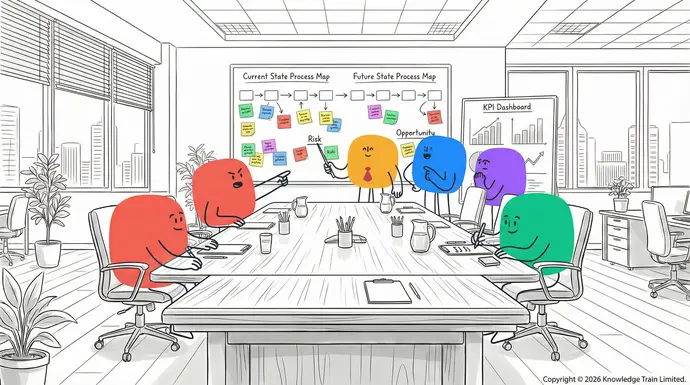
Business analysis: definition and overview
Business analysis is a professional discipline that involves understanding business needs and problems, eliciting and documenting requirements, and proposing solutions that drive The main difference between a programme manager and a portfolio manager is that a programme manager’s role is more tactical and focused on delivering a set of related projects, while a portfolio manager’s role is more strategic, focusing on aligning all projects and programmes with the organization’s strategy.process improvementA programme manager oversees a group of related projects, ensuring they are coordinated and managed in a way that maximizes benefits and controls risks that wouldn’t be possible if the projects were managed individually. They are responsible for achieving the strategic goals set for the programme, managing interdependencies among the projects, and delivering the program’s overall benefits. and deliver value. It acts as a bridge between stakeholders and technical teams, ensuring that strategic objectives are aligned with operational execution. Reputable bodies such as the A portfolio manager oversees an organization’s portfolio, which includes multiple projects and programmes, potentially across different departments or areas of business. The portfolio manager’s role is more strategic, focusing on ensuring the portfolio aligns with the organization’s strategic objectives, managing resource allocation across the portfolio, balancing risks and returns among the different projects and programmes, and maximizing the value of the overall portfolio.International Institute of Business Analysis (IIBA)What is the difference between portfolio and project work? define business analysis as the practice of enabling change in an organisational context by defining needs and recommending solutions that yield benefits for key stakeholders.
The objectives and value of business analysis
- Identifying business needs and opportunities for improvementThe difference between portfolio and project work can be summarised as:
- Supporting stakeholders in achieving strategic goalsPortfolio work involves managing a group of projects and programmes to achieve strategic objectives. Portfolio management encompasses the selection and oversight of projects.
- Facilitating Project work focuses on the execution of a single project to achieve its specific objectives. Project management involves the execution and delivery of the project itself.change managementWhat is the difference between project and portfolio management? processes
- Reducing project risk through clear requirements and solution assessment
- Ensuring solutions are feasible, cost-effective, and aligned with business requirementsThe difference between project and portfolio management can be summarised as:
Business analysts enable informed decision-making, increase process efficiency, and help organisations remain competitive.Project management is the discipline of planning, organizing, and managing resources to successfully complete a specific project. It involves the applying knowledge, skills, tools, and techniques to meet project requirements and deliver desired outcomes within cost, scope, schedule, and quality constraints.
Key responsibilities of a business analystPortfolio management is the strategic management of a collection of projects, programmes, subsidiary portfolios, and operations to achieve organizational goals. It involves selecting and prioritizing projects or programmes based on their alignment with strategic objectives, optimizing resource allocation, balancing risk, and maximizing value across the entire portfolio.
The Why is project portfolio management important?business analyst plays a critical role throughout project lifecycles and change initiatives. Their main responsibilities include:
- Requirements elicitation:Why is project portfolio management important? Facilitating workshops, interviews, and surveys to gather needs from stakeholdersProject portfolio management is important for 5 main reasons:
- Requirements documentation:Strategic alignment Creating clear business and technical requirements using various formats (e.g., It ensures that projects and programmes are aligned with the organization’s strategic goals and objectives. This alignment ensures that resources are allocated to initiatives that contribute the most value and support the organization’s overall strategy.user storiesOptimized resource allocation, use cases)Project portfolio management helps organizations make informed decisions about resource allocation. By assessing project priorities, dependencies, and resource availability, it enables efficient allocation of resources, reducing bottlenecks and maximizing productivity.
- Gap analysis and feasibility studies:Risk Management Assessing current and desired future states to highlight improvements and evaluate solution viabilityA portfolio perspective allows organizations to assess and manage risks at a higher level. By evaluating project risks collectively, portfolio managers can identify and address risks that may not be apparent at the individual project level, making informed decisions to mitigate potential negative impacts.
- Stakeholder engagement:Portfolio performance monitoring Communicating with diverse stakeholders to ensure requirements are validated and alignedProject portfolio management provides a comprehensive view of the performance of projects and programmes. It enables monitoring and tracking of key performance indicators, allowing organizations to assess the progress, make adjustments, and take corrective actions to ensure successful project delivery and desired outcomes.
- Process mapping and Optimal decision-makingbusiness process modellingWith project portfolio management, organizations can make data-driven decisions regarding project initiation, continuation, or termination. It provides a structured framework to evaluate project proposals, prioritize investments, and select the most valuable projects to pursue.:Subscribe to our exclusive offers and promotions Visualising workflows for process improvement opportunities
- Solution assessment and validation:Subscribe now Reviewing proposals to ensure solutions address documented requirements and deliver value{"@context":"https://schema.org","@type":"ImageObject","contentUrl":"https://www.knowledgetrain.co.uk/training-courses/portfolio-management.png","description":"Relationships between projects, programmes, and portfolios.","license":"https://www.knowledgetrain.co.uk/license","acquireLicensePage":"https://www.knowledgetrain.co.uk/license","creditText":"Knowledge Train","uploadDate":"2023-05-18T08:07:28.000Z","copyrightNotice":"© 2023 Knowledge Train Limited. All rights reserved.","creator":{"@type":"Organization","name":"Knowledge Train","url":"https://www.knowledgetrain.co.uk"}}
- Change management : Supporting the transition of solutions into the business and managing effects on people and processesRelated articles
Main business analysis processes
| Process | Description |
|---|---|
| Requirements elicitation | Gathering information from stakeholders using interviews, workshops, observation, and document analysis |
| Requirements documentation | Capturing business and technical requirements in written formats, such as user stories , use cases, or requirement specifications |
| Requirements validation | Ensuring requirements are accurate, feasible, and aligned with business goals |
| Stakeholder engagement | Building relationships with all parties affected by the change to ensure their needs are met |
| Process improvementProject management triangle | Analysing existing workflows and recommending enhancements for efficiency |
| Solution assessmentKnowledge Train | Evaluating potential solutions against requirements19 Feb 2026 |
- DevOps )
- Process mapping tools (such as Visio, Lucidchart)
- Mind mapping and collaboration softwareProject management vs product management
- Data analysis tools (for example, Excel, Power BI)
MethodologiesKnowledge Train
- BABOK (Business Analysis Body of Knowledge):19 Feb 2026 The leading global standard published by IIBAGet insights on how project management and product management differ, and how these two skills impact each other. Understanding their importance in the business landscape is fundamental for achieving success. Read this article to learn about the key differences and similarities., outlining best practices and techniques for business analysis
- Agile : An iterative methodology focusing on flexibility, frequent delivery, and collaboration (often using user stories)
- Waterfall methodology : A linear, phased project approach suitable for well-defined requirements
Choosing the right methodology depends on project size, risk, stakeholder needs, and desired adaptability.PRINCE2 Agile Foundation sample exam questions
Essential skills and competencies for business analysts
- Analytical and critical thinkingSimon Buehring
- Effective communication and stakeholder engagement19 Feb 2026
- Attention to detail in requirements documentation
- Problem-solving and solution assessmentEvaluate the quality of PRINCE2 Agile Foundation sample exam questions available online. Read this guide to find reliable practice resources.
- Knowledge of business and technical requirements
- Proficiency in process improvement and data analysis
Certification and career progression
BCS offers globally recognised certifications, such as Business Analysis Foundation , Developing your project management careerInternational Diploma in Business Analysis , Practitioner certificates in Simon BuehringRequirements Engineering19 Feb 2026, Modelling Business ProcessesDeveloping your project management career takes strategic planning. Discover actionable strategies to advance in the field by reading this article., and Business Analysis Practices .
The International Institute of Business Analysis (IIBA) offers globally recognised certifications, such as ECBA, CCBA, and CBAP, based on the BABOK Guide . Certifications demonstrate expertise in requirements elicitation, stakeholder management, and business analysis best practices. Aspiring business analysts may also pursue project management or change management qualifications to support broader career progression.
FAQs
What is business analysis?
Business analysis is the systematic investigation and evaluation of business needs to recommend solutions that achieve organisational objectives. It includes requirements gathering, stakeholder engagement, and process optimisation.
What does a business analyst do?
A business analyst identifies business problems, elicits requirements, engages stakeholders, and ensures that proposed solutions align with business goals. They act as a bridge between business and IT functions.
What are the key techniques in business analysis?
Common business analysis techniquesGive us a call include SWOT analysis , gap analysis, requirements elicitation, process mapping, use case modelling, and stakeholder analysis.+44 (0)207 148 5985
What are the main types of requirements in business analysis?
Business analysts work with Or chat with us using the link at the bottom of the screen.business requirementsContact us with questions about the courses on this page, or about which project management certification or training is best for you. (organisational goals), Finance FAQsstakeholder requirementsContact, and Cookiestechnical requirementsPrivacy (system or IT needs).Terms
What is the BABOK?Customer Support
BABOK refers to the Business Analysis Body of Knowledge, a globally-accepted standard containing best practices, techniques, and competencies for business analysis, maintained by IIBA.
What qualifications or certification should a business analyst have?[email protected]
Common Join Our Teamcertifications include BCS’s Business Analysis Foundation certificate, [email protected]International Diploma in Business Analysis Copyright © 2005-2026 Knowledge Train Limited. , and Practitioner certificates in Business Analysis Practices, Requirements Engineering, and Modelling Business Processes. Registered in UK: 5566983.
In addition, there are IIBA’s ECBA, CCBA, and CBAP, which validate knowledge of BABOK and proficiency in requirements elicitation, stakeholder engagement, and process improvement. Registered VAT: GB872413526.
How does business analysis differ from project management? Knowledge Train
Business analysis focuses on defining requirements and recommending solutions, while ®project management is a registered trademark of Knowledge Train Limited.