

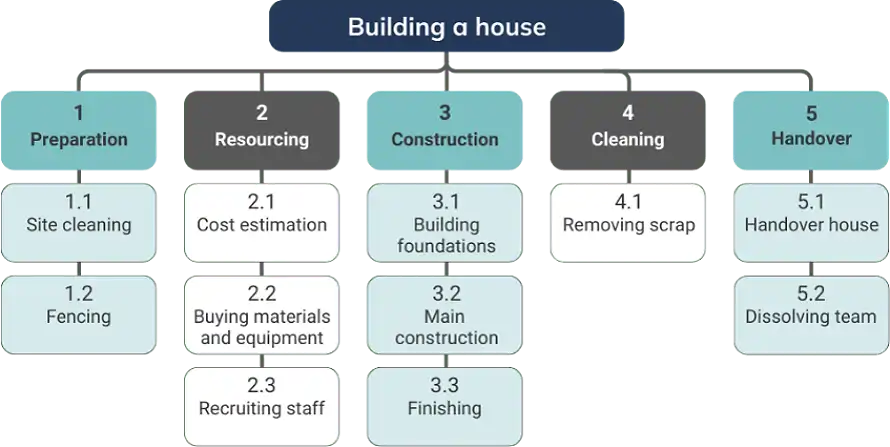
- Projects: Work packages are the lowest level in the WBS hierarchy. These are tangible deliverables that can be assigned, scheduled, and tracked. Work packages should be small enough to be manageable but large enough to be efficient.
- Control accountsProgrammes: Control accounts are management control points where scope, budget, actual cost, and schedule are integrated and compared to earned value for performance measurement. They serve as a crucial checkpoint for Purpose and objectivesproject managersDeliver specific, outputs within a set time and cost. to monitor project progress and make informed decisions.Achieve a broader set of strategic outcomes by managing a group of interrelated projects.
By understanding these fundamentals, you will be well-equipped to create and utilise a WBS effectively.Scope and timeframe
Benefits of a WBSHave a defined scope and timescale.
Implementing a work breakdown structure (WBS) as part of your Have a broader scope, comprising multiple related projects. Their timescale continues until all the desired outcomes are achieved.project management strategyManagement approach offers a wide range of benefits that can help you achieve success.Focuses on the delivery of specific outputs,
- Better planning and organisationmanaging risks: WBS help , issues, quality, and stakeholders.project managersFocuses on coordinating multiple related projects to achieve a common outcome. Also focuses on managing project interdependencies and realizing benefits. to plan and organise projects more effectively by breaking them down into smaller, more manageable components. This makes it easier to develop more accurate schedules and identify potential bottlenecks in advance.Benefits of programmes
- Improved communication and clarityThere are multiple benefits to an organization if it manages its change initiatives as programmes.: The visual representation of the different components of a project that is provided by a WBS makes it easier for everyone involved in the project to understand its scope and objectives. This can help to reduce misunderstandings and ensure that all parties are on the same page when it comes to project deliverables and expectations.Strategic alignment
- More efficient use of resources and budgetingProgramme management: The level of detail that is provided by a WBS can also help project managers to allocate resources more efficiently and stick to their budgets. By having a clear understanding of the tasks that need to be completed, project managers can more accurately estimate the resources they will require and avoid over-allocation or underutilisation. ensures that all projects within a programme align with the broader organizational goals, ensuring resources are channelled towards initiatives that match the strategic vision.
- Better project tracking and controlOptimized resource allocation: The hierarchical structure of a WBS also makes it easier to track project progress at different levels of detail. Project managers can compare actual progress against the planned WBS and identify any deviations from the plan early on. This allows them to take corrective action sooner and increases the chances of the project being completed successfully within its constraints.Resources, including time, manpower, and finances, are allocated and utilized more efficiently across various projects, preventing redundancy and waste.
Creating an effective WBSBoosted morale and team cohesion
Developing a robust work breakdown structure is crucial for project success. This section provides a step-by-step guide and best practices to help you create an effective WBS.With clear objectives and coordinated efforts, teams have a clearer sense of purpose, leading to increased motivation and collaboration.
Four steps guide to developing a WBSIn essence,
- Defining project scope and objectivesprogramme management: Clearly define your project’s scope and objectives. This foundational step ensures that your WBS aligns with the overall project goals. Collaborate with stakeholders to establish a comprehensive project charter, outlining key deliverables, constraints, and success criteria. offers organizations a structured and strategic approach to managing multiple projects, ensuring not just their successful delivery but also the realization of broader business objectives and benefits.
- Identifying major deliverablesEnhance your skills with our expert-led courses: Identify the high-level deliverables required to achieve your project objectives. These deliverables form the first level of your WBS hierarchy. Consider both tangible and intangible outcomes that contribute to project completion.
- Breaking down deliverables into manageable tasks : Systematically decompose each major deliverable into smaller, more manageable components. Continue this process until you reach a level of detail that allows for accurate estimation and effective task assignment. Remember to apply the 100% rule at each level of decomposition.
- Assigning responsibilities and resourcesInstructor-led: Assign responsible individuals or teams for each work package. Allocate the necessary resources, considering both human and material requirements. This step enhances accountability and facilitates efficient resource management throughout the project lifecycle.MSP Practitioner (with Foundation) course
Best practices for WBS creation
- Maintain the right level of detail£1,899 +vat: Avoid going too deep or too shallow with your WBS. A highly detailed WBS can lead to micromanagement and increased complexity, while a high-level WBS can result in lack of control and oversight. Finding the right balance ensures your WBS is detailed enough to be useful but not so detailed that it becomes unwieldy.
- Ensure mutual exclusivity of tasksSee all dates: Make sure that no work is counted in more than one place in the WBS. Each element in the WBS should be a unique piece of work, and the tasks should not overlap or be duplicated. This helps avoid confusion and double-counting of effort and makes it easier to allocate resources and track progress accurately.
- Follow the 8/80 rule for work packages : The 8/80 rule states that work packages in a WBS should require no less than 8 hours and no more than 80 hours of work. This rule is a guideline for maintaining an appropriate level of detail and for estimation. Adjust this rule as necessary, for your specific reporting needs and project requirements.
Using these steps and some best practices for WBS development you should be able to create an effective WBS that will serve as a solid backbone for your project management efforts.Self-paced
WBS formats and toolsMSP Practitioner (with Foundation) self-paced online
When it comes to WBS, it’s not just about structure and levels, but also about the right tools and formats. This section dives into the common formats for WBS, the software that can help you create and manage it, and how you can integrate it with other project management tools£1,399 +vat for maximum efficiency.
Common WBS formats
- Tree diagram : A visual representation of the hierarchical structure of a WBS. Starting with the project at the top, it branches down into finer levels of detail. This format is great for getting a birds-eye view of the project and understanding the relationships between different elements.Instructor-led
- Outline or list viewMSP Foundation course: As the name suggests, this format displays the WBS as a numbered or bulleted list. Each level of indentation signifies a new level in the hierarchy. This is a simple format to create and can be easily converted into other formats if needed.
- Tabular format£1,299 +vat: This format organises WBS elements into columns and rows. It’s especially useful if you want to include additional information such as task owners, durations, or costs alongside the WBS structure.
Software tools for creating and managing WBSSee all dates
- Dedicated WBS softwareSummary: There are software tools specifically designed for creating and managing WBS, like WBS Schedule Pro. These tools often come with advanced visualisation and analysis features.Programmes represent unique yet interrelated aspects of strategic organizational management. Managing and integrating programmes within broader
- Project management platformsportfolios: Comprehensive project management platforms like Microsoft Project or Wrike also include WBS functionality. These integrate WBS creation and management with the rest of your project management toolkit. provides organizations with a competitive edge, amplifying benefits realization and enhancing investment returns.
Integrating WBS with other project management toolsEnterprises that prioritize
- Gantt chartsprogramme management: Elements from a WBS can be easily mapped to tasks in a Gantt chart. This allows for a visual representation of task dependencies, durations, and timelines. and adopt standardized methodologies are best positioned to garner superior advantages in a progressively competitive landscape.
- Project schedulesSubscribe to our exclusive offers and promotions: The WBS forms the backbone of detailed project schedulesSubscribe now. Each work package can be further broken down into specific activities with assigned durations and resources.
Choosing the right format and tools for your WBS can greatly enhance your project’s performance and the efficiency of your project team.
Common WBS challenges and solutions{"@context":"http://schema.org","@type":"WebPage","headline":"Programmes | Programme Definition | What is Programme?","url":"https://www.knowledgetrain.co.uk/programme-management/programmes","significantLink":"https://www.apm.org.uk/resources/what-is-project-management/what-is-programme-management/","about":[{"@type":"Thing","name":"programmes","sameAs":["http://en.wikipedia.org/wiki/Program_management","https://www.google.com/search?&kgmid=/m/01pqtb"]}],"mentions":[{"@type":"Thing","name":"governance","sameAs":["https://en.wikipedia.org/wiki/Governance","https://www.google.com/search?&kgmid=/m/02_tns","https://www.wikidata.org/wiki/Q1553864"]},{"@type":"Thing","name":"programme management","sameAs":["https://en.wikipedia.org/wiki/Program_management","https://www.google.com/search?&kgmid=/m/01pqtb","https://www.wikidata.org/wiki/Q603948"]},{"@type":"Thing","name":"project management","sameAs":["https://en.wikipedia.org/wiki/Project_management","https://www.google.com/search?&kgmid=/m/05_p2","https://www.wikidata.org/wiki/Q179012"]},{"@type":"Thing","name":"public policy","sameAs":["https://en.wikipedia.org/wiki/Public_policy","https://www.google.com/search?&kgmid=/m/01400v","https://www.wikidata.org/wiki/Q546113"]},{"@type":"Thing","name":"change management","sameAs":["https://en.wikipedia.org/wiki/Change_management","https://www.google.com/search?&kgmid=/m/05qb9n6","https://www.wikidata.org/wiki/Q116348"]},{"@type":"Thing","name":"leadership","sameAs":["https://en.wikipedia.org/wiki/Leadership","https://www.google.com/search?&kgmid=/m/025rt2s","https://www.wikidata.org/wiki/Q484275"]},{"@type":"Thing","name":"risk management","sameAs":["https://en.wikipedia.org/wiki/Risk_management","https://www.google.com/search?&kgmid=/m/06k_y","https://www.wikidata.org/wiki/Q189447"]},{"@type":"Thing","name":"management","sameAs":["https://en.wikipedia.org/wiki/Management","https://www.google.com/search?&kgmid=/m/04_tv","https://www.wikidata.org/wiki/Q2920921"]},{"@type":"Thing","name":"managers","sameAs":["https://en.wikipedia.org/wiki/Management","https://www.google.com/search?&kgmid=/m/04_tv","https://www.wikidata.org/wiki/Q2920921"]},{"@type":"Thing","name":"training","sameAs":["https://en.wikipedia.org/wiki/Training","https://www.google.com/search?&kgmid=/m/014jg3","https://www.wikidata.org/wiki/Q918385"]},{"@type":"Thing","name":"stakeholder engagement","sameAs":["https://en.wikipedia.org/wiki/Stakeholder_engagement","https://www.google.com/search?&kgmid=/m/0fpjz9q","https://www.wikidata.org/wiki/Q2930198"]},{"@type":"Thing","name":"cmi","sameAs":["https://en.wikipedia.org/wiki/Chartered_Management_Institute","https://www.google.com/search?&kgmid=/m/01x_ff","https://www.wikidata.org/wiki/Q5086844"]},{"@type":"Thing","name":"work programme","sameAs":["https://en.wikipedia.org/wiki/Work_Programme","https://www.google.com/search?&kgmid=/m/0n4cjyg","https://www.wikidata.org/wiki/Q8034586"]},{"@type":"Thing","name":"resource allocation","sameAs":["https://en.wikipedia.org/wiki/Resource_allocation","https://www.google.com/search?&kgmid=/m/01njxn","https://www.wikidata.org/wiki/Q287260"]}]}
Scope creepSome related articles occurs when project boundaries expand uncontrollably, leading to an increased workload and potential delays. Solution: To prevent scope creep, ensure that the project scope is clearly defined during the initial WBS development. Establish a robust change control process to manage and approve any changes to the project scope. Regularly review and update the WBS to reflect approved changes, ensuring it aligns with the project’s objectives.
Finding the right balance between detail and manageability is essential. Excessive detail may lead to micromanagement, while too little detail can result in oversight. To strike this balance, use the 80/20 rule when creating work packages and apply the principle of progressive elaboration, adding more detail as the project progresses. Regularly evaluate the WBS’s effectiveness and adjust as necessary to optimise its utility.
Team buy-in is crucial for the successful implementation of WBS. If team members do not understand or support the WBS, it can hinder its effectiveness.
Solution: Involve the project team in the WBS creation process and ensure clear communication of its benefits to all stakeholders. Provide training and support for team members to become comfortable with using and maintaining the WBS. Celebrate successes and improvements that result from WBS implementation to reinforce its value to the team.
29 Apr 2026projects . The examples have shown how using WBS allows you to improve your projects and control them to a better extent. As you continue your work with different projects, create your WBS and experience the benefits of clarity, organisation, efficiency, and accuracy.P3O, or Portfolio, Programme and Project Offices, is a best practice framework that helps organisations optimise decision-making, governance and delivery across their initiatives. Learn how the P3O model supports effective management of portfolios, programmes and projects.