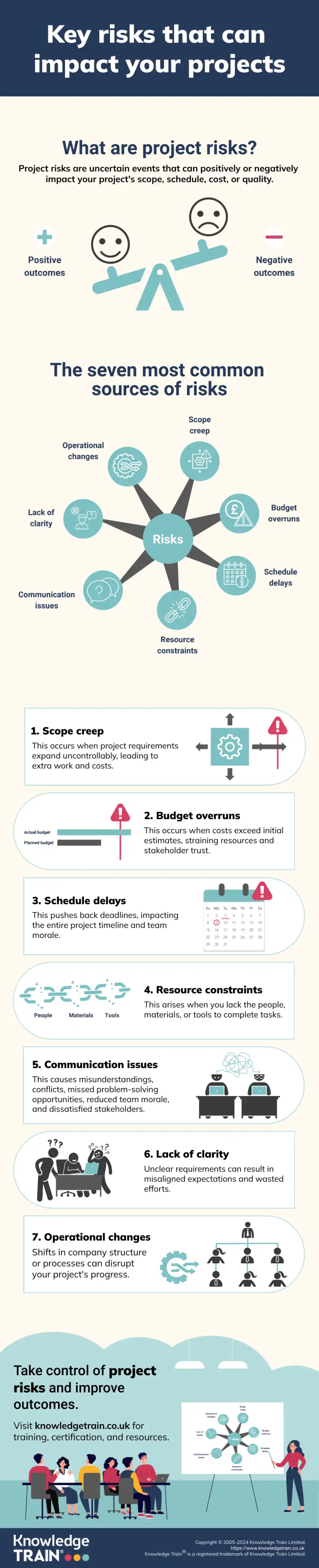
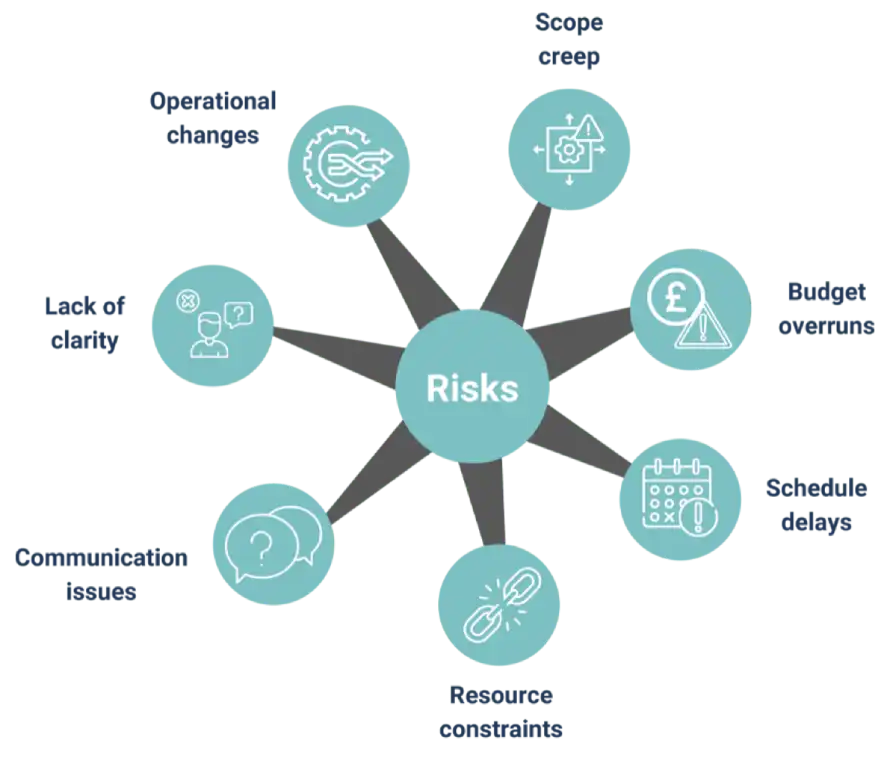
Select your preferred training course below:Budget overruns occur when the actual cost of a project exceeds the initially allocated budget. Common causes of budget overruns include inaccurate cost estimation, scope changes, unforeseen expenses, and poor resource management.
ImpactWORKSHOPS
- Select your preferred training course below:
Impact on project execution
Operational changes can affect AGILE PROJECT MANAGEMENT COURSESprojectsSelect your preferred training course below: by disrupting established workflows, requiring additional training or resources, altering project priorities and necessitating scope or timeline adjustments.
Stay informed about potential organisational changes and maintain flexibility in PRINCE2 AGILE COURSESproject planningSelect your preferred training course below:s.AGILE COURSES
By knowing about common project management risks, you can make specific plans to help prevent or overcome them. In addition, proactive risk management involves:Select your self-paced training course topic.
- Regular risk assessments
- Clear communication with stakeholdersAGILE PROJECT MANAGEMENT COURSES
- Robust change management processesSelect your preferred training course below:
- Continuous monitoring and adaptation.
Keep in mind that effective risk management is an ongoing process that needs careful monitoring and flexibility throughout the project. If you plan and work for these common risks, you will be able to increase the probability of success in your project.PRINCE2 AGILE COURSES
Risk management processSelect your preferred training course below:
Risk identification
The first step in risk management is to identify potential risks that could impact your project. Some common techniques include:SCRUM COURSES
- Brainstorming with team membersSelect your preferred training course below:
- Reviewing historical information from similar projectsLEAN SIX SIGMA COURSES
- Conducting stakeholder interviewsSelect your preferred training course below:
- Analysing project documentation.
Create a BUSINESS ANALYST COURSESrisk registerSelect your self-paced training course topic. to document all identified risks.
Risk assessment and prioritisationBCS BUSINESS ANALYST COURSES
After identifying risks, assess their potential impact and likelihood of occurrence. Tools you can use include:Select your preferred training course below:
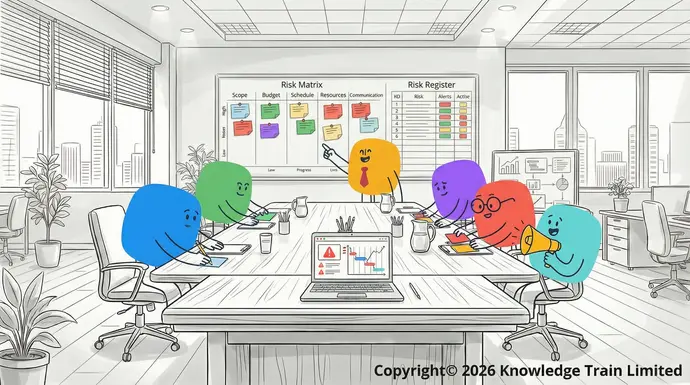
- Risk matrix : Plot risks on a chart based on their probability and impactCHANGE MANAGEMENT COURSES
- Quantitative analysisSelect your self-paced training course topic.: Assign numerical values to risks
- Qualitative analysisAPMG CHANGE MANAGEMENT COURSES: Categorise risks based on severity.Select your preferred training course below:
Prioritise risks based on their potential impact.
Risk response planningPROGRAMME MANAGEMENT COURSES
For each prioritised risk, develop a response strategy. Common responses include:Select your self-paced training course topic.
- Avoidance : Eliminate the threat by changing MSP COURSESproject plansSelect your preferred training course below:
- Mitigation : Reduce the probability or impact of the riskIT QUALIFICATIONS
- TransferSelect your preferred qualification.: Shift the risk to a third party (e.g. insurance)
- AcceptanceITIL COURSES: Acknowledge the risk and prepare contingency plans.Select your preferred training course below:
Document your response strategies in a risk management plan.
Risk monitoring and controlIT QUALIFICATIONS
Continuously monitor risks throughout the project lifecycle. This includes:Select your preferred qualification.
- Regular risk reviews and updates
- Tracking risk triggers and early warning signsITIL COURSES
- Implementing planned responses when necessarySelect your preferred training course below:
- Evaluating the effectiveness of risk responses.
Adjust your risk management approach as needed based on new information and changing project conditions.LEARNING LIBRARIES
By following this structured process, you can effectively manage risks and increase your project’s chances of success.Select your preferred training course topic.
Tools and techniques for project risk management
Risk registerKnowledge Train is a PRINCE2 Agile Accredited Training Organization.
A risk registerKnowledge Train is a Better Business Cases Accredited Training Organization. is a document that lists all identified risks along with their potential impact and planned mitigation. Components to include are:
- Risk descriptionKnowledge Train is a P3O Accredited Training Organization.
- Probability and impact assessment
- Risk ownerKnowledge Train is an AgilePM Accredited Training Organization.
- Mitigation strategies
- Contingency plans.Knowledge Train is a PRINCE2 Agile Accredited Training Organization.
Maintain your risk register throughout the project, regularly updating it as needed.
SWOT analysisKnowledge Train is an Agile BA Accredited Training Organization.
SWOT analysis is used to identify factors that may impact your project:BCS accredited training partner for Business Analysis.
- Strengths: Project advantages
- Weaknesses: Areas for improvementKnowledge Train is an Agile BA Accredited Training Organization.
- Opportunities: Potential benefits
- Threats: Possible risks.Knowledge Train is a Change Management Accredited Training Organization.
Performing a SWOT analysis gives you a well-rounded view of your project’s risk landscape.
Brainstorming sessionsKnowledge Train is an MSP Accredited Training Organization.
Organise structured brainstorming sessionsKnowledge Train is a PRINCE2 Accredited Training Organization. with your team to identify potential risks. Encourage open discussion and creative thinking. Techniques you can use include:
- Nominal group techniqueKnowledge Train is an AgilePM Accredited Training Organization.
- Affinity diagramming
- Mind mapping.Knowledge Train is a PRINCE2 Agile Accredited Training Organization.
Brainstorming sessions can help identify risks that might be overlooked otherwise.
Project management softwareKnowledge Train is a Better Business Cases Accredited Training Organization.
Project management software is a valuable tool for helping to streamline your risk management processes. Features to consider include:Knowledge Train is an AgilePM Accredited Training Organization.
- Risk tracking and monitoring
- Automated alerts for risk triggersKnowledge Train is a PRINCE2 Agile Accredited Training Organization.
- Collaboration tools for team communication
- Reporting capabilities for stakeholder updates.Knowledge Train is a Lean Six Sigma Accredited Training Organization.
Project management software can greatly improve your ability to manage risks throughout your project.
Strategies for mitigating common project risksBCS accredited training partner for Business Analysis.
Preventing scope creep
- Clearly define project boundaries and scope during the planning stageKnowledge Train is a Change Management Accredited Training Organization.
- Implement a change control process to evaluate and approve scope changes
- Communicate the impact of scope changes to all stakeholders.Knowledge Train is an MSP Accredited Training Organization.
Managing budget risks
- Accurate cost estimation and inclusion of contingency reservesAXELOS Peoplecert accredited training organisation for ITIL (IT Infrastructure Library).
- Regular budget monitoring and reporting
- Cost control measures and prioritisation of expenses.AXELOS Peoplecert accredited training organisation for ITIL (IT Infrastructure Library).
Addressing schedule delays
- Utilise Knowledge Train is an AIPGF Accredited Training Organization.critical path analysis to identify key milestones and dependenciesKnowledge Train is an AIPGF Accredited Training Organization.
- Build buffer time into project schedulesBCS accredited training partner for Business Analysis.
- Regularly review and adjust timelines based on progress updates.
Optimising resource allocationWHAT YOU WILL GET
- Conduct thorough resource planning at the outset of the projectOur courses and workshops include:
- Utilise Certification exam(s) where applicableresource levellingAccredited training course materials techniques to balance workloadsExpert, experienced trainers to support you
- Maintain a skills inventory to quickly identify and address skill gaps.Course manual where applicable.
Improving communication
- Establish clear communication channels and protocolsSELF-PACED ONLINE TRAINING COURSES
- Schedule regular team meetings and stakeholder updatesSelf-paced online training courses (e-learning) include:
- Utilise collaboration tools to facilitate information sharing.Certification exam(s) where applicable
Ensuring clarity in project requirementsAccredited training course materials
- Conduct thorough requirements gathering sessions with stakeholdersSupport from expert, experienced trainers
- Create detailed, unambiguous project specificationsLatest educational technology.
- Implement formal requirements review and approval process.
Adapting to changesBUSINESS SOLUTIONS
- Stay informed of potential changes within the organisation
- Build flexibility into project plansTO HELP ORGANISATIONS IMPROVE to accommodate operational shiftsWe offer solutions to help improve team performance including:
- Develop contingency plans for significant operational disruptions.Consultancy services
By following these tips, you can avoid most of the common pitfalls that can cause problems in your projects. Keep in mind that risk management is a continuous process. It is important to revisit the steps in this process as you continue with your project.Staff development
Best practices for effective risk managementCompliance training
Proactive approach to risk identificationApprenticeship training
- Try to spot potential risks at the start of a Custom e-Learning developmentproject
- Ask team members to raise red flags as soon as possible
- Look at past data and apply any relevant lessons learnt.Find out more
Regular risk assessment
- Hold regular check-ins to review identified risks and their status
- Re-evaluate risks as the project progresses and circumstances change
- Revise risk mitigation plans as necessary.CONTACT US
Stakeholder involvement in risk management
- Include stakeholders in identifying and assessing risks
- Keep stakeholders informed of risk management plans and progress
- Seek stakeholder input on risk mitigation strategies.
Continuous learning and improvement
- Record lessons learnt from risk management successes and failuresName
- Share information with other project teams to improve organisational risk management
- Invest in ongoing training and development of risk management skills.
Follow these tips to help you establish a positive risk management culture and improve project success.Email
Conclusion
What role do stakeholders play in project risk management? Request a quote
Stakeholders can provide valuable input in identifying risks, assessing their potential impact, and helping to develop risk mitigation strategies.
Can all project risks be eliminated?
No, not all project risks can be eliminated. The focus should be on effectively managing and mitigating risks.
How can small teams effectively manage project risks with limited resources?
Small teams can prioritise risks based on their potential impact, use simple risk assessment tools, and leverage the diverse expertise of team members to ensure comprehensive risk management.+44 (0)207 148 5985
Infographic