- Regular risk reviews and updates, MSP
- Tracking risk triggers and early warning signs®
- Implementing planned responses when necessary, ITIL
- Evaluating the effectiveness of risk responses.®
Adjust your risk management approach as needed based on new information and changing project conditions., P3O
By following this structured process, you can effectively manage risks and increase your project’s chances of success.®
Tools and techniques for project risk management
Risk register
A risk register is a document that lists all identified risks along with their potential impact and planned mitigation. Components to include are:
- Risk description
- Probability and impact assessment
- Risk owner
- Mitigation strategies
- Contingency plans.
Maintain your risk register throughout the project, regularly updating it as needed.®
SWOT analysis is a registered mark of the DevOps Institute. “PMI”, “PMBOK
SWOT analysis® is used to identify factors that may impact your project: Guide”, “PMP” and “CAPM” are registered marks of Project Management Institute, Inc. Knowledge Train Scrum Essentials™, Business Learning Library (BLL)™, Business Analysis Learning Library (BALL)™, Agile Learning Library (ALL)™, IT Learning Library (ITLL)™, and Compliance Learning Library (CLL)™ are trademarks of Knowledge Train Limited. All rights reserved.
- Strengths: Project advantagesKnowledge Train Ltd is an Introducer Appointed Representative of NewDay Cards Ltd for the Newpay finance product provided by NewDay Ltd. NewDay Cards Ltd acts as a credit broker, not a lender. We will introduce you exclusively to Newpay finance products provided by NewDay Limited under this Introducer Appointed Representative arrangement. Finance available from other lenders is not covered by this arrangement. NewDay Ltd and Newday Cards Ltd are authorised and regulated by the Financial Conduct Authority (ref nos 690292 and 682417 respectively).
- Weaknesses: Areas for improvement
- Opportunities: Potential benefits
- Threats: Possible risks.
Performing a SWOT analysis gives you a well-rounded view of your project’s risk landscape.
Brainstorming sessions
Organise structured Searchbrainstorming sessions with your team to identify potential risks. Encourage open discussion and creative thinking. Techniques you can use include:
- Nominal group technique
- Affinity diagramming
- Risk tracking and monitoring
- Automated alerts for risk triggers
Regular risk assessment
- Hold The technical storage or access is necessary for the legitimate purpose of storing preferences that are not requested by the subscriber or user.regular check-ins to review identified risks and their status
- Re-evaluate risks as the project progresses and circumstances change
- Revise risk mitigation plans as necessary.
Stakeholder involvement in risk managementStatistics
- Include stakeholders in identifying and assessing risks
- Keep stakeholders informed of risk management plans and progress
- Seek stakeholder input on risk mitigation strategies.
Continuous learning and improvementStatistics
- Record lessons learnt from risk management successes and failures
- Share information with other project teams to improve organisational risk management
- Invest in ongoing training and development of risk management skills.
Follow these tips to help you establish a positive risk management culture and improve project success.
Conclusion
Recap of key points
Effective project risk management is a multi-faceted approach that involves identifying and assessing potential risks, developing mitigation strategies, utilising appropriate tools and techniques, and implementing best practices for continuous improvement.
These elements form a comprehensive framework for managing uncertainties in project management.
Importance of ongoing risk managementThe technical storage or access is required to create user profiles to send advertising, or to track the user on a website or across several websites for similar marketing purposes.
Risk management is an ongoing process that requires constant vigilance, regular reassessment and adaptation to changing project conditions.Manage options
By prioritising risk management throughout the project lifecycle, you increase the likelihood of project success. Remember, proactive risk management is an investment in your project’s future, safeguarding its objectives and deliverables.Manage services
FAQsManage {vendor_count} vendors
What is the difference between internal and external project risks?Read more about these purposes
Internal risks are those that originate within the project or organisation, while external risks stem from outside factors beyond the direct control of the project team.
How often should risk assessments be conducted during a project?Accept
Risk assessments should be conducted regularly throughout a project, often at predetermined intervals or key project milestones. Monthly risk assessments are typical for most projects.
What role do stakeholders play in project risk management?Deny
Stakeholders can provide valuable input in identifying risks, assessing their potential impact, and helping to develop risk mitigation strategies.
Can all project risks be eliminated?View preferences
No, not all project risks can be eliminated. The focus should be on effectively managing and mitigating risks.
How can small teams effectively manage project risks with limited resources?Save preferences
Small teams can prioritise risks based on their potential impact, use simple risk assessment tools, and leverage the diverse expertise of team members to ensure comprehensive risk management.
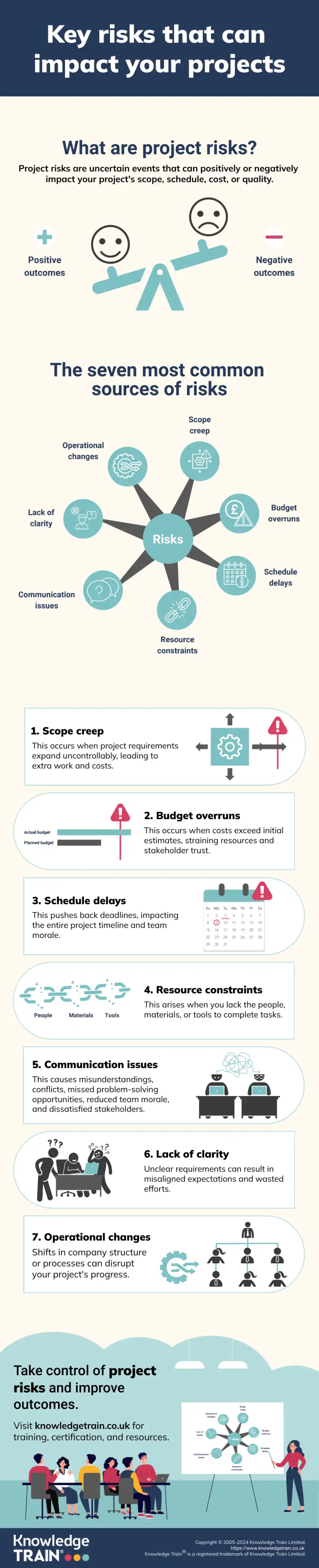
InfographicView preferences