Key takeaways
Strong risk management improves delivery certainty by surfacing threats early and agreeing responses.
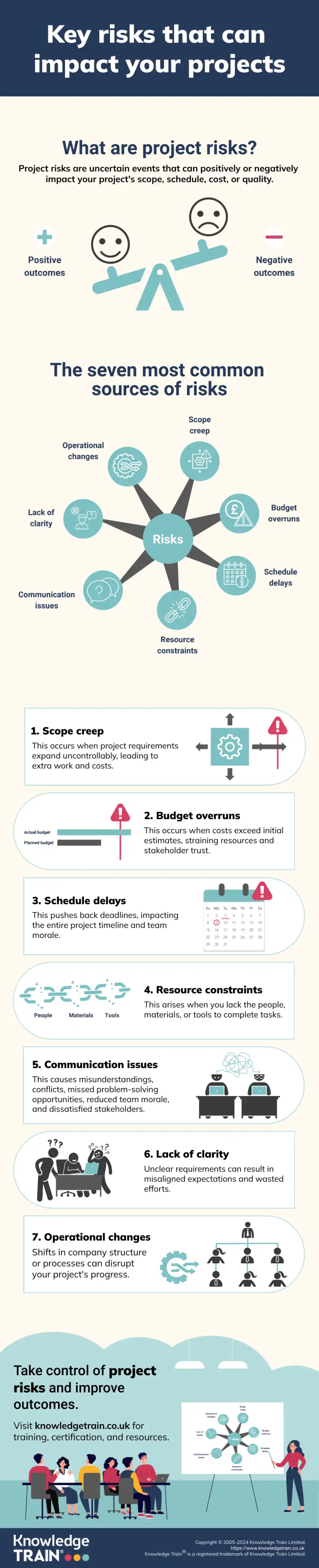
- Define risks as uncertain events that can help or harm scope, schedule, cost, or quality.
- Classify risks (internal, external, technical, financial, operational, strategic) to avoid blind spots.
- Use a repeatable cycle: identify, assess likelihood and impact, plan responses, then monitor and adapt.
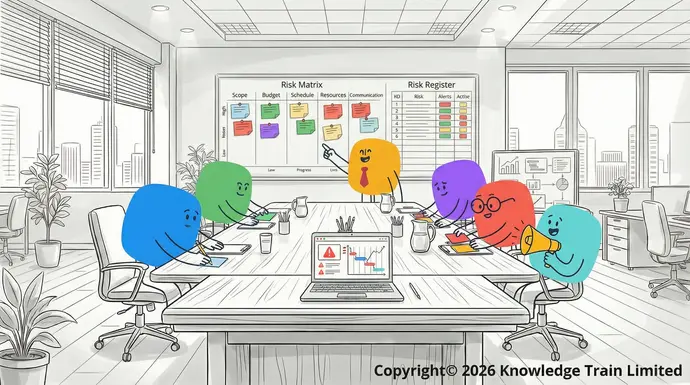
- Maintain a live risk register, supported by tools such as a risk matrix, SWOT, and project software alerts.
- Prevent common failures by controlling scope changes, monitoring budgets, managing dependencies, and planning resources.
- Keep stakeholders engaged with clear communication so risks are understood, owned, and acted on.
- Project Fundamentals Qualification (PFQ)
- Improve the chances of your project’s success.Start your APM project management career.
You can also learn about project risk management on a Project Management Qualification (PMQ) project management courseAdvance your APM project management expertise. such as Project Risk Single Certificate Level 1 PRINCE2 courseEnhance your project risk management skills. or an AgilePMAPM course®
project risk managementPractitioner and how to protect your projects from potential risks.Includes Foundation & Practitioner combined option.
Understanding project risksPRINCE2
Definition of project risk®
A Agileproject riskFoundation refers to an uncertain event or condition that, if it occurs, has the potential to either positively or negatively affect the outcome of a project. Risks can impact project objectives such as scope, schedule, cost, or quality. Examples of project risks include changes in customer requirements, budget constraints, delays in schedules, technical issues, resource shortages, and more.Learn the fundamentals of the PRINCE2 Agile method.
Types of project risksPractitioner
Project risks can be classified into various categories, including:Includes Foundation & Practitioner combined option.
- Internal risksAI Project Governance Framework (AIPGF): These risks originate from within the project or the organisation itself. They can be related to factors such as team dynamics, resource availability, or management decisions.Foundation
- External risksLearn the fundamentals of the governance framework.: These risks arise from factors outside the project’s control, such as economic conditions, regulatory changes, natural disasters, or market trends.Practitioner
- Technical risksIncludes Foundation & Practitioner combined option.: Technical risks are associated with the technology or methodologies used in the project. They may involve issues like software glitches, hardware failures, integration challenges, or inadequate technical expertise.Better Business Cases
- Financial risks™: Financial risks impact the project’s budget, funding, or financial resources. They can include factors like unexpected cost overruns, currency fluctuations, or inadequate financial planning.Foundation
- Operational risksLearn the fundamentals of Better Business cases.: Operational risks affect the day-to-day functioning of the project. They can encompass issues like human errors, process inefficiencies, supply chain disruptions, or equipment failures.Practitioner
- Strategic risksIncludes Foundation & Practitioner combined option.: Strategic risks influence the project’s alignment with the organisation’s overall business goals. They may involve risks related to changing market demands, competitive pressures, or organisational changes.P3O
Impact of risks on project success®
Risks can have a variety of impacts on a project’s success:Foundation
- Positive effectsLearn the fundamentals of the P3O project management office.: These could include opportunities for innovation or efficiency improvementsPractitioner
- Negative effectsIncludes Foundation & Practitioner combined option.: These could lead to delays, cost overruns, or quality issues.Workshops
Effective Introduction to Project Management risk management1-day workshop to learn the basics of project management. is important for minimising negative impacts and maximising the potential for opportunities and overall project success.Project Management Essentials
By identifying and assessing risks, 2-day workshop to learn how to manage projects without getting certified.project managersWriting Business Cases can develop contingency plans and take proactive steps to mitigate potential problems. This helps increase the chances of achieving project goals and delivering value to stakeholders.Half-day workshop to learn to write robust business cases.
Common project management risksLearn the key principles of Agile Project Management.
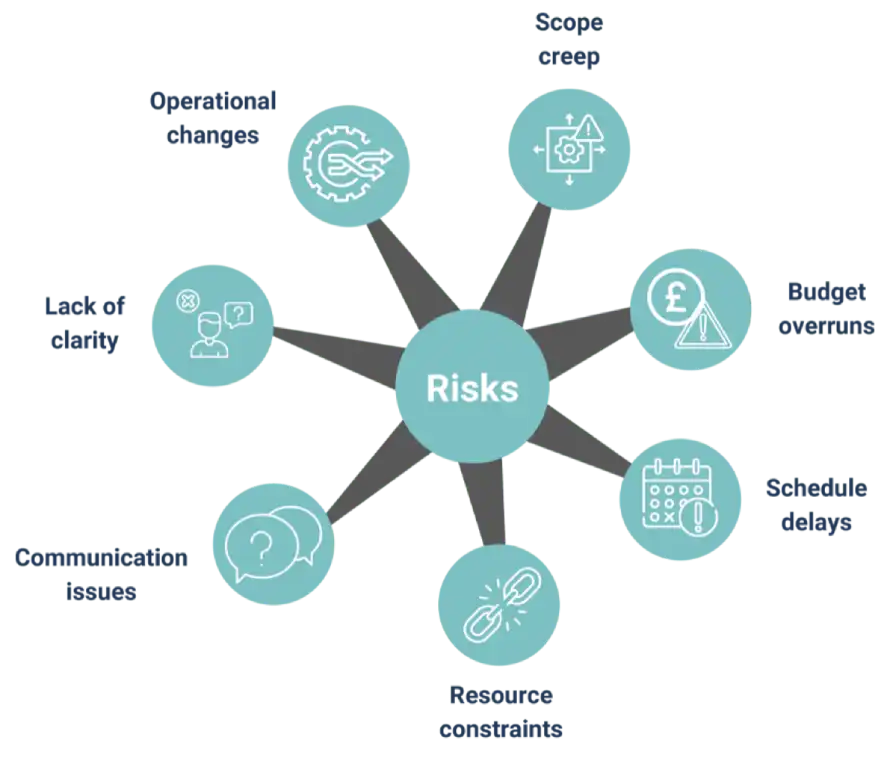
Scope creepPractitioner
Common causesIncludes Foundation & Practitioner combined option.
Scope creepPRINCE2 is the uncontrolled expansion of a project’s scope without corresponding adjustments to time, budget, and resources. Common causes of scope creep include ambiguous initial requirements, lack of change control processes, Stakeholder pressure for additional features, and insufficient stakeholder engagement.®
Impact Agile
Scope creep can have several impacts on a project:Foundation
- It can increase the project’s duration, require more resources and increase costsLearn the fundamentals of the PRINCE2 Agile method.
- It can lead to delays and missed deadlinesPractitioner
- It can cause the project to lose focus and drift away from its original objectivesIncludes Foundation & Practitioner combined option.
- It can lead to team burnout and demotivation.Scrum
To prevent scope creep, it is crucial to have a clear understanding of the project’s objectives and requirements, and to establish change control processes to manage and approve any changes to the project scope.Scrum Essentials
Budget overrunsSelf-paced training course to learn the essentials of Scrum.
Common causesScrum Master
Budget overrunsChoose Scrum Alliance or Scrum.org Scrum Master training courses. occur when the actual cost of a project exceeds the initially allocated budget. Common causes of budget overruns include inaccurate cost estimation, scope changes, unforeseen expenses, and poor resource management.Scrum Product Owner
ImpactChoose Scrum Alliance or Scrum.org Product Owner training courses.
Prevent budget problems by performing a detailed cost analysis and ensuring financial reporting is transparent throughout the project.AgileBA
Schedule delays®
Common causes – Agile Business Analysis
Schedule delaysFoundation can occur due to a variety of reasons:Learn the fundamentals of Agile Business Analysis.
- Unrealistic time estimatesPractitioner
- Resource unavailability4-day course including Foundation.
- Dependency conflictsLean Six Sigma
- External factors (e.g. weather, supplier delays).Yellow Belt
ImpactSelf-paced training course to gain LSS Yellow Belt.
Schedule delays can lead to missed deadlines and milestones, increased costs due to prolonged project duration, reduced stakeholder satisfaction and potential loss of competitive advantage.PMI
To address time-related risks, implement effective project scheduling techniques and regularly monitor project progress.®
Resource constraintsPMI-ACP
Types of resource risksSelf-paced course to prepare you for the exam (exam not included).
Resource risksKanban can take various forms, such as:Estimating for Agile Foundation
- Skill shortagesAgile Learning Library (ALL)™
- Equipment or material unavailabilityBUSINESS ANALYSIS
- Insufficient fundingBCS Business Analysis
- Limited time availability.Business Analysis Foundation
Impact on project performanceLearn the fundamentals of business analysis.
Resource constraints can result in reduced productivity, compromised quality of deliverables, increased stress on team members and potential project delays.Modelling Business Processes
Conduct thorough resource planning and maintain open communication with stakeholders to proactively address resource-related issues.Gain practitioner certificate in modelling business processes.
Communication issuesBusiness Analysis Practices
Importance of effective communicationGain practitioner certificate in business analysis practices.
Effective communicationRequirements Engineering
- Select your self-paced training course topic. to identify key milestones and dependencies
- Build buffer time into AGILE PROJECT MANAGEMENT COURSESproject schedulesSelect your preferred training course below:
- Regularly review and adjust timelines based on progress updates.
Optimising resource allocationPRINCE2 AGILE COURSES
- Conduct thorough resource planning at the outset of the projectSelect your preferred training course below:
- Utilise resource levellingSCRUM COURSES techniques to balance workloadsSelect your preferred training course below:
- Maintain a skills inventory to quickly identify and address skill gaps.
Improving communicationLEAN SIX SIGMA COURSES
- Establish clear communication channels and protocolsSelect your preferred training course below:
- Schedule regular team meetings and stakeholder updates
- Utilise collaboration tools to facilitate information sharing.BUSINESS ANALYST COURSES
Ensuring clarity in project requirementsSelect your self-paced training course topic.
- Conduct thorough requirements gathering sessions with stakeholders
- Create detailed, unambiguous project specificationsBCS BUSINESS ANALYST COURSES
- Implement formal requirements review and approval process.Select your preferred training course below:
Adapting to changes
- Stay informed of potential changes within the organisationCHANGE MANAGEMENT COURSES
- Build flexibility into Select your self-paced training course topic.project plans to accommodate operational shiftsAPMG CHANGE MANAGEMENT COURSES
- Develop contingency plans for significant operational disruptions.Select your preferred training course below:
By following these tips, you can avoid most of the common pitfalls that can cause problems in your projects. Keep in mind that risk management is a continuous process. It is important to revisit the steps in this process as you continue with your project.
Best practices for effective risk managementPROGRAMME MANAGEMENT COURSES
Proactive approach to risk identificationSelect your self-paced training course topic.
- Try to spot potential risks at the start of a projectMSP COURSES
- Ask team members to raise red flags as soon as possibleSelect your preferred training course below:
- Look at past data and apply any relevant lessons learnt.
Regular risk assessmentIT QUALIFICATIONS
- Hold Select your preferred qualification.regular check-ins to review identified risks and their statusITIL COURSES
- Re-evaluate risks as the project progresses and circumstances changeSelect your preferred training course below:
- Revise risk mitigation plans as necessary.
Stakeholder involvement in risk managementIT QUALIFICATIONS
- Include stakeholders in identifying and assessing risksSelect your preferred qualification.
- Keep stakeholders informed of risk management plans and progress
- Seek stakeholder input on risk mitigation strategies.ITIL COURSES
- Record lessons learnt from risk management successes and failuresLEARNING LIBRARIES
- Share information with other project teams to improve organisational risk managementSelect your preferred training course topic.
- Invest in ongoing training and development of risk management skills.
Follow these tips to help you establish a positive risk management culture and improve project success.AI QUALIFICATIONS & WORKSHOPS
Conclusion
Recap of key pointsKnowledge Train is a PRINCE2 Agile Accredited Training Organization.
Effective project risk management is a multi-faceted approach that involves identifying and assessing potential risks, developing mitigation strategies, utilising appropriate tools and techniques, and implementing best practices for continuous improvement.
These elements form a comprehensive framework for managing uncertainties in project management.Knowledge Train is a Better Business Cases Accredited Training Organization.
Importance of ongoing risk management
Risk managementKnowledge Train is a P3O Accredited Training Organization. is an ongoing process that requires constant vigilance, regular reassessment and adaptation to changing project conditions.
BCS accredited training partner for Business Analysis.
Stakeholders can provide valuable input in identifying risks, assessing their potential impact, and helping to develop risk mitigation strategies.
Can all project risks be eliminated?Knowledge Train is an Agile BA Accredited Training Organization.