Risk management on projects years delivering accredited project management training

Key takeaways
Strong risk management improves delivery certainty by surfacing threats early and agreeing responses.
- Define risks as uncertain events that can help or harm scope, schedule, cost, or quality.This course is suitable for anyone who uses computers, email or online systems, whether at work or at home. It is ideal if you are new to cyber security or want to feel more confident in recognising and responding to potential threats.
- Classify risks (internal, external, technical, financial, operational, strategic) to avoid blind spots.Do I need any technical background to take this course?
- Use a repeatable cycle: identify, assess likelihood and impact, plan responses, then monitor and adapt.
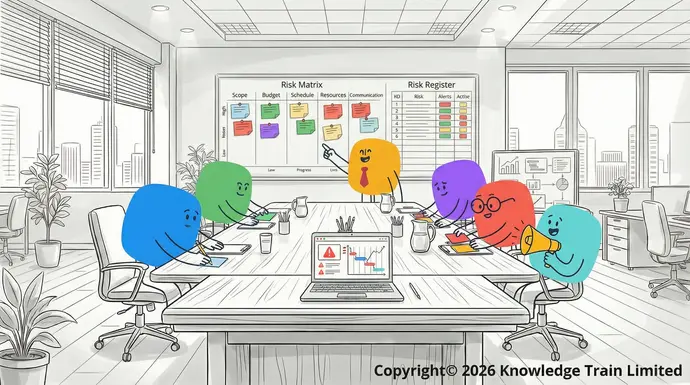
- Maintain a live risk register, supported by tools such as a risk matrix, SWOT, and project software alerts.
- Prevent common failures by controlling scope changes, monitoring budgets, managing dependencies, and planning resources.No. You do not need any technical or IT background. The course is written in plain English and avoids technical jargon. It focuses on practical steps anyone can take to stay safer online.
- Keep stakeholders engaged with clear communication so risks are understood, owned, and acted on.Can my employer purchase this course for staff?
IntroductionSubmit
Project management is a challenging process that is prone to many possible failures. Risk management{"@context":"http://schema.org","@type":"WebPage","headline":"Cyber Awareness Training Courses For Employees","url":"https://www.knowledgetrain.co.uk/it/cyber-security/cyber-security-courses/cyber-awareness-training-course","significantLink":"https://www.ncsc.gov.uk/cyberaware/home","about":[{"@type":"Thing","name":"cybersecurity awareness","sameAs":["https://en.wikipedia.org/wiki/Internet_security_awareness"]},{"@type":"Thing","name":"training","sameAs":["http://en.wikipedia.org/wiki/Training","https://www.google.com/search?&kgmid=/m/014jg3","https://www.wikidata.org/wiki/Q918385"]}],"mentions":[{"@type":"Thing","name":"internet security awareness","sameAs":["https://en.wikipedia.org/wiki/Internet_security_awareness","https://www.wikidata.org/wiki/Q96375765"]},{"@type":"Thing","name":"online course","sameAs":["https://en.wikipedia.org/wiki/Educational_technology","https://www.google.com/search?&kgmid=/m/067_f8","https://www.wikidata.org/wiki/Q1068473"]},{"@type":"Thing","name":"cybersecurity awareness","sameAs":["https://en.wikipedia.org/wiki/Internet_security_awareness"]},{"@type":"Thing","name":"phishing","sameAs":["https://en.wikipedia.org/wiki/Phishing","https://www.google.com/search?&kgmid=/m/027b9k","https://www.wikidata.org/wiki/Q135005"]},{"@type":"Thing","name":"phished","sameAs":["https://en.wikipedia.org/wiki/Phishing","https://www.google.com/search?&kgmid=/m/027b9k","https://www.wikidata.org/wiki/Q135005"]},{"@type":"Thing","name":"ransomware","sameAs":["https://en.wikipedia.org/wiki/Ransomware","https://www.google.com/search?&kgmid=/m/0657nv","https://www.wikidata.org/wiki/Q926331"]},{"@type":"Thing","name":"phishing attacks","sameAs":["https://en.wikipedia.org/wiki/Phishing","https://www.google.com/search?&kgmid=/m/027b9k","https://www.wikidata.org/wiki/Q135005"]},{"@type":"Thing","name":"cyber threat","sameAs":["https://en.wikipedia.org/wiki/Threat_(computer_security)","https://www.google.com/search?&kgmid=/m/0dlk536","https://www.wikidata.org/wiki/Q7797190"]},{"@type":"Thing","name":"risk","sameAs":["https://en.wikipedia.org/wiki/Risk","https://www.google.com/search?&kgmid=/m/06d5f","https://www.wikidata.org/wiki/Q104493"]},{"@type":"Thing","name":"antivirus","sameAs":["https://en.wikipedia.org/wiki/Antivirus_software","https://www.google.com/search?&kgmid=/m/01np0n","https://www.wikidata.org/wiki/Q93249"]},{"@type":"Thing","name":"strong passwords","sameAs":["https://en.wikipedia.org/wiki/Password_strength","https://www.google.com/search?&kgmid=/m/0c3ngs","https://www.wikidata.org/wiki/Q1990841"]}]} is a key aspect of project management that can help increase the likelihood of project success. This involves the process of identifying, assessing, and mitigating risks that can threaten the project.
In this article, we will explore some of the risks that can arise on projects and how to deal with them effectively. We will discuss the following topics:
- The definition and importance of understanding project risks
- The different types of common project risks
- The process of risk management on projects
- The tools and techniques used in risk management
- The strategies for effective risk mitigation
- The best practices for successful risk management on projects.
By the end of this article, you will be able to:
- Identify potential risks on your projects
- Apply effective risk management strategies
- Improve the chances of your project’s success.
You can also learn about project risk management on a project management course such as PRINCE2 course or an APM course .
Let’s begin and explore the world of project risk management and how to protect your projects from potential risks.
Understanding project risks
Definition of project risk
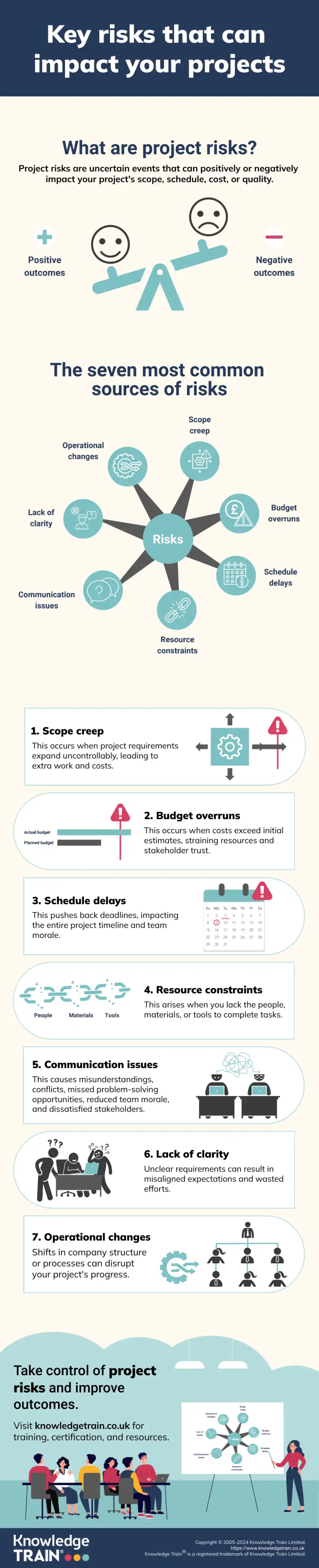
A project risk refers to an uncertain event or condition that, if it occurs, has the potential to either positively or negatively affect the outcome of a project. Risks can impact project objectives such as scope, schedule, cost, or quality. Examples of project risks include changes in customer requirements, budget constraints, delays in schedules, technical issues, resource shortages, and more.
Types of project risksGive us a call
Project risks can be classified into various categories, including:
- Internal risks
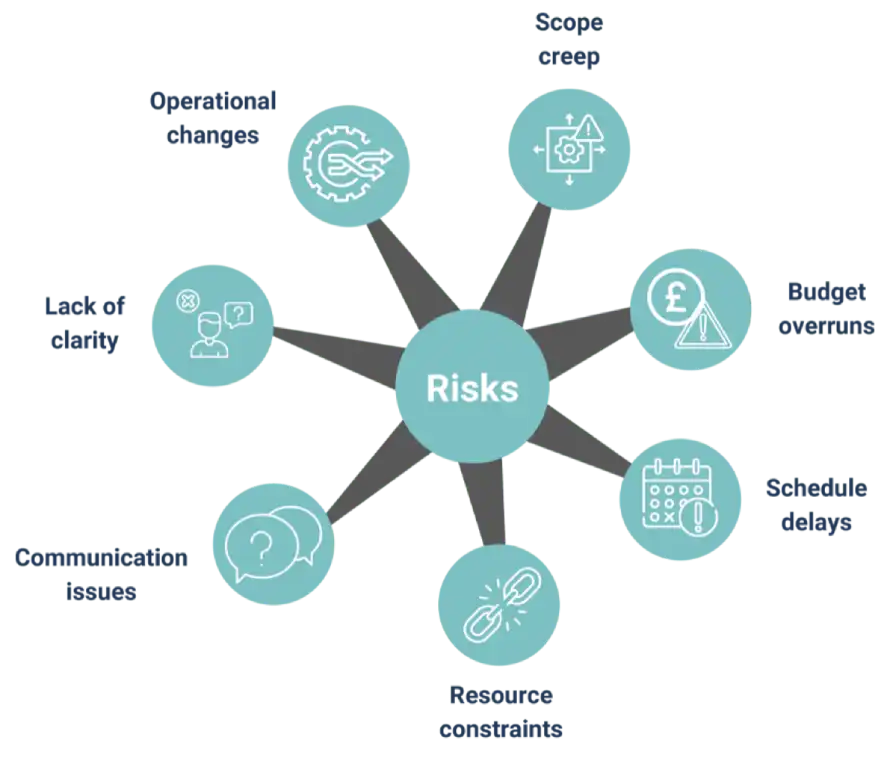
Common project management risks®
Scope creep and AgileBA
Common causes®
Scope creep are registered trademarks of Agile Business Consortium Limited. All rights reserved. The APMG International AgilePM and Swirl Device logo, APMG International AgileBA and Swirl Device Logo, APMG International Change Management and APMG International Better Business Cases and Swirl Device logo are trademarks of The APM Group Limited, used under permission of The APM Group Limited. All rights reserved. Better Business Cases™ is a trademark of Her Majesty’s Treasury. All rights reserved. DevOps Foundation is the uncontrolled expansion of a project’s scope without corresponding adjustments to time, budget, and resources. Common causes of scope creep include ambiguous initial requirements, lack of change control processes, Stakeholder pressure for additional features, and insufficient stakeholder engagement.®
Impact is a registered mark of the DevOps Institute. “PMI”, “PMBOK
Scope creep can have several impacts on a project:®
- It can increase the project’s duration, require more resources and increase costs Guide”, “PMP” and “CAPM” are registered marks of Project Management Institute, Inc. Knowledge Train Scrum Essentials™, Business Learning Library (BLL)™, Business Analysis Learning Library (BALL)™, Agile Learning Library (ALL)™, IT Learning Library (ITLL)™, and Compliance Learning Library (CLL)™ are trademarks of Knowledge Train Limited. All rights reserved.
- It can lead to delays and missed deadlinesKnowledge Train Ltd is an Introducer Appointed Representative of NewDay Cards Ltd for the Newpay finance product provided by NewDay Ltd. NewDay Cards Ltd acts as a credit broker, not a lender. We will introduce you exclusively to Newpay finance products provided by NewDay Limited under this Introducer Appointed Representative arrangement. Finance available from other lenders is not covered by this arrangement. NewDay Ltd and Newday Cards Ltd are authorised and regulated by the Financial Conduct Authority (ref nos 690292 and 682417 respectively).
- It can cause the project to lose focus and drift away from its original objectives
- It can lead to team burnout and demotivation.
To prevent scope creep, it is crucial to have a clear understanding of the project’s objectives and requirements, and to establish change control processes to manage and approve any changes to the project scope.
Budget overruns
Common causes
Budget overrunsSearch occur when the actual cost of a project exceeds the initially allocated budget. Common causes of budget overruns include inaccurate cost estimation, scope changes, unforeseen expenses, and poor resource management.
Impact
Prevent budget problems by performing a detailed cost analysis and ensuring financial reporting is transparent throughout the project.
Schedule delays
Common causes
Schedule delays can occur due to a variety of reasons:
- Unrealistic time estimates
- Resource unavailability
- Dependency conflictsRequest a quote
- External factors (e.g. weather, supplier delays).
Impact
Schedule delays can lead to missed deadlines and milestones, increased costs due to prolonged project duration, reduced stakeholder satisfaction and potential loss of competitive advantage.
To address time-related risks, implement effective project scheduling techniques and regularly monitor project progress.
Resource constraints
Types of resource risks
Resource risks can take various forms, such as:Manage Consent
- Skill shortages
- Equipment or material unavailabilityTo provide the best experiences, we use technologies like cookies to store and/or access device information. Consenting to these technologies will allow us to process data such as browsing behavior or unique IDs on this site. Not consenting or withdrawing consent, may adversely affect certain features and functions.
- Insufficient funding
- Limited time availability.
Impact on project performance
Resource constraints can result in reduced productivity, compromised quality of deliverables, increased stress on team members and potential project delays.
Conduct thorough resource planning and maintain open communication with stakeholders to proactively address resource-related issues.Functional
Communication issues
Importance of effective communication
Effective communication is vital for project success. It facilitates alignment of project objectives, timely issue resolution, stakeholder engagement and buy-in and efficient team collaboration.
Consequences of poor communication
Poor communication can lead to misunderstandings and conflicts, missed opportunities for problem-solving, reduced team morale and productivity and stakeholder dissatisfaction.
Establish clear communication channels and protocols to promote open and transparent dialogue throughout the project.Functional
Lack of clarity
Sources of unclear requirements Always active
Unclear requirements can stem from ambiguous project objectives, insufficient stakeholder input, lack of detailed documentation and changing business needs.
Effects on project outcomes
Lack of clarity can lead to misaligned expectations, rework and wasted resources, delayed decision-making and compromised project quality.
Invest time in gathering and documenting clear requirements and maintain ongoing stakeholder engagement to ensure alignment.
Operational changes
Types of operational risksThe technical storage or access is strictly necessary for the legitimate purpose of enabling the use of a specific service explicitly requested by the subscriber or user, or for the sole purpose of carrying out the transmission of a communication over an electronic communications network.
Operational changes can include:
- Organisational restructuring
- Process modifications
- Technology upgradesPreferences
- Regulatory changes.
Impact on project execution
Operational changes can affect projectsPreferences by disrupting established workflows, requiring additional training or resources, altering project priorities and necessitating scope or timeline adjustments.
- Marketing
- Create detailed, unambiguous project specifications
- Implement formal requirements review and approval process.
Adapting to changes
- Stay informed of potential changes within the organisation
- Build flexibility into project plans to accommodate operational shifts
- Develop contingency plans for significant operational disruptions.The technical storage or access is required to create user profiles to send advertising, or to track the user on a website or across several websites for similar marketing purposes.
By following these tips, you can avoid most of the common pitfalls that can cause problems in your projects. Keep in mind that risk management is a continuous process. It is important to revisit the steps in this process as you continue with your project.
Best practices for effective risk managementManage options
Proactive approach to risk identificationManage services
- Try to spot potential risks at the start of a Manage {vendor_count} vendorsprojectRead more about these purposes
- Ask team members to raise red flags as soon as possible
- Look at past data and apply any relevant lessons learnt.Accept
Regular risk assessment
- Hold Denyregular check-ins to review identified risks and their statusView preferences
- Re-evaluate risks as the project progresses and circumstances change
- Revise risk mitigation plans as necessary.Save preferences
Stakeholder involvement in risk management
- Include stakeholders in identifying and assessing risksView preferences
- Keep stakeholders informed of risk management plans and progress{title}
- Seek stakeholder input on risk mitigation strategies.{title}
Continuous learning and improvement{title}
- Record lessons learnt from risk management successes and failuresManage consent
- Share information with other project teams to improve organisational risk managementManage consent
- Invest in ongoing training and development of risk management skills.
Follow these tips to help you establish a positive risk management culture and improve project success.
Conclusion
Recap of key points
Effective project risk management is a multi-faceted approach that involves identifying and assessing potential risks, developing mitigation strategies, utilising appropriate tools and techniques, and implementing best practices for continuous improvement.
These elements form a comprehensive framework for managing uncertainties in project management.
Importance of ongoing risk management
Risk management is an ongoing process that requires constant vigilance, regular reassessment and adaptation to changing project conditions.
By prioritising risk management throughout the project lifecycle, you increase the likelihood of project success. Remember, proactive risk management is an investment in your project’s future, safeguarding its objectives and deliverables.
FAQs
What is the difference between internal and external project risks?
Internal risks are those that originate within the project or organisation, while external risks stem from outside factors beyond the direct control of the project team.
How often should risk assessments be conducted during a project?
Risk assessments should be conducted regularly throughout a project, often at predetermined intervals or key project milestones. Monthly risk assessments are typical for most projects.
What role do stakeholders play in project risk management?
Stakeholders can provide valuable input in identifying risks, assessing their potential impact, and helping to develop risk mitigation strategies.
Can all project risks be eliminated?
No, not all project risks can be eliminated. The focus should be on effectively managing and mitigating risks.
How can small teams effectively manage project risks with limited resources?
Small teams can prioritise risks based on their potential impact, use simple risk assessment tools, and leverage the diverse expertise of team members to ensure comprehensive risk management.
Infographic