Project management methods: a guide to modern approachesSOCIAL RESPONSIBILITY

- {"@context":"http://schema.org","@type":"BreadcrumbList","itemListElement":[{"@type":"ListItem","position":1,"name":"Home","item":"https://www.knowledgetrain.co.uk/"},{"@type":"ListItem","position":2,"name":"Project Management","item":"https://www.knowledgetrain.co.uk/project-management"},{"@type":"ListItem","position":3,"name":"Construction project management","item":"https://www.knowledgetrain.co.uk/project-management/construction-project-management"}]} such as Scrum and Kanban
- Lean project management principles
- Hybrid and adaptive frameworks.
We will review the strengths and weaknesses of each project management method, enabling you to select the most appropriate one for your next endeavor. Gain a better understanding of these methods, and it will be easier for you to lead your team to victory.Construction project management guide
Traditional project management methodologies
In this article, we will dive deep into several traditional Conclusionproject management methodologies. These have been in use for years, and if you are new to the field or are simply curious to learn more, read on!FAQs
WaterfallIntroduction
Process and stagesThe construction industry plays a foundational role in both economic expansion and the development of infrastructure.
WaterfallConstruction project management methodology follows a linear and sequential approach consisting of the following stages: stands as a discipline which directs the coordination among resources, timelines, and stakeholders. This guide examines construction project management fundamentals to provide useful information for experienced practitioners as well as beginners in the industry.
- Requirements gatheringOur exploration covers essential
- Designproject
- Implementation roles; lifecycle stages of construction and processes needed for seamless execution. This section will identify common project management challenges and reveal the best strategies to address them. This guide concludes with our
- Testingtop 10 UK university course
- Deployment selections for construction project management which serve as excellent springboards for career advancement within this field.
- Maintenance.This guide provides valuable information for
Each stage must be completed before proceeding to the next, with an emphasis on documentation and clear milestones.project managers
Best use cases who want to improve their abilities as well as students exploring construction careers and professionals aiming to understand industry complexities.
Construction projects, manufacturing processes, large-scale infrastructure projects and projects with well-defined and stable requirements are particularly suitable for Waterfall.Key roles in construction project management
Pros and consTo achieve success in construction
Pros:projects
- Clear structure and timeline professionals need to collaborate as a team.
- Easy to understand and manageProject manager
- Detailed documentation at each stage.: The Project Manager coordinates every part of the project throughout both planning and execution stages.
Cons: General contractor
- Limited flexibility for changes: Manages day-to-day site operations, vendors, and trades.
- Late identification of issues Subcontractors
- Potentially lengthy development cycles.: Subcontractors serve as experts who handle particular jobs including electrical tasks and plumbing work.
Critical Path Method (CPM)Project owner
Key concepts and implementation: The project owner represents either the client or organisation receiving the completed construction.
CPM Architects and Engineers is a scheduling technique for project activities. It involves identifying all necessary tasks, task dependencies, calculating the longest path of planned activities, and determining the minimum project duration.: Architects and engineers create structural designs that adhere to all specified requirements.
Suitable projects and industriesEstimators
CPM is commonly used in construction projects, product development, research initiatives, and event planning.: Provide detailed cost projections for the project.
PRINCE2 (PRojects IN Controlled Environments)Enhance your skills with our expert-led courses
Framework overview
PRINCE2 is a process-based method that emphasises organisation and control. Its key features include division into manageable stages, defined roles and responsibilities, product-based planning approach and a strong focus on business justification.
When to use PRINCE2Self-paced
PRINCE2 is well-suited for large-scale government projects, IT implementations, business transformations and APM PFQ blended onlineprojects with a need for strict governance.£749 +vat
Project Management Body of Knowledge (PMBOK)
Core principles and processes
PMBOK is a comprehensive guide that offers best practices across five process groups:Self-paced
- InitiatingPRINCE2 Agile Practitioner (with Foundation) self-paced online
- Planning
- Executing£1,399 +vat
- Monitoring and Controlling
- Closing.
It also encompasses ten knowledge areas, including scope, time, cost, and quality managementSelf-paced.AgilePM Practitioner (with Foundation) self-paced online
Applications in various industries
PMBOK principles can be applied in information technology, healthcare, finance and banking, engineering and construction, and education industries, among others.£1,299 +vat
These traditional methodologies provide reliable frameworks for managing projects. They work best in situations where requirements are well-defined, and stability is preferred over flexibility. However, they can face challenges in rapidly changing environments or when continuous stakeholder feedback is essential.The 5 stages of construction projects
Ultimately, the choice of methodology depends on the specific needs of your 1. Planning and developmentprojectFeasibility assessments and capital budgeting alongside stakeholder feedback happen during this stage. It determines if the project should proceed., the capabilities of your team, and the organisational culture you operate within. In some cases, a combination of different approaches may be the most effective solution.2. Design
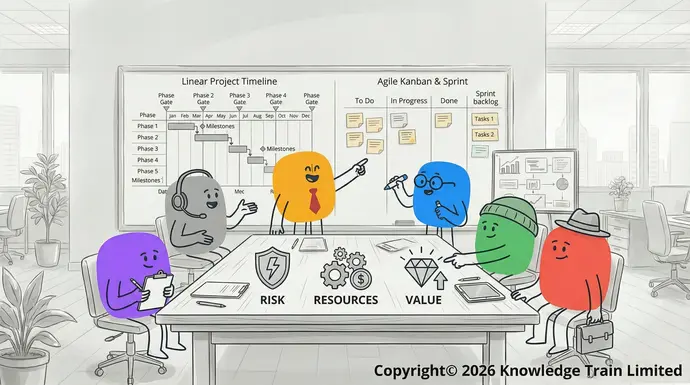
Agile project management methodologiesApproved concepts transform into detailed blueprints and specifications.
Agile methodologies 3. Preconstructionemphasise flexibility, collaboration, and rapid delivery of value. These approaches have gained significant popularity, particularly in software development and other dynamic industries.The preconstruction phase concentrates on assigning resources and planning budgets while scheduling work and evaluating risks.
Scrum4. Procurement
Roles, events, and artifactsThe sourcing process for materials and services considers both supply chain logistics and timing requirements.
Scrum5. Construction is a lightweight framework that helps teams work together effectively. It consists of:Construction starts and continues with consistent progress tracking and
| Rolesmanagement of changes | Events. | ArtifactCore construction project management processes |
| Product OwnerIdeation and research | ||
Industries benefiting from Kanban
re principles and adaptabilityMaintain regular communication with all stakeholders.
Crystal methodologies share common principles, such as frequent delivery, reflective improvement, osmotic communication, personal safety and focus.Monitor project progress continuously and adjust plans when needed.
The framework is highly adaptable, allowing teams to customise their approach based on project needs.Make safety and quality control your top priori
Feature Driven Development (FDD)
Five processes of FDD
FDD consists of five main processes:
- Develop an overall modelties throughout the duration of the project.
- Build a features listEnhance your skills with our expert-led courses
- Plan by feature
- Design by feature
- Build by feature
Advantages for client-focused projectsSelf-paced
FDD offers several benefits for client-centric projects:APM PFQ blended online
- Regular, tangible progress
- Early detection of errors£749 +vat
- Accurate status reporting
- Scalability for larger projects.
Agile methodologies offer numerous advantages, including increased flexibility, faster delivery of value, and improved stakeholder satisfaction. However, they also present challenges, such as the need for cultural change and potential difficulties in long-term planning.
When considering an Agile approach, evaluate your team’s skills, project requirements, and organisational culture. Some projects may benefit from combining elements of different Agile methodologies or even blending Agile with traditional approaches.Self-paced
Remember that successful implementation of any Agile methodology requires commitment from the entire team and support from management. Continuous learning and adaptation are key to maximising the benefits of PRINCE2 Agile Practitioner (with Foundation) self-paced onlineAgile project management
