li><
li>Practices: prioritization, time-boxing, facilitated workshops, modelling, iterative development
>
- li>Estimating, planning and control on agile projects<
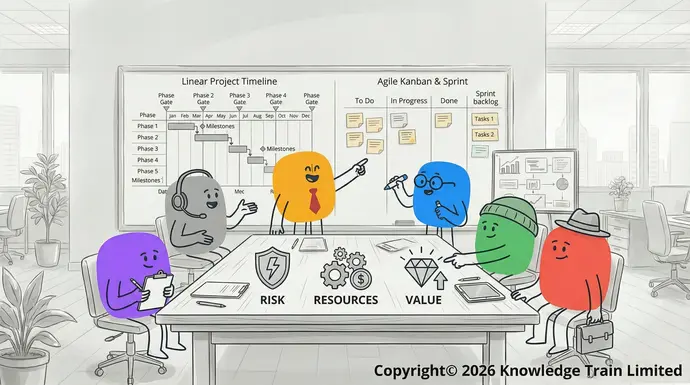
Core project management philosophies
linearLinear (Waterfall) approachDescription and key principles< from start to finish, ensuring successful outcomes.Knowledge Train
The Advantages: Disadvantages:< success. We’ll also cover qualifications, potential career paths, and future trends in this rapidly growing field. Whether you are interested in making a career change or enhancing your Agile methodologies, on the other hand, emphasise flexibility, collaboration, and the rapid delivery of working products. Core tenets of Agile approaches include iterative development cycles (known as sprints), continuous feedback and adaptation, close collaboration with stakeholders, and a focus on delivering value early and frequently. Advantages:Advantages and disadvantages
Iterative (Agile) approach
Description and key principles
Advantages and disadvantages< and objectives
PRINCE2 Agile Practitioner (with Foundation) self-paced onlinespan>The roles and responsibilities within an Agile project and correctly determine the appropriate personnel to fulfil these roles
>>li>
span>The mechanisms for control of an Agile Project which are specific to an Agile project
>
>AgilePM Practitioner (with Foundation) self-paced onlineli>
- span>How to test, estimate and measure progress in an Agile project
- £1,299 +vat>
- Essential skills for project managers>
- Project managers need a combination of hard and soft skills to lead their li>
- projectsspan>The Agile approach to managing requirements and identify action to rectify problems with requirements within an Agile project
- to success. This is what sets great project managers apart from the rest and makes them able to deliver results.>
Technical skills>
In-depth understanding of li>
project management methodologiesspan>What is needed to pass the AgilePM Practitioner exam.
such as >
PRINCE2>
- and >","learningResourceType":"presentation","teaches":"
- Agileh3>Curriculum
- Proficiency in 3>
project management softwareh4>AgilePM Practitioner (with Foundation)
- like Microsoft Project or Jira4>
- Knowledge of industry-specific tools and techniques related to the project field.p>Agile PM Practitioner (with Foundation) training covers the following topics:
- Soft skills>
Leadership and team managementul>
Ability to inspire and motivate team membersli>What is Agile?
Create a collaborative work environment>Conflict resolution skills.li>Choosing an appropriate agile approach
Communication and negotiation>
Clearly articulate project goals and expectationsli>DSDM philosophy, principles, and project variables
Negotiation skills with stakeholders and team members>
Ability to present complex information in a simple and understandable way.li>DSDM roles and responsibilities on agile projects
Problem-solving and decision-making>Analyse problems from various anglesli>DSDM agile project management processes
Make informed decisions under pressure>
Implement innovative solutions to overcome challenges.li>DSDM productsTime management and organisation>Prioritise tasks effectivelyli>Practices: prioritization, time-boxing, facilitated workshops, modelling, iterative development
Manage multiple deadlines>
Maintain accurate project documentation.li>Estimating, planning and control on agile projects
Business acumen>In-depth understanding of business processes and organisational structures.li>AgilePM Foundation exam preparation
- Financial management skills for budget and resource allocation>
- Strategic thinking to align li>Everything listed under Practitioner below.
- projects>
- with overall business goals.>
- Developing these core skills, project managers can successfully guide teams, overcome obstacles, and achieve project goals. Embracing a mindset of continuous improvement is essential in this ever-evolving discipline.h4>AgilePM Practitioner
Qualifications and career path4>Educational backgroundp>Agile PM Practitioner training focuses on tailoring the DSDM agile project framework learned at Foundation level.Relevant degrees: Business, engineering, or >
ITp>Agile Project Management Practitioner training covers the following topics:
.>
Professional certifications: ul>
APMli>The project manager’s view (Association for Project Management) and >PMIli>Agile project management through the life cycle
(Project Management Institute).>
Entry-level positionsli>Effectively using productsAssistant project manager>
Sector-specific project coordinator.li>Delivering on time using MoSCoW prioritization and time-boxing
These roles typically offer experience in project support and coordination. They are an excellent opportunity to learn from experienced professionals and gain practical skills.>
Career progressionli>People, teams, and interactionsAs project managers gain experience, there are opportunities for career advancement such as:>
£1,399 +vat
- Here are some of the future trends in the field of
project management
Increasing demand
: Increasing demand for
project management skills
across industries and organisations.
AI and automation
- Statistics
- Statistics
The technical storage or access that is used exclusively for statistical purposes.
The technical storage or access that is used exclusively for anonymous statistical purposes. Without a subpoena, voluntary compliance on the part of your Internet Service Provider, or additional records from a third party, information stored or retrieved for this purpose alone cannot usually be used to identify you.
- Marketing
- Marketing
The technical storage or access is required to create user profiles to send advertising, or to track the user on a website or across several websites for similar marketing purposes. Manage options
