Project management methods: a guide to modern approaches

Key takeawaysLearn the key principles of Agile Project Management.
Choose a project approach that fits the work, the team, and the organisation.Practitioner
- Waterfall suits stable requirements and benefits from clear phases, documentation, and predictable planning.Includes Foundation & Practitioner combined option.
- Agile methods prioritise rapid, iterative delivery, close collaboration, and frequent feedback to handle change.PRINCE2
- Lean improves delivery by maximising customer value and removing waste, and Lean Six Sigma adds data-driven quality control.®
- Hybrid approaches like Scrumban blend structure and flow to cope with shifting priorities and unexpected work. Agile
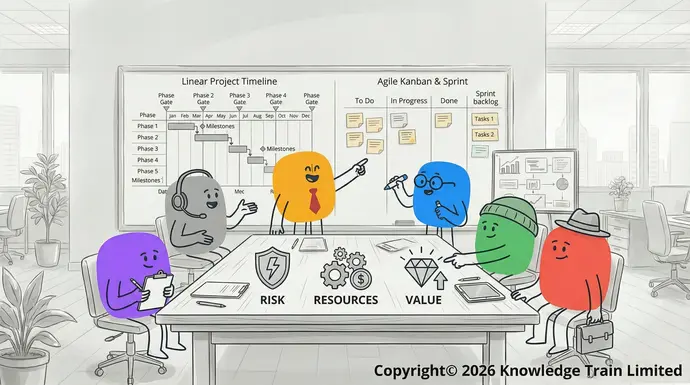
- Method selection should reflect project complexity, stakeholder involvement, risk, and organisational culture, and be reviewed at key milestones.Foundation
- Learn how to use AI tools in everyday project work. such as AGILEScrumAgilePM and Kanban®
- Lean project management principles – Agile Project Management
- Hybrid and adaptive frameworks.Foundation
We will review the strengths and weaknesses of each project management method, enabling you to select the most appropriate one for your next endeavor. Gain a better understanding of these methods, and it will be easier for you to lead your team to victory.Learn the key principles of Agile Project Management.
Compliance Learning Library (CLL)™Key concepts and implementation
CPMIT Learning Library (ITLL)™ is a scheduling technique for project activities. It involves identifying all necessary tasks, task dependencies, calculating the longest path of planned activities, and determining the minimum project duration.Business solutions
Suitable projects and industries_blank
CPM is commonly used in construction projects, product development, research initiatives, and event planning.About
PRINCE2 (PRojects IN Controlled Environments)_blank
Framework overviewBlog
PRINCE2 is a process-based method that emphasises organisation and control. Its key features include division into manageable stages, defined roles and responsibilities, product-based planning approach and a strong focus on business justification.EXPLORE SUBJECTS
When to use PRINCE2Select your preferred subject.
PRINCE2 is well-suited for large-scale government projects, IT implementations, business transformations and projectsPROJECT MANAGEMENT QUALIFICATIONS & WORKSHOPS with a need for strict governance.Select your preferred qualification or workshop.
Project Management Body of Knowledge (PMBOK)
Core principles and processesPRINCE2 COURSES
PMBOKSelect your preferred training course below: is a comprehensive guide that offers best practices across five process groups:
- InitiatingAPM COURSES
- PlanningSelect your preferred training course below:
- Executing
- Monitoring and ControllingAGILE PROJECT MANAGEMENT COURSES
- Closing.Select your preferred training course below:
It also encompasses ten knowledge areas, including scope, time, cost, and quality managementPRINCE2 AGILE COURSES.Select your preferred training course below:
Applications in various industries
PMBOK principles can be applied in information technology, healthcare, finance and banking, engineering and construction, and education industries, among others.BETTER BUSINESS CASES COURSES
These traditional methodologies provide reliable frameworks for managing projects. They work best in situations where requirements are well-defined, and stability is preferred over flexibility. However, they can face challenges in rapidly changing environments or when continuous stakeholder feedback is essential.Select your preferred training course below:
Ultimately, the choice of methodology depends on the specific needs of your projectP3O COURSES, the capabilities of your team, and the organisational culture you operate within. In some cases, a combination of different approaches may be the most effective solution.Select your preferred training course below:
Agile project management methodologies
Agile methodologies WORKSHOPSemphasise flexibility, collaboration, and rapid delivery of value. These approaches have gained significant popularity, particularly in software development and other dynamic industries.Select your preferred workshop below:
Scrum
Roles, events, and artifactsAGILE QUALIFICATIONS
ScrumSelect your preferred qualification. is a lightweight framework that helps teams work together effectively. It consists of:
| RolesAGILE PROJECT MANAGEMENT COURSES | EventsSelect your preferred training course below: | Artifact |
| Product OwnerPRINCE2 AGILE COURSES | Sprint PlanningSelect your preferred training course below: | Product Backlog |
| Scrum MasterSCRUM COURSES | Daily ScrumSelect your preferred training course below: | Sprint Backlog |
| Development TeamAGILE BUSINESS ANALYSIS COURSES | Sprint ReviewSelect your preferred training course below: | Review Increment |
| Sprint RetrospectiveBUSINESS ANALYSIS QUALIFICATIONS |
Sprint planning and executionSelect your preferred qualification.
Scrum operates in time-boxed iterations known as SprintsBCS BUSINESS ANALYSIS COURSES, typically ranging from 1 to 4 weeks. During each Sprint, the team commits to delivering a set of features.Select your preferred training course below:
Benefits and challenges
Benefits:AGILE BUSINESS ANALYSIS COURSES
- Improved product qualitySelect your preferred training course below:
- Increased stakeholder satisfaction
- Better team collaboration.CHANGE MANAGEMENT QUALIFICATIONS
Challenges:Select your preferred qualification.
- Requires cultural shift
- Potential for scope creepAPMG CHANGE MANAGEMENT COURSES
- Difficulty in estimating long-term projects.Select your preferred training course below:
Kanban
Visualising workflow with Kanban boardsPROGRAMME MANAGEMENT QUALIFICATIONS
KanbanSelect your preferred qualification. uses visual boards to represent work items as they move through different stages of completion.
Principles of KanbanMSP COURSES
Key principles include:Select your preferred training course below:
- Visualise the workflow
- Limit Work In Progress (WIP)PMI COURSES
- Manage flowSelect your preferred training course below:
- Make process policies explicit
- Implement feedback loops.PMI COURSES
Industries benefiting from KanbanSelect your preferred training course below:
Kanban is versatile and can be applied in various sectors, including software development, marketing and design, human resources, and manufacturing.
Extreme Programming (XP)PRINCE2 COURSES
Key practices and valuesSelect your preferred training course below:
XP emphasises technical excellence and customer satisfaction. Core practices include pair programming, test-driven development, continuous integration, and small, frequent releases.APM COURSES
Best scenarios for XP implementationSelect your preferred training course below:
XP is particularly effective for projects with changing requirements, small to medium-sized development teams, and environments that value close collaboration with customers.
CrystalAGILE PROJECT MANAGEMENT COURSES
Family of methodologiesSelect your preferred training course below:
Crystal is a family of PRINCE2 AGILE COURSESAgile methodologiesSelect your preferred training course below:, each named after a precious gemstone. Popular variants include:
- Crystal ClearBUSINESS CASE COURSES
- Crystal YellowSelect your preferred training course below:
- Crystal Orange
- Crystal Red.AGILE COURSES
Each variant is designed for different team sizes and project criticality.Select your self-paced training course topic.
Knowledge Train is an AIPGF Accredited Training Organization. is a comprehensive Agile project delivery framework that emphasises the early and continuous delivery of business value. It provides a structured approach to Agile project management.
MoSCoW prioritisation technique
DSDMKnowledge Train is an AIPGF Accredited Training Organization. utilises the MoSCoWBCS accredited training partner for Business Analysis. method for WHAT YOU WILL GETprioritising requirementsOur courses and workshops include:, which includes:Certification exam(s) where applicable
- Must haveAccredited training course materials
- Should haveExpert, experienced trainers to support you
- Could haveCourse manual where applicable.
- Won’t have this time.
This prioritisation technique ensures that the focus remains on essential deliverables within time and resource constraints.SELF-PACED ONLINE TRAINING COURSES
Adaptive Project Framework (APF)Self-paced online training courses (e-learning) include:
Flexibility in uncertain environmentsCertification exam(s) where applicable
APFAccredited training course materials is designed to handle projects with high levels of uncertainty. It allows for continuous adaptation and adjustment as new information becomes available.Support from expert, experienced trainers
Key components of APFLatest educational technology.
APF consists of five stages:
- Project scopeBUSINESS SOLUTIONS
- Cycle plan
- Cycle build
- Client checkpointTO HELP ORGANISATIONS IMPROVE
- Post-cycle review.We offer solutions to help improve team performance including:
These stages promote iterative development and frequent stakeholder involvement.Consultancy services
Hybrid and adaptive methodologies provide tailored solutions for complex and dynamic projects. By combining elements from various approaches, teams can create flexible frameworks that address specific project needs and organisational cultures.Staff development
Choosing the right project management methodologyCompliance training
Factors to considerApprenticeship training
- Project complexity and sizeCustom e-Learning development: Larger, complex projects may benefit from a more structured approach like waterfall or Find out morePRINCE2 .
- Team size and expertise : Smaller, highly skilled teams may thrive using A gile methodsCONTACT US.
- Industry standards and requirements : Some industries have established preferences or regulations for specific methodologies.
Conclusion
Recap of key methodologies
We’ve covered various project management methodologies , including traditional waterfallAWARDS, We don’t go seeking awards, but here are two of the awards we have received for our training.PRINCE2 , and A Request a quotegile methodologies and Kanban. We also touched on hybrid approaches like Scrumban that combine elements of different methodologies.
Importance of continuous learning and adaptation
Project management is an ever-evolving field. To be successful, +44 (0)207 148 5985project managers must stay updated on new methodologies, tools, and industry best practices. The ability to adapt your approach based on the specific needs of your projects and teams is crucial.[email protected]
It’s important to emphasise that no methodology is perfect for every situation. The key to success lies in understanding different methodologies and choosing the most appropriate one for each unique project.
FAQs
How often should I reassess my chosen project management methodology?
It’s a good practice to regularly evaluate the effectiveness of your methodology, especially during project milestones or when encountering new challenges.
Remember, the best project management methodology is the one that suits your project’s specific needs and your team. Don’t be afraid to adapt and refine your approach as necessary.
InfographicUnited Kingdom
