Project management methods: a guide to modern approaches

Key takeaways
Choose a project approach that fits the work, the team, and the organisation.
- Waterfall suits stable requirements and benefits from clear phases, documentation, and predictable planning.
- Agile methods prioritise rapid, iterative delivery, close collaboration, and frequent feedback to handle change.
- Lean improves delivery by maximising customer value and removing waste, and Lean Six Sigma adds data-driven quality control.
- Hybrid approaches like Scrumban blend structure and flow to cope with shifting priorities and unexpected work.
- Method selection should reflect project complexity, stakeholder involvement, risk, and organisational culture, and be reviewed at key milestones.
Introduction
Running a modern business requires that certain tasks are coordinated in a way that increases chances of getting results. Project management methodology is a set of rules and processes that are implemented by teams in order to plan, develop, and deliver project outcomes. In this way, business people can make the most of the project to achieve business goals.
Choosing the right one is important for several reasons: the methodology should be applicable to your teams’ strong suits and their project needs it should also be helpful in communication and collaboration it needs to improve the process of resource allocation and risk management and, finally, it is likely to increase the chances of project success.
This comprehensive guide will look at the most relevant project management methodologies, including:
- Traditional approaches like waterfall
- Agile methodologies such as Scrum and Kanban
- Lean project management principles
- Hybrid and adaptive frameworks.
We will review the strengths and weaknesses of each project management method, enabling you to select the most appropriate one for your next endeavor. Gain a better understanding of these methods, and it will be easier for you to lead your team to victory.
Core project management philosophies
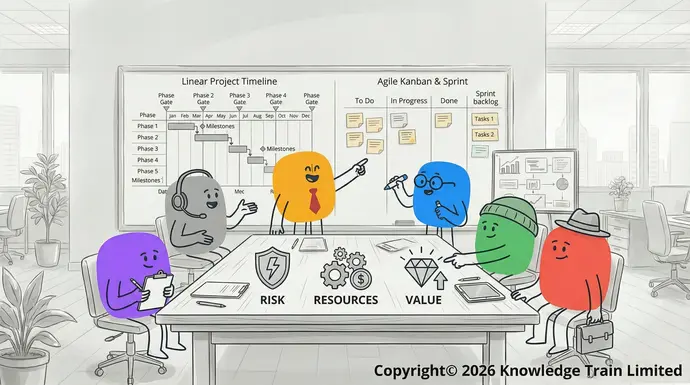
Project management methodologies may be classified into two broad categories, based on their fundamental philosophies. These are linear and iterative. It’s important to be aware of these core strategies when choosing the best approach for your project.
Linear (Waterfall) approach
Description and key principles
The Waterfall strategy is a linear approach where a project is broken down into distinct phases, and each phase is completed before progressing to the next. Core tenets of this approach include detailed upfront planning, comprehensive documentation at each phase, rigorous change control processes, and a strong emphasis on following the planned path.
Advantages and disadvantages
Advantages:
- Clear structure and defined milestones
- Well-defined deliverables
- Easier costs and timelines estimation.
Disadvantages:
- Limited flexibility to accommodate changes
- Late identification of issues or misalignments
- Potentially longer development cycles.
Iterative (Agile) approach
Agile methodologies, on the other hand, emphasise flexibility, collaboration, and the rapid delivery of working products. Core tenets of Agile approaches include iterative development cycles (known as sprints), continuous feedback and adaptation, close collaboration with stakeholders, and a focus on delivering value early and frequently.
Advantages and disadvantages
Advantages:
- Adaptability to changing requirements
- Early and frequent delivery of usable products
- Increased stakeholder satisfaction
- Quicker identification and resolution of issues.
Disadvantages:
- Risk of scope creep
- Challenges in estimating overall project timelines
