
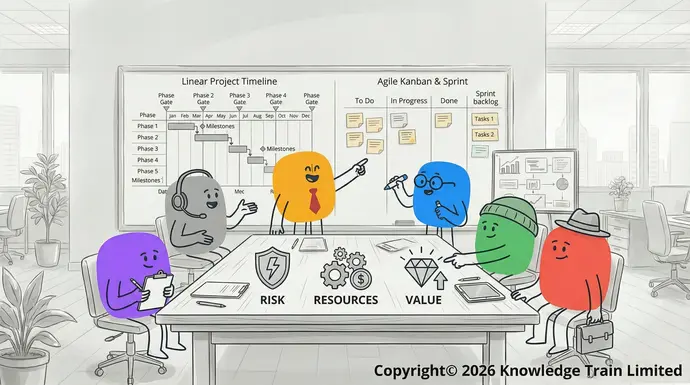
Traditional project management methodologiesUse burndown charts to track your progress. A burndown chart shows you how much work remains in your sprint and whether you are on schedule
In this article, we will dive deep into several traditional Keep the meeting short and concise. Make sure that everyone is speaking straight to the pointproject managementAnswer questions like: What have I done since the last Scrum meeting? What do I plan to do before the next meeting? What are the issues I need help with? methodologies. These have been in use for years, and if you are new to the field or are simply curious to learn more, read on!Don’t
WaterfallBring up topics unrelated to the user stories you’re working on from the backlog
Process and stagesTop Tip
WaterfallDon’t cancel a Scrum Meeting, even if you are busy or if the attendance is poor. The Daily Scrum meeting is an essential component to a Scrum project. When you cancel one, it becomes easier to cancel others and this disrupts the team’s focus. methodology follows a linear and sequential approach consisting of the following stages:Enhance your skills with our expert-led courses
- Requirements gathering
- Design
- Implementation
- TestingInstructor-led
- DeploymentCertified Scrum Master course
- Maintenance.
Each stage must be completed before proceeding to the next, with an emphasis on documentation and clear milestones.£699 +vat
Best use cases
Construction projects, manufacturing processes, large-scale infrastructure projects and projects with well-defined and stable requirements are particularly suitable for Waterfall.See all dates
Pros and cons
Pros:
- Clear structure and timeline
- Easy to understand and manageInstructor-led
- Detailed documentation at each stage.Certified Scrum Product Owner course
Cons:
- Limited flexibility for changes£699 +vat
- Late identification of issues
- Potentially lengthy development cycles.See all dates
Critical Path Method (CPM)
Key concepts and implementation
CPM is a scheduling technique for project activities. It involves identifying all necessary tasks, task dependencies, calculating the longest path of planned activities, and determining the minimum project duration.
Suitable projects and industries
CPM is commonly used in construction projects, product development, research initiatives, and event planning.
PRINCE2 (PRojects IN Controlled Environments)
Framework overview
PRINCE2 is a process-based method that emphasises organisation and control. Its key features include division into manageable stages, defined roles and responsibilities, product-based planning approach and a strong focus on business justification.
When to use PRINCE2Self-paced
PRINCE2 is well-suited for large-scale government projects, IT implementations, business transformations and Scrum Essentials self-paced onlineprojects with a need for strict governance.£499 +vat
Project Management Body of Knowledge (PMBOK)4) Sprint Review
Core principles and processesBy the end of each sprint, the Development Team should deliver a potentially shippable product increment. In other words, the product increment should be in a useable condition. No incomplete work should be presented during a sprint review.
PMBOKDuring a sprint review, the team present what they have accomplished during the sprint. They demonstrate the functionality of the product increment to the Product Owner and customer. The purpose of the sprint review is to get feedback from everyone on the product increment. After the feedback is shared, the next set of product backlog items can be discussed. is a comprehensive guide that offers best practices across five process groups:Do
- InitiatingLet everyone provide feedback and suggest new ideas
- PlanningMake changes to the product backlog when necessary
- ExecutingDon’t
- Monitoring and ControllingUse the sprint review as a signoff or user acceptance meeting
- Closing.Top Tip
It also encompasses ten knowledge areas, including scope, time, cost, and Don’t forget to focus on the end users. Make sure to fully involve them during the sprint review. It may seem difficult collaborating with your customers because of the fear of making changes or hearing criticism, but it is easier to hear everything sooner rather than later.quality management5) Sprint Retrospective.During a sprint retrospective, the team evaluate the whole sprint. The two main questions that are asked are “what went well?” and “what can be improved in the next sprint?”
Applications in various industriesDo
PMBOK principles can be applied in information technology, healthcare, finance and banking, engineering and construction, and education industries, among others.Make a list of what to start, stop, and continue
These traditional methodologies provide reliable frameworks for managing projects. They work best in situations where requirements are well-defined, and stability is preferred over flexibility. However, they can face challenges in rapidly changing environments or when continuous stakeholder feedback is essential.Don’t
Ultimately, the choice of methodology depends on the specific needs of your Point fingers or blame. Try to be constructive insteadprojectTop Tip, the capabilities of your team, and the organisational culture you operate within. In some cases, a combination of different approaches may be the most effective solution.Get creative! Play games and keep people moving. Engage in mentally stimulating activities and help to break down tension
Agile project management methodologies6) Product increment
Agile methodologies The product increment is the output of all the product backlog items completed during the sprint (plus any previous sprints). It must be fully functional, in a useable condition and meet the allocated acceptance criteria or definition of done. The Product Owner decides whether to release the product increment.emphasise flexibility, collaboration, and rapid delivery of value. These approaches have gained significant popularity, particularly in software development and other dynamic industries.Interim delivery
ScrumDuring an interim delivery, the product increment is tested by the customer. If the product is incomplete, the Development Team return to the product backlog to prepare for another sprint. This cycle repeats until all user stories are completed to the Product Owner’s satisfaction.
Roles, events, and artifactsDo
ScrumRemember what was discussed during the sprint retrospective and apply it to the next sprint is a lightweight framework that helps teams work together effectively. It consists of:Don’t
| RolesDwell on past mistakes. Move on and learn from whatever went wrong during the previous sprint | EventsTop Tip | ArtifactIt’s easy to get caught up in preparing for the next sprint, but don’t forget to celebrate achievements and good results from the previous sprint. This gives you some room to breathe and get pumped up for the next cycle |
| Product OwnerPractice makes perfect! If you are new to | Sprint PlanningScrum | Product Backlog, you might not get everything right at the beginning. Learning takes practice and the more you do, the better you will be at using the technique |
| Scrum MasterEnhance your skills with our expert-led courses | Daily Scrum | Sprint Backlog |
| Development Team | Sprint ReviewInstructor-led | Review IncrementCertified Scrum Master course |
| Sprint Retrospective |
Sprint planning and execution£699 +vat
Scrum operates in time-boxed iterations known as SprintsSee all dates, typically ranging from 1 to 4 weeks. During each Sprint, the team commits to delivering a set of features.
Benefits and challenges
Benefits:
- Improved product qualityInstructor-led
- Increased stakeholder satisfactionCertified Scrum Product Owner course
- Better team collaboration.
Challenges:£699 +vat
- Requires cultural shift
- Potential for scope creepSee all dates
- Difficulty in estimating long-term projects.
Kanban
Visualising workflow with Kanban boards
KanbanSelf-paced uses visual boards to represent work items as they move through different stages of completion.Scrum Essentials self-paced online
Principles of Kanban
Key principles include:£499 +vat
- Visualise the workflowFinal delivery
- Limit Work In Progress (WIP)Completing a project takes several sprints. Once all the user stories are completed to the Product Owner’s satisfaction, the product is ready for final delivery to the customer.
- Manage flowHopefully this has been a useful guide to the
- Make process policies explicitScrum methodology
- Implement feedback loops. and whether it would be useful for managing product development in your organization. Some teams like to use
Industries benefiting from KanbanScrum
Kanban is versatile and can be applied in various sectors, including software development, marketing and design, human resources, and manufacturing. alongside Kanban, a highly visual work management method, also under the agile umbrella.
Extreme Programming (XP)Subscribe to our exclusive offers and promotions
Key practices and values
XPSubscribe now emphasises technical excellence and customer satisfaction. Core practices include pair programming, test-driven development, continuous integration, and small, frequent releases.
Best scenarios for XP implementationRelated articles
XP is particularly effective for projects with changing requirements, small to medium-sized development teams, and environments that value close collaboration with customers.
Crystal
Family of methodologies
Crystal is a family of Agile methodologies , each named after a precious gemstone. Popular variants include:
- Crystal Clear
- Crystal Yellow
- Crystal Orange
- Crystal Red.
Each variant is designed for different team sizes and project criticality.
Lean project managementExplore the 6 essential principles of the Scrum framework that guide successful projects. Scroll down for an in-depth look.
Origins and principles of lean
Lean is a philosophy that originated in the manufacturing industry, particularly in the production system of Toyota. The primary principle of Lean is to maximise customer value while minimising waste. Lean thinking has been adapted to other industries, including project management .
Key principles of Lean include:Should I do PMP or Agile certification?
- Identify value
- Map the value streamSimon Buehring
- Create flow23 Feb 2026
- Establish pull
- Seek perfection.Choosing between PMP and Agile certification can be crucial. Read on to compare these paths and decide which suits your career goals best.
Eliminating waste in project management
Lean project management is all about identifying and eliminating waste in processes. There are 8 types of waste that Lean project management focuses on:
- Defects
- Overproduction
- Waiting
- Non-utilised talent
- Transportation
- InventoryThe top 15 Agile books you should read
- Motion
- Extra-processing.Simon Buehring
By reducing these wastes, teams can improve efficiency and provide more value to stakeholders.19 Feb 2026
Lean Six Sigma
Combining Lean and Six Sigma methodologiesExplore our top 15 Agile book recommendations to enhance your understanding and skills. Read on to choose your next read.
Lean Six Sigma combines Lean principles with Six Sigma’s data-driven approach to quality improvement. The goal is to reduce waste and variation in processes.
DMAIC process
Lean Six Sigma projects use a process called DMAIC, which stands for Define, Measure, Analyse, Improve, and Control:
- Define: Identify the problem and project goalsAgile principles
This prioritisation technique ensures that the focus remains on essential deliverables within time and resource constraints.
Adaptive Project Framework (APF)
Flexibility in uncertain environments
APF is designed to handle projects with high levels of uncertainty. It allows for continuous adaptation and adjustment as new information becomes available.Give us a call
Key components of APF
APF consists of five stages:
- Project scope+44 (0)207 148 5985
- Cycle plan
- Cycle buildOr chat with us using the link at the bottom of the screen.
- Client checkpointContact us with questions about the courses on this page, or about which project management certification or training is best for you.
- Post-cycle review.Finance FAQs
These stages promote iterative development and frequent stakeholder involvement.Contact
Hybrid and adaptive methodologies provide tailored solutions for complex and dynamic projects. By combining elements from various approaches, teams can create flexible frameworks that address specific project needs and organisational cultures.Cookies
Choosing the right project management methodologyPrivacy
Factors to considerTerms
- Project complexity and sizeCustomer Support: Larger, complex projects may benefit from a more structured approach like waterfall[email protected] or
- Team size and expertise[email protected]: Smaller, highly skilled teams may thrive using Copyright © 2005-2026 Knowledge Train Limited. A Registered in UK: 5566983. gile methods Registered VAT: GB872413526.. Knowledge Train
- Industry standards and requirements®: Some industries have established preferences or regulations for specific methodologies. is a registered trademark of Knowledge Train Limited.
- Stakeholder involvement 20 Old Bailey, London, EC4M 7AN, England, United Kingdom.: Iterative methods like Scrum can work well when stakeholder involvement is high. Knowledge Train are experts in project management, PRINCE2, agile and change management training and certification. Choose from a full range of instructor-led and self-paced
- Risk tolerance and adaptabilityproject management courses: Adaptive methodologies are more appropriate when the project requirements are uncertain or evolving., a
Importance of organisational culture fitPRINCE2 course
The methodology you choose should align with your organisation’s culture, values, and working style. Mismatch can result in resistance and decreased effectiveness., or an
Remember, there is no one-size-fits-all methodology. Consider your project’s unique requirements and be flexible enough to adapt your approach as the project evolves.agile project management course
Conclusion is a registered mark of the DevOps Institute. “PMI”, “PMBOK
Recap of key methodologies®
We’ve covered various Guide”, “PMP” and “CAPM” are registered marks of Project Management Institute, Inc. Knowledge Train Scrum Essentials™, Business Learning Library (BLL)™, Business Analysis Learning Library (BALL)™, Agile Learning Library (ALL)™, IT Learning Library (ITLL)™, and Compliance Learning Library (CLL)™ are trademarks of Knowledge Train Limited. All rights reserved.project management methodologiesKnowledge Train Ltd is an Introducer Appointed Representative of NewDay Cards Ltd for the Newpay finance product provided by NewDay Ltd. NewDay Cards Ltd acts as a credit broker, not a lender. We will introduce you exclusively to Newpay finance products provided by NewDay Limited under this Introducer Appointed Representative arrangement. Finance available from other lenders is not covered by this arrangement. NewDay Ltd and Newday Cards Ltd are authorised and regulated by the Financial Conduct Authority (ref nos 690292 and 682417 respectively)., including traditional waterfall , PRINCE2 , and ASearchgile methodologies like Scrum and Kanban. We also touched on hybrid approaches like Scrumban that combine elements of different methodologies.
Importance of continuous learning and adaptation
Project management is an ever-evolving field. To be successful, project managers must stay updated on new methodologies, tools, and industry best practices. The ability to adapt your approach based on the specific needs of your projects and teams is crucial.
It’s important to emphasise that no methodology is perfect for every situation. The key to success lies in understanding different methodologies and choosing the most appropriate one for each unique project.
