Project controls – your driver to project successKey takeaways

Key takeaways
Project controls turn project data into decisions that protect time, cost, and outcomes.Project closing
- Use baselines for scope, schedule, and budget to measure progress consistently.
- Track milestones, KPIs, and Earned Value to spot deviation early and act quickly.Project management best practices
- Manage cost through realistic estimates, regular variance analysis, and clear reporting.
- Reduce disruption with disciplined scope control and documented change requests.Conclusion
- Identify and prioritise risks, then apply practical mitigation plans owned by clear roles.
- Choose tools that fit your workflow, train users, and standardise data inputs for accuracy.FAQs
IntroductionBrief overview of each phase
Project controlsInitiation are a crucial part of : Identify the project’s goals, scope, and feasibility. Document them in a project charter and identify key stakeholders.project managementPlanning. They help project teams know and steer the time and cost that go into a project. : Project controlsPlan the project can help you: in detail, including the timeline, budget, and resources needed. Communication and risk management strategies should also be developed.
- Stay on scopeExecution
- Avoid budget overruns: Execute the project plan, manage team workflows, and ensure effective communication among stakeholders.
- Meet deadlines.Monitoring and controlling
In this article, we will look at the definition and importance of project controls. We will examine some techniques and implementation approaches. We will see how controls can be beneficial and what their impact is on the success of a project. We will also discuss the tools, software and career opportunities in this field. By the end of this article, you will know how project controls can improve your project management practices.: Measure and track project progress, performance, and quality to ensure they align with the plan. Adjust as necessary to keep the project on track.
Understanding project controlsClosing
Comprehensive definition: Deliver the final product or service, conduct a project review, document
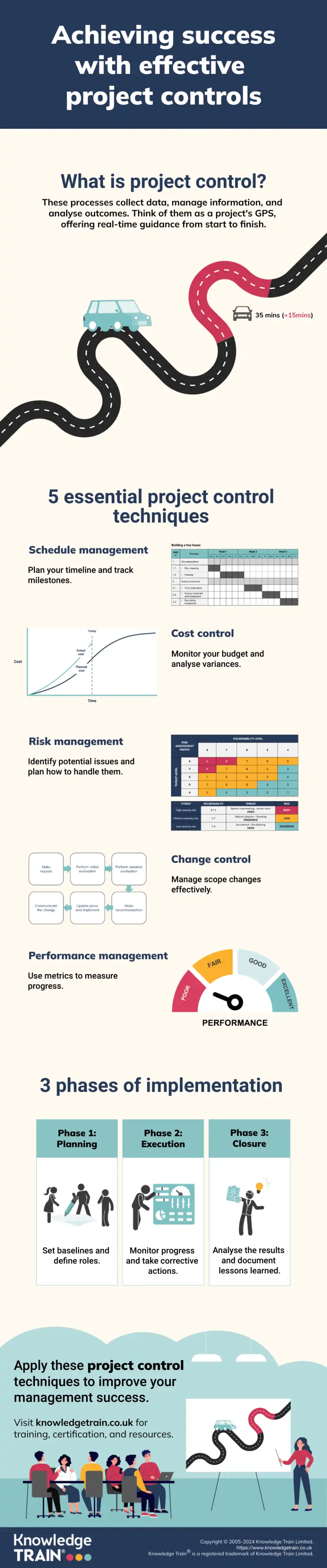
Project controlslessons learned are methods and processes that help you collect data, process it and analyse results. They help you predict, understand and positively influence time and cost aspects of a , and archive project documents.projectImportance of understanding the project lifecycle
- Spot deviations from the planEnhance your skills with our expert-led courses
- Recommend actions to correct the course.
Key components of project controls
These are the main components of project controls:
- Planning and schedulingSelf-paced
- Cost estimation and controlAPM PFQ blended online
- Risk assessment and management
- Change control£749 +vat
- Performance monitoring and reporting.
Differences between project controls and project management
While project managementSelf-paced is the top level of the project, project controls focus on:PRINCE2 Agile Practitioner (with Foundation) self-paced online
- Time and cost aspects
- Data processing and reporting£1,399 +vat
- Performance measurement
- Predictive modelling.
Project controls provide project managersSelf-paced with valuable insights and recommendations. This allows AgilePM Practitioner (with Foundation) self-paced onlineproject managers to make informed decisions and steer projects towards successful completion.£1,299 +vat
Essential project control techniquesIdentify constraints and assumptions.
Schedule managementCreating a project charter
Timeline developmentThe
Ensure the requirements are stated clearly and unambiguously
Scope managementValidate the requirements with relevant experts and end-users.
Establish Developing a detailed project schedulescopeCreating an effective project schedulemanagement is crucial for meeting project deadlines. The steps involved are as follows: processes to avoid unauthorised changes. Define project boundaries and deliverables in the planning phase.Work Breakdown Structure
Change request processes (
Establish WBSchange request processes) to evaluate and approve needed changes. Ensure that all changes are reviewed, documented and executed.: Break down the project into manageable tasks
Performance managementTask Duration
Key Performance Indicators (KPIs): Estimate the duration of each task realistically
Define relevant Task DependenciesKPIs: Identify and document dependencies between tasks to measure the progress and success of your project. Track these KPIs regularly to see how your project is doing. Use them to spot any areas that need improvement.Resource Allocation
Earned Value Management (EVM): Allocate resources to tasks efficiently
Apply MilestonesEarned Value Management: Define significant points of progress or project phases to be achieved. (EVM) techniques to measure project performance objectively. This method integrates scope, schedule and cost metrics to provide an overview of project status.Setting SMART and CLEAR goals
Implementing project controlsCombine
Project planning phaseSMART
Establishing baselines (Specific, Measurable, Achievable, Relevant, Time-bound) and
Start with establishing CLEARproject (Collaborative, Limited, Emotional, Appreciable, Refinable) goal-setting methods for comprehensive project objectives. Project planbaselinesIn this phase a project plan captures the project goals, scope, resources, schedule, budget, and main requirements for the project. The initial version of the project plan needs to be approved by the project sponsor before proceeding to the next phase and will be updated regularly as the project proceeds. for scope, schedule and budget. These are the starting points of the project. They will be used to measure progress throughout the project lifecycle. Ensure that all stakeholders agree on the project baselines before moving forward.
Defining roles and responsibilitiesCreating a communication plan
communicationroles and responsibilities is vital for project success. A comprehensive plan should: for the project control activities. Create a responsibility matrix to specify what each team member does. This will prevent confusion and ensure that you cover all control activities.Key Elements
Project execution phaseDescription
Monitoring and reportingStakeholders
Implement Identify all parties involved in communicationmonitoring processesFrequency to track the performance of the project. Define standard reporting templates that include key metrics and deviations. Regular reporting will help you stay transparent and enable quick decision making.Determine how often updates will be shared
Corrective action implementationChannels
When you identify deviations, implement Specify methods of communiccorrective actions quickly. Establish a process for reviewing and approving corrective measures. Ensure that all corrective measures support the project goals and stakeholder expectations.
Project closure phase
Post-mortem analysis
Conduct a post-mortem analysisation (e.g., emails, meetings) to review the project control process. Evaluate how accurate your estimates were, how effective risk mitigation strategies were and how the project performed overall.Content
Lessons learned documentationOutline what information will be shared
Document Responsibilitieslessons learnedAssign roles for creating and disseminating information from the project control process. Find what worked and what needs improvement. Share this information across the organisation to improve project control efforts.Risk assessment and mitigation strategies
Applying project controls throughout all project phases will help you achieve better project results and improve organisational learning.Successful
Benefits of effective project controlsResolve issues as they occur.
Improved project visibilityManaging team workflows
Effective project controls can significantly improve the Efficient visibility of a projectworkflow management. They give you an insight into the current status of the project, its performance metrics, and potential risks. With this insight, you can keep track of everything. is crucial for maintaining productivity. Consider the following strategies:
Enhanced decision-makingSet clear processes for handoffs between team members
With the right information and at the right time, project controls can make Use decision-makingAgile approaches more effective such as . You can quickly identify trends, spot problems, and make the right decisions. You can manage risks more efficiently and maximise the benefits of the project.Scrum
Increased project success rates or Kanban to manage projects
Effective project controls can increase the Hold regular stand-up meetings to discuss progress and challengessuccess rates of projectsEncourage communication so that bottlenecks can be addressed quickly.. With the right control measures in place, the project team can quickly identify deviations and resolve them before the project objectives are jeopardised. Thus, the organisation can achieve higher satisfaction of its stakeholders and a better reputation.Ensuring effective collaboration
Cost and time savingsCollaboration
Project controls can help to optimise resource allocation, thus is key to project success. To foster a collaborative environment:reducing the costs and timeStrategy of the project. It allows to spot and solve issues early on, thus preventing overruns and delays. Moreover, it enables you to optimise the utilisation of resources throughout the project.Description
Better stakeholder communicationClear roles
Project controls can be the foundation of the Define responsibilities for each team membercommunication with stakeholdersOpen communicationstatus of the project, problems, and achievements. Thus, the project controls can increase trust and alignment among the stakeholders.Conflict resolution
Project control tools and softwareAddress disagreements promptly and constructively
Popular project management toolsUtilising project management tools
You can use Project management toolsproject management platforms can be leveraged to improve execution efficiency. Task management software can be used to track progress and deadlines. Collaboration platforms can centralise communication and file sharing. Time-tracking tools can be implemented to monitor resource allocation and productivity. Reporting dashboards can be utilised to provide real-time project status updates. to run your projects. Most of them provide project controls as a part of their functionality. You can use Microsoft Project, Asana, and Jira to schedule the project, allocate resources, and track the progress. Moreover, these tools can provide you with customisable dashboards to monitor critical metrics.By effectively implementing these strategies during the execution phase, project managers can ensure smooth project progression and maintain team momentum towards achieving project goals.
Specialised project control softwareEnhance your skills with our expert-led courses
For larger and more complicated projects, you can use specialis ed project control software . You can get cost control features, earned value management, and risk analysis with Primavera, Deltek Cobra, and EcoSys. They are great for Self-pacedprojectsAPM PFQ blended online in different industries.
Integrating tools into existing workflows£749 +vat
You should integrate tools into your workflows thoughtfully. You can consider these five steps to make this happen:
- Assess your current workflows and find the gapsSelf-paced
- Choose tools that fit your needsPRINCE2 Agile Practitioner (with Foundation) self-paced online
- Provide your team with training
- Create protocols to input data and analyse it£1,399 +vat
- Check the process regularly and optimise it.
By choosing the right tools and integrating them into your workflows, you can improve your project controls significantly and overall project performance.