PRINCE2 management products

Key takeaways
PRINCE2 management products provide the information needed to plan work, control change, and govern progress.
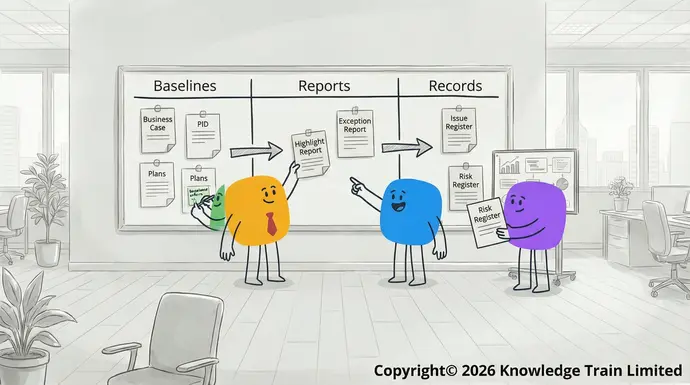
- Management products fall into three groups: baselines, reports, and records.
- Baselines define what will be delivered and how, and once approved they are controlled and versioned.
- Reports provide time-based snapshots that support decisions, including managing by exception.
- Records are continuously updated logs and registers that track day-to-day status without version control.
- Most baseline products are shaped during start-up and initiation, with many forming the PID.
Introduction
PRINCE2 management products help the project management team plan, manage, and control the project. They may be documents, presentations, spreadsheets, or some other output created by a software tool. They can take any form suitable for the needs of the project, such as paper, electronic, verbal, or even written on an ‘information radiator’ written on a whiteboard.
There are three types of management product in PRINCE2. These are baselines, reports, and records.
Management products are created and maintained within the PRINCE2 processes. The responsibilities for creating, maintaining, and approving them is described in the PRINCE2 practices.
When preparing for your exams to get your PRINCE2 certification, be aware that for the PRINCE2 Foundation you must be able to recall the purpose of each management product. For PRINCE2 Practitioner, you must demonstrate how each of management product can be tailored to a specific scenario.
In the PRINCE2 manual, the management products are listed in detail in Appendix A. For a full set of templates for the management products, these can be downloaded from the PRINCE2 templates page.
Baseline management products
Baseline management products are those that define aspects of the project and once they have been approved, are subject to change control. Usually, baseline products have a version number assigned to them to identify the baseline.
Most baseline management products evolve during pre-project and during the initiation stage. The baseline management products of PRINCE2 are described below. Many of these form part of the project initiation documentation (PID) which is also indicated below.
- Benefits management approach
- Business case
- Change management approach
- Communication management approach
- Commercial management approach
- Digital and data management approach
- Issue management approach
- Plan (project, stage, team, exception)
- Product description
- Project brief
- Project initiation documentation
- Project product description
- Quality management aproach
- Risk management approach
- Sustainability management approach
- Work package description
Benefits management approach (part of PID)
The purpose of the benefits management approach is to identify the benefits management actions and reviews that will be performed to ensure the outcomes of the project will be achieved, and to confirm that the benefits are realized.
Business case
A business case contains all the information needed for the business to decide whether the proposed project is desirable, viable, and achievable.
A business case serves as the continual rationale for the project, and its validity must persist throughout the entire project life cycle . Typically, the outline business case is developed by the executive, and then is refined in more detail by the project manager during the project’s initiation phase, who then maintains it throughout the project’s duration.
Change management approach (part of PID)
A change management approach serves as a blueprint for the target organizational state required for the project to meet its objectives and describes how the business will move from the current state to the future state.
Communication management approach (part of PID)
The communication management approach describes the communications with stakeholders, both inside and outside the project, throughout its duration. The approach fosters stakeholder engagement by orchestrating a structured and two-way exchange of information.
Commercial management approach (part of PID)
A commercial management approach describes any processes, standards, and techniques to be used, and the responsibilities for commercial management, including things such as procurement and contract management.
Digital and data management approach (part of PID)
A digital and data management approach describes how data will be managed across the project, and after the project closes.
Issue management approach (part of PID)
An issue management approach describes the processes for managing issues, and how changes to the project baseline will be controlled.
Plan (project plan, stage plans, team plans, exception plans)
A plan provides an overview of the objectives, how they will be achieved, when they will be completed, and with what resources. A plan outlines the scope of the work, the products to be delivered, and the activities and resources responsible. PRINCE2 recommends three levels of plan – project plan, stage plan(s), and team plan(s).
Product description
Product descriptions are created during planning. They are attached into plans and are written at the level of detail required by the plan. For example, for a team plan, a product description will be detailed, but for a project plan , it will not contain the same level of detail.
A product description is often written for each product contained with a product breakdown structure.
Project brief
risk management and covers how risk will be identified, assessed, controlled, and communicated in the project, and the responsibilities for performing risk management activities. The risk management approach is established in the project initiation stage, and forms part of the project initiation documentation.
Sustainability management approach (part of PID)
The purpose of the sustainability management approach is to identify the actions, reviews and controls needed to ensure that sustainability performance targets for the project are achieved.
Work package description
A work package description is an agreement between the project manager and a team manager about what work is to be done by a team to deliver the required products. A work package description contains one or more product descriptions, the specialist techniques to be performed, tolerances for cost, time, scope, and risks, and the reporting requirements for the team manager.
A work package description passes formal responsibility for the delivery of products to a team manager. It forms the interface between the business, represented by the project manager, and the supplier, represented by the team manager.
documents any lessons that might be of value later in the current project, or to future projects. It is created by the project manager either at the end of a stage, and/or at the end of the project.
The purpose of a lessons report is to initiate actions to enable the organization (or project) to avoid any negative lessons in the future and to embed any good lessons within the organization’s or project’s ways of working.
Records
Records are dynamic management products used to maintain regular status information about the project. Records do not need to be kept under version control because they are continuously updated to reflect project progress.
Collectively, these are referred to as the project log and contain the items listed below.
Project log
The project log is used to record all the continuously changing information about issues, lessons, products, quality, and risks, and any other informal actions or events. Because it is dynamic it contains both the current and historic record of project progress.
Daily log (part of project log) Request a quote
The daily log is used by the [email protected]project manager to record notes, any informal issues, notes, and information not captured in the other management products. +44 (0)207 148 5985
Team managers may also have their own Coursesdaily logPROJECT MANAGEMENT to record information about their work package.
Issue register (part of project log)PRINCE2
An ®issue registerFoundation is used to capture and manage formal issues. An Learn the fundamentals of the PRINCE2 method.issue registerPractitioner contains information such as unique issue identifier, type of issue, date raised, raised by, description, status, and closure date.Includes Foundation & Practitioner combined option.
Lessons log (part of project log)Association for Project Management (APM)
The Project Fundamentals Qualification (PFQ) lessons log records all useful experiences (both the good and the bad) that might be useful later in this project, or to other Start your APM project management career.projectsProject Management Qualification (PMQ) . Information from the Advance your APM project management expertise.lessons logProject Risk Single Certificate Level 1 is incorporated into lessons reports.Enhance your project risk management skills.
Product register (part of project log)AgilePM
The ®product register – Agile Project Management is a list of the products required for a plan and their status.Foundation
The Practitioner quality registerIncludes Foundation & Practitioner combined option.PRINCE2® Agile
Foundation
Learn the fundamentals of the PRINCE2 Agile method.Practitioner Includes Foundation & Practitioner combined option.